Brazil's iron ore export price slides to $52/t as Chinese port stocks build

Published: Nov 18, 2026 02:44 (GMT+8)
Brazil's iron ore export price fell to $52/t in November so far from $74/t a year ago, as SMM data show Brazilian ore stocks building at Chinese ports.

Brazil exported 14,594.9 kt of iron ore in the first two weeks of November at an average $52/t, down 29.7% from $74/t in November 2025, according to weekly trade data from Secex. Export value per working day fell 37.7% and volume per day fell 10.2%, over a month that so far has only 9 business days.
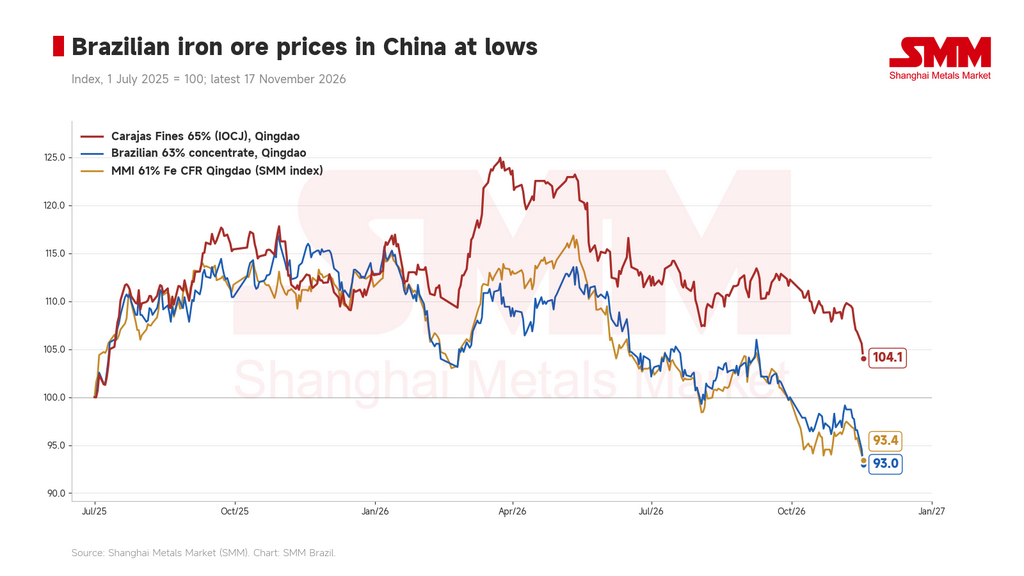
 

Line chart: Carajas fines, Brazilian 63% concentrate and MMI 61% prices in China indexed since July 2025; all at lows

Prices for Brazilian ore in China fell at the same time. SMM's Brazilian 63% concentrate at Qingdao dropped to 651 yuan per wet tonne on November 17, the lowest since the series began in June 2025. Carajas Fines 65% (IOCJ) fell for a seventh straight session to $108.04 per dry tonne, 5.2% below November 6.

Why iron ore prices are falling in China

Macro pressure and ore piling up at ports are likely some of the key issues. US inflation came in above expectations, markets priced a December Fed rate hike at around 90%, and the dollar strengthened. Funds added short positions: open interest in the most-traded Dalian contract rose from 541,400 lots on November 13 to 607,900, and the contract closed at 640.5 yuan/mt on November 17, down 2.44%, per SMM's daily review. Stocks at 35 Chinese ports reached 152.12 million mt, while blast furnace maintenance and environmental curbs in Tangshan limited demand.

Brazilian iron ore stocks at Chinese ports rise

SMM data show Brazilian iron ore stocks at 10 Chinese ports rose for a fourth straight week to 36,281.3 kt in the week to November 12, the highest since April and 10.9% more than four weeks earlier.

The decline in Brazil's export price predates November. In Comex Stat data for iron ore fines (NCM 2601.11.00), the average export price fell from $70/t in January to $54/t in October, and shipments in January-October totalled 309,841.8 kt, 4% less than a year earlier. Secex and Comex prices are FOB per wet tonne, while SMM's China assessments are CFR per dry tonne, so the series show the direction of prices, not a spread.

What to watch for Brazil iron ore exports

SMM expects iron ore prices to stay weak in the near term and said the imported ore margin is likely to remain negative. Full November Secex data, due on the first working day of December, will show whether the lower price holds over the whole month.
Data Source Statement: Except for publicly available information, all other data are processed by SMM based on publicly available information, market communication, and relying on SMM's internal database model. They are for reference only and do not constitute decision-making recommendations.

For any inquiries or for more information, please contact: lemonzhao@smm.cn
For more information on how to access our research reports, please contact:service.en@smm.cn
Related News
MMi Daily Iron Ore Report (november 17)
11 hours ago
MMi Daily Iron Ore Report (november 17)
Read More
MMi Daily Iron Ore Report (november 17)
Iron ore futures extended their weakness today. The DCE most-traded I2701 contract closed at 640.5 yuan/mt, down 2.44% from the previous trading day. Spot prices at Qingdao port fell by about 5-7 yuan/mt on average. Traders were firm on offers, steel mills bought mainly on an as-needed basis and spot trading was average.
11 hours ago
[EU imposes anti-dumping duties of up to 27.9% on cold-rolled flat steel from India and four other countries]
11 hours ago
[EU imposes anti-dumping duties of up to 27.9% on cold-rolled flat steel from India and four other countries]
Read More
[EU imposes anti-dumping duties of up to 27.9% on cold-rolled flat steel from India and four other countries]
[EU imposes anti-dumping duties of up to 27.9% on cold-rolled flat steel from India and four other countries]
The European Commission said on Monday it will impose anti-dumping duties of up to 27.9% on cold-rolled flat steel products from India, Japan, Taiwan, Türkiye and Vietnam, effective from Tuesday, November 17. Japan faces the highest rate at 27.9%, followed by Taiwan at 20.7%-27%, Vietnam at 16% and Türkiye at 3%-7.8%; the rate applicable to India was not specified in the report. The measures follow an investigation by the European Commission, the EU's executive arm, which found that cold-rolled flat steel from the five countries was being sold in the European market at prices below normal value, a practice known as dumping. The steel is widely used in cars, aircraft, home appliances and construction. Indian steelmakers Tata Steel, JSW Steel, SAIL and Jindal Steel are among the companies in focus following the measure. [SMM Iron Ore]
11 hours ago
[Tata Steel targets 50 Mt India steelmaking capacity over next decade]
11 hours ago
[Tata Steel targets 50 Mt India steelmaking capacity over next decade]
Read More
[Tata Steel targets 50 Mt India steelmaking capacity over next decade]
[Tata Steel targets 50 Mt India steelmaking capacity over next decade]
Tata Steel aims to raise its annual steelmaking capacity in India to 50 Mt over the next decade and is exploring a possible 15 Mt greenfield plant in Maharashtra, Managing Director and CEO T V Narendran said. The company currently has annual capacity of about 27 Mt, has a roadmap for 40 Mt and believes its existing facilities can support expansion to 50 Mt. Narendran said Maharashtra, with Gadchiroli a potential location, could become the next major expansion destination once talks with the state government conclude and land is secured, but the company does not depend on a single greenfield site: its existing facilities at Jamshedpur, Kalinganagar, Meramandali and Neelachal Ispat Nigam offer growth options, and it is evaluating steelmaking routes including electric arc furnaces and recycling-based production. India now accounts for 70% of the company's revenue, up from 30% 15 years ago. Capital expenditure this year is around Rs 18,000-20,000 crore, of which about 75% will be invested in India; annual capex in India is around Rs 15,000-16,000 crore. Narendran said hydrogen-based steelmaking remains a longer-term option and would require hydrogen at around USD 2 per kg to make the economics attractive. [SMM Iron Ore]
11 hours ago
Register to Continue Reading
Gain access to the latest insights in metals and new energy
Already have an account?Sign in here