After international sulfur broke below the $800/tonne mark, the market split into two camps over the outlook: one argues that downstream demand has been deeply damaged and prices will keep sliding; the other holds that demand has merely been postponed and suppressed, and that there is still downside support given low inventories. Deciding who is right is not a matter of counting evidence on each side, but of distinguishing which demand is "genuinely gone" and which is "simply not buying yet."
First, the part that is "genuinely gone" — this is a reduction in demand stock, a real destruction. The most typical case is voluntary production cuts driven by deteriorating end-product economics: on the Indonesian HPAL side, the MHP supply-demand balance has shifted from deficit to surplus from late Q3 into early Q4, with producers mired in immediate cost inversion and the strongest willingness to cut output; domestically in China, phosphate downstream is weak, phosphate fertilizer exports have fallen to zero, and producers are increasingly inclined to control output amid persistent losses in sulfur-based acid. The common feature of this demand is that production is being cut not because sulfur cannot be bought, but because end-products are unprofitable — lower sulfur prices cannot save them. Since November, sulfur has moved through a "fall–rise–fall again" cycle while wet-process phosphoric acid quotes have not moved once, indicating that pricing power currently lies not on the cost side, but in the balance between inventory and demand. The suppression of sulfur prices by weak end-demand is real and structural — this is the foundation of the bear case.
However, equating this with "deep demand destruction" may overstate the depth of the damage. A substantial share of the "not buying" is not disappearing demand, but demand that is being suppressed, postponed, or re-routed — this is flow, which does not constitute a sufficient condition for a rebound, but does form a buffer beneath prices. Specifically, there are three categories:
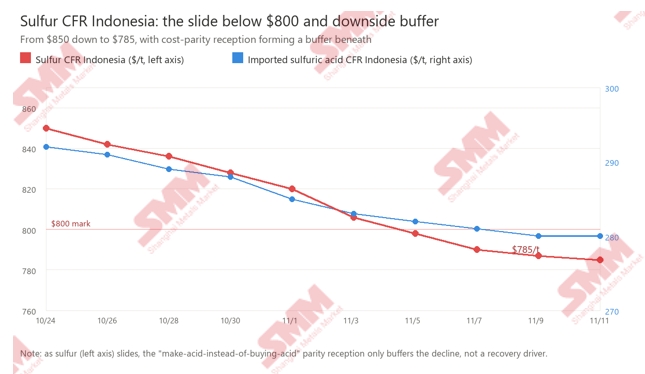
First, suppressed wait-and-see demand. Indonesian and Chinese buyers are watching prices and buying only on an as-needed basis. This is not a refusal to buy, but a wait for a clearer price signal — with sulfur CFR Indonesia sliding from $850 all the way to $785, buyers have every reason to hold off. This demand is "accumulating," not "exiting," but it will only convert into purchases once a price signal appears.
Second, restocking potential under low inventory. Rising Chinese port inventories are the short-term factor currently weighing on the market, but this "rise" is a recovery from the extremely low inventory of the prior period, and the absolute level is not high; more importantly, Indonesia's sulfur imports surged 155.9% month-on-month to 704,500 tonnes in September, showing that the purchasing tonnage of the demand side is capable of returning quickly. Low inventory itself creates no demand and no rebound momentum, but it means that once prices fall deep enough, restocking can appear in "real tonnage" rather than "paper willingness," supporting prices.
Third, re-routed trade flows. Indonesia's sulfur import sources have shifted from a previously concentrated pattern to a diversified mix of Malaysia (475,900 tonnes in September) + Canada (90,200 tonnes) + the UAE (73,800 tonnes), with Canada's sulfur exports up nearly 20% year-on-year in January–September. The volume has not disappeared — only the routes and sources have changed. This is not demand destruction but trade-flow restructuring — it has lowered prices, yet it has also strengthened buyers' bargaining power and purchasing flexibility, making it harder for suppliers to keep conceding at low levels.
These three flows, taken together, do not "drive a rebound" but rather "provide a buffer to prices." This buffer comes from a cost-parity mechanism: the sulfur price is the "switch" of sulfuric acid pricing; when sulfur breaks below the critical point and the sulfur-based acid cost line reattaches below the smelting acid line, sulfur-based acid becomes the marginal supply again and drags acid prices lower — that is, falling sulfur drags acid prices down along the cost chain, but the acid price itself cannot in turn pull sulfur back up. Indonesia is the only market in the world that imports both sulfur and sulfuric acid at large scale with the two in direct competition, so buyers are always calculating "buy sulfur to make acid in-house, or buy acid directly," which makes the sulfur price the implicit anchor of international acid prices. When sulfur falls far enough that the gap between in-house acid cost and imported sulfuric acid widens and buying sulfur to make acid becomes clearly more economical, buyers will shift more toward purchasing sulfur rather than imported acid — this only forms a mild demand reception at low levels, slowing sulfur's decline. The current combination of sulfur CFR Indonesia at $785 and imported sulfuric acid CFR Indonesia at about $280 means that a continued deep slide in sulfur will gradually trigger this "make-acid-instead-of-buying-acid" parity reception, giving the decline a buffer; but this buffer is one-way and mild — it can flatten the slope of the decline, but it cannot lift prices back up.
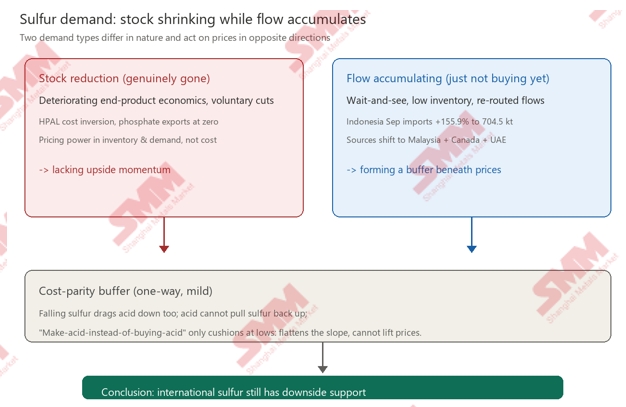
So the conclusion is not a binary choice between "destruction" and "rebound," but a layered judgment: the demand destruction from real production cuts does exist, concentrated in the part with deteriorating end-product economics (HPAL, phosphate fertilizer), and it is a stock reduction that "lower sulfur prices cannot save" — this determines that prices lack upside momentum; meanwhile, more demand suppressed by wait-and-see attitudes, low inventory, and re-routed flows has not disappeared — it does not constitute reversal momentum, but it jointly forms a buffer beneath prices.
The outlook therefore converges on a single line: current sulfur demand is not "deep destruction," but "stock shrinking while flow accumulates" — upside momentum is lacking, but downside support remains. In the short term, weak end-demand and seller concessions continue to weigh on prices, and sulfur may consolidate weakly in the $720–800 range with still some room to edge lower; but the further prices fall, the thicker the constraint of the cost anchor and the suppressed flow, and the more limited the space for further deep declines. To sum up in one line: international sulfur prices still have downside support — demand has not disappeared, only been temporarily suppressed; what has fallen out is a downward shift in the price center, not the clearing-out of demand.