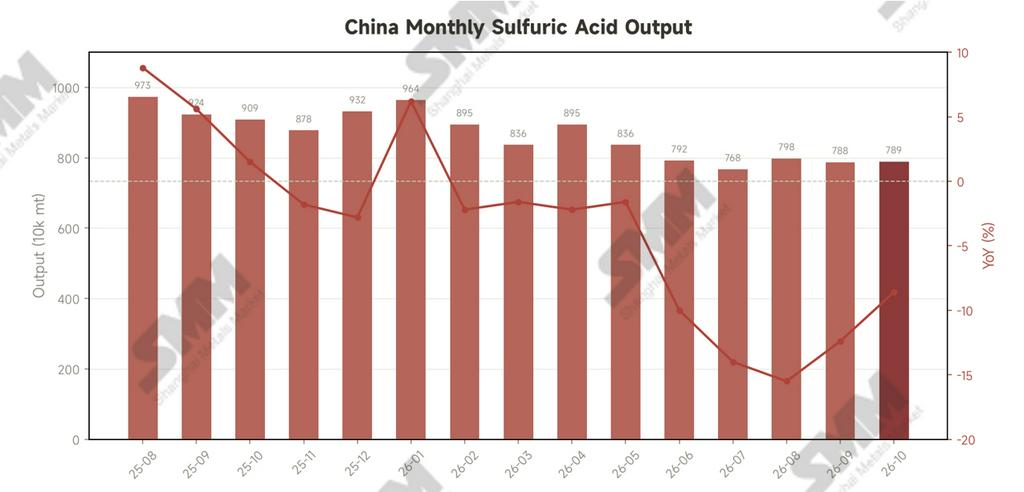
I. Total output: YoY decline narrows, cumulative decline broadly steady
NBS data show that China's October sulfuric acid output (100% basis) stood at 7.894 million tonnes, up slightly by 0.18 million tonnes from September, and down 8.6% year on year. Cumulative output in the first ten months of 2026 reached 84.282 million tonnes, down 5.4% year on year. Output has now contracted year on year for seven consecutive months since April, but the October decline narrowed markedly from -12.4% in September, suggesting the off-season pullback is stabilising.
II. By province: Yunnan leads at 1.17 million tonnes; Hubei and Chongqing cut deeply
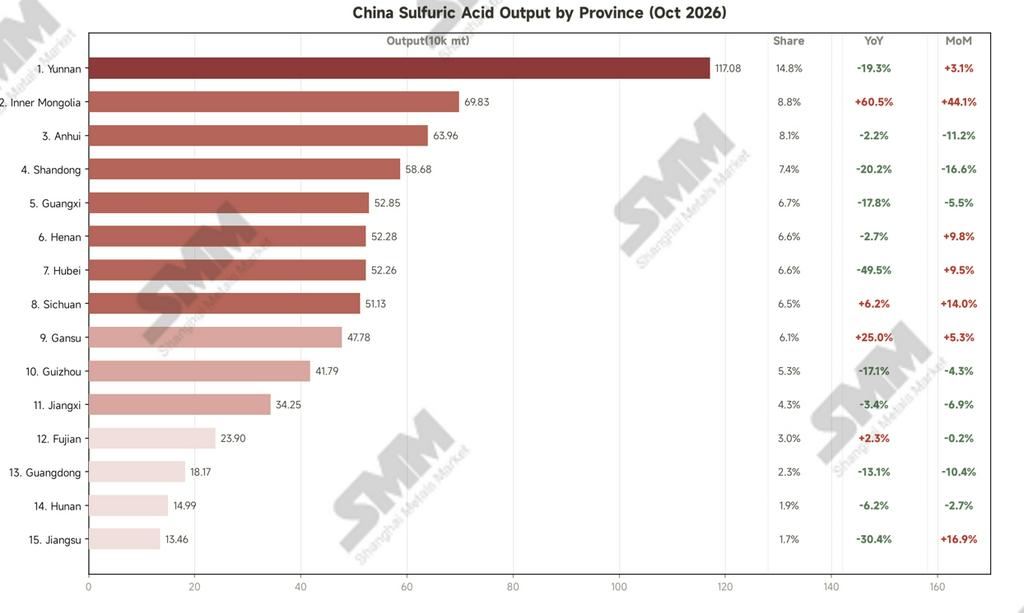
By province, Yunnan retained the top spot at 1.1708 million tonnes, though down 19.3% year on year. Inner Mongolia (0.6983 million tonnes), Anhui (0.6396 million tonnes), Shandong (0.5868 million tonnes) and Guangxi (0.5285 million tonnes) rounded out the top five. The top five provinces together accounted for 45.9% of national output and the top ten for 77.0%, confirming the continued concentration of output toward major phosphate-chemical and smelting-support provinces.
Provincial performance diverged sharply. Hubei produced 0.5226 million tonnes in October, plunging 49.5% year on year, the largest cut by volume (about 0.51 million tonnes less year on year). Chongqing posted the deepest percentage decline at 65.8%, with Zhejiang, Liaoning and Shaanxi down 43.2%, 38.4% and 34.0% respectively. By contrast, Inner Mongolia (+60.5%), Ningxia (+38.0%) and Gansu (+25.0%) grew against the trend, and Xinjiang (+9.5%) and Sichuan (+6.2%) also posted gains. Inner Mongolia added about 0.26 million tonnes year on year, becoming the largest contributor of incremental output, largely supported by smelting-related capacity ramp-up.
III. By region: Southwest leads; Southwest-Central phosphate belt keeps shrinking
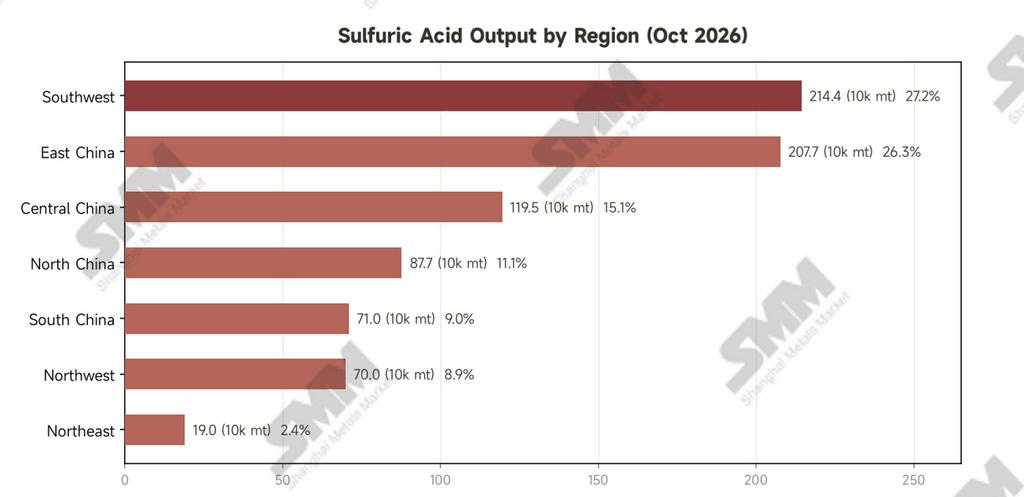
By region, Southwest led at 2.144 million tonnes (27.2%), followed by East China at 2.0771 million tonnes (26.3%) and Central China at 1.1953 million tonnes (15.1%); Northeast contributed only 0.1899 million tonnes (2.4%). Overall, the contraction was concentrated in the Southwest-Central phosphate-chemical belt formed by Yunnan, Guizhou, Sichuan, Chongqing and Hubei, where Hubei, Chongqing and Guizhou saw the steepest year-on-year declines. The East China smelting belt remained relatively resilient, while North China - where Inner Mongolia is located - strengthened against the trend on smelting capacity releases.
IV. Outlook
The current downturn in sulfuric acid output is driven mainly by scheduling adjustments in the phosphate-chemical belt and the exit of some units, while the East China smelting belt and the North China smelting-support belt provide relatively stable support. In Q4, the key watch points are the phosphate fertilizer production schedule and the restart of units in deeply cut regions such as Hubei and Chongqing. Whether the continued ramp-up of smelting-support capacity in Inner Mongolia and Gansu can offset the contraction in the phosphate-chemical belt will be pivotal to any stabilisation, and whether overall output can stop falling and recover remains to be seen.