At the -hosted , Zhao Baichuan, Senior Analyst of the SMM Aluminum Industry, shared his insights on “Global Bauxite Market Analysis and Development.” He noted that from a supply-demand balance perspective, SMM expects China’s bauxite market to show an oversupply in 2026, mainly due to the combined effect of both the shipment side and the inventory side: first, excessive shipments driven by Guinea’s policies and sentiment boosted current supply; second, nearly 10 million mt of new alumina capacity in China, with advance stockpiling and inventory replenishment, and this portion of inventory is difficult to digest in the short term. Under the influence of these two factors, the market in 2026 will show a clear oversupply. From 2027 to 2030, the oversupply pattern will gradually narrow. SMM believes Guinea’s quota policy will most likely be implemented in 2027, tightening external supply; at the same time, high inventory remains, and continued release of new alumina capacity will boost ore demand. The combination of tightening supply and growing demand will continue to narrow the oversupply.

Global Bauxite: Overall Surplus Pattern Unchanged, Annual Surplus Volume Gradually Narrowing
According to SMM, global bauxite reserves are about 29 billion mt, with Guinea holding the largest share, followed by Australia, then Vietnam, Indonesia, and Brazil. China’s bauxite reserves account for only about 2%, yet this 2% supports 60% of global alumina production. As a result, China has a significant bauxite deficit, which is entirely filled by imported ore—a long-term constraint determined by resource endowment and the starting point for understanding subsequent supply-demand and price issues.
From a supply-demand balance perspective, SMM expects China’s bauxite market to show an oversupply in 2026, mainly due to the combined effect of both the shipment side and the inventory side: first, excessive shipments driven by Guinea’s policies and sentiment boosted current supply; second, nearly 10 million mt of new alumina capacity in China, with advance stockpiling and inventory replenishment, and this portion of inventory is difficult to digest in the short term. Under the influence of these two factors, the market in 2026 will show a clear oversupply.
From 2027 to 2030, the oversupply in China’s bauxite market will gradually narrow. SMM believes Guinea’s policy will most likely take effect in 2027, tightening overall supply; combined with bauxite inventory remaining high and continued release of new alumina capacity driving demand growth, the two forces of tightening supply and growing demand will narrow the balance.
Global bauxite production and landscape shifts: Guinea output rises in Q3 2026, Australia and Europe hold steady, Asia and the Americas edge down
SMM estimates that global bauxite production in 2026 will grow by around 4.8% compared with 2025, with Guinea contributing the bulk of the increase. Guinea alone is up 14.5% YoY, while all other countries combined contribute almost nothing.
China's bauxite production also posted negative growth, mainly because mine production and production resumptions have been constrained after the Shanxi coal mine incident. China contributed no growth and instead dragged on the total. As a result, Guinea is now the core pillar of global supply.
China bauxite supply-demand balance: supply peaks in 2026E, surplus narrows sharply in 2027E
SMM reviews and forecasts China's bauxite supply-demand balance from 2023 to 2030. According to SMM, the market was in short supply in 2023 and 2024, mainly due to tight ex-China shipments. After entering 2025, ex-China shipments gradually stabilized and the market shifted to a clear oversupply. In 2026, the surplus worsened compared with 2025, driven by excessive shipments from Guinea amid policy and sentiment effects, the release of new alumina capacity, and difficulty digesting previously stockpiled inventory.
From 2026 to 2030, SMM forecasts that the compound annual growth rates of both supply and demand will decline to varying degrees, narrowing the market surplus. The weakening demand is mainly due to the impact of ex-China alumina imports on China's alumina production.
Bauxite trade flows: Guinea and Australia imports fall in January-August; Guinea shipments drop sharply on high freight outlook
By country, China's cumulative bauxite imports from January to August reached 155.57 million mt, with Guinea accounting for 80.2% and Australia around 16.4%. For the full year, China is expected to import around 224 million mt, accounting for more than 44% of global production.
It is worth noting that with high freight rates in September and losses at some mines, Guinea's shipments have already declined significantly. Combined with high inventory and near-saturated demand, the high-price environment is further suppressing shipment willingness.
Bauxite prices: ocean freight lifts near term, quotas dominate medium and long-term
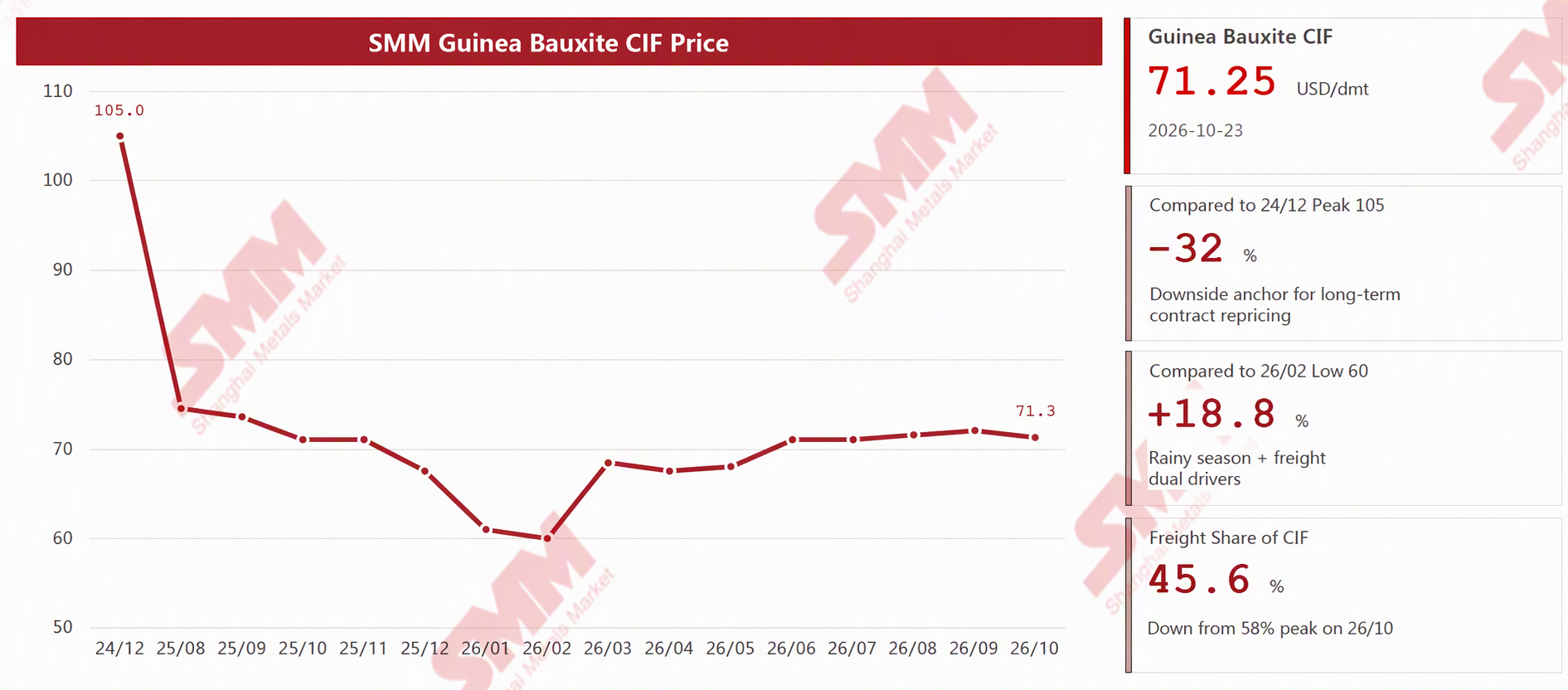
From the price trend in the chart above, Guinea bauxite CIF pulled back from $105 at the end of 2024 to $60 in February this year, then rebounded 18.8% in Q2 to the current $71.3, boosted by quota expectations and freight rates. This rebound was driven mainly by ocean freight rates rather than mine price hikes. SMM believes this price is capped by quotas and high inventories, while supported by freight rates and mine cash costs, with around $71 as the new price center.
Bauxite inventories: Total 88.68 million mt, 92.9 days Bauxite prices under pressure
According to SMM statistics, as of September 2026, China's bauxite inventories have grown from just over 57 million mt at the beginning of 2025 to around 88 million mt today. Meanwhile, days of inventories at alumina refineries have also increased from around 80 days in August 2025 to 92.9 days today. Inventory days exceeding three months indicate weak downstream restocking willingness, and high inventories are putting bauxite prices under pressure. Without the support of rigid restocking demand, bauxite prices can only rely on freight rates and quotas for narrative support.
Guinea bauxite prices: High freight rates keep ore prices elevated
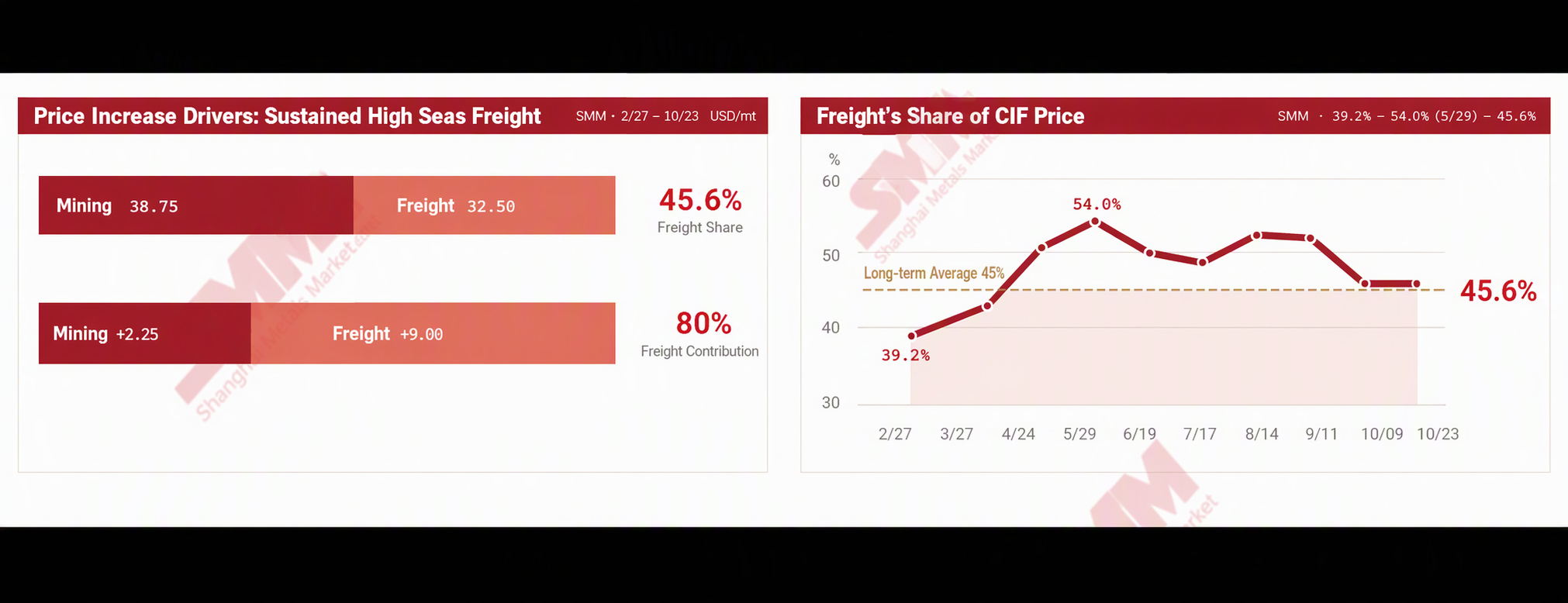
According to SMM, from February to October this year, the CIF price of bauxite rose,mainly boosted by freight rates rather than an increase in ore prices themselves: the total increase was $11.25, of which freight contributed $9, accounting for 80% of the gain. During this period, freight rates rose from $23.5 to $32.5, an increase of 38%. Freight's share of the CIF price has been rising, from 39.2% at the beginning of the year to a peak of 54% at end-May, when freight was even more expensive than the ore itself. It has since pulled back to 45.6%, still above the normal center. Ocean freight rates have become the core factor driving ore prices.
Looking ahead to 2027, shipping risks come from two sources: first, geopolitical issues pushing up fuel costs, and second, ore rush in West Africa and tight vessel supply. The impact of both is similar in magnitude and both require close attention. If these risks materialize, ocean freight rates are expected to rise 27%, driving CIF prices up 13%. The impact on alumina production costs is stark: under ample shipping capacity, freight at $27 and CIF at $65 would lower alumina costs by 115 yuan/mt; under tight shipping capacity, freight at $42 and CIF at $80 would raise alumina costs by 173 yuan/mt. The overall cost fluctuation of nearly 288 yuan/mt is essentially all driven by freight.
Alumina divergence in China and ex-China: Import losses widen to 659 yuan/mt Ex-China FOB prices rise across the board Brazil leads the gains
According to SMM, the rise in ocean freight rates has not only affected bauxite but has also been transmitted to the alumina segment. China's monthly alumina import profit margin has shifted from a profit of 94 yuan at its peak in September 2025 to a net loss of 659 yuan/mt in October 2026.
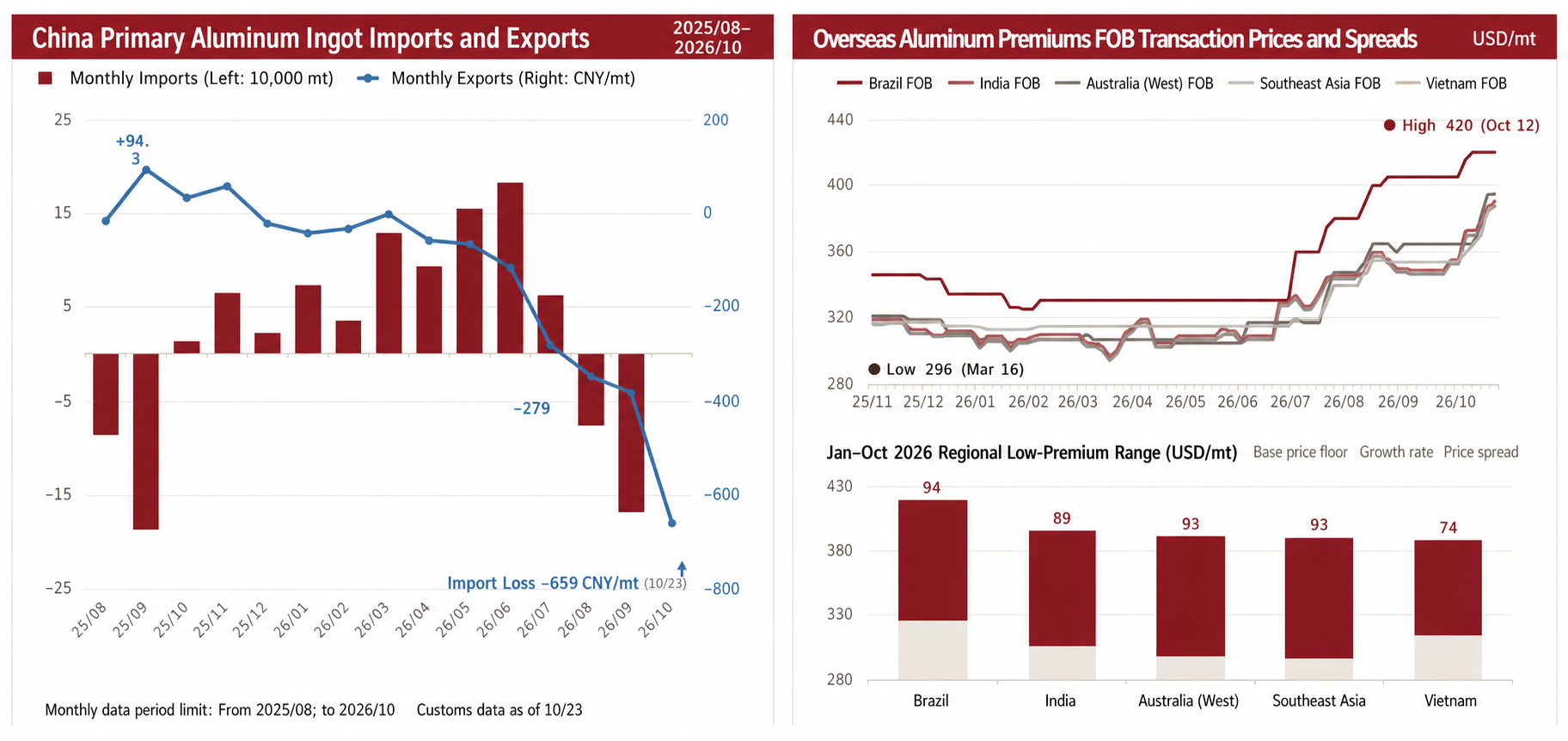
Ex-China, metallurgical-grade alumina FOB prices in five regions have all risen this year, with Indonesia, East Australia, Brazil, West Australia, and Vietnam all posting gains exceeding 20%. Price spreads ex-China have continued to widen, already presenting a net export pattern. According to SMM, the price rise was driven by multiple factors: the Middle East situation pushed up logistics costs for bagged alumina, restricted bauxite supply in Indonesia created alumina supply risks, and production cuts in Australia further tightened supply.
Price increases diverged in China and ex-China, with overseas price hikes significantly outpacing China, turning alumina imports from a profit of 94 yuan into a loss of 659 yuan.
Alumina imports and exports: imports concentrated from Australia, exports flowing to the Middle East, shifting back to net exports from 2027
Data shows that in January-September 2026, China imported 3.063 million mt of alumina, with Australia accounting for as much as 72.2% of imports, and Indonesia adding 19.6%, meaning the two countries accounted for over 90%—import sources were highly concentrated.
On the export side, Russia accounted for 75.8% of China's alumina exports in 2025, falling to 61.4% in the same period of 2026; Oman's share jumped sharply from 4% to 22.8%, the UAE's share rose to 6.2%, and Bahrain and Saudi Arabia entered the top five export destinations, shifting export flows from Russia-dominated to a multi-point layout in the Middle East. The core driver of this change was aluminum production resumptions in the Middle East, which increased procurement based on the cost advantages of Chinese bagged alumina; meanwhile, total exports grew from 2 million mt in the same period last year to 2.576 million mt, with the scale continuing to rise.
SMM expects that China will shift to net alumina exports in 2027. The main reasons are new aluminum capacity coming online ex-China and capacity expansion in Indonesia, while supporting alumina supply is insufficient, creating a gap that needs to be filled by Chinese alumina; rising domestic alumina output in China will also drive continued growth in bauxite demand, while potential policy changes in Guinea are an important variable for 2027.
Guinea bauxite export volume: quotas constrain growth, China's share peaks
Regarding bauxite export volumes in the coming years, SMM has set two scenarios for China's bauxite supply: without quota constraints, supply capability would grow from 215 million mt in 2026 to around 250 million mt by 2030, a five-year increase of 18.8%; if quotas are implemented in 2027, supply would be compressed to around 195 million mt at once, then gradually relaxed year by year, reaching around 210 million mt by 2030, down 17.7% from the no-quota scenario.
Demand-side pace diverges. In 2027, China's alumina capacity will continue to expand and can still absorb Guinean ore inflows; after 2028, new alumina capacity ex-China will impact the Chinese market, and combined with domestic ore production resumptions, China's demand for Guinean bauxite will decline, shifting ore flows and potentially creating an ex-China ore deficit. Guinea's bauxite export share to China will peak at around 85% in 2027 before gradually flowing to other markets.
Core view: Quotas constrain shipment pace rather than existing supply. 2027 marks both the starting point of supply tightening and the watershed for a reversal in ore flows.
Ore source economics: cost advantages of imported ore for alumina reverse
Comparing the cost differences between domestic bauxite and imported ore: In terms of full alumina cost, imported ore is mainly sourced from Guinea and Australia; domestic ore is divided by region, with the average around 2,767 yuan/mt. Capacity that runs entirely on domestic ore has overall production costs lower than those using imported ore. The reason is that ocean freight rates remain persistently high—costs for using imported ore in Shanxi, Henan, and Shandong are clearly higher than for domestic ore. However, domestic ore is constrained by reserves and production, so substitution has an upper limit and cannot fully replace imported ore across all regions.
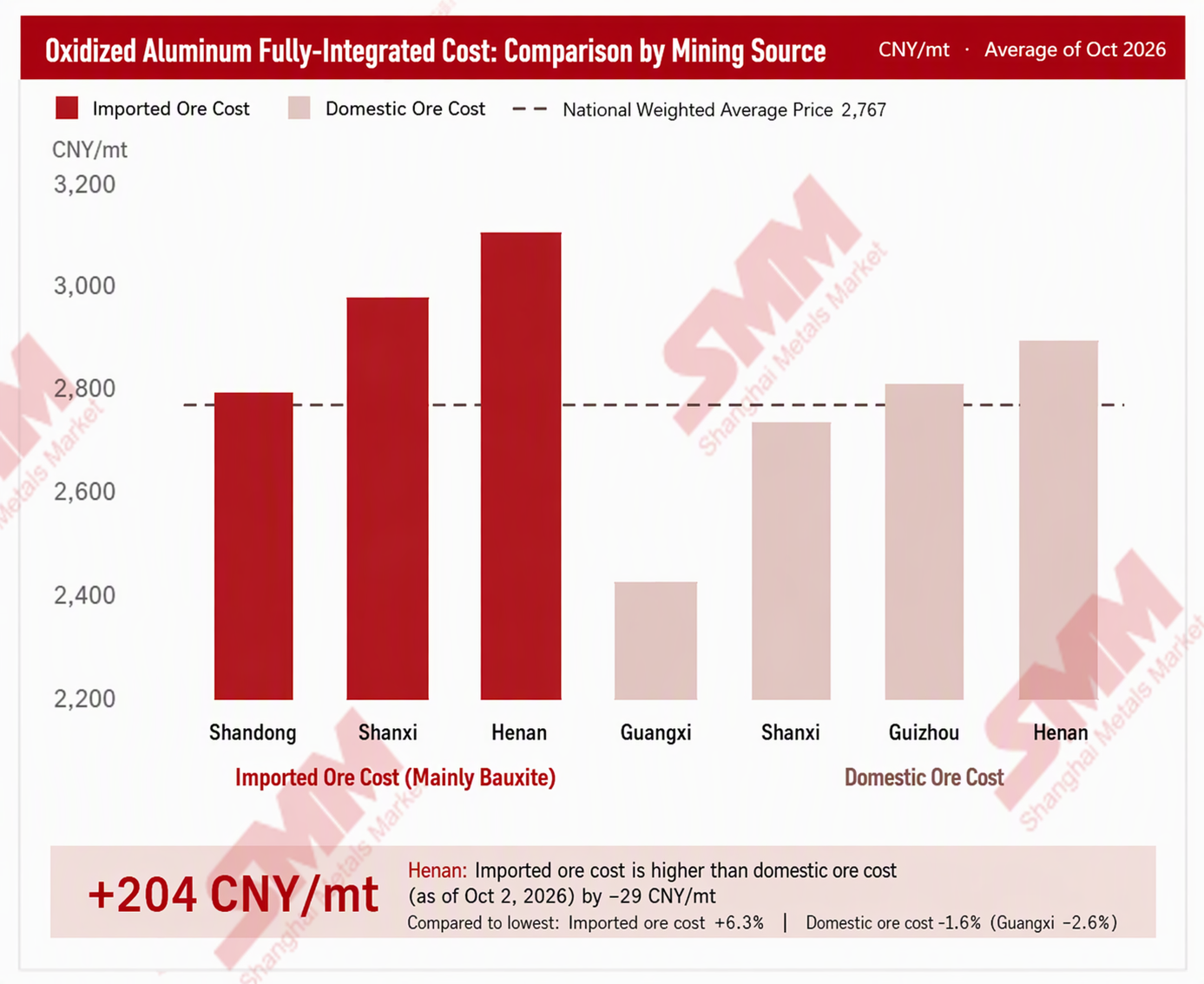
Going forward, as domestic ore production resumes in Shanxi and Henan, domestic ore usage will rise and gradually squeeze the share of imported ore. SMM expects the share of imported ore to peak and pull back in 2027, driven mainly by Guinea supply constraints combined with domestic ore production resumptions.
Overall, costs determine the direction of substitution: high ocean freight rates support the cost advantages of domestic ore, and production resumptions drive substitution forward; resources determine the boundary of substitution: domestic ore supply is limited, so substitution is only a gradual, regional process. As a result, the share of imported ore will decline slowly after peaking in 2027, with a clear trend and a mild pace.
Alternative sources amid Guinea supply constraints: Australia's stabilizing role and limited flexibility
SMM expects that, against the backdrop of Guinea supply constraints, Guinea's share of China's bauxite imports will decline by 2030. As substitutes for Guinea ore, Australian ore is the preferred option on the ore side, with Ghana, Malaysia, West Africa, India, and Brazil as supplements, but each ore type has shortcomings in grade and compatibility. On the alumina side, nearly 8 million mt of imported alumina can directly fill the downstream gap, bypassing the bauxite stage. The gap created by Guinea supply constraints will not necessarily be filled entirely by alternative ore sources; part of it will be absorbed by imported alumina.
Alumina costs: rising ore prices push up domestic alumina costs, while imported alumina's cost advantage becomes more pronounced
According to SMM calculations, alumina costs are highly correlated with ore prices, and bauxite accounts for more than half of alumina's full cost. Therefore, rising ore prices will push up domestic alumina costs. After comparing the costs of two supply pathways, SMM finds that compared with coastal alumina refineries using imported Guinea ore, Indonesia's integrated projects, which leverage coordination between mines and captive power plants and ship alumina back to China, have more significant cost advantages.
Indonesia Shake-Up: Structural Bauxite Shortage from 2026E, Alumina Continues to Expand
In terms of Indonesia's alumina capacity and production, SMM expects alumina capacity and production to begin expanding from 2026. On the production side, SMM projects Indonesia's alumina production to grow 3.6-fold over six years from 2024 to 2030. Meanwhile, alumina capacity is also climbing year by year, with the six-year utilization rate expected to rise from 67% to around 85%.
On the bauxite supply-demand front, SMM expects Indonesia's bauxite market to shift into deficit for the first time in 2026, with the shortfall persisting for five years. The supply deficit will be most severe in 2027, mainly due to Indonesia's RKAB quota management for bauxite. In 2025, local alumina capacity is limited and quota supply is ample. Starting in 2026, RKAB will shift to annual adjustments, reducing policy flexibility. Combined with the continued commissioning of new alumina capacity, ore demand will rise markedly, turning Indonesia's domestic market from supply-demand balance to deficit, with the gap widening to its largest in 2027. Subsequently, as new mines come online, the supply deficit will narrow somewhat, but ore will remain tight overall.
Overall, the global bauxite oversupply situation remains unchanged, but supply has already peaked in 2026, and the most ample period has passed. Going forward, continued attention is needed on the actual enforcement of Guinea's bauxite quotas, the annual adjustment results and actual supplementary volumes of Indonesia's RKAB, the commissioning pace of coastal alumina capacity in China, and the extent to which imported alumina becomes a regular feature.