Key points: Gotion’s Solid-State Roadmap: Materials, Cells, and Validation in Parallel
-
Materials: Watch Anqing’s 300-ton lithium sulfide pilot line for scale-up data and cost reductions (from RMB 1.3M/t toward RMB 500k/t).
-
Cells & Validation: While G-Yuan’s 12 GWh capacity is built, actual deliveries await customer on-vehicle testing. The Jinshi 2 GWh line is delayed, lacking formal equipment tendering.
-
Timeline: 2026 focuses on engineering and sample delivery, with volume installation likely pushed to 2027.
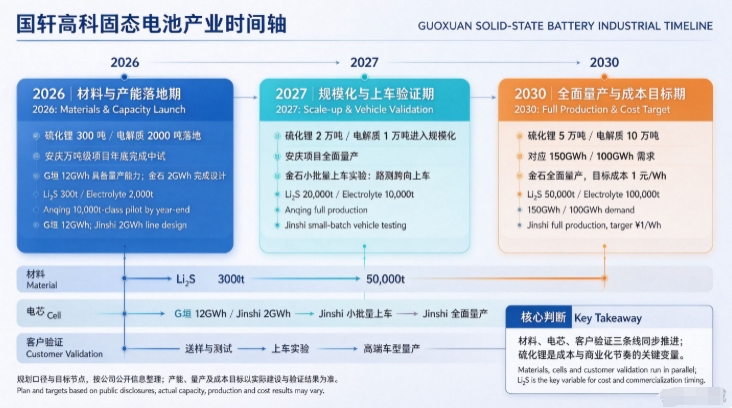
The most important thing to watch in Gotion’s current solid-state layout is not any single energy-density figure, but the fact that it has compressed materials (lithium sulfide + sulfide electrolytes), cells (semi-solid batteries + solid-state batteries) and customer validation onto roughly the same timetable. Many Chinese battery makers are working on solid-state technology, but Gotion is the most advanced in being willing to enter lithium sulfide—an expensive and hard-to-handle segment—itself, with capacity planning directly pushed to the 10,000-ton scale. Another company that makes both ternary and LFP cathode materials is rumored to have a 10,000-ton electrolyte layout, but it has not reached the level of public confirmation, so I will not elaborate here.
The timeline is roughly as follows: in 2026, 300 tons of lithium sulfide and 2,000 tons of electrolyte will be in place, and the Anqing 10,000-ton project will complete pilot testing by year-end; G-Yuan’s 12 GWh capacity will be completed and ready for mass production, with batch deliveries to start within the year; the Jinshi 2 GWh line will complete design and enter construction, while the 0.2 GWh pilot line continues on-vehicle road testing. In 2027, 20,000 tons of lithium sulfide and 10,000 tons of electrolyte will enter scale-up, and the Anqing project will be in full mass production; Jinshi will begin small-batch on-vehicle testing. In 2030, lithium sulfide capacity will reach 50,000 tons and electrolyte capacity 100,000 tons, corresponding to demand at the 150 GWh and 100 GWh levels; Jinshi will enter full mass production, with a cost target of RMB 1/Wh.
Many Chinese battery makers are working on solid-state technology, but Gotion is the most advanced in being willing to enter lithium sulfide—the most “dangerous” and most expensive segment—itself, with capacity planning directly pulled to the 10,000-ton scale. There is also a rumor that another company making both ternary and LFP cathode materials has a 10,000-ton electrolyte layout.
Gotion has placed its solid-state battery layout entirely in Anhui. Anhui is also home to Changxin Technology, which became a leader immediately after listing; Gotion previously invested heavily in LMFP batteries, but the results fell short of expectations. This article attempts to analyze whether Gotion can also achieve a “become king upon listing” position in the solid-state battery sector.
I. Lithium Sulfide: A Formidable Player in Gotion’s Solid-State Battery Game
Why lithium sulfide cannot be avoided: Gotion itself lays out the arithmetic bluntly—in the cost of sulfide solid-state batteries, solid electrolytes account for 70%–80%, and within electrolyte costs, another 70%–80% is concentrated in lithium sulfide.
In other words, the price curve of lithium sulfide essentially sets the opening and closing rhythm of the commercialization window for all-solid-state batteries. According to SMM data, as of October 2026, the market price of battery-grade lithium sulfide was still around RMB 1.3 million/t, while Gotion’s target cost is RMB 500,000/t; the corresponding target at the electrolyte end is RMB 300,000/t. Only when both numbers are achieved can cell material costs be expected to approach RMB 1/Wh. This gap cannot be papered over by process optimization; it must be closed through scale. SMM predicts that the RMB 1/Wh threshold will emerge around 2031.
1.1 Gotion’s lithium sulfide pace is being laid out quickly:
the 300-ton pilot line is in the equipment selection and procurement stage (as of the end of October 2026).
The 300 t/y lithium sulfide pilot line to be located in Anqing in 2026 is led by Qianyuan Technology under Gotion Holdings, with total investment of RMB 620 million. It is planned to complete pilot-line construction by year-end and conduct three years of full-process testing. The core task is to validate process parameters for a 10,000-ton line. The 10,000-ton high-purity lithium sulfide mass-production line, launched on July 21, 2026, is also located in Anqing and is planned to be fully completed in 2027. On the capacity ladder: 300 tons in 2026, 20,000 tons in 2027 and 50,000 tons in 2030, corresponding to solid-state battery demand at the 150 GWh level (according to SMM estimates, for each GWh of 60 Ah sulfide solid-state batteries, sulfide electrolyte unit consumption is 0.7 t; within LPSC651 sulfide electrolyte, lithium sulfide unit consumption is 0.4; each GWh of solid-state battery consumes 280 kg of lithium sulfide).
1.2 Lithium sulfide process: gas–liquid–solid three-phase reaction method
On process, Gotion is betting on the “gas–liquid–solid three-phase reaction method,” claiming a 3x improvement in reaction efficiency and a 40% reduction in energy consumption, with pilot products at 99.99% purity and particle size below 3 μm.
SMM believes that if this route can maintain batch consistency and continuous operation stability under inert atmosphere during pilot-scale amplification, the 20,000-ton plan for 2027 will have a basis for implementation; but if scale-up effects emerge during pilot testing, the commissioning node for the 10,000-ton line will be passively pushed back, which would directly constrain the installation pace of Jinshi batteries in 2027–2028.
4N purity is not so easy to achieve. In the lithium sulfide segment, it is not “whoever has capacity wins,” but “only when capacity runs reliably and cost falls to RMB 500,000/t can one truly sit at the table.”
II. Solid Electrolytes: Can Sulfide Carry the Load, with Oxide Playing a Supporting Role?
2.1 The electrolyte plan is interlocked with lithium sulfide
Capacity is planned at 2,000 t/y in 2026, 10,000 t/y in 2027 and 100,000 t/y in 2030, corresponding to nearly 150 GWh of solid-state battery supporting demand (according to SMM estimates, 100,000 tons of sulfide electrolyte supports 143 GWh of solid-state batteries).
2.2 Products are split into two lines
microcrystalline electrolyte with particle size of 1–5 μm and conductivity greater than 8 mS/cm; nanocrystalline electrolyte with particle size at the hundred-nanometer level, conductivity of 4–6 mS/cm and 60% lower energy consumption.
Microcrystalline pursues performance first, while nanocrystalline pursues energy consumption and cost first. Running both lines in parallel shows that Gotion is not putting all its eggs in one process basket in the electrolyte segment either.
2.3 Where does oxide electrolyte fit?
Sulfide electrolytes and oxide electrolytes need to be viewed separately, because they undertake completely different tasks in Gotion’s portfolio.
Sulfide electrolyte is the foundation of the Jinshi all-solid-state battery, with a clear target toward high-specific-energy scenarios above 400 Wh/kg. The cost is that three mountains press simultaneously: lithium sulfide cost, inert-atmosphere manufacturing and interface engineering.
Oxide electrolyte mainly sits on the G-Yuan semi-solid hybrid route, which follows different economics: G-Yuan second generation is based on a ternary system, silicon-carbon anode and a new oxide solid electrolyte, with energy density above 300 Wh/kg. At the system level, it claims “500 km of range from a 9-minute charge and full-charge range exceeding 1,000 km,” with supporting capacity stated as 10 GWh locked for delivery in the same year. Gotion’s cost guidance for semi-solid hybrids is also relatively restrained: material costs are capped at a 10%–15% increase compared with liquid batteries, and this premium is acceptable to customers in the mid-to-high-end vehicle segment.
These two routes within Gotion are not in a relationship of “who replaces whom,” but rather “who supports whom first.” Semi-solid hybrids are responsible for generating cash flow and validating customers and the manufacturing system in 2026–2028; all-solid-state is responsible for taking over high-end and differentiated scenarios after 2028. Zhu Xingbao previously stated that the composite-route semi-solid battery iteration would be completed before 2028, and only afterward would all-solid-state be pushed. This pace is clear-headed and much more honest than those claims that put all-solid-state mass production in 2027.
The market is full of PPT promises about solid-state batteries from many companies. Whether Gotion’s pie can be successfully baked needs time to test.
III. Semi-Solid Batteries: The Real Short-Term “Volume” Is Here; Commercialization Is Likely to Take Shape
3.1 The G-Yuan line deserves to be singled out
In May 2025, the first-generation G-Yuan was released, and the No. 001 prototype vehicle accumulated more than 10,000 km. By 2026, the second-generation G-Yuan smart battery was released. Gotion disclosed that over the past year it had engaged with nearly 40 domestic and international customers; cell-to-pack completed national standard testing and certification; seven or eight companies are conducting on-vehicle testing; and by year-end it will first be installed in B-segment and above high-end battery-electric models. The 12 GWh supporting capacity has been built and is capable of mass production.
3.2 But the industrialization difficulty of semi-solid hybrids is not as low as outsiders imagine
A detail Zhu Xingbao mentioned in communication is very telling: in gel curing of 200 Ah-class large cells, the heat field propagates from the outside inward; the outer part cures first while the inside has not yet cured. The curing process itself generates gas, and after the outside is sealed, the gas cannot escape, directly affecting yield and consistency.
Gotion’s solution is to split curing into three steps: external curing, internal curing and internal adjustment, while retaining internal flexibility to cope with 300% volume expansion of the silicon-carbon anode. Such problems do not appear in press-conference specification sheets, but they determine whether G-Yuan’s 10 GWh-level delivery is merely “can deliver” or “can deliver stably.”
The actual delivery volume of semi-solid batteries in 2026 will be milder than the capacity figure. The pace of customer testing and on-vehicle validation is the real pacemaker; capacity is the ceiling, not shipment guidance.
IV. All-Solid-State: Cell Metrics Are Not the Bottleneck; Manufacturing and Cost Are
Jinshi all-solid-state battery’s current headline data are competitive.
400 Wh/kg, vacuum-heating weight-loss rate of 0.01%, no fire or smoke in nail-penetration and hot-box tests, yield of more than 90% on the 0.2 GWh pilot line, which has already started on-vehicle road testing; design of the 2 GWh mass-production line is basically complete, with a target of small-batch installation before the end of 2026.
Jinshi cells are already running in real vehicles—the Chery Exeed Sterra ET—and Volkswagen and Audi have signed letters of intent, with a clear indication of priority supply to high-end models.
But the pace of the 2 GWh line needs to be broken down.
There is still considerable distance from design completion to equipment tendering, installation and commissioning, and yield ramp-up. As of now, formal tendering for GWh-level equipment and materials has not started.
Gotion’s node is marked as “2 GWh mass-production line expected to enter equipment commissioning at the end of 2026, with small-batch production in 2027.”
This means that Jinshi’s more realistic goal within 2026 is to complete production-line engineering and customer sample delivery; true volume installation is likely to fall in 2027.
The first half of all-solid-state competition is on the materials side; the second half is on the manufacturing side. Gotion’s materials layout runs ahead, but the yield ramp-up and cost-decline curve on the manufacturing side are what determine whether it can convert its first-mover materials advantage into cell-cost advantage.
V. What About Gotion’s Downstream Applications and Capacity Pace?
Putting the lines together, Gotion’s solid-state system has a tiered downstream landing pattern:
5.1 Passenger vehicles are the base and the validation ground
G-Yuan semi-solid batteries target B-segment and above BEVs; Jinshi all-solid-state prioritizes Volkswagen and Audi high-end models; Chery Exeed Sterra has already conducted real-vehicle road testing; Leapmotor and other customers are also on the incremental list. In the short term, all-solid-state volume in passenger vehicles will not be large. Its significance lies in pushing the 400 Wh/kg performance label into the high-end supply chain and securing a position for subsequent volume growth after cost reduction.
5.2 Energy storage is a more realistic scale outlet for semi-solid hybrids
Gotion is pushing large-capacity, ultra-long-duration products in large-scale energy storage. The extension of safety boundaries by solid-state technology is easier to price in energy-storage scenarios than in passenger vehicles. If G-Yuan’s 10 GWh-level capacity sees passenger-vehicle delivery slower than expected, energy storage and commercial vehicles will be important buffers for absorbing capacity.
eVTOL, humanoid robots and low-altitude aircraft are where valuation elasticity lies, but they are not volume for 2026–2027. Gotion has already formed a strategic cooperation with EHang; G-Yuan’s application scenarios cover eVTOL and humanoid robots and have entered customer validation. These scenarios have strong willingness to pay for high specific energy, but unit demand is far smaller than vehicles and energy storage, so their short-term contribution to capacity absorption is limited; they are more about technology positioning.
5.2 Capacity
On capacity pace, Gotion’s plan for 2030—50,000 tons of lithium sulfide, 100,000 tons of electrolyte and 100–150 GWh of solid-state battery supporting capacity—is a vertical expansion blueprint centered on material self-supply.
SMM believes that after a wave of solid-state pilot lines comes online, mismatches between capacity planning and real demand are commo, and Gotion is no exception. Its particularity is that once the 10,000-ton lithium sulfide project runs reliably in 2027, Gotion will hold two cards at the same time: “cost-controllable sulfide electrolyte” and “externally supplyable material capacity.” Even if its own cell volume growth is slower than planned, external material supply can keep prior investment from sitting idle. This is an extra safety cushion that Gotion’s approach has compared with battery makers simply betting on cell mass production.
VI. Summary
Overall, Gotion’s solid-state layout rhythm can be summarized as: semi-solid secures the present, all-solid bets on the future, and lithium sulfide decides survival.
The real point—key things to watch—in 2026–2027 are not how many vehicles Jinshi installs, but the scale-up data from the Anqing lithium sulfide pilot line, whether G-Yuan’s customer on-vehicle testing can be closed out on schedule, and when tendering starts for the Jinshi 2 GWh line’s equipment. The quality of progress on these three matters will say more about how far Gotion can roll on the long slope of solid-state than any energy-density figure—and whether it can move faster than the six major companies receiving national subsidies. Wait and see.
Contact information:
Tel: 021-20707860 (or add WeChat 13585549799), Yang Chaoxing. Thank you!