South America's solar opportunity increasingly depends on what happens after generating capacity is installed. Grid access, the timing of electricity delivery and predictable revenues are becoming central to project economics, alongside equipment costs and solar resources.
Recent official information highlights different market conditions. Brazil continues to add centralised solar capacity, Chile is developing solar and battery projects, Colombia is expanding renewable capacity alongside investment-incentive reforms, and Argentina provides a contracting route linked to corporate electricity demand. These developments reflect different stages of market growth. New installations show completed investment, construction figures indicate potential additions, and policy changes shape development conditions. Future equipment demand will depend on projects securing financing, grid access and construction commitments
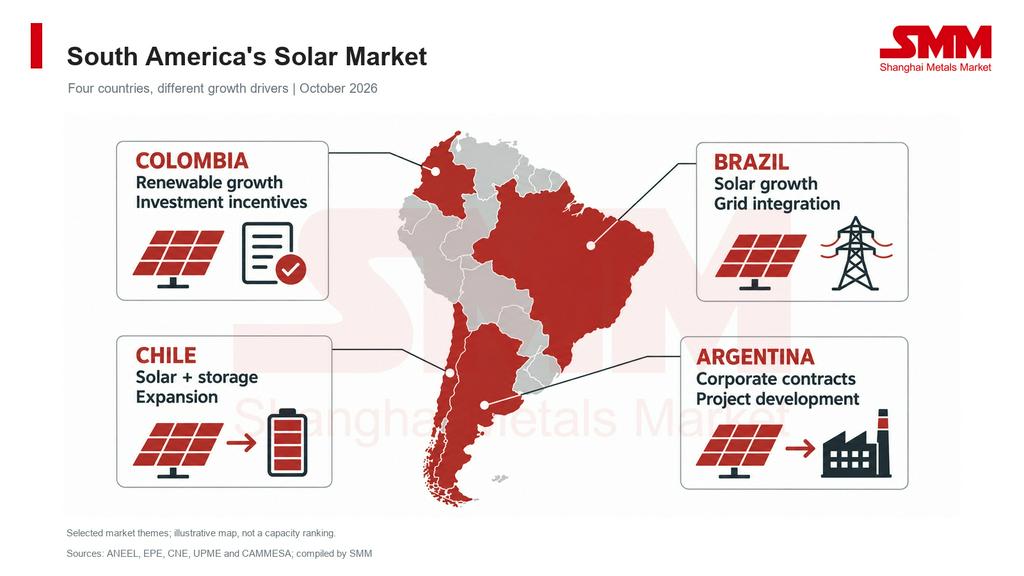
Brazil: Installation Growth Meets Integration Challenges
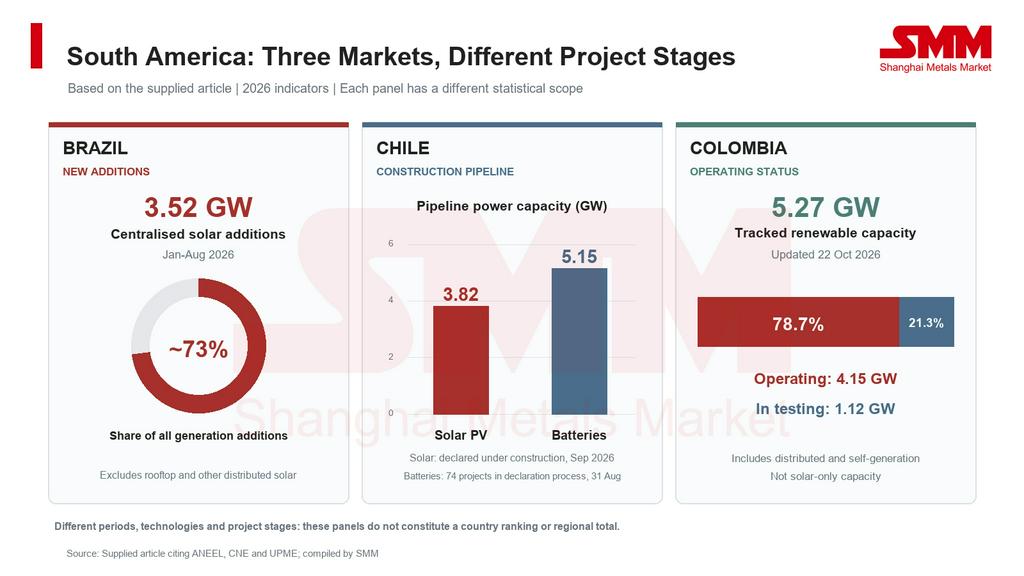
According to Brazil's electricity regulator, ANEEL, centralised solar additions reached approximately 3.52 GW between January and August 2026, representing around 73% of generation capacity additions during that period. The figures exclude rooftop and other distributed generation.
Continued installations support market activity, but transmission congestion and excess supply can restrict electricity sales. For new investment, connection conditions and curtailment exposure therefore matter alongside construction costs.
In October, ANEEL approved rules governing the order of mandatory generation cuts, with definitive application scheduled 18 months after publication. A September consultation separately proposes updated connection requirements for distributed solar, batteries and other technologies.
Storage procurement is also advancing. Under the Ministry of Mines and Energy's framework, battery capacity auctions are scheduled for December 2 and 4, 2026, with 15-year supply periods beginning in August 2028. The Energy Research Office, EPE, published the price-ceiling calculation methodology on October 19.
The next commercial signals will be auction outcomes and project execution. Preparatory measures do not themselves constitute awarded contracts or financed construction.
Chile: Storage Broadens the Solar Investment Case
Chile's National Energy Commission, CNE, listed approximately 3.82 GW of solar photovoltaic projects declared under construction in its September 2026 report. It also identified 74 battery projects with combined net power capacity of approximately 5.15 GW under the construction-declaration process as of August 31.
These are construction figures, not operating capacity. They nevertheless show investment extending from generation into infrastructure that can shift electricity delivery between hours.
Storage can absorb daytime surplus and discharge later. Chile's framework also recognises capacity remuneration for eligible storage, potentially adding income beyond electricity trading.
Commercial value depends on charging costs, discharge revenues, grid access and storage duration. Batteries with equal MW ratings can hold different amounts of energy, affecting equipment requirements and delivery capability.
Colombia: Incentives Support Development, but Testing Is Not Operation
Colombia's Mining and Energy Planning Unit, UPME, reported approximately 5.27 GW of tracked renewable capacity on its dashboard updated October 22, 2026. Around 4.15 GW was operating and 1.12 GW was undergoing testing.
The coverage includes distributed generation and small- and large-scale self-generation. It is not a total for commercially operating utility-scale solar alone.
UPME Resolution 563 of 2026 updates certification procedures for eligible tax benefits, including income-tax deductions, VAT exclusions, customs-duty exemptions and accelerated depreciation. Applications can be submitted annually from February 1 to December 15.
Administrative flexibility may support investment preparation. However, testing capacity still needs to complete the relevant commissioning steps, while incentive certification does not establish that financing, permits or connections are secured.
Argentina: Corporate Contracts Provide a Route to Investment
Market information published by Argentina's wholesale electricity market administrator, CAMMESA, outlines MATER, the renewable electricity contracting framework for large users.
Negotiated corporate contracts can improve revenue visibility and support financing. Buyers can procure renewable electricity without developing their own generating assets.
The investment case still depends on customer credit, transmission access and achievable delivery schedules. Corporate demand supports development when purchasing commitments are matched with projects capable of supplying electricity on the agreed terms.
Outlook: Project Milestones Will Determine the Pace of Growth
In the near term, Brazil's auction outcomes, Chile's construction progress and Colombia's transition from testing to operation will provide useful evidence of market development. In Argentina, financing and connection arrangements remain important to projects serving corporate buyers.
Over the medium term, grid investment and workable revenue mechanisms will influence whether development pipelines become operating capacity. For equipment suppliers, financing commitments and construction schedules provide stronger procurement signals than announcements alone.
The figures in this article cover different technologies and project stages and should not be combined into a regional installation total or country ranking.
SMM will continue to track policy implementation, grid access, commissioning and their implications for solar and storage equipment demand.
Compiled from official agency and electricity market publications checked on October 26, 2026. Reporting periods and capacity definitions vary by country.