Unified Pricing Formula Links Retail Energy Prices to the Wholesale Market
Under the Guidelines, the energy component of all Jiangsu retail electricity packages in 2027 will follow a unified formula:
Retail package energy price = Wholesale market price + Negotiated price adjustment + Kₐₗₗₒc × Monthly cost allocation price
The wholesale market price reflects the electricity retailer’s overall time-of-use procurement volumes and prices across the medium- and long-term, day-ahead, and real-time markets and is published monthly. The negotiated price adjustment is agreed between the retailer and the retail customer. Kₐₗₗₒc determines the proportion of relevant monthly allocated costs passed through to the customer.
Compared with the 2026 hybrid model combining fixed-price and market-linked electricity volumes, the new formula removes parameters such as the fixed-price electricity share and the spot-price-linked electricity share. All electricity volumes will instead be settled against wholesale market prices plus the negotiated adjustment, subject to the applicable cost allocation component. Retailers can still lower procurement costs through their trading capabilities, but will no longer be able to take positions on the spread between fixed retail prices and wholesale market movements.
Peak–Valley Structures Remain, with Time-of-Use Base Prices Also Drawn from the Wholesale Market
In 2027, Jiangsu will continue to allow customers and retailers to choose either time-of-use or non-time-of-use packages and to agree on different price adjustments for different periods. Peak, flat, and valley pricing structures will therefore remain in place as fixed prices are phased out.
The change is that the base price for each period in a time-of-use package will also be derived from the wholesale market. Pricing will increasingly follow “the monthly wholesale price for the relevant period plus the corresponding negotiated adjustment,” rather than three absolute peak, flat, and valley prices locked in ahead of delivery.
Until Jiangsu formally issues its notice on electricity trading arrangements for 2027, parameters such as time-of-use price adjustment ratios, warning thresholds, and price-cap multipliers will refer to their 2026 levels. They may subsequently be adjusted in response to policy changes and market conditions.
The Guidelines also retain a cap mechanism for the energy component. Customers’ price exposure is therefore subject to certain limits, but the cap serves as a risk buffer rather than a return to fixed pricing. Customers will still need to assess how wholesale prices, allocated costs, and their own consumption profiles jointly affect their average monthly settlement prices.
Jiangsu Is Part of a Broader Shift: 11 Provinces and Municipalities Have Advanced Changes to Fixed Time-of-Use Tariffs
Jiangsu’s adjustment is not an isolated development. A review of publicly available information indicates that 11 provinces and municipalities have issued notices specifying that customers participating in the electricity market will no longer be subject to government-set fixed time-of-use tariffs. Nine have implemented the changes, while the arrangements in Jiangsu and Shanxi had previously remained in progress.
The nine jurisdictions that have implemented the removal are:
Guizhou, Hebei—primarily the southern Hebei grid area—Hubei, Shaanxi, Jilin, Yunnan, Chongqing, Liaoning, and Henan.
Implementation approaches differ. Hubei, Chongqing, the southern Hebei grid area, Shaanxi, and Jilin have specified that, for entities directly participating in medium- and long-term electricity trading, tariff periods and price levels will no longer be administratively prescribed. Time-of-use prices will instead be determined by the market.
Henan, Guizhou, and Yunnan have stipulated in their latest adjustments to commercial and industrial time-of-use tariffs that market-participating customers will no longer be subject to fixed time-of-use tariffs. Jiangsu is passing wholesale market prices through by revising retail package formulas. Its phased approach retains administratively defined time-of-use tariffs as a backstop while gradually increasing the share of electricity subject to market-based time-of-use pricing.
The policy basis is clear. The Basic Rules for the Medium- and Long-Term Electricity Market, jointly issued by the National Development and Reform Commission and the National Energy Administration in December 2025, stipulate that, from March 1, 2026, entities directly participating in market transactions will no longer be subject to government-prescribed time-of-use tariff levels and periods. This marks the beginning of a systematic phaseout of the fixed time-of-use tariff framework that has been in place for more than four decades.
Over the longer term, electricity spot markets in Shanxi, Guangdong, Shandong, Gansu, Inner Mongolia, Hubei, Zhejiang, the southern Hebei grid area, and Anhui have entered regular operation, while Shaanxi and Liaoning are conducting continuous settlement trials. More mature spot markets provide the foundation for wholesale–retail price linkage.
The national direction is clear: package names, cap mechanisms, and cost allocation methods may vary, but the channels for passing wholesale costs through to retail customers are becoming more clearly defined.
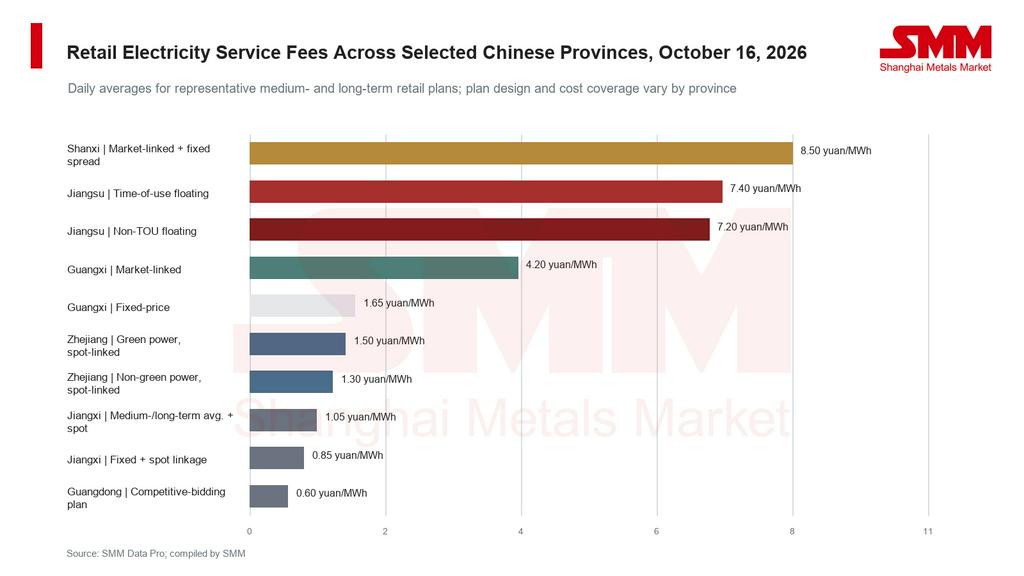
Retail Service Fees Vary Significantly Across Provinces, with Jiangsu Relatively High
According to SMM’s daily tracking of average service fees for representative medium- and long-term retail electricity packages, sample quotations ranged from RMB 0.60/MWh to RMB 8.50/MWh as of October 16, 2026, highlighting substantial differences across provinces.
Shanxi’s “market-linked price plus fixed spread” package stood at RMB 8.50/MWh, the highest in the sample. In Jiangsu, time-of-use and non-time-of-use floating-price packages were quoted at RMB 7.40/MWh and RMB 7.20/MWh, respectively, a difference of just RMB 0.20/MWh.
In Guangxi, the market-linked package was quoted at RMB 4.20/MWh, compared with RMB 1.65/MWh for the fixed-price package, indicating a pronounced gap between the two products. Zhejiang’s green electricity spot-linked package stood at RMB 1.50/MWh, versus RMB 1.30/MWh for its non-green electricity counterpart, implying a green electricity premium of approximately RMB 0.20/MWh.
Jiangxi’s “medium- and long-term average price plus spot linkage” package was quoted at RMB 1.05/MWh, while its “fixed price plus spot linkage” package stood at RMB 0.85/MWh. Guangdong’s competitive allocation package was quoted at RMB 0.60/MWh, the lowest in the sample.
These wide differences do not necessarily mean that provinces with lower service fees offer lower overall electricity costs. Wholesale price benchmarks, responsibility for imbalances, risk coverage, green electricity attributes, cost allocation mechanisms, and minimum transaction volume requirements vary across packages.
Retailers Must Adjust Their Operating Focus, While Customers Need to Reassess Risk
For electricity retailers, procurement portfolio management, load forecasting, spot trading, imbalance management, and customer service will become increasingly important. Their earnings model will shift from assuming fixed-price spread risk toward monetizing negotiated price adjustments and professional trading capabilities. Wholesale–retail price linkage does not eliminate retailers’ risks: performance security requirements, forecasting errors, cash flow, and customer management will continue to directly affect business performance.
For commercial and industrial customers, package selection should extend beyond a comparison of negotiated price adjustments. At a minimum, customers should examine four elements: how the wholesale market price is calculated; the value and sign convention of Kₐₗₗₒc; whether a price cap applies; and contractual provisions governing time-of-use consumption profiles, imbalances, and early termination. For large electricity users, the fit between their load profile and the retailer’s aggregated customer portfolio may matter more than saving one or two yuan per MWh in service fees.
For commercial and industrial energy storage and distributed PV projects, revenue assessments based on a fixed annual peak–valley spread will need to be updated. Storage charging and discharging decisions should increasingly reflect actual settlement price profiles rather than static peak and valley periods. The value of distributed PV self-consumption must also be reassessed in terms of avoided electricity costs when midday wholesale prices decline. Project models should incorporate the energy component, service fees, allocated costs, and other electricity bill components, rather than extrapolating total project returns solely from the energy price in a retail package.