In the first full trading week after the holiday, iron ore extended its decline, but the fall was markedly smaller than in the week before the break. The SGX main contract eased from $91.24/mt on October 9 to $90.45/mt on October 15, down $0.79 or 0.87%; the DCE main contract I2701 fell from 682.5 yuan/mt to 671.5 yuan/mt, down 1.61%; and the MMI 61% iron ore port spot index slipped from 664 yuan/wmt to 654 yuan/wmt, down 1.51%. Against a 2.35% drop in the SGX contract the previous period, the loss of downward momentum this week is clear.
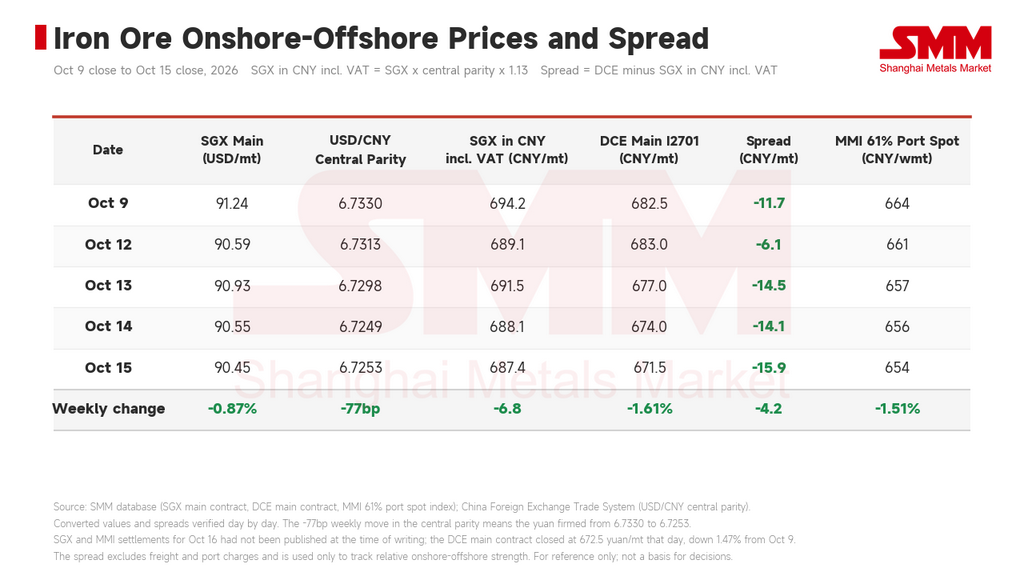
The week was steady first and weaker later. The futures board was close to flat on October 12, then closed lower for four consecutive sessions, leaving I2701 at 671.5 yuan/mt on October 15, a cumulative 31 yuan/mt below the last pre-holiday session on September 30.
Onshore and offshore strength diverged this week. The yuan central parity firmed 77 basis points over the week to 6.7253, so on a yuan-converted basis the SGX contract fell only 6.8 yuan/mt while the DCE fell 11 yuan over the same stretch, widening the onshore-offshore spread from minus 11.7 yuan to minus 15.9 yuan and deepening the onshore discount. That is the mirror image of the last pre-holiday session, when the offshore market was pricing in the demand vacuum of the break while the onshore board was lifted by position cutting and short covering. With the post-holiday repositioning complete, the board is again reflecting China’s own inventory and demand pressure.
II. Supply: a third straight weekly fall in arrivals, ports still building, and freight pulling cost support away
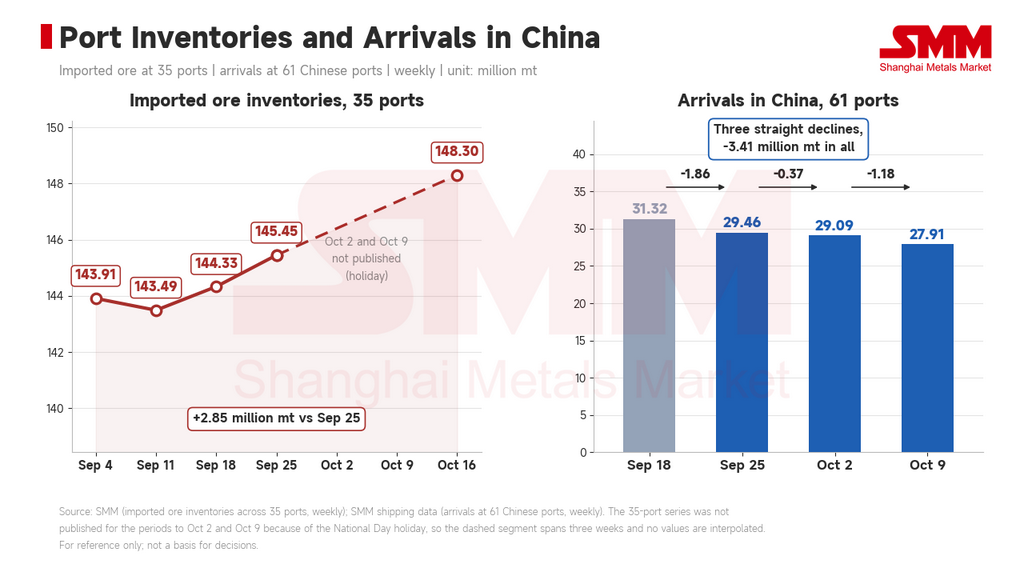
SMM shipping data put global iron ore shipments at 34.14 million mt in the week to October 9, down 1.80 million mt week on week, while arrivals in China came to 27.91 million mt, down 1.18 million mt. That is a third consecutive weekly decline, a cumulative 3.41 million mt below the 31.32 million mt of the week to September 18. Volumes destined for China fell to 19.43 million mt, down 3.49 million mt from 22.92 million mt in the week to September 25.
Arrivals are contracting, yet ports are still building. Imported ore inventories across the 35 ports stood at 148.30 million mt on October 16, up 2.85 million mt from the last pre-holiday reading on September 25; SMM’s 10-port inventories were 105.14 million mt on October 15, up 2.12 million mt from before the break, with fines and lump accounting for most of the build. Port outbound volume of imported ore over the same period was 3.19 million mt, below the 3.24 million mt of the week to September 25. This build has not been pushed up by arrivals; outbound shipment simply has not kept pace, which makes it demand showing through in the supply numbers.
The change most worth recording on the supply side this week is freight. Australia-to-China freight fell from $14.39/mt on October 9 to $11.60/mt on October 15, down 19.4% over the week, while Brazil-to-China freight eased from $33.68/mt to $31.39/mt, down 6.8% on the week and a cumulative 27.1% below the $43.06/mt of September 24. Last week’s commentary set out a conditional view: if Brazil-to-China freight held at the level then prevailing, low-grade capacity facing the same margin pressure might follow with cuts of its own. That condition has not held this week. Freight has turned down first, and the external premise behind CSN Mineração’s freight-driven production cut has changed. For iron ore prices, lower freight pulls landed costs down directly, and cost support beneath the market loosens with it.
III. Demand: hot metal steadies while maintenance losses keep widening, though more slowly
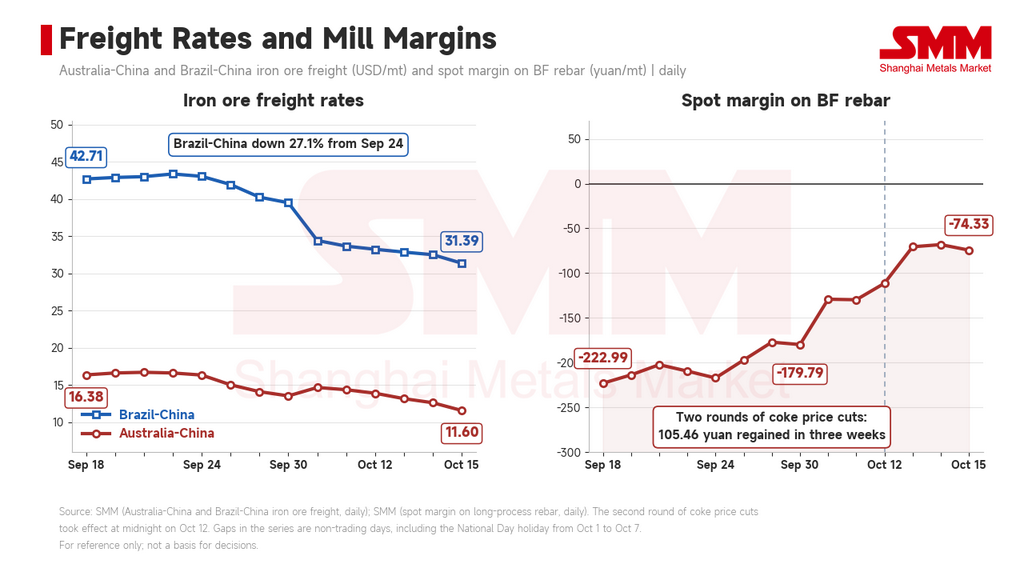
The holiday-period drop has already been realised. Average daily hot metal output across 242 steel mills was 2.3532 million mt in the period to October 7, down 35,000 mt from 2.3882 million mt on September 30, and 2.3520 million mt in the period to October 14, a further decline of just 1,200 mt, leaving it 36,200 mt below the pre-holiday level. The blast furnace operating rate was 87.03% and capacity utilisation 86.81%, down 1.54 and 1.34 percentage points respectively from before the break. After six consecutive periods of decline from 2.4080 million mt in the period to September 2, hot metal has essentially stopped falling this week.
The drag has not lifted. Hot metal lost to blast furnace maintenance came to 1.9011 million mt in the period to October 16, up 78,600 mt week on week and a fourth consecutive period of expansion from 1.5288 million mt in the period to September 18, a cumulative increase of 372,300 mt. The increments themselves are converging, however, running at 101,100, 113,900, 78,700 and 78,600 mt across the four periods, with the last two slowing noticeably. A peak in the pace of maintenance expansion typically comes before hot metal turns back up.
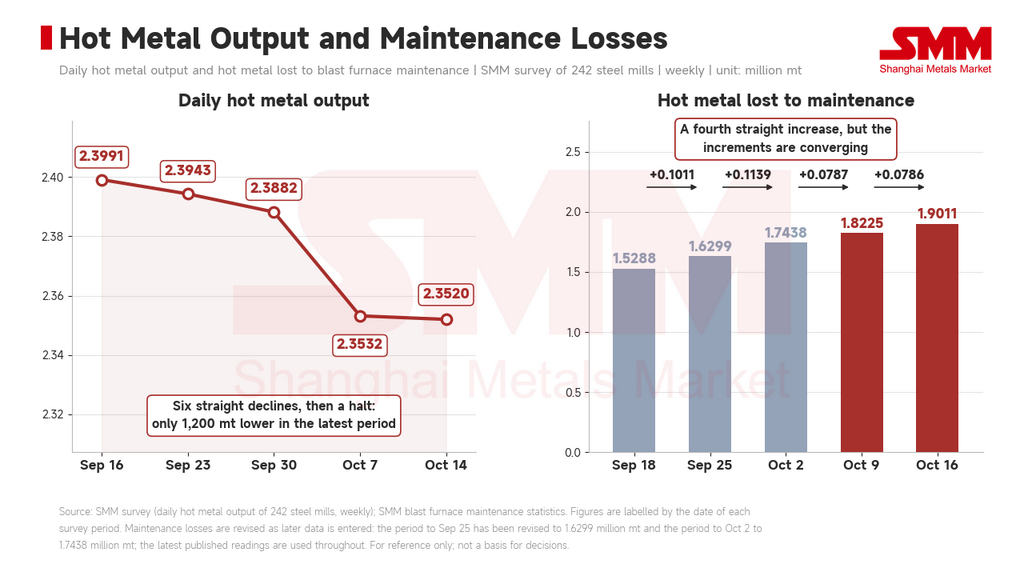
Mill margins have repaired in a real way. The second round of coke price cuts took effect at midnight on October 12, with wet-quenched coke down 100 yuan/mt and dry-quenched coke down 110 yuan/mt, taking the national average for quasi-grade-one dry-quenched metallurgical coke from 2,310 yuan/mt to 2,200 yuan/mt. After two rounds, the spot margin on BF rebar recovered from minus 179.79 yuan/mt before the holiday to minus 74.33 yuan/mt on October 15, regaining 105.46 yuan in three weeks. Margin repair gives hot metal the conditions to stabilise, but it has not yet turned into incremental iron ore buying; mills are still taking rigid-demand volumes and show little appetite for active restocking.
IV. Marginal disturbances
A third round of coke price cuts is still being contested. Coke producers fell back into losses after the second round landed and are more inclined to curb output, while mills have already repaired margins somewhat, leaving them with less leverage to press prices than in the first two rounds. Market sentiment is driven by the combination of high inventories and expectations that hot metal has bottomed, and whichever side delivers a clear signal first is likely to decide the direction iron ore takes next week. Annual long-term contract negotiations are also worth watching; SMM iron ore commentary flagged them as a point of focus for the futures board twice this week.
The average margin on imported iron ore narrowed over the week from 15.37 yuan/mt to 9.60 yuan/mt, dragged down by falling port spot prices.
V. Outlook and what to watch
The SGX main contract is likely to trade in an $88-93/mt range next week. Hot metal is close to its floor and maintenance losses are growing more slowly, which limits how much further demand can fall; but port inventories are high in absolute terms and outbound shipment has yet to pick up, so there is just as little room above. The direction favours range-bound trading at low levels. Whether the centre of gravity shifts lower again rests on two trackable data points: whether arrivals in China extend their decline in the next period, and whether 10-port inventories post their first drawdown of this cycle.
From a fundamentals standpoint, the cost side is what needs watching more closely. Freight has fallen by more than a quarter in three weeks. If that trend continues, cost support beneath iron ore will weaken further, and the case for overseas production cuts driven by freight pressure will weaken with it. At the macro level, no new information emerged this week. This chain can be verified within the fourth quarter.

![Port stocks build 2.85 million mt as dispatch slips, keeping iron ore soft [SMM Daily Iron Ore Brief]](https://imgqn.smm.cn/usercenter/rBCZR20251217171716.jpg)
![[ Dillinger France Invests to Modernize Dunkirk Rolling Mill ]](https://imgqn.smm.cn/usercenter/rKOND20251217171716.jpg)