I. Power Spot Market Operations
Weekly Overview: From October 5 to 11, electricity demand showed a clear transition around the end of the National Day holiday. From October 5, rainfall across southern China gradually eased, while cooler air pushed temperatures in parts of South China to some of their lowest levels since the second half of the year began. Between October 7 and 10, much of central and eastern China turned sunnier and temperatures gradually recovered, before a new cold-air system began affecting northern regions from October 11 onward.
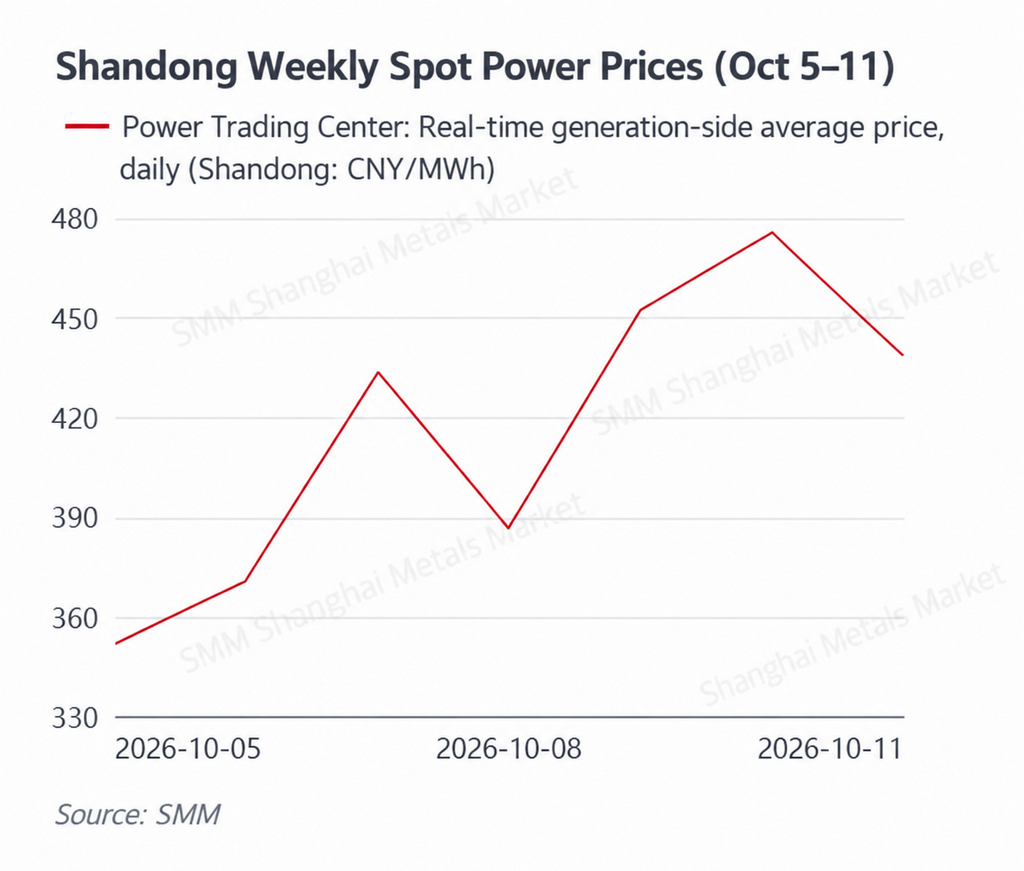
Spot prices showed increasingly divergent provincial trends. Shandong’s real-time average rose to RMB 415.61/MWh, up around 15.7% from the previous period, although negative prices still occurred on five days during the week. Guangdong’s day-ahead and real-time averages fell to RMB 391.17/MWh and RMB 379.13/MWh, down around 30.6% and 30.1%, respectively. Inner Mongolia’s generation-side real-time average rose to RMB 277.98/MWh. Jiangsu’s day-ahead and intraday averages were broadly stable at RMB 389.44/MWh and RMB 388.65/MWh. Shanxi’s day-ahead and intraday averages increased to RMB 348.48/MWh and RMB 410.17/MWh, while Shaanxi’s day-ahead and real-time averages fell to RMB 285.23/MWh and RMB 305.20/MWh. On the fuel side, port coal prices remained elevated and mine-mouth prices strengthened modestly. SMM China LNG arrival prices rebounded from the previous week, while eastern Guangdong LNG remained at RMB 6,515/mt as of October 9.
Shandong prices recovered noticeably after the holiday, but negative prices remained frequent and intraday supply-demand mismatches persisted. Shandong’s real-time generation-side average rose from RMB 351.79/MWh on October 5 to RMB 433.67/MWh on October 7. Prices strengthened further to RMB 452.28/MWh on October 9, RMB 475.67/MWh on October 10 and RMB 438.63/MWh on October 11, bringing the weekly average to approximately RMB 415.61/MWh, up around 15.7% from the previous period. The recovery in industrial and commercial demand after the holiday was an important driver of higher prices later in the week.
Nevertheless, daily minimum prices remained negative on October 5, 6, 8, 10 and 11, with the October 10 low reaching -RMB 89.70/MWh. At the same time, the daily maximum price remained as high as RMB 911.45/MWh on October 5. The coexistence of negative trough prices and elevated peak prices indicates that concentrated renewable generation continued to create temporary oversupply during some hours, while the decline in solar output during the evening peak required conventional generation to ramp up quickly. Elevated coal prices also limited the downside in thermal-generation bids when coal-fired units became marginal.
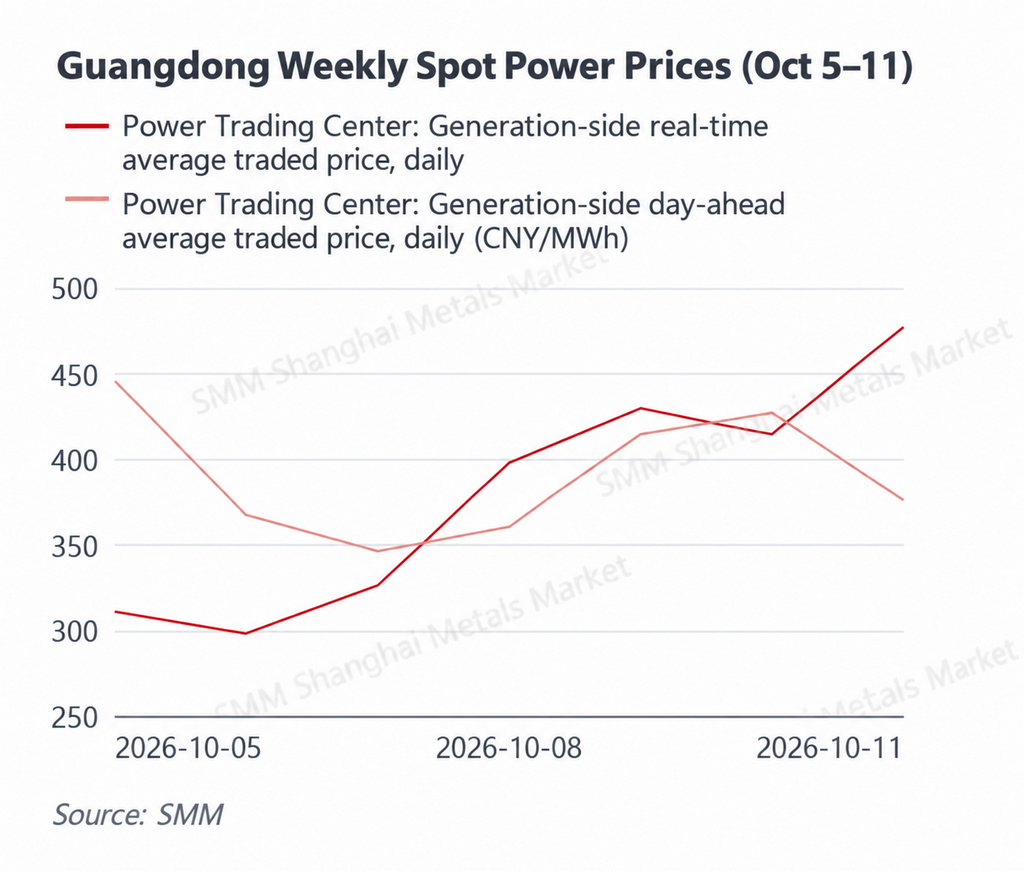
Guangdong’s price centre fell sharply as holiday-related demand weakness and earlier cooling outweighed fuel-cost support, although the real-time market gradually recovered after the holiday. Guangdong’s weekly day-ahead average fell to approximately RMB 391.17/MWh, down around 30.6% from the previous week, while its real-time average declined to approximately RMB 379.13/MWh, down around 30.1%. During October 5–7, which still overlapped with the National Day holiday, real-time prices were only RMB 310.95/MWh, RMB 298.46/MWh and RMB 326.05/MWh, respectively.
From October 8 onward, as production activity resumed and temperatures in South China began to recover, real-time prices gradually rose to RMB 397.90/MWh and RMB 429.10/MWh before reaching RMB 476.66/MWh on October 11. Eastern Guangdong LNG remained at a relatively high level, continuing to support the marginal cost of gas-fired generation. However, when holiday demand was weak, elevated fuel costs alone were insufficient to prevent spot prices from declining.
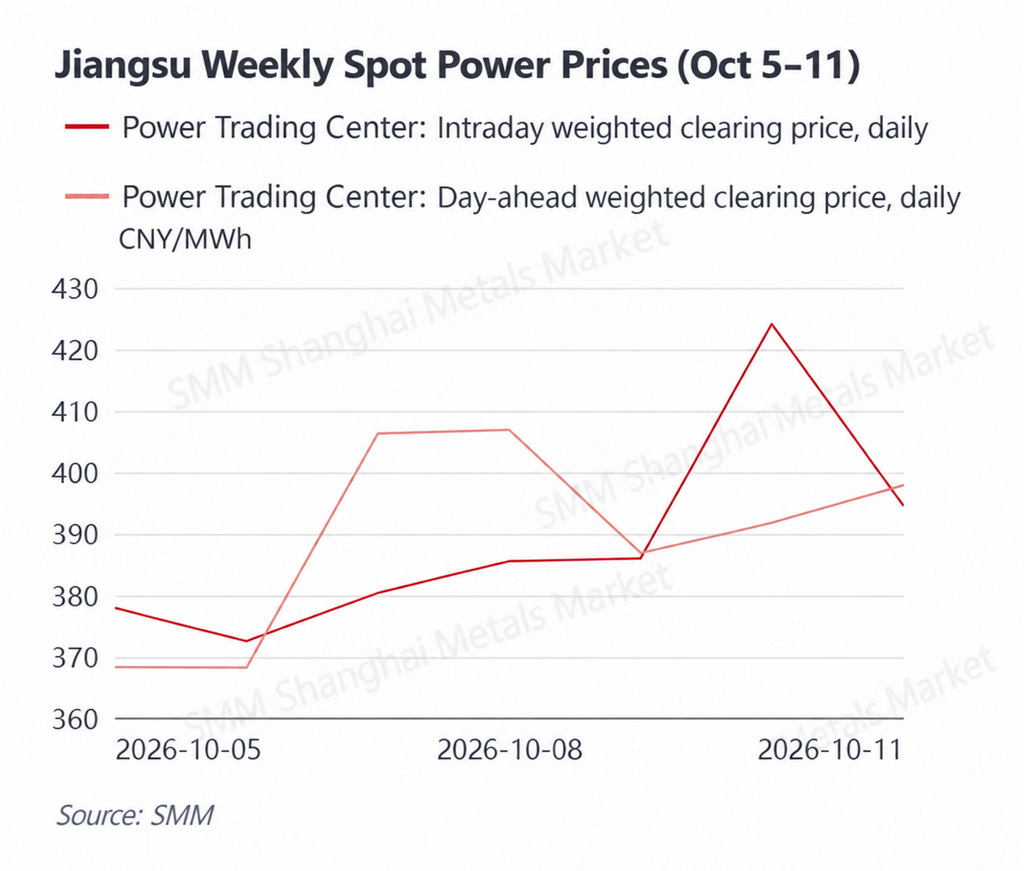
Jiangsu’s day-ahead and intraday weekly averages were nearly identical, while prices recovered moderately after the holiday and the market remained relatively stable overall. Jiangsu’s day-ahead weighted clearing price averaged approximately RMB 389.44/MWh, while the intraday weighted average stood at approximately RMB 388.65/MWh, a difference of less than RMB 1/MWh.
Intraday prices mainly ranged between RMB 372/MWh and RMB 386/MWh from October 5 to 9, before rising to RMB 424.10/MWh on October 10 and easing to RMB 394.52/MWh on October 11. Day-ahead prices mostly remained within RMB 368–407/MWh. The close weekly averages indicate relatively limited overall forecast deviations, although the noticeably higher intraday price on October 10 still reflected temporary tightening caused by post-holiday load recovery, actual renewable output and other short-term system variables. Elevated coal prices continued to provide support to coal-fired marginal costs.
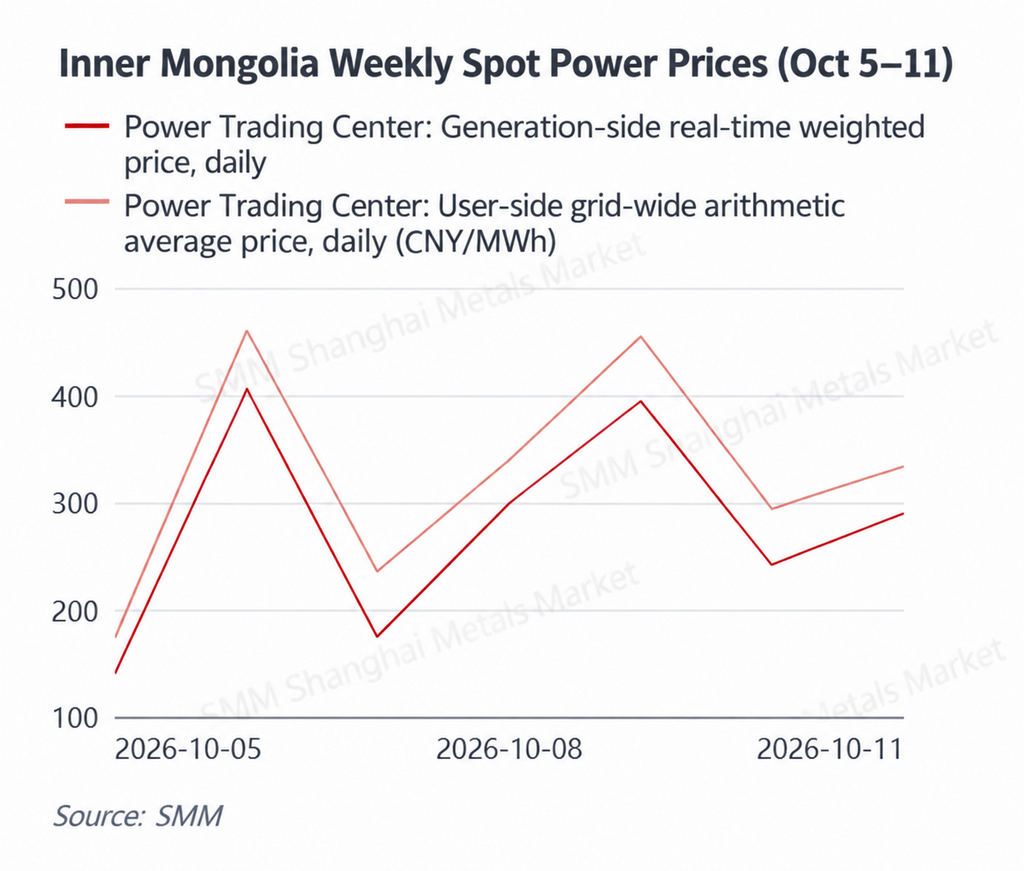
Inner Mongolia continued to experience wide price fluctuations. The weekly average recovered from the previous week, while renewable output remained the dominant short-term driver. Inner Mongolia’s generation-side real-time weighted average reached approximately RMB 277.98/MWh, up around 8.2% from the previous week, while the system-wide user-side arithmetic average rose to approximately RMB 327.33/MWh, up around 9.9%.
Daily prices remained highly volatile. The generation-side average was only RMB 140.13/MWh on October 5, surged to RMB 405.70/MWh on October 6, dropped back to RMB 174.87/MWh on October 7, and then climbed again to RMB 394.53/MWh on October 9. Such frequent swings highlight that, in a market with a high share of renewable generation, load changes alone are insufficient to explain price movements. Actual wind and solar output and interprovincial export demand remain the primary determinants of marginal supply-demand conditions. When renewable output declines and thermal generation has to increase, higher mine-mouth coal prices further amplify thermal bidding costs.
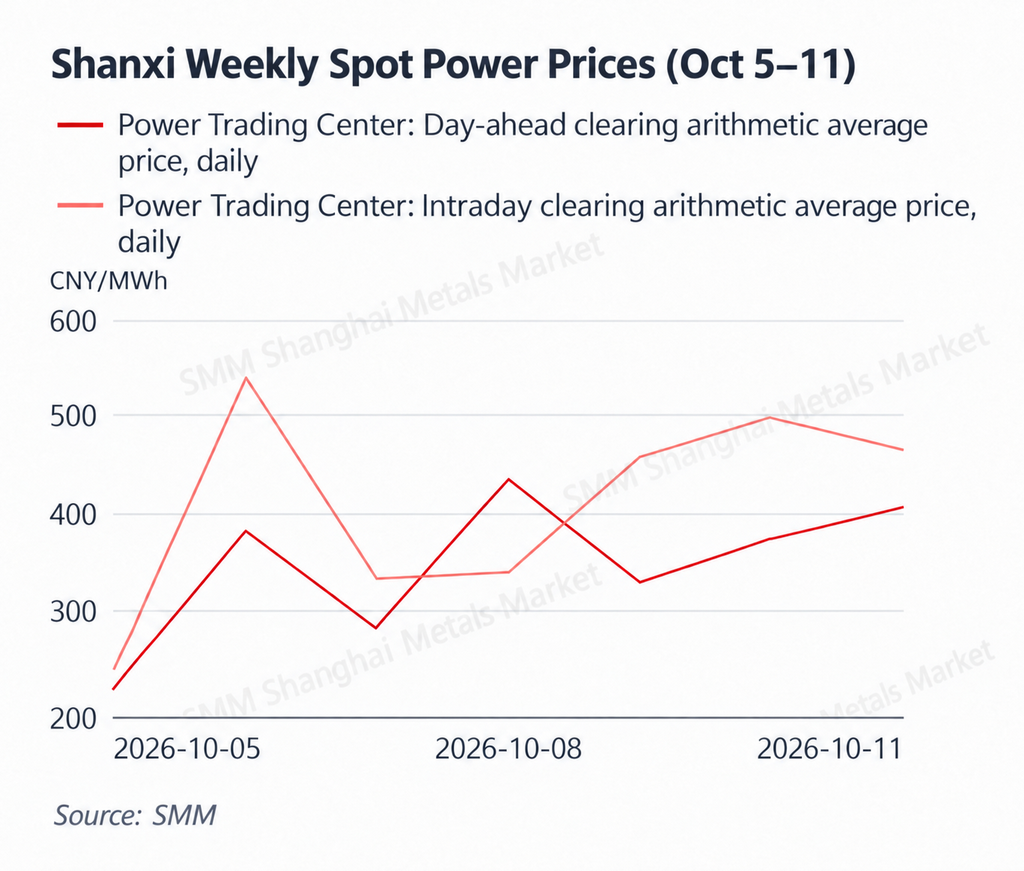
Shanxi recorded the strongest post-holiday price rebound, with intraday prices remaining well above day-ahead levels and actual supply-demand deviations still pronounced. Shanxi’s day-ahead arithmetic average rose to approximately RMB 348.48/MWh, up around 34.3% from the previous week, while the intraday average increased to approximately RMB 410.17/MWh, up around 26.5%. The intraday average exceeded the day-ahead average by around RMB 61.7/MWh.
On October 6, the intraday average reached RMB 533.41/MWh, approximately RMB 151/MWh above the day-ahead price for the same day. Intraday prices also reached RMB 456.38/MWh, RMB 494.93/MWh and RMB 463.11/MWh on October 9, 10 and 11. The recovery in industrial demand after the holiday provided an important demand-side foundation for the price rebound. At the same time, Shanxi’s relatively high coal-fired generation share meant that rising mine-mouth coal prices further strengthened the marginal-cost floor. When actual renewable output or load deviated from day-ahead forecasts, high-cost marginal units more readily pushed intraday prices higher.
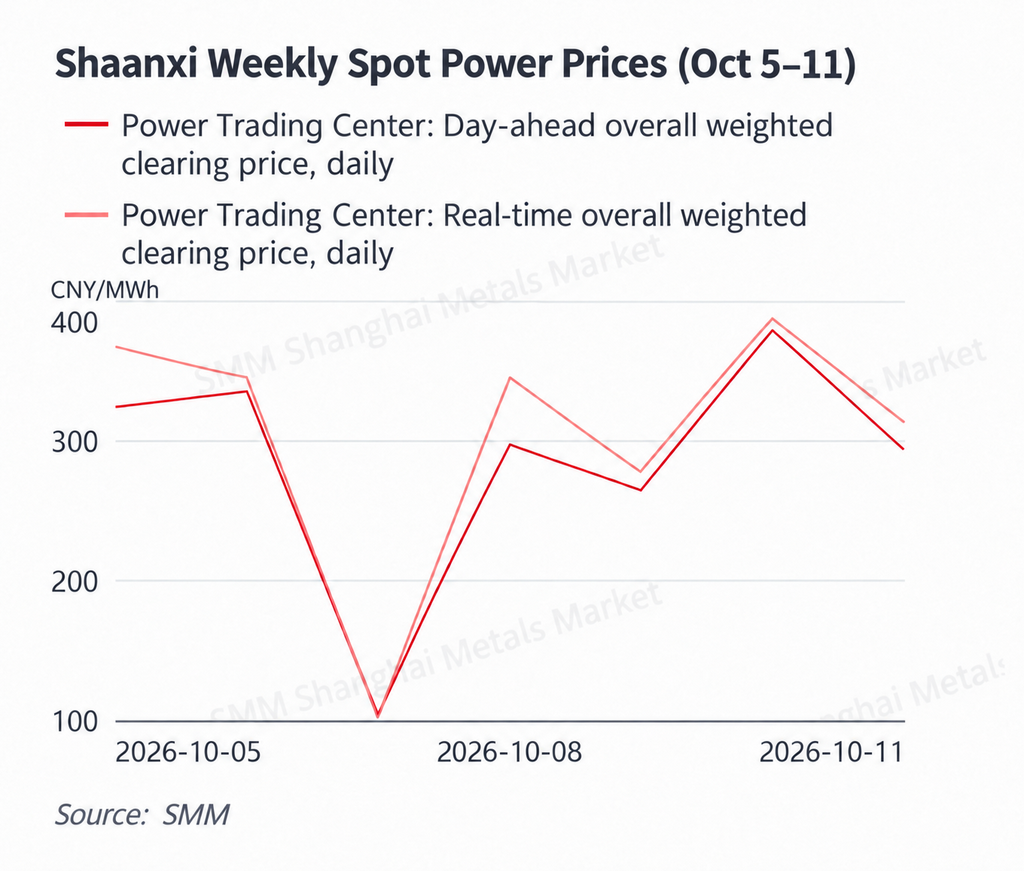
Shaanxi’s weekly average declined modestly, with prices falling sharply toward the end of the holiday before recovering after activity resumed. Shaanxi’s day-ahead weighted average fell to approximately RMB 285.23/MWh, down around 7.7% from the previous week, while the real-time average declined to approximately RMB 305.20/MWh, down around 2.3%.
On October 7, day-ahead and real-time prices plunged to RMB 103.89/MWh and RMB 101.25/MWh, respectively, the lowest levels of the week. Prices then recovered quickly on October 8 to RMB 297.38/MWh and RMB 344.64/MWh, and strengthened further on October 10 to RMB 378.83/MWh and RMB 387.17/MWh. Weak load toward the end of the holiday, combined with changes in renewable output, exerted strong downward pressure early in the week. Post-holiday demand recovery then supported a rebound, but weekly averages remained below the previous week. Compared with Shanxi, the day-ahead/real-time spread in Shaanxi remained relatively limited, indicating less persistent tightening during actual system operation.
Overall, this week’s spot market showed a clear transition from holiday-related weak demand to post-holiday recovery, but price directions varied materially across provinces. Shandong, Inner Mongolia and Shanxi recorded higher weekly averages, with Shanxi’s intraday market particularly strong. Guangdong’s previous-week price base was high, meaning that even though real-time prices recovered gradually after the holiday, its weekly average still fell sharply. Shaanxi remained relatively weak, while Jiangsu was broadly stable.
At the same time, frequent negative prices in Shandong show that the challenge of absorbing concentrated renewable generation has not eased during the autumn low-load period. As economic activity normalises after the holiday, the next stage of spot pricing will depend increasingly on the strength of industrial-load recovery, actual wind and solar output and fuel costs for thermal generation.
Primary Energy
October 5–11
Thermal coal: Port prices remained elevated while mine-mouth prices strengthened, with supply constraints continuing to support the market.
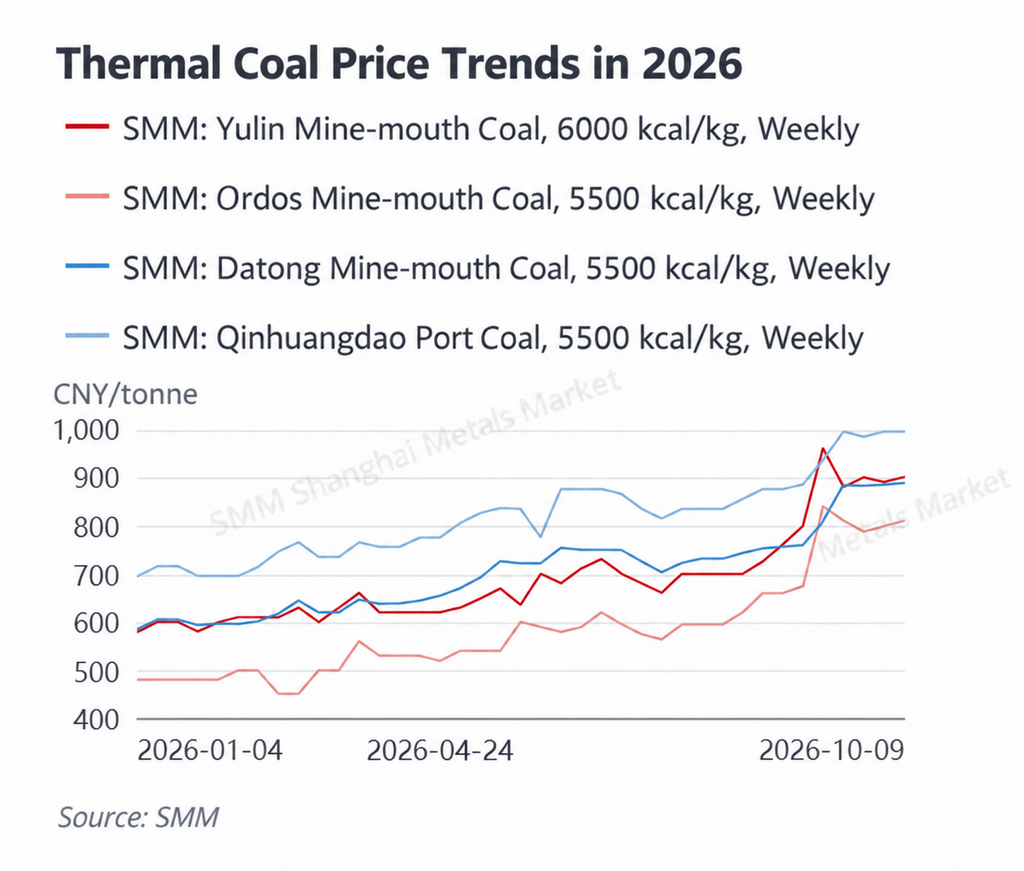
As of October 9, SMM Qinhuangdao Port 5,500 kcal coal remained at RMB 995/mt, unchanged from September 28. Over the same period, Datong mine-mouth 5,500 kcal coal rose from RMB 885/mt to RMB 887/mt, Ordos mine-mouth 5,500 kcal coal increased from RMB 800/mt to RMB 810/mt, and Yulin mine-mouth 6,000 kcal coal rose from RMB 890/mt to RMB 900/mt. Although the benchmark port price did not rise further, mine-mouth prices generally strengthened, keeping the coal market at elevated levels.
Supply: Safety-related restrictions remained in place across major coal-producing regions, while production at some mines continued to recover cautiously, limiting incremental spot supply. In early October, autumn maintenance on the Daqin railway also constrained inflows into northern ports to some extent. Combined with earlier inventory drawdowns, this maintained relatively strong pricing power among traders. In Ordos and Yulin, relatively smooth shipments supported further increases in mine-mouth prices, highlighting that physical supply remained far from abundant.
Demand: Industrial and power-sector demand weakened temporarily during the National Day holiday, while northern China had not yet entered the peak heating season. Power plants therefore remained cautious toward expensive spot coal and continued to rely mainly on term contracts and essential procurement. However, industrial activity recovered after the holiday and expectations for winter stockpiling strengthened as the heating season approached. The current coal-price strength therefore reflects not a surge in power-sector demand alone, but a combination of slow supply recovery, transport constraints and expectations of winter replenishment.
Inventories: Power-plant inventories still provide a reasonable buffer, limiting the willingness of end-users to chase higher prices. However, northern port inventories remain relatively low and freely available spot cargoes are not abundant. Thermal coal prices are therefore more likely to remain elevated and range-bound in the near term, with supply constraints supporting the downside while shoulder-season coal burn and end-user resistance to high prices cap further rapid gains.
For coal-heavy markets such as Shandong, Shanxi, Inner Mongolia and Shaanxi, elevated coal prices mean that coal-fired marginal costs will continue to provide relatively strong support during high-price periods.
LNG: Import prices rebounded from the previous week while eastern Guangdong LNG remained elevated, leaving gas-fired generation costs under continued pressure.
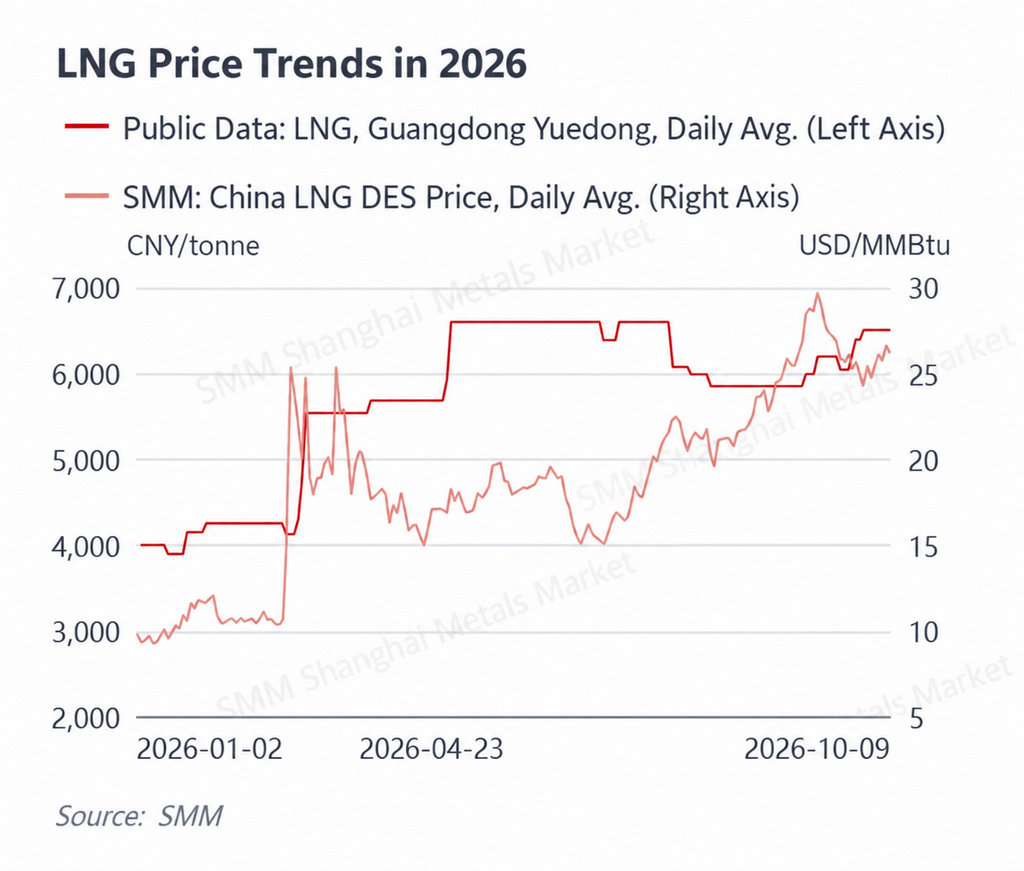
SMM China LNG arrival prices fluctuated mainly between USD 25/MMBtu and USD 27/MMBtu during the week. Prices stood at USD 25.56/MMBtu on October 5, rose to USD 26.14/MMBtu on October 6, eased to USD 25.78/MMBtu on October 7, climbed further to USD 26.69/MMBtu on October 8 and settled at USD 26.23/MMBtu on October 9. The October 5–9 average was approximately USD 26.08/MMBtu, around 4.0% above the September 28–October 2 average of approximately USD 25.07/MMBtu.
Eastern Guangdong LNG stood at RMB 6,515/mt on both October 8 and 9, unchanged from the September 30 level, indicating that coastal domestic spot prices had not eased materially.
Supply: Domestic feedgas costs remained relatively high, continuing to support LNG production costs. Meanwhile, imported spot LNG costs recovered from the previous week, limiting the scope for coastal prices to decline. With the heating season approaching, expectations of stronger winter demand also reinforced suppliers’ willingness to hold prices.
Demand: During the first half of the week, the National Day holiday reduced industrial gas demand and electricity load, contributing to relatively low Guangdong real-time power prices. After October 8, commercial and industrial activity resumed, while temperatures in South China gradually recovered, supporting a marginal improvement in gas-fired generation demand.
Elevated LNG prices therefore functioned primarily as a cost floor for Guangdong’s power market. When electricity demand was weak, high gas prices could not prevent spot prices from falling. Once demand recovered and gas-fired units became marginal, however, elevated fuel costs increased the upward elasticity of electricity prices.
Overall, the LNG market shifted from the previous week’s decline in import costs back toward high-level consolidation. Key variables for the coming weeks include the start of northern heating demand, domestic feedgas costs and movements in imported spot LNG prices.
Weather Review
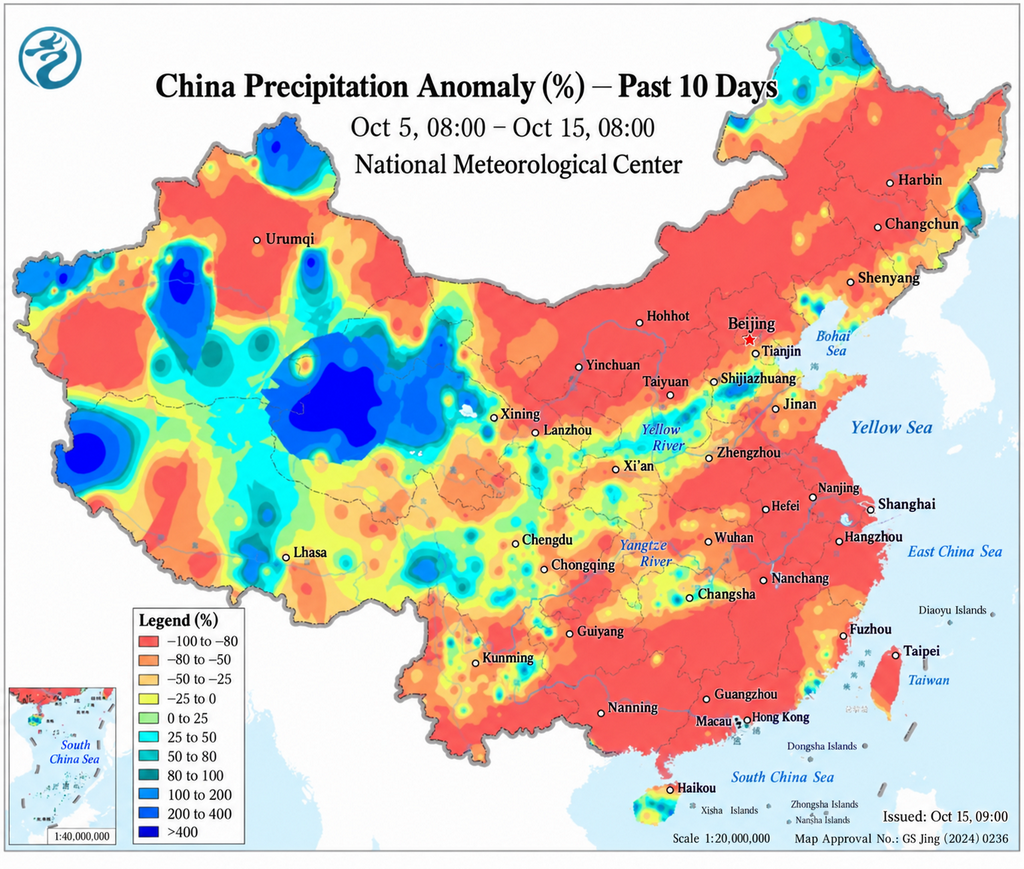
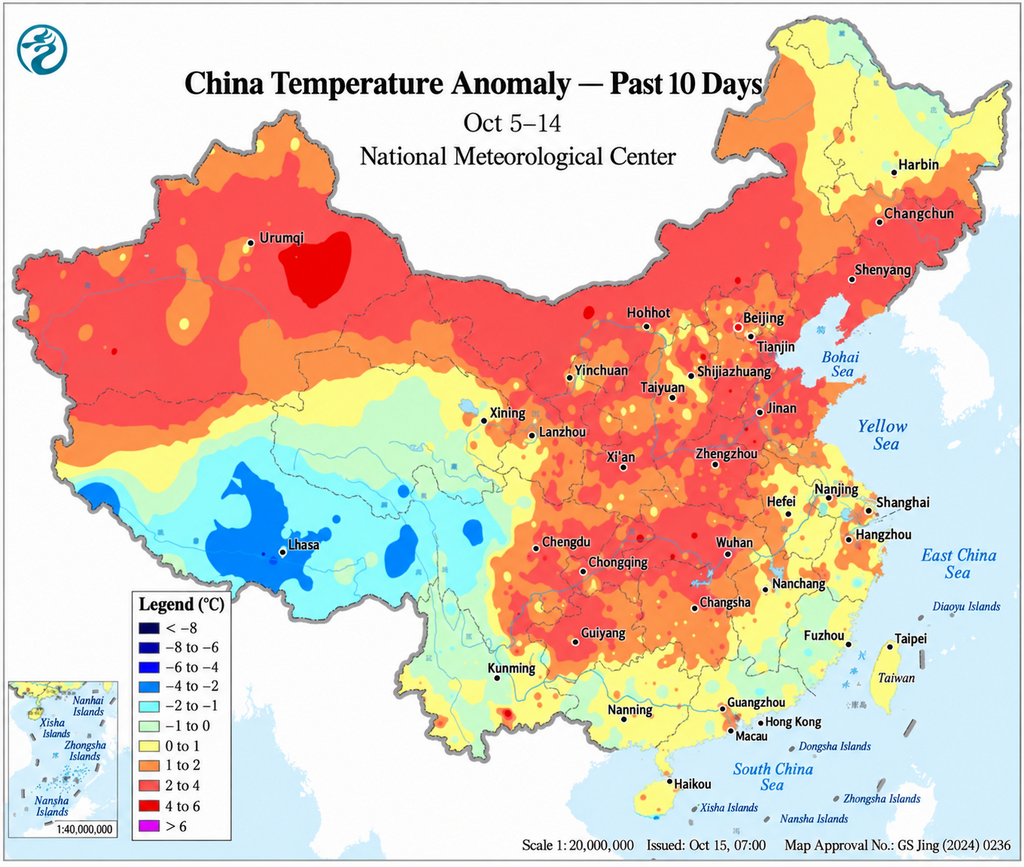
During October 5–11, China experienced a weather pattern characterised by cold-air influence, widespread clearing and warming, followed by the arrival of another cold front. From October 5, rainfall across southern China gradually eased, while cold air pushed temperatures lower across parts of South China, with some cities recording their lowest temperatures since the second half of the year began.
Between October 6 and 10, much of central and eastern China turned sunnier and drier, and daytime temperatures gradually recovered, while the day-night temperature range widened. Northern China also experienced a period of relatively stable weather after early-week northerly winds.
From October 11, a new cold-air system began affecting northern regions, bringing another round of wind and cooling to parts of North China and eastern Inner Mongolia. In the south, temperatures gradually recovered after the earlier cooling, and daytime temperatures in much of Guangdong returned to around or above 30°C by October 10, allowing cooling demand to recover to some extent.
From the perspective of the power market, the weather effect was closely intertwined with the holiday cycle. Cooling and reduced economic activity suppressed demand during the holiday, while clearer and warmer conditions combined with post-holiday production recovery to lift electricity consumption later in the week. As stronger cold-air activity develops in mid-October, northern China is moving into a transition period in which cooling demand has largely disappeared but heating demand has not yet fully started. Actual renewable output and load-forecast deviations are therefore likely to become increasingly important drivers of spot-price volatility.
II. Key Developments in China’s Power Market
On September 30, the Qinghai Power Exchange issued the Notice on the Formal Operation of Qinghai’s Daily Integrated Medium- and Long-Term Power Market Trading, confirming that the mechanism would enter formal operation from October 1. The daily integrated trading mechanism had been under continuous settlement trial operation since July 1 under the Qinghai Daily Integrated Medium- and Long-Term Power Market Trading Work Plan (Qing Energy Operation [2026] No. 44). The mechanism allows market participants to adjust medium- and long-term positions more frequently and closer to delivery, while linking more closely with day-ahead and real-time spot markets. For a province with a high share of renewable generation, this provides a more flexible tool for deviation management.
On October 8, the National Energy Administration reported that average daily charging volume for new energy vehicles on China’s expressways increased 51.42% year on year during the National Day holiday. From October 1 through 7, monitored expressway charging facilities recorded 6.711 million charging sessions and total electricity consumption of 163 million kWh, equivalent to an average daily charging volume of 23.2566 million kWh. Concentrated EV travel during major holidays is creating an increasingly significant new load profile, while also expanding the resource base for virtual power plants, vehicle-grid interaction and demand-side flexibility.
On October 8, the National Energy Administration convened its September monthly dispatch meeting on renewable-energy development and construction. During January–August 2026, nationwide renewable generation capacity reached 2.496 billion kW, accounting for 60.8% of total installed generation capacity. Combined wind and solar capacity reached 1.992 billion kW, or 48.5% of the national total, while wind and solar generation reached 1.71 trillion kWh, equivalent to 23.8% of total electricity consumption. The continued rise in renewable penetration means that midday low prices, negative prices and stronger intraday volatility are increasingly becoming structural market features, raising the value of storage, flexible demand and cross-regional trading.
On October 10, the Zhejiang Regulatory Office of the National Energy Administration reported on power-supply security measures during the National Day holiday. Zhejiang organised market-based valley-filling responses through virtual power plants. On October 1, 50 virtual power plant operators and 2,542 aggregated users participated, with the maximum response reaching 3.5952 GW. Participation by user-side storage also reached a record high. The scale of the programme indicates that demand-side flexibility is moving beyond conventional pilot demand response toward more regular market-based system balancing.
Zhejiang had previously issued rules allowing grid-side independent new-type energy storage to participate in the electricity market, including participation in either the energy market or frequency-regulation ancillary services under applicable scheduling arrangements. As storage and virtual power plants accelerate their market entry, the balancing of low-price renewable generation periods and peak-hour supply security is gradually shifting from administrative dispatch toward market-based price signals.
Overall, this week’s market and policy developments point to three trends: finer trading granularity, faster market integration of demand-side and storage resources, and greater visibility of low-price renewable absorption challenges under high renewable penetration. Repeated negative prices in Shandong, persistent day-ahead/intraday spreads in Shanxi, Zhejiang’s large-scale valley-filling response and Qinghai’s transition to formal daily integrated trading all point in the same direction: as renewable penetration rises, market participants increasingly need not only to forecast price direction, but also to manage positions, deviations and flexibility on a much higher-frequency basis.