October 15, 2026 news:
China’s leading downstream aluminum processors operated at 61.7% this week, up 1.2 percentage points WoW, as producers resumed output after the National Day holiday and worked through a backlog of orders, lifting operating rates across most sectors. Secondary aluminum and aluminum wire & cable led the gains, aluminum extrusion edged higher, primary aluminum alloy and aluminum foil held flat WoW, while aluminum plate, sheet & strip slipped slightly.
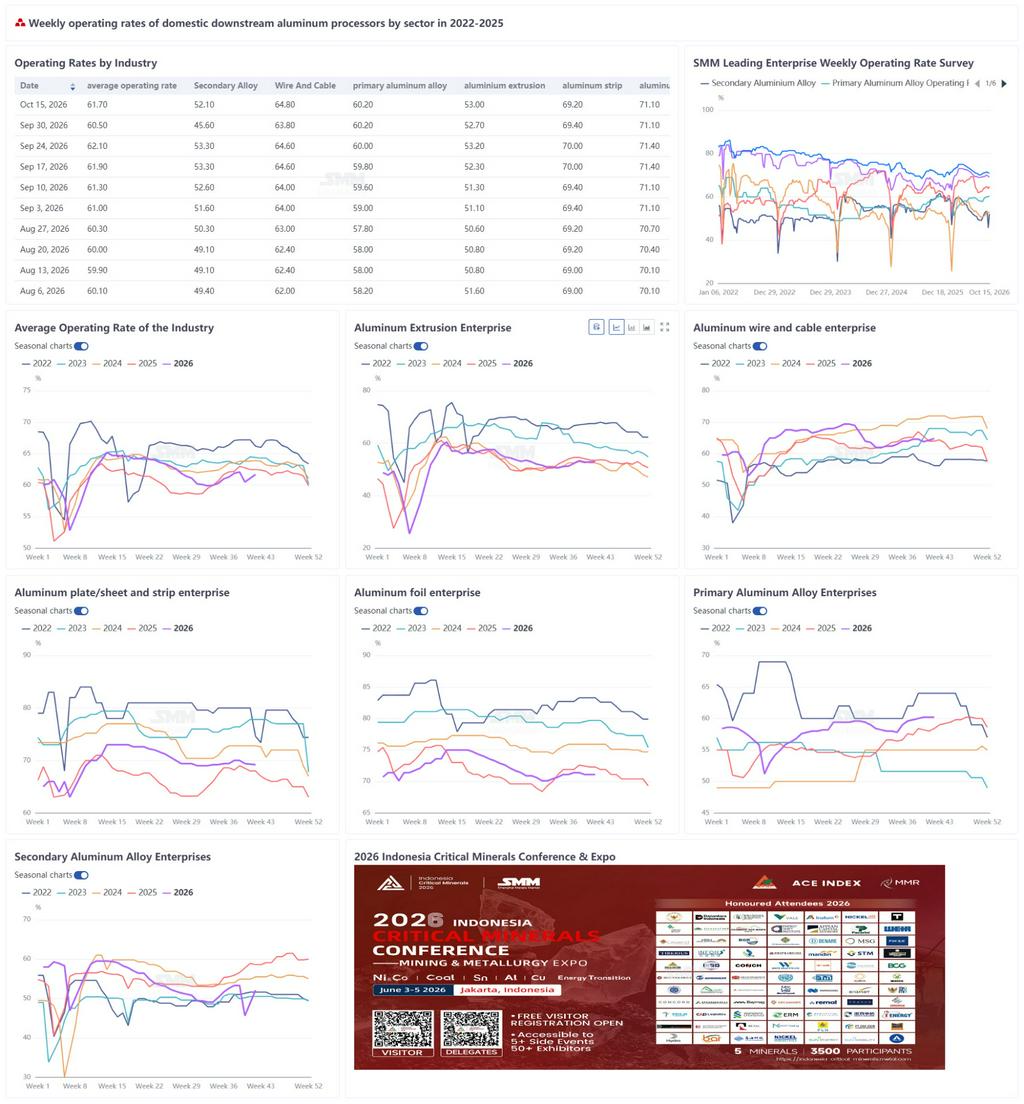
Primary aluminum alloy: The operating rate of leading primary aluminum alloy producers held steady at 60.2% this week. Producers maintained normal schedules focused on long-term contract deliveries, with no notable adjustment. Auto production recovered from earlier levels, but the rebound was limited and demand has yet to be released in full. Lower aluminum prices lifted downstream inquiries and trading sentiment, though actual purchasing and restocking stayed cautious. The operating rate is expected to edge up modestly next week.
Aluminum plate, sheet & strip: The operating rate of leading aluminum plate, sheet & strip producers came in at 69.2%, down 0.2 percentage points WoW. Aluminum prices fell steadily after the holiday, dropping 360 yuan/t on October 15 alone, reinforcing a wait-and-see stance among downstream buyers and delaying pickups. Producers are also seeing a mismatch between scheduling and incoming orders, with some Q4 order books still patchy and lacking sizeable new demand; November–December will face both a demand vacuum and the exhaustion of pulled-forward orders. LME aluminum has fallen below USD 3,000/t, squeezing export margins. The operating rate lacks upside in the near term and faces a risk of accelerating declines in November–December.
Aluminum wire & cable: The operating rate of aluminum wire & cable producers rose to 64.8%, up 1.0 percentage point WoW and the highest since mid-September. Producers completed maintenance and stepped up output after the holiday, while warmer aluminum rod consumption lifted drawing and stranding loads. On orders, State Grid tenders totaled about 122,000 t in September, and deliveries typically begin about five months after tendering, with the peak falling in February–March next year and roughly half the volume concentrated in Q1. Q4 will be about digesting existing orders and advancing construction. Export orders remained light. The operating rate is expected to recover further.
Aluminum extrusion: The operating rate of aluminum extrusion producers recovered 0.3 percentage points to 53.0%. In architectural extrusion, lower aluminum prices lifted purchasing interest and a backlog built up during the National Day break was scheduled in after the holiday, supporting a modest rebound. Industrial extrusion stayed firm: new-energy vehicle demand was broadly stable, with one Guangdong auto extrusion producer reporting good October schedules, while some Anhui producers trimmed capacity for low-margin photovoltaic frame orders. The operating rate is expected to remain firm to slightly stronger.
Aluminum foil: The operating rate of leading aluminum foil producers held at 71.1% WoW. Packaging demand outperformed last year, with aseptic packaging order books relatively full. In air-conditioner foil, October household AC output schedules showed some repair, but downstream raw material inventories are still being drawn down; even to meet year-end targets, customers prefer to cut inventories first, so any recovery in AC foil orders remains contingent on destocking being completed. The operating rate is expected to stay stable, with AC foil weakness still capping the upside.
Secondary aluminum: The operating rate of leading secondary aluminum producers rose 6.5 percentage points to 52.1% versus pre-holiday levels, mainly as sample producers resumed output after the National Day holiday, though it remained below last year’s level. Lower aluminum prices eased feedstock cost pressure, but tight supply of compliant scrap and stricter tax-invoice supervision continued to constrain production. “Silver October” demand fell short of expectations, and bargain hunting by some downstream buyers provided only limited support. The operating rate is expected to stay broadly stable, with limited room for further gains.
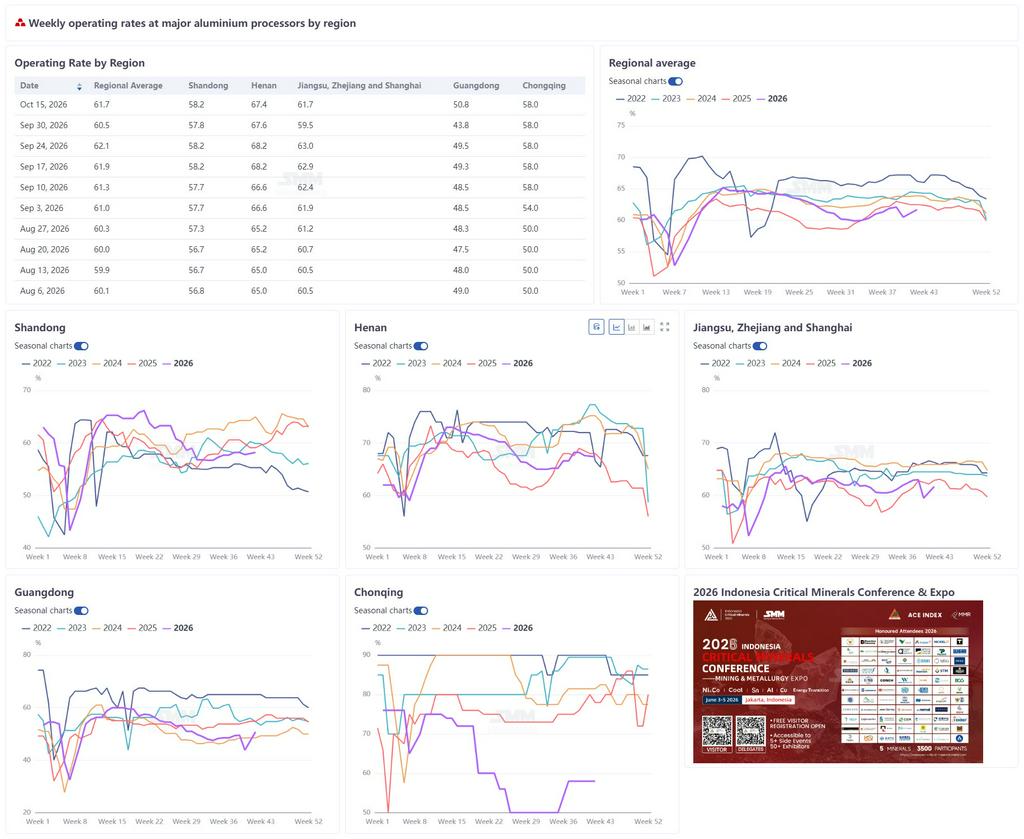
Overall, post-holiday restarts and lower aluminum prices lifted the industry operating rate, but end-user demand has yet to improve materially, peak-season performance remains lacklustre, and cost and feedstock constraints persist. Sectors are expected to diverge in the near term.
(SMM Aluminum Team)
![Post-holiday restarts lift aluminum processors’ operating rates; demand still soft [SMM weekly survey]](https://imgqn.smm.cn/usercenter/ECUsL20251217171652.jpg)
![Aluminum Prices Plunge Again, Spot Market Unusually Weak [SMM South China Spot Aluminum Daily Review]](https://imgqn.smm.cn/usercenter/TFHUe20251217171651.jpg)
![Weakening cost support coupled with insufficient peak-season realization drove ADC12 price center lower [Aluminum Scrap and Secondary Aluminum Weekly Review]](https://imgqn.smm.cn/usercenter/XUnxM20251217171723.jpeg)