Rio Tinto released its third quarter operations review on 14 October 2026. Global iron ore sales were 90.8 Mt in Q3, up 3% year on year. Simandou output reached an annualised rate of about 10 Mtpa, and the first ore through the SimFer port is expected in Q4. Full-year iron ore sales and cost guidance are unchanged.
Production and sales overview
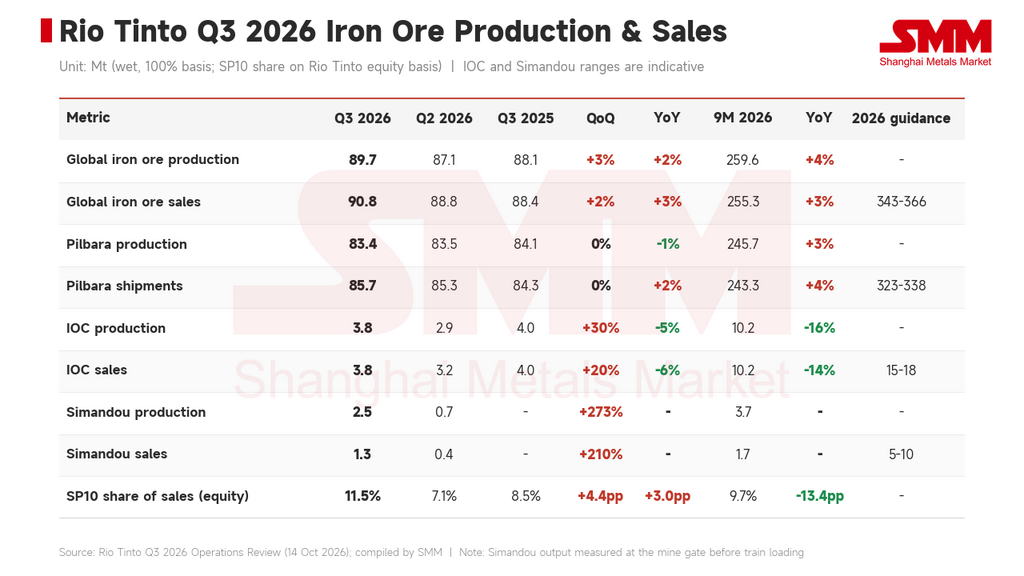
Global iron ore: Q3 production was 89.7 Mt, up 2% year on year and 3% quarter on quarter. Sales were 90.8 Mt, up 3% year on year and 2% quarter on quarter. Sales for the first nine months totalled 255.3 Mt, up 3%.
Pilbara: Q3 production was 83.4 Mt, down 1% year on year and flat quarter on quarter. Shipments were 85.7 Mt, up 2% year on year and flat quarter on quarter. The company said strong mine performance and healthy port inventories supported shipments. Pilbara shipments for the first nine months reached 243.3 Mt, up 4%.
IOC: Iron Ore Company of Canada produced 3.81 Mt in Q3, up 30% quarter on quarter and down 5% year on year. Sales were 3.78 Mt, up 20% quarter on quarter and down 6% year on year. The company said its operational focus remains on progressively improving pit health, supported by mine sequencing and higher total material movement. The rebound in sales reflected higher concentrator feed and a return to normal port in-load rates after the ore dumper was replaced.
Full-year guidance: 2026 global iron ore sales guidance remains 343-366 Mt. Pilbara guidance is 323-338 Mt, and the indicative ranges for IOC and Simandou are 15-18 Mt and 5-10 Mt respectively (all on a 100% basis). Pilbara unit cash cost guidance remains US$23.5-25.0/wmt (FOB).
Pilbara: product mix and sales
Lower-grade share rises: On a Rio Tinto equity basis, Q3 sales of SP10 (including other lower-grade products) were 8.57 Mt, or 11.5% of Pilbara sales, up from 7.1% in Q2. For the first nine months SP10 made up 9.7%, against 23.2% a year earlier, so the product mix has shifted clearly towards mainstream products this year. Q3 sales of Pilbara Blend lump and fines were 17.59 Mt and 33.03 Mt, each down 1% quarter on quarter.
By operation: On a 100% basis, Hope Downs produced 9.58 Mt in Q3, up 1% year on year. Robe River's Pannawonica produced 7.40 Mt, up 9%, while West Angelas produced 8.39 Mt, down 10%.
Portside trading and pricing: Q3 portside sales in China were 4.7 Mt (4.9 Mt a year earlier), and 71% of them were screened or blended in Chinese ports. Portside inventory at end-September was 3.7 Mt, including 2.4 Mt of Pilbara product. In Q3, 9% of sales were priced on the prior quarter's average index lagged by one month; the rest were priced on the current quarter average, the monthly average or spot. 26% of sales were made on an FOB basis.
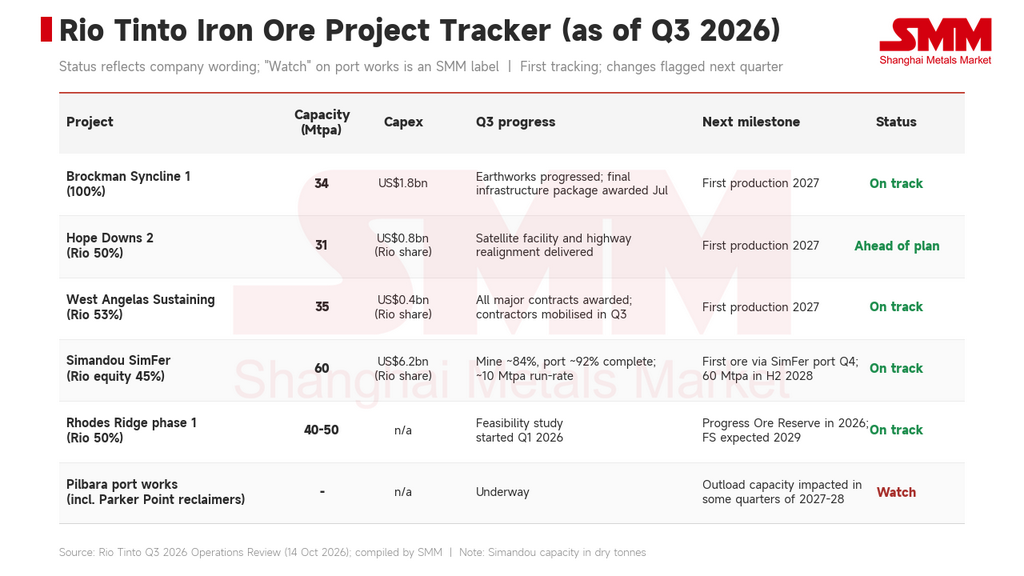
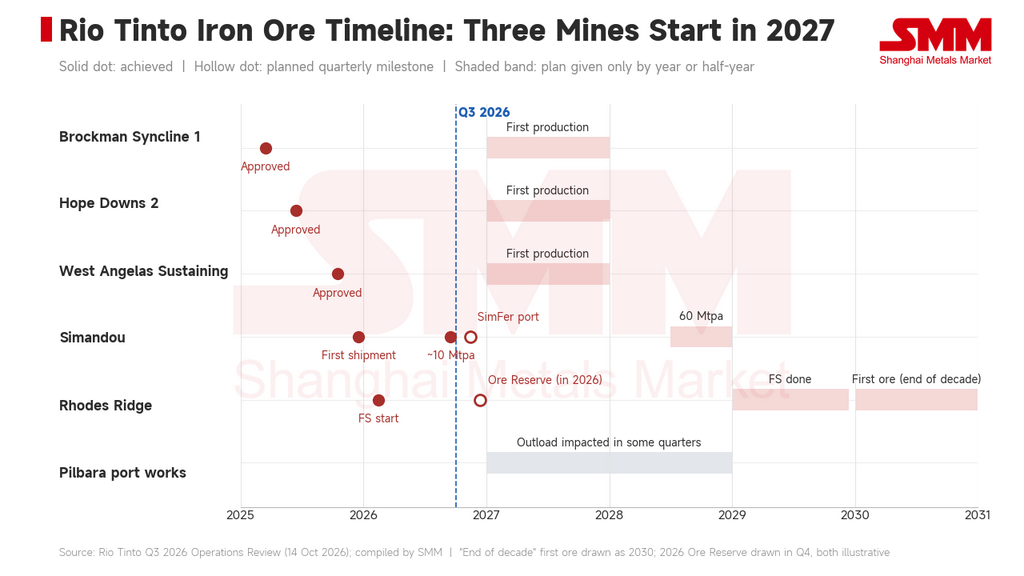
Port works: Several major port projects, including the Parker Point reclaimers, will affect outload capacity in some quarters of 2027 and 2028. The works aim to improve system flexibility and prepare for the Rhodes Ridge project.
Simandou and IOC
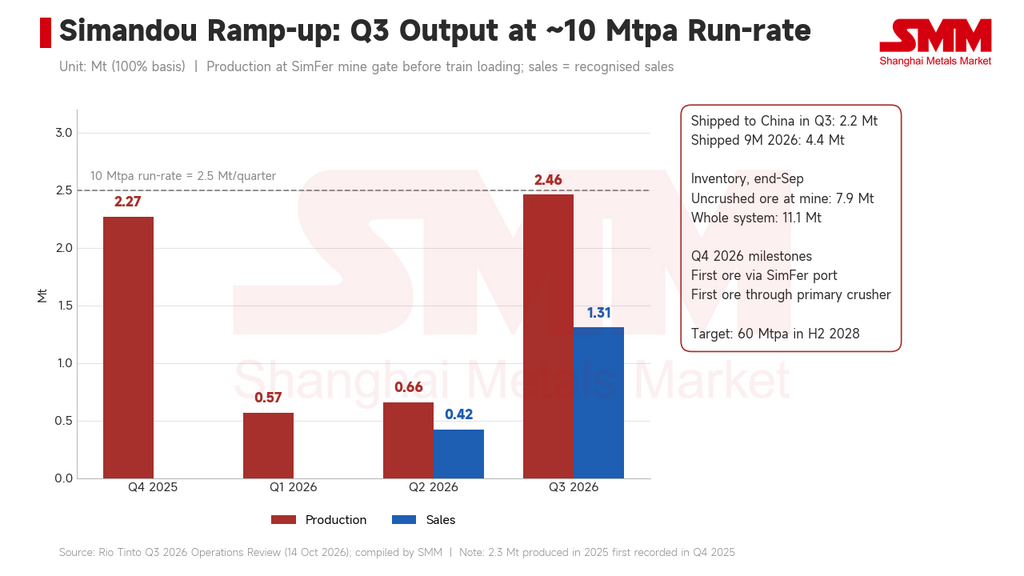
Production and sales: Simandou produced 2.46 Mt in Q3 (100% basis, as below), up 273% quarter on quarter and equal to an annualised rate of about 10 Mtpa. It shipped 2.2 Mt to China in Q3, and recognised sales were 1.31 Mt. For the first nine months, production was 3.69 Mt, shipments 4.4 Mt and sales 1.73 Mt.
Inventory: At end-September, 7.9 Mt of uncrushed ore was stockpiled at the mine. Including the Guinean port, ships at sea and Chinese ports, inventory across the whole system was 11.1 Mt.
Construction: The SimFer mine is about 84% complete. Load commissioning and first ore through one of the two primary crushers are expected in Q4. Port and marine infrastructure is about 92% complete. The first trans-shipment vessel arrived in Guinea late in Q3, and the first ore through the SimFer port is expected in Q4. Until then, ore is railed to the main line via the SimFer spur and shipped through the WCS port. The company kept its target of a 60 Mtpa run-rate during H2 2028.
Costs and markets
Costs: Higher diesel prices added US$0.9/t to Pilbara unit costs in the first nine months compared with the same period of 2025. If diesel stays at about US$175/bbl in Q4, the full-year impact will rise to US$1.1/t. At US$0.70 per Australian dollar, the currency adds about US$1.0/t to full-year unit costs against a guidance assumption of 0.67.
Middle East: The company said the Middle East conflict kept energy and freight markets volatile, but caused no material disruption to Rio Tinto's production or outbound supply chains. Fuel supply remained adequate thanks to inventory buffers and alternative sourcing.
Company market view: According to Rio Tinto, the 61% Fe delivered index averaged US$97/dmt in Q3, down 8% quarter on quarter, and the 65% Fe index averaged US$113/dmt, down 7%. Higher seaborne freight compressed producer netbacks, especially for long-haul Atlantic supply, and seaborne lump premiums rebounded 33% quarter on quarter. Rio Tinto estimates that China's finished steel consumption fell about 4% quarter on quarter in Q3, while steel exports rose 3% year on year to an annualised 122 Mt. High operating and freight costs squeezed marginal supply, and seaborne iron ore supply fell 1% quarter on quarter. China's domestic iron ore production fell 8% year on year.
Full-year guidance progress
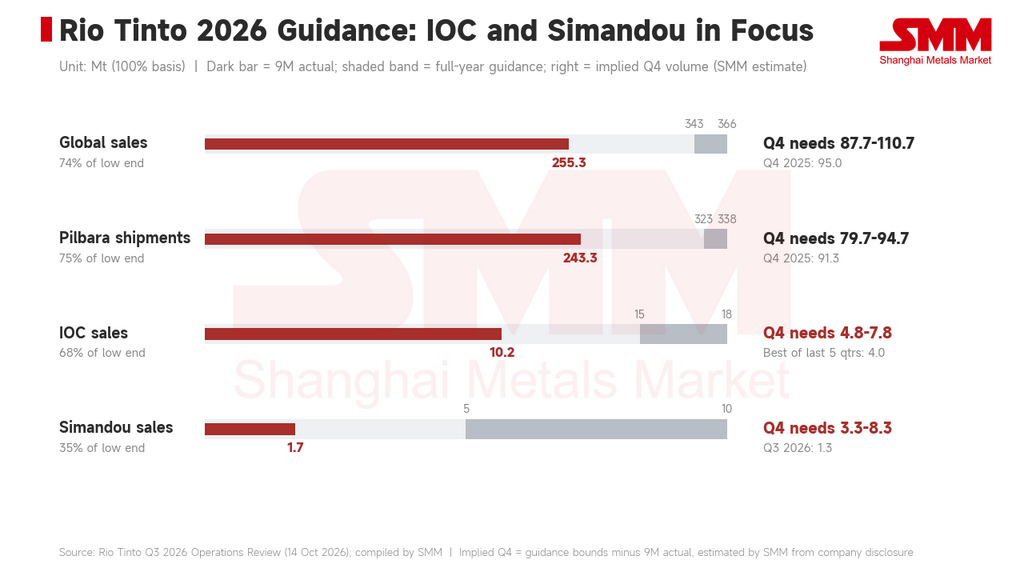
Pilbara: Shipments in the first nine months were 243.3 Mt, or 75% of the low end of guidance. Based on the guidance range, Q4 shipments need to be 79.7-94.7 Mt. Q4 2025 shipments were 91.3 Mt.
Simandou: Recognised sales in the first nine months were 1.73 Mt, so Q4 sales need to reach 3.3-8.3 Mt to land in the guidance range. Based on company disclosure, SMM estimates about 3.2 Mt of system inventory beyond the uncrushed stockpile at the mine, roughly the Q4 volume needed for the low end.
IOC: Sales in the first nine months were 10.24 Mt, or 68% of the low end of guidance. Q4 sales need to be 4.76-7.76 Mt. The low end is about 26% above Q3 and above the best quarter of the last five (4.02 Mt in Q3 2025). The company has not changed its IOC range, but at the current pace, reaching the low end looks difficult.
Key projects
Brockman Syncline 1: 34 Mtpa capacity, US$1.8 billion capex. Bulk earthworks progressed, the final supporting infrastructure package was awarded in July 2026, and first production remains on track for 2027.
Hope Downs 2: 31 Mtpa capacity, US$0.8 billion capex (Rio Tinto share). Construction is ahead of plan. The Hope Downs 2 satellite facility and the Great Northern Highway realignment have been delivered, and first production remains on track for 2027.
West Angelas Sustaining: 35 Mtpa capacity, US$0.4 billion capex (Rio Tinto share). All major contracts have been awarded, non-process infrastructure and services contractors mobilised to site in Q3, and first production remains on track for 2027.
Simandou: The SimFer mine has a capacity of 60 Mtpa (dry tonnes; 27 Mtpa Rio Tinto share), with US$6.2 billion of capex as Rio Tinto's share. The target of reaching full run-rate in H2 2028 is unchanged.
Rhodes Ridge: Phase 1 capacity is 40-50 Mtpa. The feasibility study started in Q1 2026 and is expected to finish in 2029, subject to relevant approvals, with first ore expected at the end of the decade. The company aims to progress toward reporting an initial Ore Reserve in 2026, subject to review of all relevant modifying factors.
Q4 watch list
-
Whether the first ore through the SimFer port and load commissioning of the first primary crusher happen in Q4 as planned.
-
Whether Simandou's Q4 recognised sales reach 3.3 Mt, landing in the 5-10 Mt full-year range.
-
Whether IOC's Q4 sales reach 4.76 Mt or more.
-
The actual effect of diesel prices and the Australian dollar on full-year Pilbara unit costs.
-
Whether the initial Rhodes Ridge Ore Reserve is reported within the year as planned.
SMM Commentary
Rio Tinto's Pilbara output and shipments were steady in Q3, and that most of the incremental production came from Simandou. Simandou is already producing at an annualised rate of about 10 Mtpa. If the SimFer port and primary crusher start up in Q4 as planned, shipments will gradually move from the borrowed WCS port to SimFer's own port, and the pace of the ramp-up will depend on how quickly the new facilities are commissioned. In 2027, Brockman Syncline 1, Hope Downs 2 and West Angelas Sustaining will bring a combined 100 Mtpa of capacity on stream. The company describes all three as extending the life of existing mining areas, and port works including Parker Point will limit outload capacity in some quarters of 2027 and 2028, so total Pilbara shipments may not rise markedly.
SMM believes that although Rio Tinto's SP10 share rose to 11.5% in Q3, the nine-month share remains far below the same period of 2025, and Pilbara sales are still dominated by mainstream Pilbara Blend fines and lump, which together made up about 68% of equity sales in Q3. On guidance, Pilbara is likely to land within its full-year range, while IOC and Simandou are the main Q4 variables. Simandou has already shipped 4.4 Mt of high-grade fines this year; if the SimFer port starts up in Q4 as planned, arrivals could pick up further.
![[SMM Iron Ore] Higher premiums and softer spot cut imported iron ore margins to 1.10 yuan/mt](https://imgqn.smm.cn/usercenter/UrrTG20251217171717.jpg)
![[ Indian Iron Ore Exports Hit Four-Year Low in September ]](https://imgqn.smm.cn/usercenter/fljuJ20251217171715.jpg)
![[ Ferrexpo Nine-Month Iron Ore Output Plunges 54% ]](https://imgqn.smm.cn/usercenter/LSkpO20251217171720.jpg)