SMM, October 13:
In the metals market:
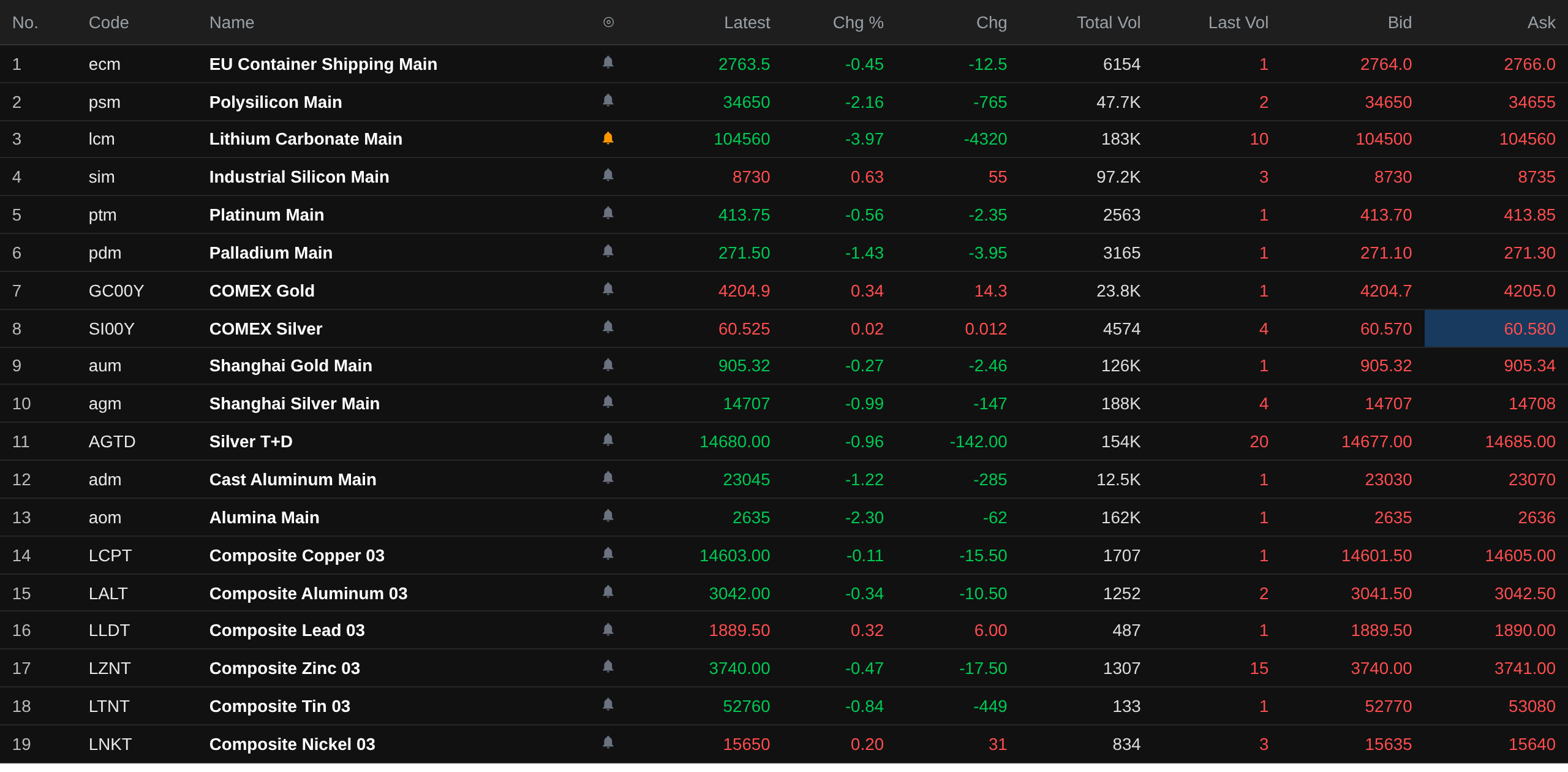
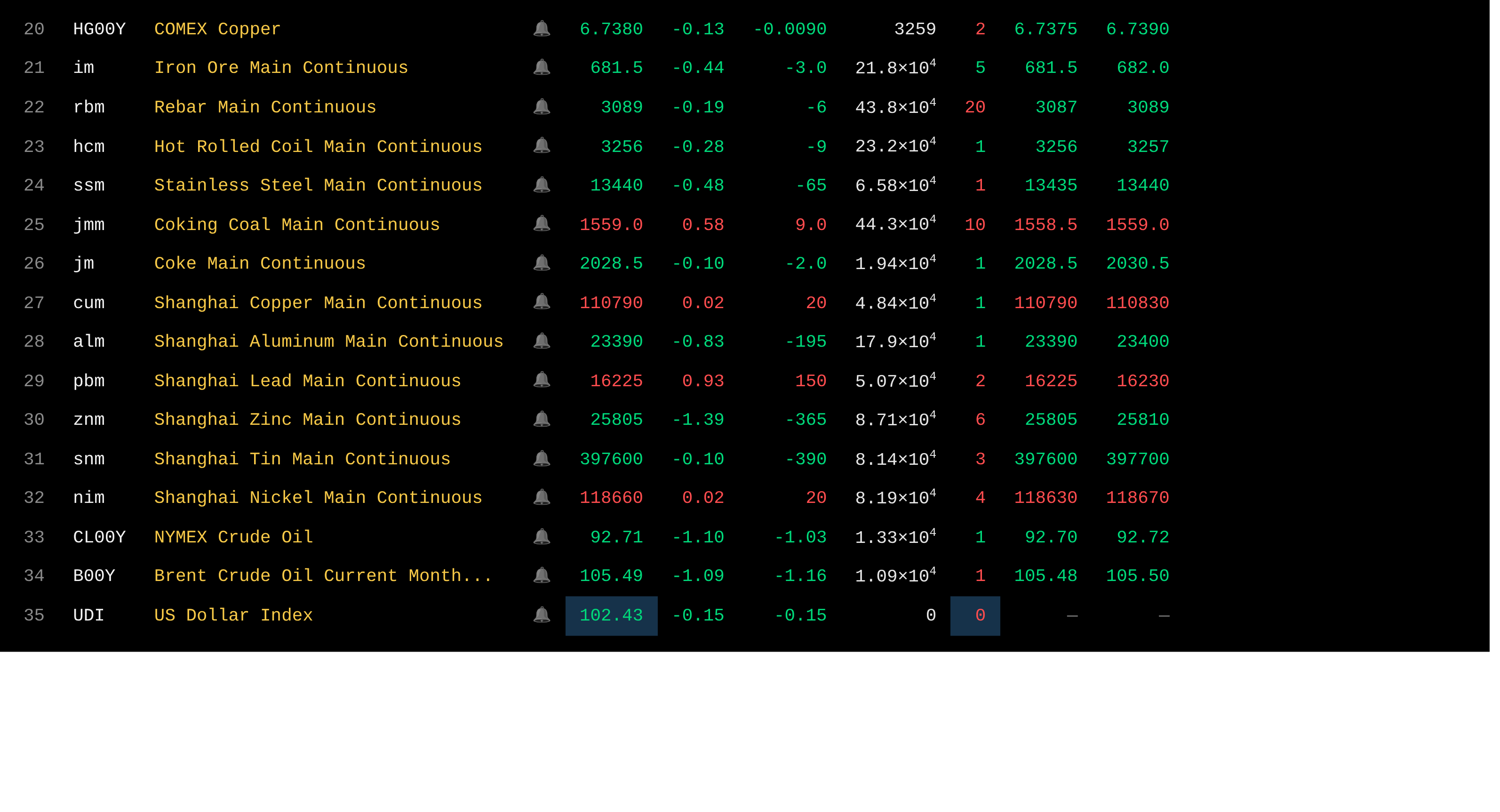
As of the midday close, base metals on the domestic market showed mixed performance. SHFE copper and SHFE nickel both edged up 0.02%, while SHFE aluminum fell 0.83%. SHFE lead rose 0.93%. SHFE zinc dropped 1.39%. SHFE tin fell 0.1%.
In addition, the most-traded cast aluminum futures contract fell 1.22%, and the most-traded alumina contract dropped 2.3%. The most-traded lithium carbonate contract extended its losing streak from the previous eight trading days, falling another 3.97%. The most-traded silicon metal contract rose 0.63%. The most-traded polysilicon futures contract fell 2.16%.
Ferrous metals were mostly lower. Iron ore fell 0.44%, while rebar, hot-rolled coil, and stainless steel all declined within 0.5%. In coking coal and coke: the most-traded coking coal contract rose 0.58%, while the most-traded coke contract fell 0.1%.
In overseas base metals, as of 11:51, LME metals were broadly lower. LME copper fell 0.11%, and LME aluminum dropped 0.34%. LME lead rose 0.32%, while LME zinc fell 0.47%. LME tin declined 0.84%. LME nickel edged up 0.2%.
In precious metals, as of 11:51, COMEX gold rose 0.34%, and COMEX silver edged up 0.02%. In domestic precious metals: SHFE gold fell 0.27%, and the most-traded SHFE silver contract dropped 0.99%.
In addition, as of the midday close, the most-traded platinum futures contract fell 0.56%, and the most-traded palladium futures contract dropped 1.43%.
As of the midday close, the most-traded European shipping route containerized freight index futures contract fell 0.45% to 2,763.5 points.
As of 11:51 on October 13, selected futures midday quotes:
Spot and Fundamentals
Copper: Today, in Guangdong, #1 copper cathode spot against the front-month contract: high-quality copper was quoted at a premium of 250 yuan/mt, down 100 yuan/mt from the previous trading day; standard-quality copper was quoted at a discount of 50 yuan/mt, down 100 yuan/mt from the previous trading day; SX-EW copper was quoted at a discount of 110 yuan/mt, down 100 yuan/mt from the previous trading day. The average price of #1 copper cathode in Guangdong was 111,490 yuan/mt, down 455 yuan/mt from the previous trading day, while the average price of SX-EW copper was 111,280 yuan/mt, down 455 yuan/mt from the previous trading day. Spot market: Guangdong inventories increased again today...
Macro Front
Domestic:
[National Energy Administration: Plan ahead for energy supply supervision during the winter peak season, and improve market mechanisms to promote new energy consumption] On October 12, the National Energy Administration held the third energy regulatory work meeting of 2026 in Beijing. The meeting stressed that the current period is a critical stage for an all-out push, and all energy regulatory agencies must anchor annual targets, consolidate work responsibilities, and continue to shore up weaknesses to ensure a successful conclusion to the year's work. We need to improve the national unified power market system, strengthen power market supervision and enforcement, and maintain a fair and competitive market order. We need to plan ahead for energy supply supervision during the winter peak, strengthen supply-demand monitoring and early warning, improve market mechanisms to promote the consumption of new energy, and promptly and properly handle the public's various energy-related demands. We need to solidly complete the "second half of the article" on comprehensive supervision in the power sector, fully advance the key annual regulatory tasks, and fully transform and apply regulatory outcomes. We need to intensify the implementation of the new round of "Access to Electricity" policies, advance the special action to improve power supply quality in a step-by-step manner, and accelerate the governance of residential communities not directly supplied by the power grid. (National Energy Administration)
[The Ministry of Commerce issued the Measures for the Administration of Export Certificates for Dual-Use Items Related to Civil Aviation for public comment]The Ministry of Commerce issued a notice soliciting public comments on the Measures for the Administration of Export Certificates for Dual-Use Items Related to Civil Aviation. The applicable entities include domestic airlines (including cargo carriers), overseas airlines, aircraft maintenance enterprises, enterprises specializing in the import and export of aviation materials with an average annual turnover of more than 2 billion yuan, and aircraft and related dual-use item manufacturers. The applicable circumstances include outbound repair, maintenance, replacement, and return of damaged items; inbound repair and return from bonded zones; and the export of reasonable quantities of spare parts by aircraft manufacturers headquartered in China. In addition, the export of drones for overseas exhibitions, demonstrations, and participation in international emergency rescue may be handled by reference to these measures.
[Liaoning: A subsidy of up to 30% will be granted based on the actual amount incurred under computing power contracts]Recently, the Liaoning Provincial Department of Finance, together with the Liaoning Provincial Data and Government Services Bureau, jointly issued the Implementation Rules for the Liaoning Province Computing Power Voucher Policy. Relying on provincial-level special funds for the digital economy, the implementation of the computing power voucher subsidy policy was officially launched, injecting fiscal momentum into the development of Liaoning's artificial intelligence industry. According to the introduction, computing power vouchers are a digital policy tool arranged by provincial-level finance to support computing power buyers such as enterprises, medical institutions, universities, and research institutions within the province in purchasing compliant intelligent computing power resources and carrying out applications such as large model training and inference, data annotation, and data analysis. The policy specifies that a subsidy of up to 30% will be granted based on the actual amount incurred under computing power contracts, with an annual subsidy cap of 2 million yuan for the same entity. Existing computing power-related subsidies at the city and county levels may be stacked as prescribed, but the cumulative subsidy ratio shall not exceed 30%. Applicants must have annual computing power procurement expenses of at least 250,000 yuan, and computing power suppliers must have on-shelf intelligent computing power of no less than 50 PFlops and complete registration on the provincial computing power platform. (Jin10 Data APP)
[The PBOC achieved a net injection of 65 billion yuan through reverse repo operations on the day]The PBOC conducted 65 billion yuan of 7-day reverse repo operations today. As there were no reverse repos maturing today, a net injection of 65 billion yuan was achieved on the day. (Jin10 Data APP)
US dollar:
As of 11:51, the US dollar index fell 0.15% to 102.43.
According to CME "FedWatch": The probability that the US Fed will keep interest rates unchanged through October is 79.5%, and the probability of a cumulative 25 basis point hike is 20.5%. The probability that the US Fed will keep interest rates unchanged through December is 12.4%, the probability of a cumulative 25 basis point hike is 70.3%, and the probability of a cumulative 50 basis point hike is 17.3%. (Jin10 Data APP)
Cleveland Fed President Hammack said the US Fed needs to bring monetary policy to a restrictive level to drive inflation back down to the 2% target. She said the current policy stance means inflation may take longer to pull back than is acceptable, so "more tightening is needed." Hammack said rate hikes may still be needed in the future, but the timing is not yet determined, and she prefers a "smaller, more frequent" adjustment approach to help enterprises and households plan ahead. Hammack said enterprise input costs are rising, and more enterprises are beginning to pass costs on to consumers. If prices are no longer constrained by demand, inflation could rise further or stay high. She noted that the biggest inflation risk is that individuals and enterprises develop an "inflation mindset" and gradually accept higher inflation levels, which would make it harder for the US Fed to bring inflation back to target, and some signs of this have already emerged. On rising US Treasury yields, Hammack said they are mainly driven by economic growth expectations, market repricing of US Fed policy, fiscal pressures, and heavy bond issuance. She said the data center investment boom is driving growth, but current financial conditions still need to tighten further to help inflation come down. Hammack also stressed that US Fed independence "is always critical." (Jin10 Data APP)
Other currencies:
According to an IMF report, global economic growth is expected to accelerate next year, but this will depend on whether emerging and developed economies can pick up speed. Among developed economies, the IMF expects expansion to slow down from 2.1% this year to 1.8%. The IMF forecasts that the US, the world's largest economy, will grow 2.3%—a slight upward revision from the 2.2% forecast in July. Among major economies, France has been hit particularly hard. Its economy is expected to grow only 0.4% this year and 0.7% in 2027. Both figures are 0.2 percentage points lower than the IMF's July forecasts. Germany is expected to grow 1.1% in 2027, while UK growth will edge down to 1.2%, as energy prices and high interest rates weigh on consumption. (Jin10 Data APP)
The International Monetary Fund (IMF) said on Tuesday that the Bank of Japan is still likely to raise interest rates gradually, moving rates "toward a neutral level," despite an expected slowdown in Japan's economic growth. This policy path is similar to that of other central banks facing inflation pressure. In its World Economic Outlook report, the IMF stated: "Japan's economic growth rate is expected to slow to 0.7% in 2026, with fiscal support measures partially cushioning the impact of rising energy prices. As the energy shock fades and monetary policy gradually normalizes, the growth rate will stabilize at this level in 2027." Japan's economy grew 1.2% last year, and the IMF expects Japan's growth rate to be 0.7% in both 2026 and 2027. The IMF did not name any country, but noted that monetary policy can refrain from responding to the direct and short-term indirect effects of a shock on inflation only if the shock is temporary in nature. The report pointed out that even if the impact of a shock is deemed temporarily ignorable, central banks may still need to raise nominal interest rates if inflation expectations rise, in order to keep real borrowing costs stable. (Jin10 Data APP)
Minutes of the Reserve Bank of Australia's September 28-29 meeting released on Tuesday showed that, given the heightened risk of persistently high inflation, the board only "briefly" considered the case for holding rates steady before unanimously voting to raise the cash rate to 4.6%. The minutes listed a series of reasons supporting tightening, including stronger-than-expected economic demand and intensifying global cost pressure from surging oil prices amid the Middle East conflict. The board judged it necessary to act "in a timely manner" to anchor inflation expectations, as the current financial environment, while assessed as restrictive, remained relatively mild in degree. The RBA still believes that inflation could prove more stubborn than expected against a backdrop of surplus domestic demand and rising global energy costs, so a fifth rate hike this year remains possible if necessary.
On the data front:
Germany's final September CPI month-over-month rate, the US September NFIB Small Business Optimism Index, the US ADP employment change for the week ending September 26, and US September existing home sales annualized data will be released today.
In addition, attention should be paid to: 2026 FOMC voting member and Cleveland Fed President Hammack delivering a speech; the RBA releasing the minutes of its September monetary policy meeting; the IMF releasing its October 2026 World Economic Outlook report; Fed Governor Waller speaking at the Bloomberg New Economy Forum held in India; and Apple holding a smart home product launch event in New York.
In crude oil:
As of 11:51, oil prices fell in both markets, with WTI down 1.1% and Brent down 1.09%.
Oil prices edged down on Tuesday as the market assessed supply risks from the attack on Saudi Arabia while also weighing the prospect of Russia potentially increasing diesel supply. US President Trump said Russia had agreed to supply diesel to global markets and announced his administration had temporarily lifted sanctions on Russian fuel. The additional supply could help ease tightness in global fuel markets, alleviating some of the supply concerns that have recently supported crude oil prices. However, bipartisan US lawmakers complained that Trump's deal with Putin appears to violate US law, which prohibits imports of Russian energy until the Russia-Ukraine conflict ends. Tim Waterer, chief analyst at KCM Trade, said increased diesel supply from Russia and stable pipeline flows from Saudi Arabia have provided some relief, but the market still appears more concerned about the risk of further attacks on vessels or pipelines in the Gulf region. (Jin10 Data APP)
Goldman Sachs estimates that the potential release of 50 million barrels of diesel inventory from European strategic reserves would lower diesel wholesale prices in the US Gulf Coast and Europe by $11/barrel.
Spot market roundup:
►
►
►
►
►
►
►
►
►
►


![Backwardation narrows on a month-to-month basis, coupled with reduced low-priced supply, spot premiums may stop falling and stabilize [SMM Shanghai spot copper]](https://imgqn.smm.cn/usercenter/TlzAr20251217171709.jpg)