SMM News on October 13:
According to SMM, on October 11, some top-tier polysilicon players gathered in Hangzhou to further implement detailed rules for the industry’s anti-involution efforts. What specific impact will this have? How does the market view the related news on production cuts and price caps? How will the supply landscape evolve going forward?
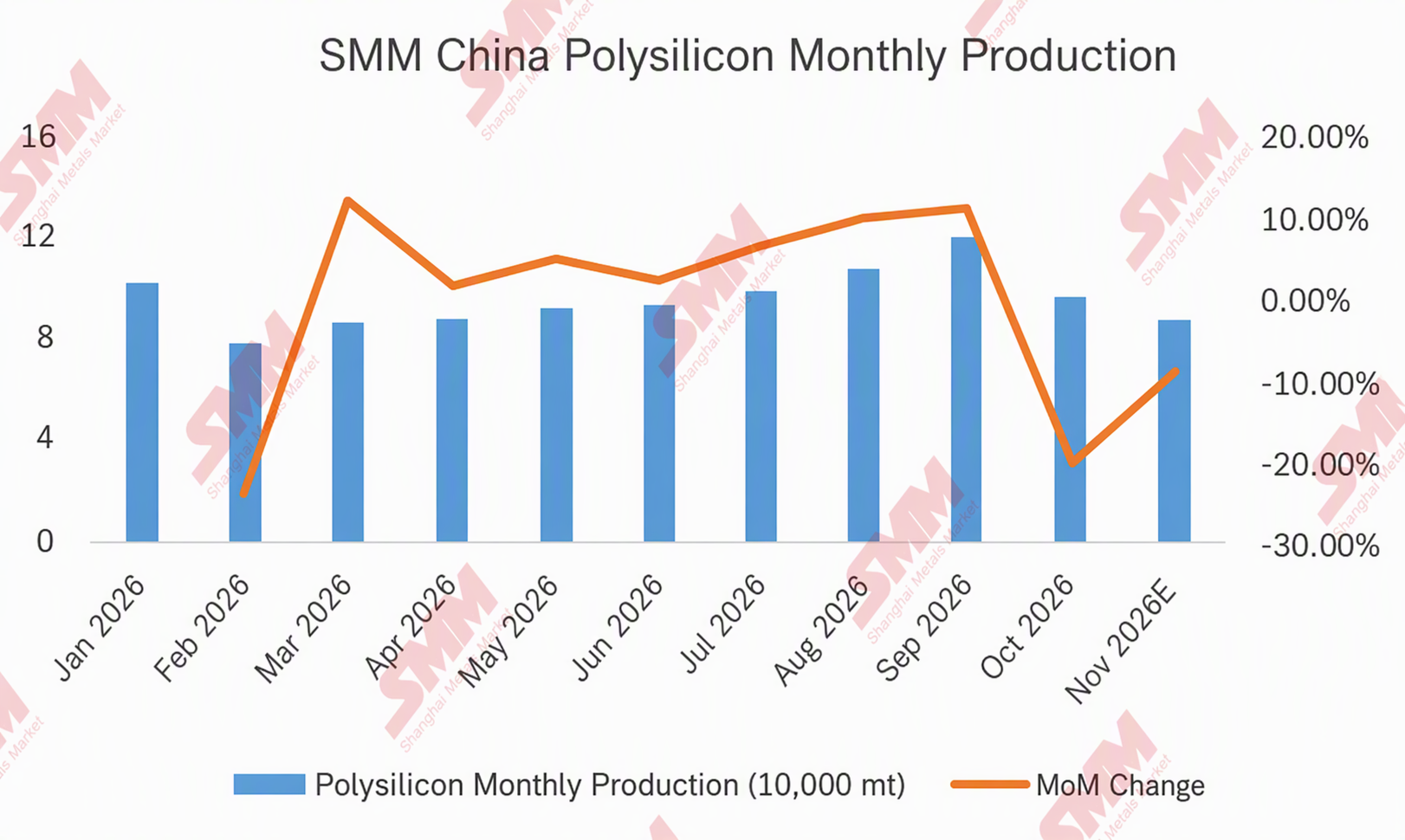
First, based on what SMM learned from some polysilicon enterprises, the most important focus of this meeting was to discuss details related to production cuts and production controls. It did achieve certain results. As SMM mentioned yesterday, a newly added base in Qinghai plans to halt production in November. Meanwhile, a small plant at this location has already begun to cut production gradually. Combined with the production-cut plans promised by some top-tier players, polysilicon production in November is expected to fall below 90,000 mt, and some market participants even forecast it could drop to around 85,000 mt.
In addition, some small plants that had plans to resume production have also postponed resuming production amid recent market conditions and the frequent convening of related meetings.
On pricing, regarding the market rumor that prices must not be lower than 43 yuan/kg, SMM also checked with some enterprises. Some said, “From a cost-side perspective, 43 yuan/kg is relatively reasonable,” and “Our quoted price is already around 43 yuan/kg.” Prices at a few enterprises have even risen to “43-45 yuan/kg.”
However, it should be noted that downstream prices are still relatively weak at present, and overly high prices will still dampen downstream purchasing enthusiasm. Moreover, no relevant ministries or commissions participated in the above meeting. Some market participants said that, based on past meeting experience, whether this price has strong long-term binding force remains to be seen.
As for the rumor that downstream solar cell prices must not be lower than 0.79 Yuan/W, SMM believes downstream is likely to find it difficult to accept this price, and it is even somewhat outrageous. Based on this price, module prices would have to be at least 1 Yuan/W, or even above 1.1 Yuan/W. Under current conditions, it would be quite difficult for end-users to accept. Even if modules could reach 0.79 Yuan/W, it would exceed the expectations of a considerable number of module manufacturers. Moreover, the main participants in this meeting were not downstream enterprises.
Regarding the upside for downstream module prices, in the author’s personal view, the IRR returns of end-user projects are always the key factor. Weak electricity-price returns, the disappearance of subsidies, and cases where IRR is so low that it is even worse than bank deposit interest rates remain the core pain points. End-users are not pushing for lower prices without limits; rather, they are struggling to clear their own return hurdles. Only by improving their returns through certain measures (such as reducing other costs, raising electricity prices, or adding auxiliary income, etc.) will module prices—and even upstream prices—have upside. Otherwise, forcing price increases will either put the midstream under pressure or may sacrifice demand that is already limited.


![[SMM PV Flash] Australia Rooftop Solar Posts Strongest First Half Since 2021](https://imgqn.smm.cn/usercenter/TtmPF20251217171741.jpg)