SMM, October 13:
Entering September, the sodium-ion battery industry chain's "advancing amid divergence" operating pattern further evolved. The electrolyte segment continued its "capacity without volume release" logic, with top-tier players' shipments highly concentrated and growth mainly flowing to undisclosed major clients. The window for scaled-up breakthroughs is expected to materialize in Q4 with GWh-level order fulfillment. In the battery cell segment, order deliveries were released intensively amid the "September-October peak season" signals, but actual project implementation pace clearly lagged plans, with regional and application-based divergence intensifying.
1. Electrolyte: Ample Capacity in Wait for GWh-Level Batch Implementation
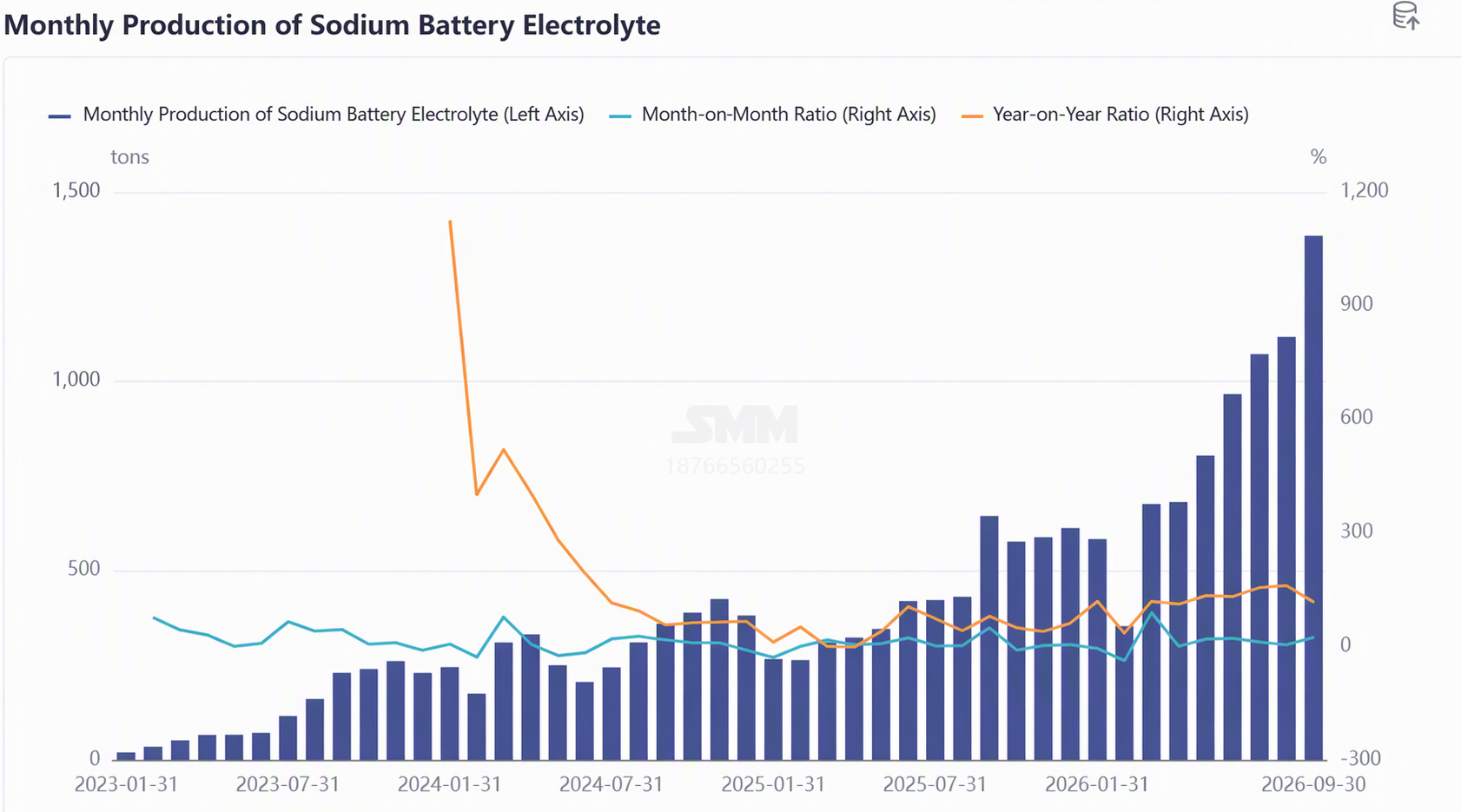
According to an SMM survey, sodium-ion battery electrolyte production rose 24% MoM and surged 115% YoY in September, sustaining high growth momentum. Production was highly concentrated, with top-tier players' shipments showing a clear breakaway lead. This round of growth likely flowed to major clients not yet publicly disclosed, and scaled shipment growth is likely delayed to Q4. September data largely reflected early stockpiling and small-batch deliveries on top of existing capacity.
From an operational perspective, the number of industry players remains limited. Traditional lithium battery electrolyte leaders still attach relatively low priority to sodium-ion battery business. Apart from a few major clients, they have yet to form bulk supply to publicly disclosed entities, with only sporadic deliveries mentioned in financial reports. Downstream demand exhibited "small-batch, project-based" characteristics—some battery cell manufacturers' sodium-ion battery shipment volumes were relatively small, with cylindrical products shipped only intermittently in small batches, mainly targeting start-stop and small power applications, and no scaled energy storage application has yet formed.
On the capacity side, since lithium battery electrolyte capacity is highly interchangeable with sodium-ion battery electrolyte capacity, overall industry capacity is ample with no obvious supply gap. However, it is worth noting that the current high returns in the lithium battery industry may crowd out sodium-ion battery electrolyte capacity. Enterprises' production scheduling priorities will continue to revolve around lithium battery business, leaving uncertainty in the pace of sodium-ion battery capacity release.
On prices and raw materials, finished electrolyte prices remained generally stable in September, while core raw materials fluctuated slightly. NaPF6 prices were relatively stable: September production pulled back from August's unusually high level but was clearly better than the same period in previous years' normal levels. The core driver of this round of rise came from marginal improvement on the demand side. Upstream and downstream players across the industry chain generally held no additional inventory, with production strictly following produce-based-on-sales. Downstream electrolyte plants made temporary purchases as needed without advance stockpiling. Despite NaPF6's favorable storage conditions and longer shelf life than similar lithium chemical products, enterprises still scheduled production based on fixed sales, reflecting the industry's prudent judgment on the pace of demand realization.
Competitive landscape-wise, the entire industry is waiting for top-tier players to deliver GWh-scale volume signals. Notably, some battery cell manufacturers have adopted low-price selling strategies right after production line commissioning and at the initial mass production stage, a commercial logic that remains to be validated over time. Looking ahead, if demand from key clients ramps up as expected in October, electrolyte and upstream NaPF6 shipments are poised for a step-change increase. SMM expects sodium-ion battery electrolyte production to rise 2% MoM and surge 146% YoY in October.
II. Battery cells: Clear peak season signals, but rollout pace falls short of expectations
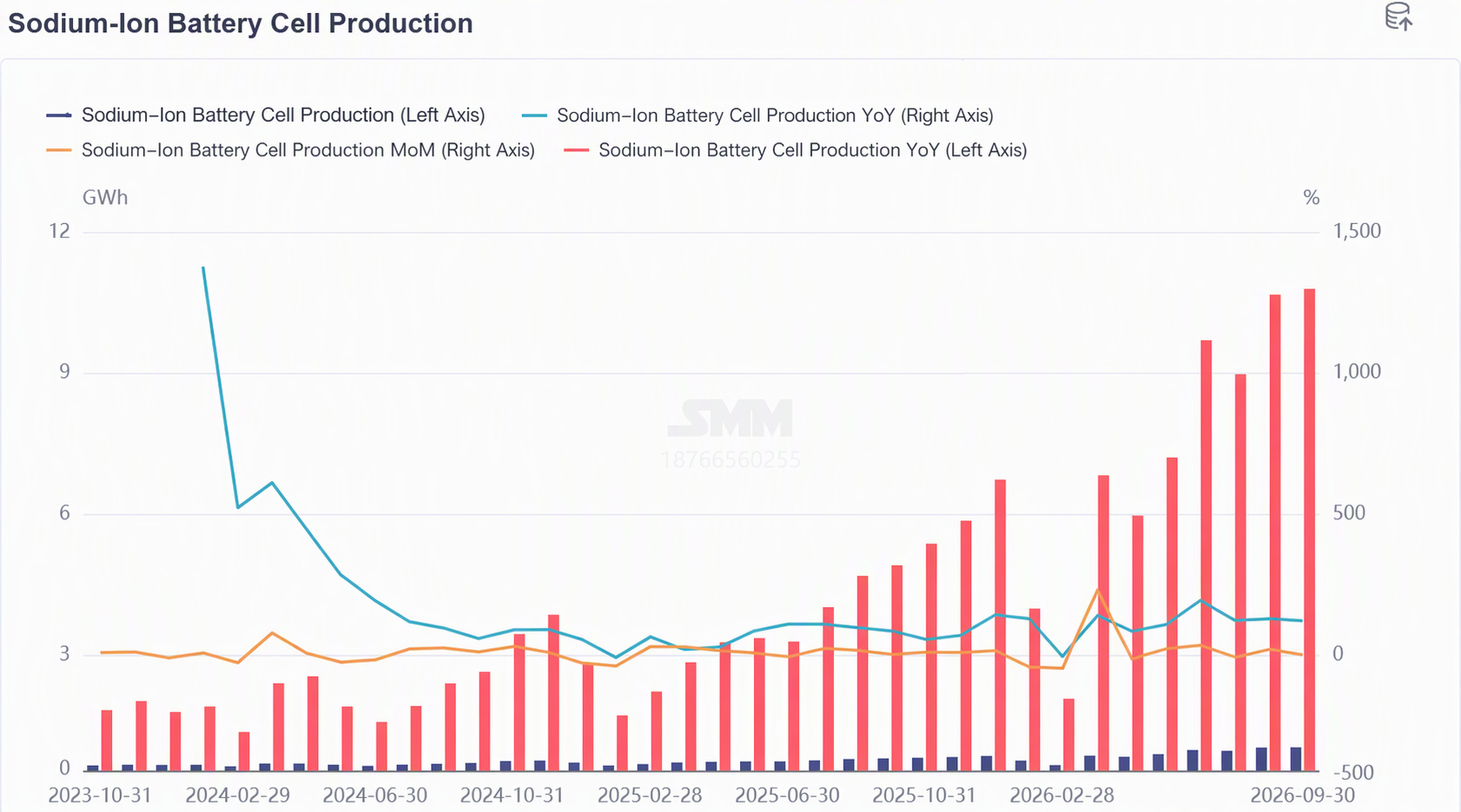
According to SMM survey, sodium-ion battery cell production rose 1% MoM and surged 120% YoY in September, with the sodium-ion battery market showing initial signs of the "September-October peak season." Constrained by the requirement that energy storage projects generally must be connected to the grid before year-end, order deliveries are being released in a concentrated manner; however, from the perspective of project implementation, actual progress is clearly lagging behind plans, with schedule pressure and execution gaps coexisting.
Regionally, utility-scale energy storage in China is concentrated in northern regions such as Hebei and Inner Mongolia, while overseas commercial and industrial storage demand is concentrated in Europe and Australia. Domestic commercial and industrial storage has yet to gain traction, presenting a three-way divergence in the demand geography: "northern storage leading, European and Australian commercial and industrial following, and domestic commercial and industrial yet to start."
From an operational perspective, mainstream producers' monthly battery cell output remains at the tens of megawatt hours level. On the capacity side, some battery cell manufacturers' new bases in Sichuan will begin production and ramp up in late October, while some existing bases face clear capacity gaps that need to be filled through toll processing. Toll processing business is mostly focused on energy storage projects, with order demand expected to last until year-end. On the technology roadmap, current capacity is concentrated in the polyanion route, demand for cylindrical start-stop battery cells is steadily rising as winter approaches, and orders for prismatic energy storage battery cells remain at high levels, with route and product differentiation trends continuing.
Price-wise, sodium-ion battery cell prices remained at low levels overall in September. Mainstream transaction prices for energy storage battery cells were around 0.6 yuan/Wh, while high C-rate start-stop products remained close to 0.7 yuan/Wh. At the system level, sodium-ion batteries were priced at over 1 yuan/Wh, with a price spread of nearly double compared to LFP systems. The payback period for commercial projects remains difficult to cover, and achieving economic viability is key to future simultaneous volume and price increases.
Competitive landscape-wise, top-tier lithium battery players are proactively entering the sodium-ion battery space, confirming it as a high-potential long-term growth market. Some leading integrators without in-house battery cell capacity are deeply partnering with specialized battery cell manufacturers to develop sodium-ion-specific systems. Currently, only a few top-tier players have the capability to adapt large-capacity sodium-ion battery pack processes. The industry overall is in a stage of tentative partnerships between battery cell manufacturers and integrators, with sodium-ion-specific system development expected to be completed next year, breaking free from reliance on lithium battery solutions. In emerging applications, AIDC-related sodium-ion battery applications are in the sampling, testing, and certification stage, with market demand expected to surge next year.
Looking ahead, the tight delivery situation in Q4 will persist. SMM expects October sodium-ion battery cell production to increase 21% MoM and surge 143% YoY. Next year, industry shipments are expected to advance toward the tens of Gwh level, but the actual pace of implementation, the speed of system cost reduction, and the progress in forming a sodium-ion-specific ecosystem remain key variables to watch.
III. Summary
Overall, in September, the sodium-ion battery electrolyte and cell segments exhibited an operating pattern of "electrolyte building momentum, cells under peak-season pressure": the electrolyte side has ample capacity flexibility, awaiting the realization of Gwh-level batch implementation signals; the cell side has shown peak-season signals, but the actual pace of project implementation and commercial economics remain key constraints. Meanwhile, the cathode material side continues to see a tight supply-demand balance, with capacity expansion and toll processing resonating to break the deadlock; the hard carbon anode side continues to see volume growth, with profitability and process validation advancing in parallel. The overall pattern of the sodium-ion battery industry chain's four segments moving forward amid differentiation remains unchanged, and the pace of volume-to-profit transmission needs to be closely tracked through Q4 head client order fulfillment and actual grid connection progress of end-user projects.
SMM New Energy Research Team
Wang Cong 021-51666838
Ma Rui 021-51595780
Feng Disheng 021-51666714
Lyu Yanlin 021-20707875
![[SMM Cobalt-Lithium Morning Meeting Summary] Raw material price trends diverge; supply-demand support for battery materials varies in strength](https://imgqn.smm.cn/usercenter/MaxcL20251217171730.jpg)
![[SMM Cobalt Morning Meeting Summary] Weak Demand and Falling Raw Material Prices Increase Destocking Pressure Across the Entire Industry Chain](https://imgqn.smm.cn/usercenter/ZVhtl20251217171724.jpeg)
![[SMM Cobalt Morning Meeting Summary] Post-holiday demand recovery limited, cost support weakening, material prices under pressure](https://imgqn.smm.cn/usercenter/HBsPu20251217171723.jpeg)