On October 12, the average price of wolframite concentrates (≥65%) closed at 337,000 yuan/standard tonne. Compared with the record high of 1,050,500 yuan/standard tonne set on March 12, the price pulled back nearly 70% over seven months, a decline of 67.92%; even compared with 453,500 yuan/standard tonne on January 5 at the start of the year, there remains a considerable gap. Looking back at the tungsten market's trajectory this year, weak end-use demand has been a force that cannot be ignored behind this round of price declines. Looking ahead, multiple factors including the supply-demand pattern, cost support, and the macro environment will continue to shape the direction of tungsten prices.
Wolframite concentrates fell nearly 68% in 7 months; APT and tungsten powder also pulled back notably
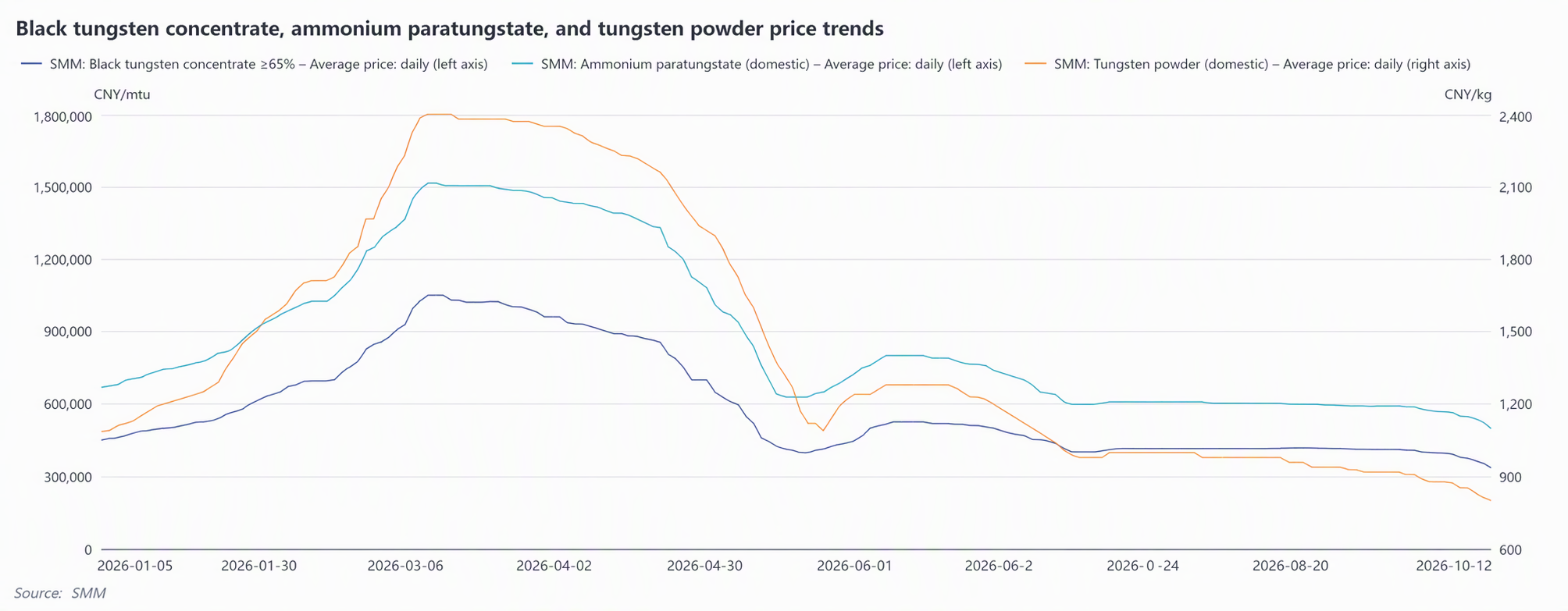
A review of the historical price trends across the tungsten industry chain shows that, first, after the average price of wolframite concentrates (≥65%) hit a record high on March 12, despite some stabilization and rebounds in between, the overall trend remained downward. As of October 12, the average price had pulled back from the record high of 1,050,500 yuan/standard tonne to 337,000 yuan/standard tonne, a decline of 67.92% over seven months.
From the price trend of APT: the record high average price of APT (domestic) on March 12 was 1,515,000 yuan/mt, compared with its average price of 500,000 yuan/mt on October 12, a decline of 67% over seven months.
A review of tungsten powder price trends shows that: the record high average price of tungsten powder (domestic) on March 12 was 2,400 yuan/kg, compared with its average price of 805 yuan/kg on October 12, a decline of 66.46% over seven months.
Outlook
Currently, the tungsten market is in a mismatched pattern of "tight supply, weak demand." On the supply side, although tungsten raw material supply remains tight overall, some smelters' maintenance shutdowns have led to a buildup of raw material inventory; smelting-side inventory is high, and with relatively ample Q4 mining quotas, some enterprises have the need to reduce inventory and recover funds. Multiple intertwined factors are jointly exerting pressure on tungsten prices.
Looking ahead, developments in the following areas warrant attention:
First, whether the demand side can see a turnaround. As the tungsten price center continues to shift downward, whether the price pullback can stimulate downstream restocking willingness and drive a recovery in tungsten market demand will be a key variable affecting the price direction.
Second, Q4 cemented carbide order performance. Q4 has traditionally been a minor peak season for cemented carbide demand, and actual order conditions can serve as an important basis for gauging the strength of downstream demand and judging when tungsten prices will stabilize.
Third, marginal changes on the export side. As tungsten prices in China pulled back, the price spread between Chinese and overseas markets widened, making Chinese tungsten products more attractive on price. The market is expected to see exports in Q4, especially as pre-Christmas stockpiling by overseas tungsten producers could become a channel for absorbing domestic inventory.
Recommended reading: