[SMM survey] Blast furnace maintenance increases, and hot metal production decline is expected to widen in October

Published: Oct 12, 2026 13:54 (GMT+8)

According to SMM’s tracking survey data, a total of 27 blast furnaces at steel mills nationwide entered maintenance in September, with a daily reduction in hot metal output of about 11.310kt. The maintenance was mainly concentrated in North China. Meanwhile, 11 blast furnaces resumed production, increasing daily hot metal output by about 47,600 mt. The blast furnaces resuming production were also mainly in North China; blast furnace maintenance was primarily driven by deepening losses at steel mills; coupled with underperform in peak season end-use demand, steel mills faced relatively high inventory pressure. SMM survey data showed that blast furnace maintenance in September led to a net decrease of 6.7 million mt in hot metal production, up 470,000 mt MoM from August. Based on SMM daily average hot metal production data, daily average pig iron production in September fell by about 0.610kt from August.
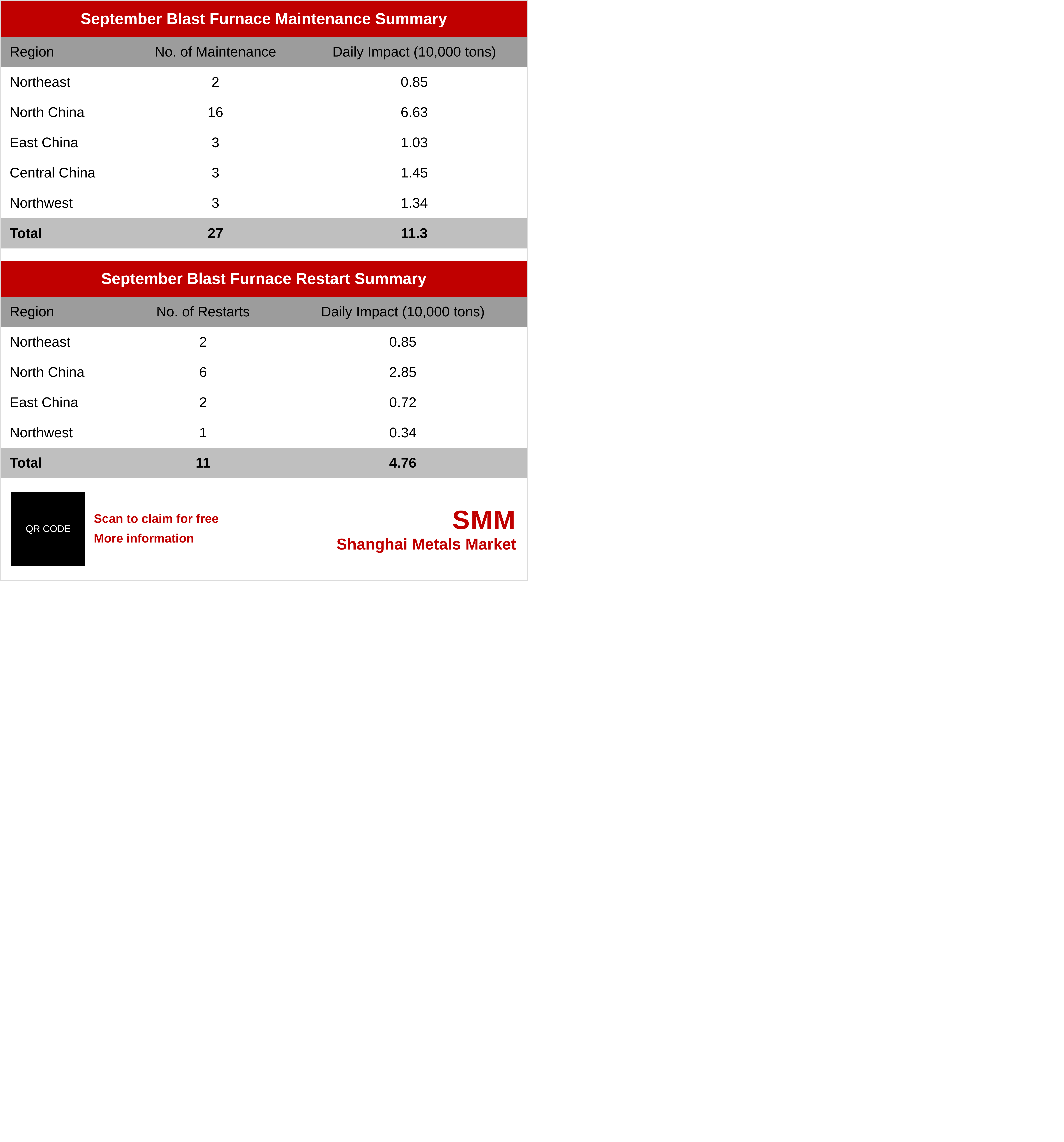

Source: SMM

According to SMM’s latest survey data, in October 2026, steel mills nationwide plan to add a total of 10 blast furnaces for maintenance, mainly concentrated in North China, with an expected daily reduction in hot metal output of about 37,000 mt; over the same period, a total of 12 blast furnaces plan to resume production, with a theoretical daily increase in hot metal output of about 58,000 mt. Based on comprehensive estimates, blast furnace maintenance in October is expected to cumulatively reduce hot metal production by about 8 million mt, with the average daily hot metal output down by about 30,000 mt MoM from September. However, considering the pronounced decline in raw material prices, steel mill profits have somewhat recovered, and maintenance at some blast furnaces that were planned may be delayed. Hot metal production’s actual reduction in October is expected to be lower than the estimate.
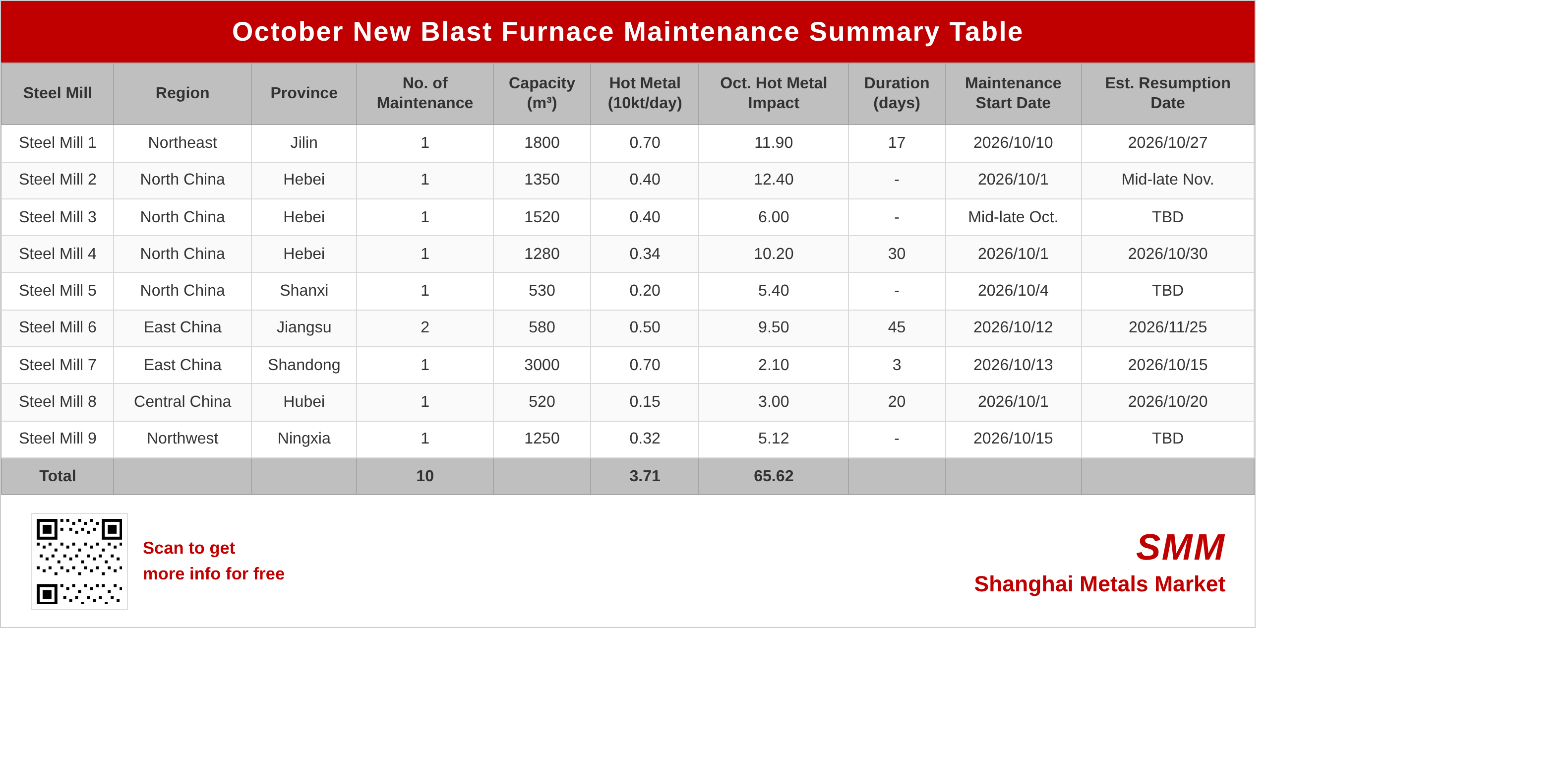
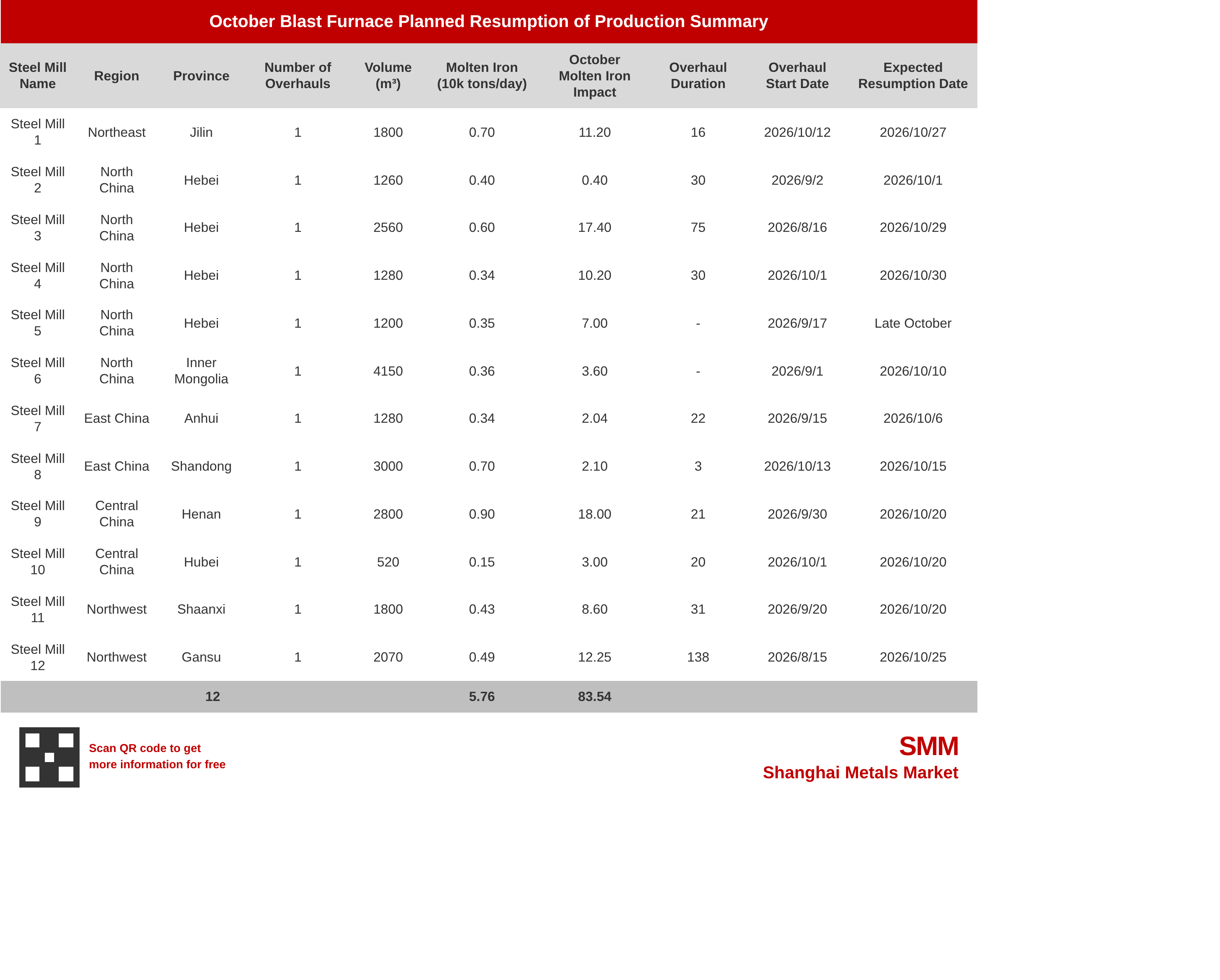
Source: SMM

You are welcome to follow SMM’s weekly release every Wednesday of the operating rate and daily average hot metal production for 242 sample blast furnaces:


Data Source Statement: Except for publicly available information, all other data are processed by SMM based on publicly available information, market communication, and relying on SMM's internal database model. They are for reference only and do not constitute decision-making recommendations.

Images in this article contain AI-translated captions for reference only.

For any inquiries or for more information, please contact: lemonzhao@smm.cn
For more information on how to access our research reports, please contact:service.en@smm.cn
Related News
[SMM Steel] European HRC Rallies: Tight Northern Supply Drives Price Surge as Q4 Quotas Sell Out
16 mins ago
[SMM Steel] European HRC Rallies: Tight Northern Supply Drives Price Surge as Q4 Quotas Sell Out
Read More
[SMM Steel] European HRC Rallies: Tight Northern Supply Drives Price Surge as Q4 Quotas Sell Out
[SMM Steel] European HRC Rallies: Tight Northern Supply Drives Price Surge as Q4 Quotas Sell Out
[Europe] European hot-rolled coil (HRC) prices rebounded strongly, with the Northern European market showing particularly sharp gains. Driven by tightening domestic supply, strict import quota constraints, and the rapid depletion of low-cost buyer inventories, market supply-demand dynamics shifted abruptly, pushing mainstream transaction baselines significantly higher. On pricing, the Northwest European HRC ex-works price surged in a single day to 742 EUR/tonne EXW (832 USD/tonne), while the Italian domestic price followed suit, rising to 737 EUR/tonne EXW (826 USD/tonne). Regionally, several leading mills in Northern Europe reported that their Q4 allocations are virtually sold out or officially closed, with recent delivered transaction levels solidifying in the 750–760 EUR/tonne DDP (841–852 USD/tonne) range. In Southern Europe, the mainstream delivered floor price likewise held firm at 750 EUR/tonne DDP (841 USD/tonne).
16 mins ago
[SMM Steel] Turkish Steel Stalled: Buyers Resist Flat Price Hikes as Rebar Slides and High Offers Diverge
23 mins ago
[SMM Steel] Turkish Steel Stalled: Buyers Resist Flat Price Hikes as Rebar Slides and High Offers Diverge
Read More
[SMM Steel] Turkish Steel Stalled: Buyers Resist Flat Price Hikes as Rebar Slides and High Offers Diverge
[SMM Steel] Turkish Steel Stalled: Buyers Resist Flat Price Hikes as Rebar Slides and High Offers Diverge
[Turkey] Domestic steel mills attempted to push offer prices higher, but underlying end-user demand remains persistently sluggish, keeping actual market trading subdued. In the flat steel segment, domestic hot-rolled coil (HRC) prices edged up by 5 USD/tonne to 625 USD/tonne EXW (excluding VAT), with mills currently allocating most of their production capacity for January delivery. However, against the backdrop of softening scrap costs and a lack of fresh order support, HRC prices face probable downward correction pressure in the coming period. On the import front, with the conclusion of China's Golden Week holiday, buyers are closely observing market signals, leaving HRC import arrivals steady at 555 USD/tonne CFR. On the export front, HRC export prices held at 610 USD/tonne FOB; although some mills quoted as high as 620–650 USD/tonne FOB, European buyers generally insist on shipment dates deferred until after the EU's quota reset on January 1st, making higher-priced transactions extremely difficult to finalize. Notably, to bypass provisional anti-dumping duties levied on certain imported HRC, several rerollers continue switching to full-hard steel coils as an alternative substrate. In long steel, Turkish domestic rebar prices extended their gradual downward trend, with mainstream transaction levels slipping to 610–615 USD/tonne EXW (excluding VAT). Regionally, offers in Izmir and Iskenderun retreated to 605–610 USD/tonne EXW; while Marmara mills maintained official quotes at 630–640 USD/tonne EXW, they broadly granted discounts of around 5 USD/tonne for bulk orders. Given soft domestic construction activity, the market broadly anticipates further downside room for rebar prices. On the export side, rebar FOB prices remained unchanged at 615 USD/tonne FOB. In long steel, Turkish domestic rebar prices extended their gradual downward drift, with mainstream transaction levels slipping to 610–615 USD/mt EXW (excluding VAT). Regionally, offers in Izmir and Iskenderun retreated to 605–610 USD/mt EXW, while Marmara mills maintained official list prices at 630–640 USD/mt EXW while offering discounts of roughly 5 USD/mt for bulk orders. Given sluggish domestic construction activity, the market broadly expects rebar prices to slide further. On exports, rebar FOB export prices held steady at 615 USD/mt FOB. Official trade data revealed that Turkish rebar exports grew 12.2% year-on-year to 2.99 million tonnes during January–August (with August alone reaching 362,070 tonnes), driven primarily by increased demand from growth markets including Yemen, Palestine, Egypt, and Peru.
23 mins ago
SMM Hot-rolled & Cold-rolled Production Schedule】——October steel mill daily average production schedule down MoM
41 mins ago
SMM Hot-rolled & Cold-rolled Production Schedule】——October steel mill daily average production schedule down MoM
Read More
SMM Hot-rolled & Cold-rolled Production Schedule】——October steel mill daily average production schedule down MoM
41 mins ago
Register to Continue Reading
Gain access to the latest insights in metals and new energy
Already have an account?Sign in here