I. Weekly Price Review
This reporting period spanned the Mid-Autumn Festival and National Day holidays (the spot market was closed from October 1 to 7). Refined bismuth prices were lowered from 131,000 yuan/mt before the holiday to 129,000 yuan/mt on September 28 (the first trading day of the reporting period), and remained steady at 129,000 yuan/mt through October 9. No further price adjustments were made in the two trading days after the holiday, signaling that prices have stopped falling and stabilized.
The current round of pullback began in mid-September: after the average refined bismuth price hit a stage high of 140,000 yuan/mt on September 9-11, downstream willingness to accept high prices weakened, and prices pulled back step by step from the high to 136,500 yuan/mt on September 18, 131,000 yuan/mt on September 24, and 129,000 yuan/mt on September 28, a cumulative decline of 11,000 yuan (-7.9%) from the high, before entering a phase of stabilization at low levels. Over the past seven weeks, refined bismuth prices fell 2.6% from 132,500 yuan/mt on August 24, largely giving back the gains from the early-September rally.
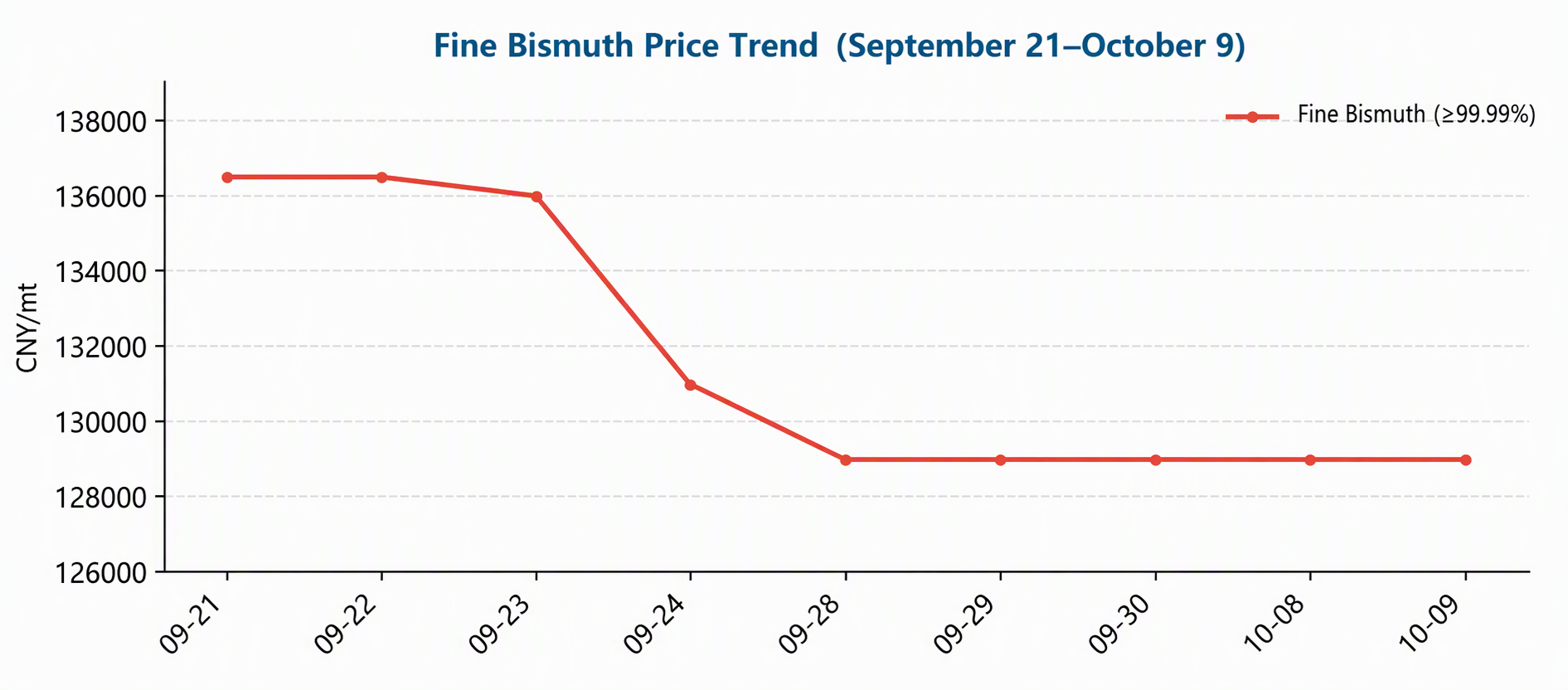
Chart-1: Refined Bismuth Price Trend (September 21 - October 9)
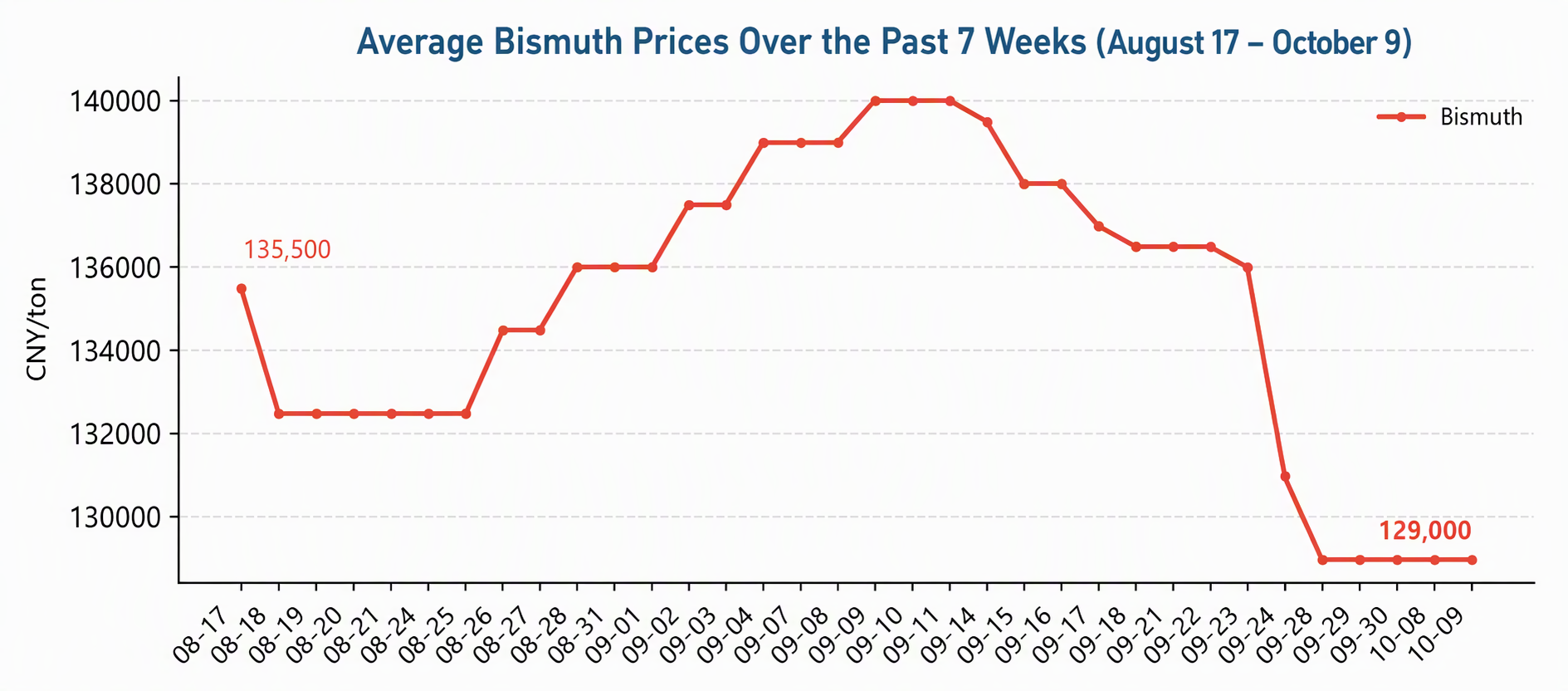
Chart-2: Refined Bismuth Average Price Trend Over the Past 7 Weeks (August 17 - October 9)
II. Supply Dynamics
China's assessed refined bismuth production in September 2026 fell about 3.5% MoM. Smelter operating rates in major producing areas were generally stable, and market supply remained basically steady. Market participants believe the production decline is within a reasonable range and did not create a significant supply shock to the market.
It is worth noting that the September decline in refined bismuth production occurred during the price correction phase, with smelters facing both the desire to hold prices firm and pressure to sell. With refined bismuth prices now down nearly 8% from the high, smelters are showing increased reluctance to sell at low prices, providing some support to the downside.
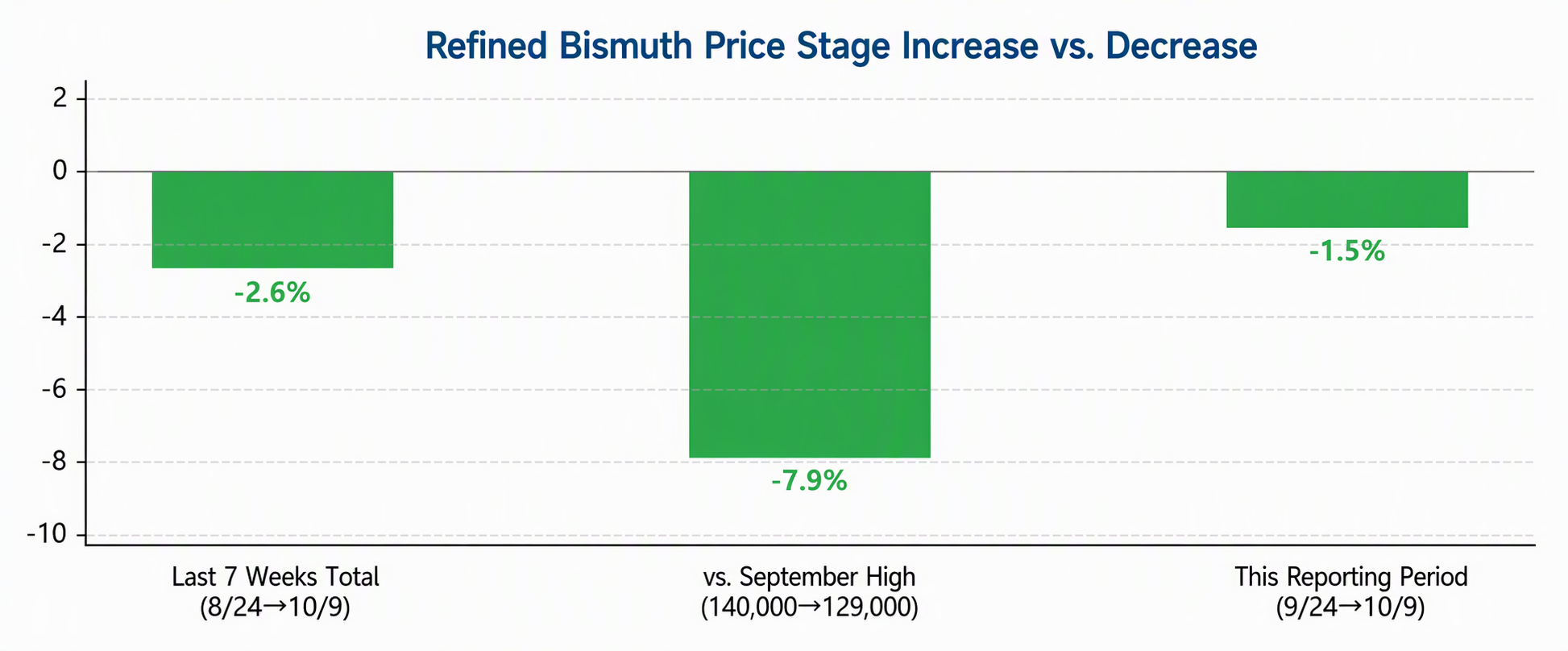
Chart-3: Refined Bismuth Price Stage-by-Stage Change Comparison
III. Trade and Policy
Export performance was weak: China's bismuth trioxide exports in August 2026 were 623.65 mt, down about 25.6% MoM from 837.91 mt in July, and remained below the 1,000 mt level for consecutive months. The boost from overseas demand to domestic prices was limited.
From a macro perspective, the China-US summit reached an eight-point consensus, including a reciprocal tariff reduction arrangement of $30 billion in the economic and trade area and the establishment of a trade council mechanism. The overall tone is positive. If the tariff environment improves going forward, it is expected to provide marginal benefits to the recovery of bismuth product export orders.
IV. End-Use Demand
End-use demand in September was generally mediocre. Bismuth's traditional downstream sectors include pharmaceuticals (bismuth-based APIs), metallurgical additives and fusible alloys, and chemicals (oxides such as bismuth trioxide). Downstream stockpiling before the holiday was relatively cautious, with most purchasing as needed, and acceptance of prices above 130,000 yuan/mt was insufficient, which was the main backdrop for this round of price correction.
Post-holiday market trading is in the early stages of recovery, but the market still holds expectations for October. Some downstream players are beginning to assess the possibility of Q4 order replenishment. If purchasing in the pharmaceutical and chemical sectors recovers, the demand side is expected to provide positive feedback to prices after stabilization.
V. Market Outlook
In the short term, after a pullback of nearly 8% from the high, refined bismuth prices have held steady at the 129,000 yuan/mt level for consecutive sessions. Panic selling pressure has been largely released. Combined with a slight contraction in production and smelters holding back from selling, the room for further significant price declines is limited. Prices are expected to stabilize at low levels and consolidate.
In the medium term, whether prices can recover depends on the strength of October end-use demand and the recovery of export orders: if demand recovers alongside production contraction, prices are expected to rebound mildly; if demand remains mediocre, prices may remain locked in a tug-of-war near 129,000 yuan/mt.
Key Points to Watch Next Week
|
Focus Area |
Details |
|
Production and Operating Rates |
October assessed refined bismuth production, smelter operating rates in major producing areas, and changes in reluctance to sell |
|
Demand Side |
Order replenishment strength and transaction volume growth in pharmaceuticals, alloys, and chemicals in October |
|
Export Side |
Whether bismuth trioxide export orders can stop falling and rebound |
|
Price Signals |
Verification of the 129,000 yuan/mt support level through transactions and the pace of trader inventory destocking |
Note: Price data as of October 9, 2026 (October 10 is a Saturday, with no spot price updates); no spot market quotes during the National Day holiday from October 1 to 7.


![September SMM assessed refined bismuth production in China is expected to decline by about 3.5% MoM [SMM data]](https://imgqn.smm.cn/usercenter/TdoSs20251217171724.jpeg)