I. Weekly Price Review
This reporting period spanned the Mid-Autumn Festival and National Day holidays (the spot market was closed from October 1 to 7). Germanium prices remained stable during the reporting period: germanium ingot (50Ω/cm) was quoted at 27,250 yuan/kg, and germanium dioxide (99.999%) at 19,250 yuan/kg, both unchanged from pre-holiday levels, with no price adjustments in the two trading days after the holiday. Previously, on September 24, germanium ingot and germanium dioxide had been raised by 250 yuan and 100 yuan, respectively, and the market entered a phase of digesting the higher prices after the holiday.
From a longer-term perspective, the current upward cycle in germanium prices began in early August, with the average germanium ingot price climbing step by step from 23,750 yuan/kg (early August) to 27,250 yuan/kg, a cumulative gain of about 14.7%, characterized by a "one step per week" stair-step pattern. Over the past seven weeks covered by this report, germanium ingot rose 9.0% from 25,000 yuan/kg, and germanium dioxide rose 6.9% from 18,000 yuan/kg, with no weekly pullback during the period—showing stronger price resilience than most minor metals.
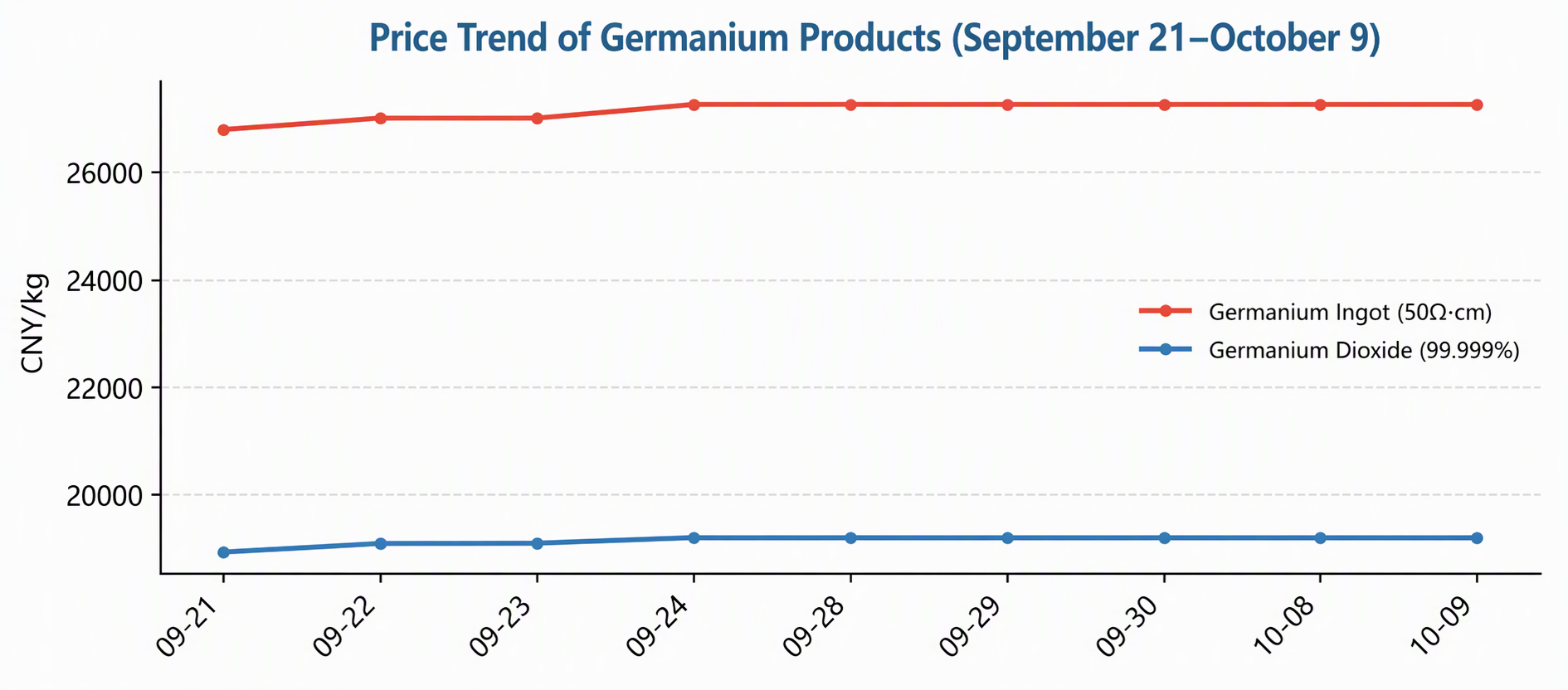
Chart-1: Germanium product price trends (September 21–October 9)
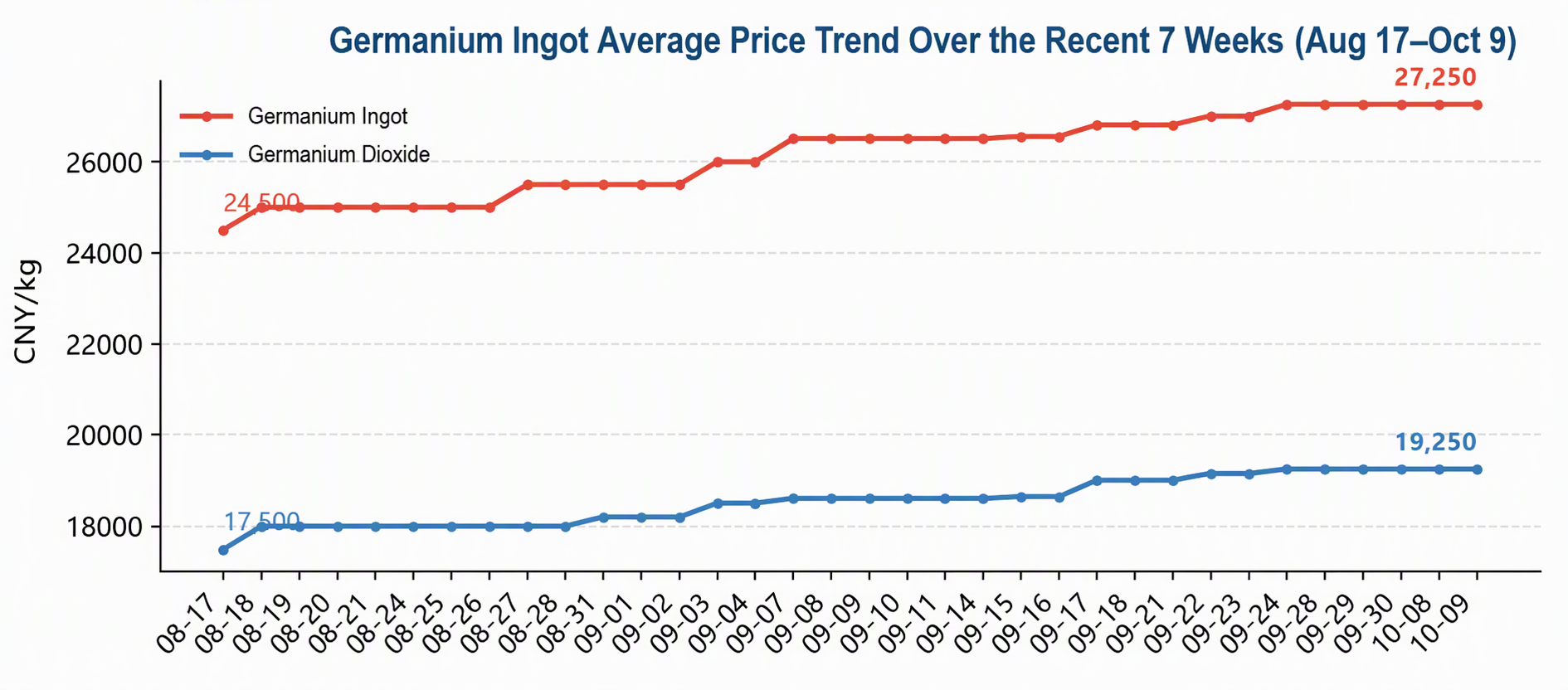
Chart-2: Average germanium product prices over the past 7 weeks (August 17–October 9)
II. Supply Dynamics
The supply side remained tight, serving as the core support for the sustained rise in germanium prices. Germanium in China is mainly associated with lead-zinc ores and lignite, with limited total mining output at the mine end, tight supply of germanium-bearing materials, low raw material inventories at smelters, and limited output flexibility. Recycled germanium mainly comes from optical fiber preform scrap and infrared lens processing scrap, which are small in volume and scattered across channels, making it difficult to effectively supplement primary supply.
Against the backdrop of continuously rising prices, smelters and traders widely adopted a mindset of holding back from selling at low prices and quoting high with a wait-and-see attitude. Actual available spot cargo in the market remained persistently tight, and sellers held the initiative in pricing.
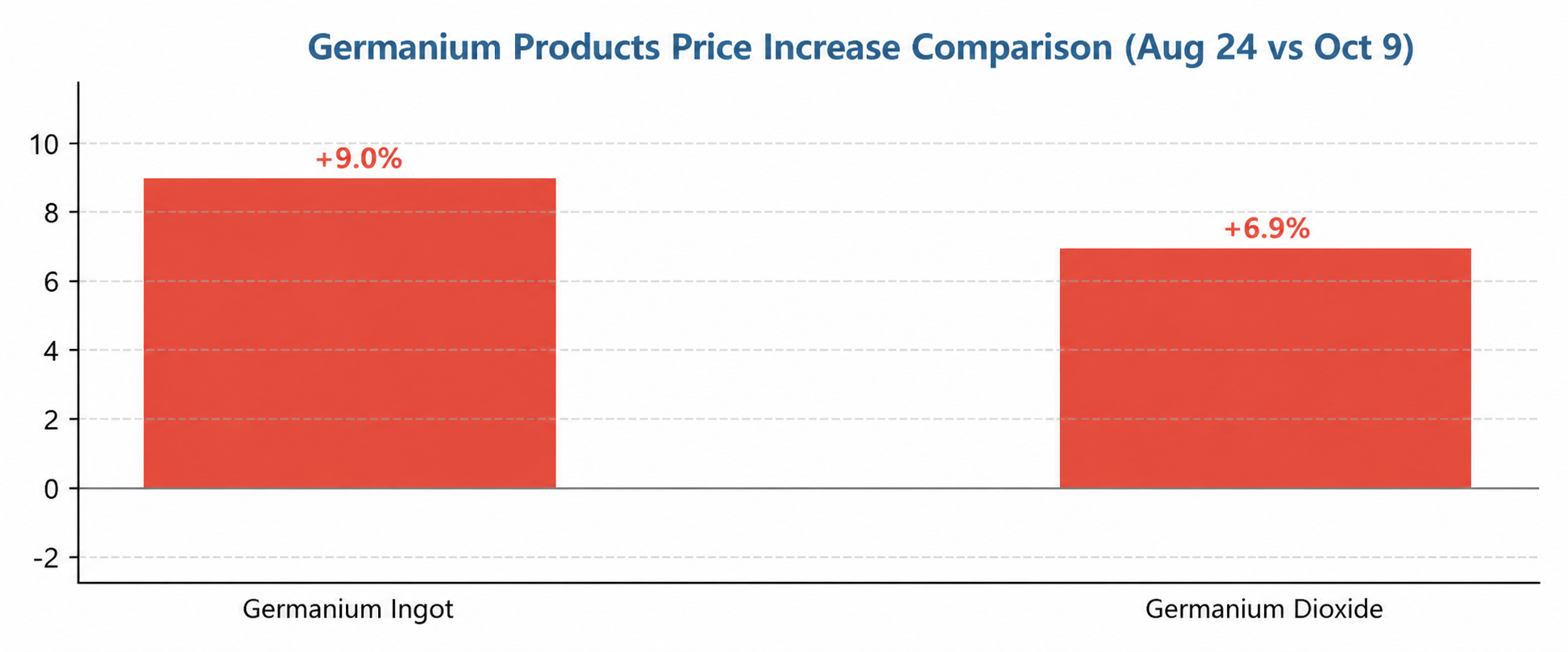
Chart-3: Comparison of % changes in germanium product prices over the past 7 weeks (August 24 vs. October 9)
III. Import, Export, and Policy
Export controls on germanium-related items continued to be implemented on a regularized basis, with exports requiring case-by-case approval and restricted circulation of overseas cargo. Germanium prices in markets outside China have long been significantly higher than domestic prices. With the inverted price spread between Chinese and overseas markets, the impulse for domestic cargo to flow abroad coexists with control constraints. High overseas prices have created a "ceiling-raising" effect on domestic prices, and domestic smelters have continued to move their quotes closer to overseas levels.
From a macro perspective, the China-US summit meeting reached an eight-point consensus, including a reciprocal tariff reduction arrangement of $30 billion in the economic and trade sphere and the establishment of a trade council mechanism, setting an overall positive tone. If the export environment improves at the margin, attention should be paid to the pace of export approvals and the direction of changes in the price spread between Chinese and overseas markets.
IV. End-Use Demand
The demand-side signals in this germanium price rally are relatively solid: infrared optics is the core driver—germanium is the key material for infrared lenses in thermal imaging cameras, and demand from national defense and military, security monitoring, industrial temperature measurement, and automotive night vision remains highly robust. Q4 has traditionally been the peak season for military order deliveries and security equipment procurement, and downstream infrared lens producers had already stepped up stockpiling of germanium-bearing materials at the end of Q3.
Satellite and optical fiber demand formed a resonance: germanium substrates are a key material for high-efficiency gallium arsenide solar cells used in satellites, and the accelerating deployment of low-orbit satellite constellations is boosting germanium substrate orders. Demand for germanium tetrachloride used in optical fiber doping remained stable along with optical communication network construction. It is worth noting that downstream acceptance of prices above 26,000 yuan/kg has weakened compared with the earlier low-price phase, and the marginal boost from demand to prices has diminished somewhat.
V. Market Outlook
In the short term, the pattern of tight supply resonating with peak-season demand remains unchanged, and germanium prices are expected to continue consolidating on a strong note with a rising center. However, given that downstream digestion of high prices takes time, the pace of gains may gradually slow compared with the earlier period, and a phase of sideways consolidation to build momentum before the next step up is more likely.
In the medium and long term, germanium's long-term logic is the most solid among strategic minor metals: on the supply side, global germanium resources are highly concentrated in China (accounting for more than 60% of global production), with strong associated-mineral characteristics and limited growth; on the demand side, the three major scenarios of infrared (military + civilian), satellite substrates, and optical fiber are all in expansion channels, and the supply-demand gap is trending wider. The germanium price center is expected to move toward 30,000 yuan/kg. Risks lie in high prices stimulating downstream reduction and substitution (some infrared lens producers have already begun evaluating alternative materials such as zinc sulfide) and the commissioning progress of new overseas supply projects.
Key Points to Watch Next Week
|
Focus Area |
Details |
|
Demand side |
Strength of Q4 military infrared order deliveries and security procurement peak season |
|
Incremental demand |
Pace of low-orbit satellite constellation deployment and sustainability of germanium substrate orders |
|
Supply side |
Supply of germanium-bearing materials from lead-zinc ores and lignite, and raw material inventories at smelters |
|
Policy and overseas market |
Pace of export control approvals and changes in the price spread between Chinese and overseas markets |
|
Substitution risk |
Progress in the application of alternative materials such as zinc sulfide under high prices |
Note: Price data are as of October 9, 2026 (October 10 is a Saturday, with no spot quote updates); no spot market quotes were available during the National Day holiday from October 1 to 7.