I. Same coil, 3.5 times the bill
Start with the question buyers ask most: what does CBAM add to a tonne of HRC?
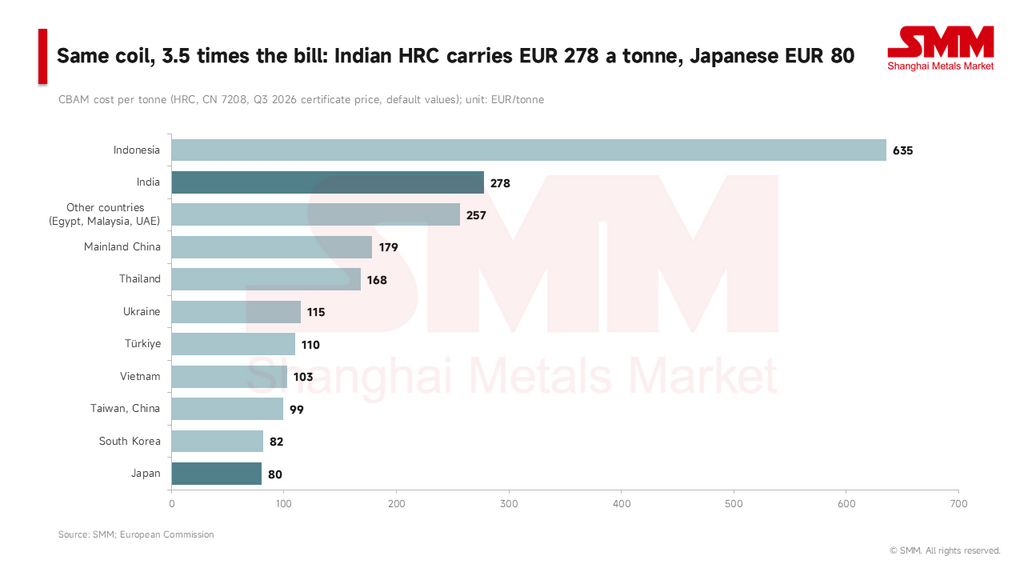
Select hot-rolled coil (CN 7208) and Q3 2026 in the calculator, then change only the origin. Indian material needs about 3.37 certificates per tonne, or roughly EUR 278; Chinese about EUR 179, Vietnamese EUR 103 and Japanese EUR 80. Figure 1 shows each origin. The certificate price is the same for everyone, so the gap comes entirely from the country-specific default values set in EU law. Egypt, Malaysia, the UAE and other origins without their own HRC value fall back to the "Other Countries and Territories" column, at about EUR 257/tonne, and the calculator flags the fallback on screen.
The Q3 price is 9.4% above Q2's EUR 75.28, adding EUR 15.28/tonne to Chinese HRC and EUR 23.74/tonne to Indian HRC. It is already built into the calculator.
II. Where spreadsheets go wrong: route and year
The first trap is the route. When importers declare on default values, the benchmark used for the free-allocation deduction is fixed by origin, not by the mill's actual process. For HRC, the blast furnace-basic oxygen furnace route has a benchmark of 1.370 tCO2e/tonne; the scrap-EAF route only 0.072.
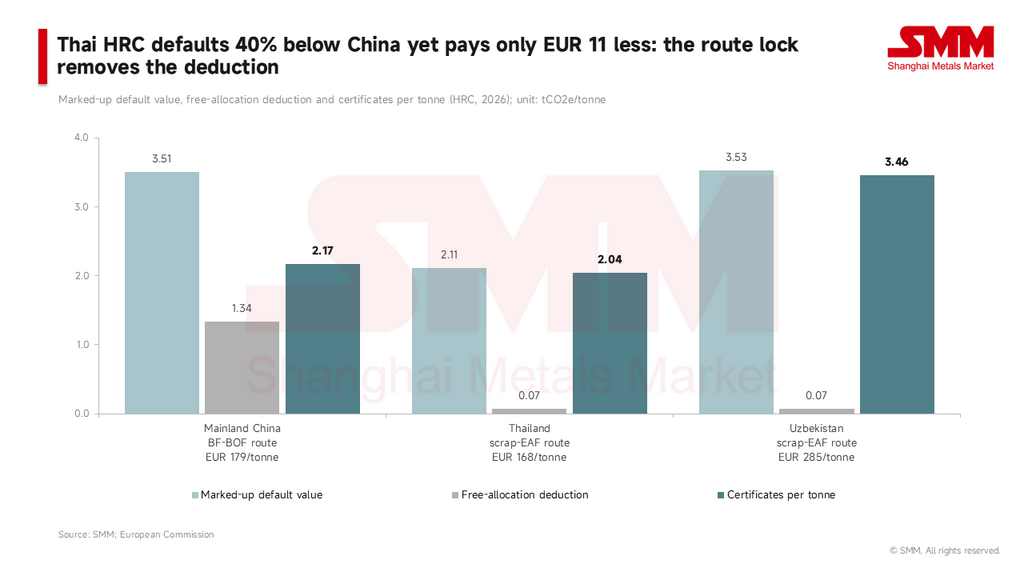
Thai HRC has a default value about 40% below China's, but Thailand is locked to the EAF route and keeps almost no deduction. It still costs about EUR 168/tonne, only EUR 11 less than Chinese coil. Uzbekistan's default is close to China's, yet its bill is EUR 106 higher. The calculator applies the right route automatically and notes the lock under the result.
The second trap is the year. The default-value mark-up rises from 10% in 2026 to 30% from 2028, while the CBAM factor falls from 97.5% to zero in 2034.
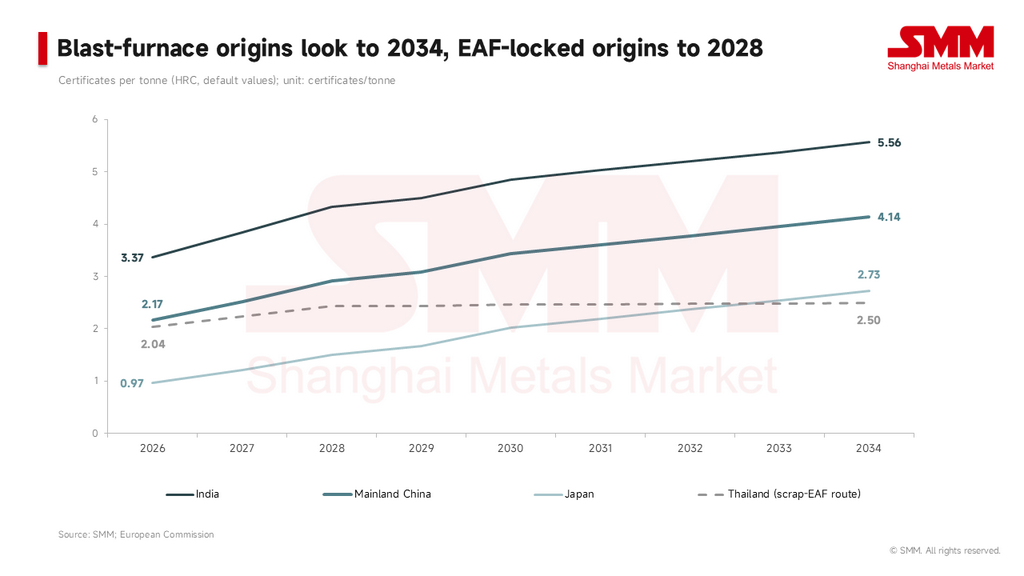
At today's price, Chinese HRC rises from EUR 179/tonne in 2026 to EUR 240 in 2028 and EUR 341 in 2034. The pattern is counter-intuitive: for blast-furnace origins most of the increase comes after 2028, with the first two years accounting for only about 38% of China's total rise; for Thailand, locked to the EAF route, about 86% of the increase arrives before 2028. Multi-year contracts should run every delivery year through the calculator.
III. What the calculator does, and how to use it
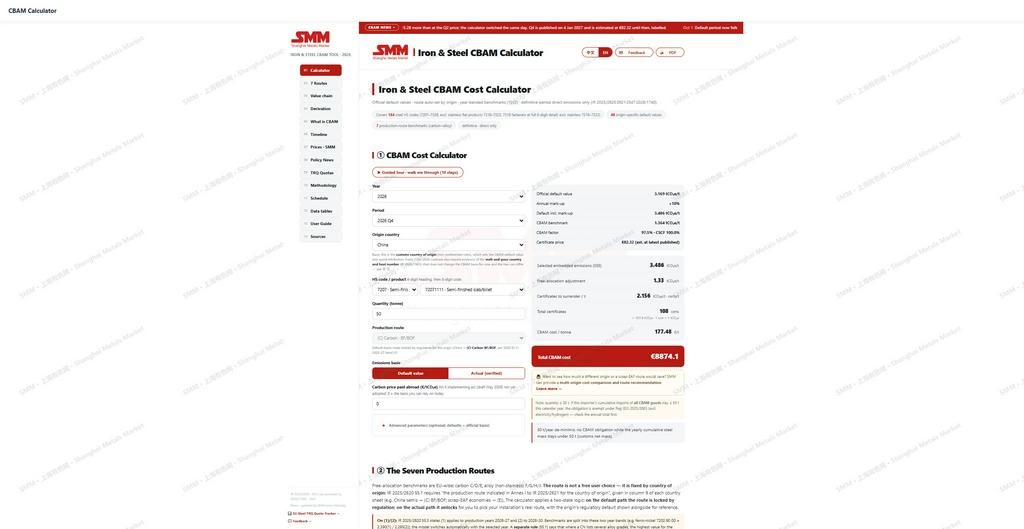
The calculator builds these rules into the interface. Table 1 lists the main features.
Table 1: Main features of the calculator
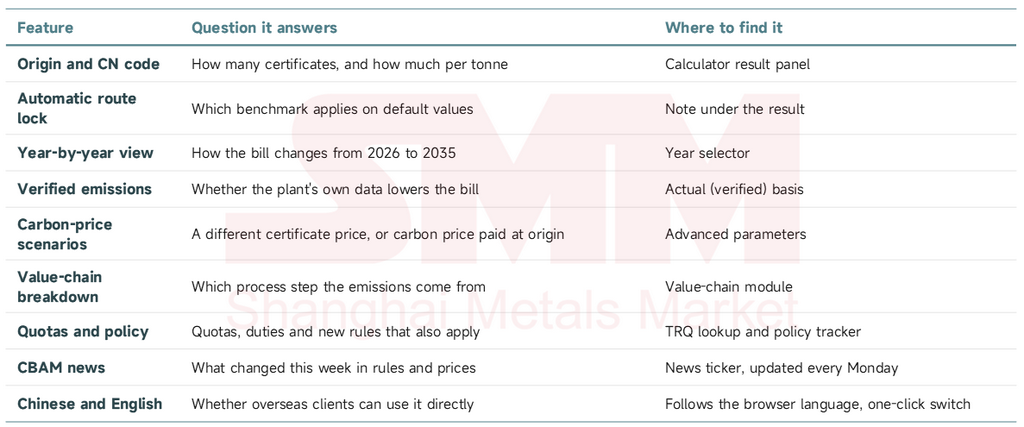
It covers 184 steel CN codes in chapters 72 and 73, 48 origin columns and seven production routes. All 5,993 default values have been checked against the Commission's official data file, with no differences. Official certificate prices for Q1, Q2 and Q3 2026 are built in; quarters not yet published are estimated at the latest official price and labelled. Using it takes three steps (Table 2).
Table 2: Three steps to the CBAM cost of a shipment

To access it, log in to SMM, open Tools on metal.com and select Steel CBAM Calculator (https://www.metal.com/resources/tool/k30vxjgNa1-GQcDV6lcxJg). The Chinese version sits under Industry Tools on smm.cn (https://www.smm.cn/resources/tool/k30vxjgNa1-GQcDV6lcxJg).
IV. Outlook
Our view is that CBAM has moved from a compliance topic to a pricing topic. Goods have been accruing certificates since January, but the cash does not go out until 2027, and that gap is the window for exporters and European buyers to agree who carries the carbon cost. Among the main suppliers, HRC under a single CN code carries anywhere from about EUR 80 to EUR 278 a tonne, and how that spread is written into contracts will shape European sourcing more directly than where the carbon price goes next.
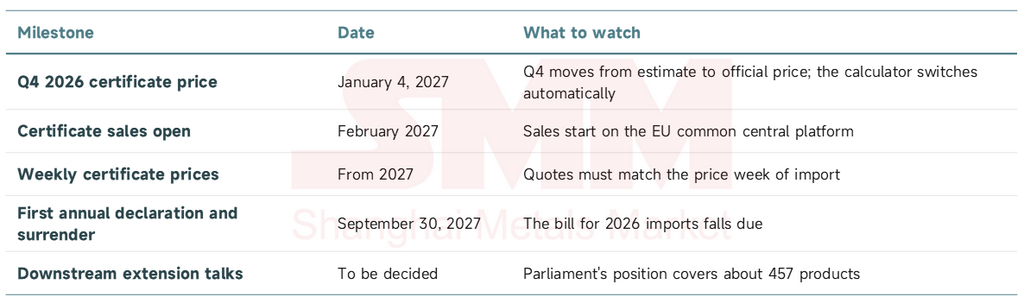
For exporters, the first step is to run their main products and delivery years through the calculator. Mills that can, especially EAF producers, should prepare verified actual-emissions data early. Table 3 lists the dates to watch.
Table 3: Dates to watch
Source: SMM; European Commission.
![[Shanghai New Home Transactions Double YoY During National Day Holiday]](https://imgqn.smm.cn/usercenter/wSpkX20251217171718.png)
![[August 2026 Home Appliance Entire Industry Chain Data Release]](https://imgqn.smm.cn/usercenter/ocJKj20251217171717.jpg)
![[CISA: August Monthly Report on Major Steel-Using Industries]](https://imgqn.smm.cn/usercenter/VgxkU20251217171719.jpg)