【SMM Analysis】Overseas Molybdenum Market Review During China's 2026 National Day Holiday and Post-Holiday Outlook: Asian Molybdenum Oxide Firms at Holiday End, Ferromolybdenum Trading Remains Muted
During China's National Day holiday from October 1 to 7, 2026, Chinese buyers temporarily withdrew from the market, reducing inquiry and trading activity in the Asian molybdenum spot market. Nevertheless, overseas trading did not come to a complete halt. Prices for 57% molybdenum oxide remained within a narrow range during the first six days of the holiday. On October 7, as the reopening of the Chinese market approached, some sellers raised their indications, resulting in a noticeable upward shift in the price range.
Compared with molybdenum oxide, the overseas ferromolybdenum market remained relatively quiet. Although a small number of DDP transactions were reported in Europe, overall inquiry and trading activity remained limited. South Korea and other Asian markets also lacked representative new transactions. Meanwhile, a fatal accident occurred at the Radomiro Tomic mine in Chile, while two unions at the Centinela mine began strike action, increasing market attention on the stability of Chilean mine supply.
Overall, the overseas molybdenum market during the holiday was characterised by narrow-range consolidation in the early period, stronger seller indications towards the end, and a lack of corresponding growth in downstream transactions. The upward movement in prices was supported by expectations of renewed Chinese buying, seller reluctance to offer at lower levels and concerns over mine-side risks. Whether the increase can be sustained will still depend on post-holiday procurement and actual transactions.
I. Asian Molybdenum Oxide Stabilises Before Seller Indications Rise Towards Holiday End
During the early part of the National Day holiday, Chinese buyers were temporarily absent from the market. The Asian molybdenum oxide market consequently lacked concentrated inquiries and procurement activity, with both buyers and sellers largely adopting a wait-and-see approach.
On October 1, the EXW price range for overseas 57% molybdenum oxide stood at $33.10–33.20/lb Mo. The range narrowed to $33.10–33.15/lb Mo on October 2 and remained at that level on October 5 and 6. The market therefore did not experience a sustained decline during the first six days of the holiday, but instead consolidated within a narrower range.
Although some stockholders retained an interest in selling during the absence of Chinese buyers, sellers did not make significant price concessions. At the same time, downstream users lacked motivation to replenish inventories in large volumes and showed limited acceptance of higher-priced material. Consequently, short-term support emerged around $33.10/lb Mo, leaving buyers and sellers in a narrow-range stalemate.
On October 7, as the Chinese market prepared to reopen, some overseas sellers raised their indications. The price range for 57% molybdenum oxide moved up to $33.25–33.40/lb Mo. The availability of lower-priced cargoes declined, while expectations that Chinese buyers would resume inquiries after the holiday strengthened sellers’ reluctance to sell and encouraged firmer offers.
However, the $33.25–33.40/lb Mo range primarily reflected higher seller indications and had not yet been confirmed by sufficient new transactions across the entire range. The market should therefore be described as shifting from consolidation towards tentative upward pricing, rather than as having already achieved a broad-based recovery in transaction prices.
Asian EXW prices also cannot be compared directly with European DDP transactions. Cargoes collected from bonded warehouses in Busan are generally uncleared and duty-unpaid, whereas European DDP prices may include freight, duties, taxes and delivery costs. Differences in origin, product form, payment terms and delivery conditions remain important sources of price dispersion across overseas markets.
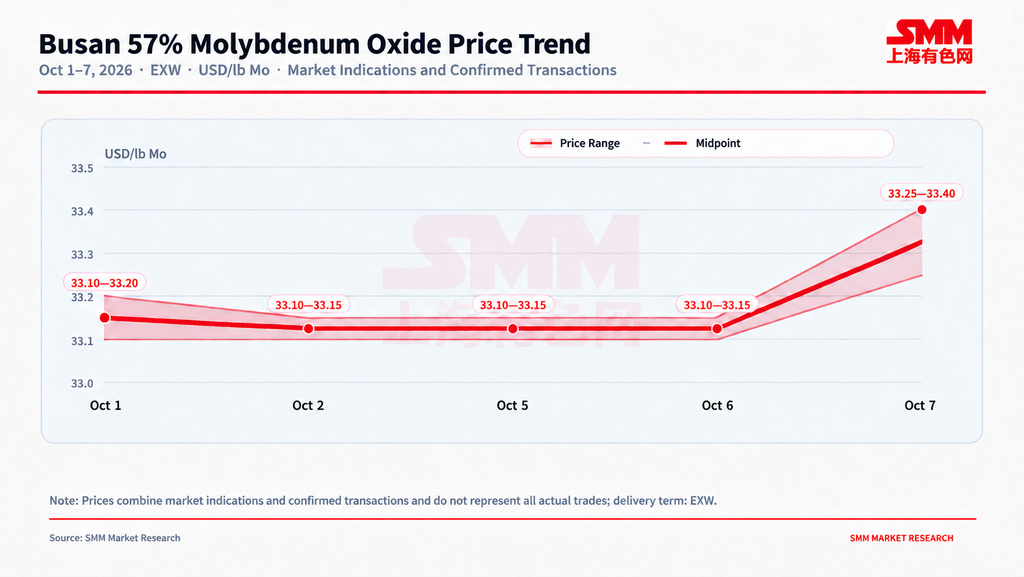
Figure 1. Busan Port 57% Molybdenum Oxide Market Price Trend, October 1–7, 2026
Note: Prices are quoted on an ex-bonded warehouse basis, before customs clearance and payment of duties and taxes. The chart incorporates indicative market offers and market feedback, and is intended to show directional movements only; it does not represent all actual transactions.
Source: SMM Market Research.
II. Sporadic European Ferromolybdenum Transactions Emerge, but Overall Trading Remains Quiet
The overseas ferromolybdenum market did not experience any clear wave of concentrated procurement during the Chinese holiday. European duty-unpaid ferromolybdenum prices were assessed at approximately $75.50–75.75/kg Mo, with an import duty of about 2.7%.
Around October 6, ferromolybdenum transactions were heard in southern Europe at $76.50–77.00/kg Mo on a DDP basis. As duty-unpaid quotations and DDP transactions include different tax, freight and delivery components, the two price bases cannot be used to calculate a direct price increase.
The transactions indicated that some rigid procurement demand remained in Europe. However, both the number of transactions and the available samples were limited, while overall inquiry activity showed no obvious improvement. These sporadic deals were therefore insufficient to demonstrate a broad recovery in the European ferromolybdenum market or a sustained improvement in end-user demand.
Some of the transactions occurred shortly before the end of China’s holiday and may have reflected advance positioning by traders or downstream users in anticipation of changes in raw-material prices after the Chinese market reopened. It remains unclear whether the increase in transactions reflected genuine consumption growth or short-term inventory replenishment by individual buyers.
The Asian ferromolybdenum market was even quieter. South Korea and other Asian markets reported few active inquiries or actual transactions during the holiday. Although some orders emerged in India, midstream ferromolybdenum producers competed aggressively for limited business. Prices for 60% ferromolybdenum were at one point around $75–76/kg Mo, indicating continued downstream bargaining pressure.
Overall, molybdenum oxide prices moved higher towards the end of the holiday, but the cost increase had not yet been transmitted smoothly to the ferromolybdenum market. Unless new ferromolybdenum orders increase in parallel, processors’ ability to accept higher-priced molybdenum oxide will remain constrained by their profit margins.
III. Fatal Accident at Radomiro Tomic and Strike at Centinela Increase Supply Uncertainty
Chile’s mining sector experienced consecutive safety and labour incidents during the National Day holiday, increasing overseas market attention on the stability of South American molybdenum raw-material supply.
On October 1, a fatal accident occurred at Codelco’s Radomiro Tomic mine. The accident involved the mine’s crushing and material-handling area. Activities in the affected area were suspended immediately and an investigation was launched.
As of the publication cut-off, Codelco had not disclosed the accident’s specific impact on overall mine operations or molybdenum output. SMM learned through market research that participants generally regarded the scope of the disruption as relatively limited, although the timing of a full resumption of activities in the affected area remained uncertain. The incident should therefore not yet be translated directly into a loss of molybdenum supply.
On October 7, two unions at the Centinela mine began strike action after government-mediated negotiations failed to produce an agreement. The strike involved 709 employees, representing approximately 22% of the mine’s directly employed workforce. Centinela produces copper concentrates, copper cathodes and molybdenum concentrates. Its molybdenum output reached approximately 3,400 mt in 2025, giving the strike a direct connection to overseas molybdenum raw-material supply.
Centinela stated, however, that despite the operational difficulties that could arise from the strike, its projected production remained unchanged. It is therefore too early to conclude that the strike has already reduced molybdenum concentrate output, and the potential risk should not be converted directly into a quantified supply loss.
The Centinela strike began on the same day that seller indications for molybdenum oxide moved higher. South American copper-molybdenum operations had already faced challenges including winter weather, power supply, road transportation, changes in ore characteristics and lower molybdenum recovery rates. The new labour action consequently heightened concern over the stability of Chilean supply.
Nevertheless, molybdenum oxide prices were also influenced by expectations surrounding China’s market reopening, reduced availability of lower-priced cargoes and sellers’ reluctance to sell. The upward shift in the October 7 price range cannot therefore be attributed entirely to a single mine-related event.
The market should continue monitoring the resumption of activities in the affected area at Radomiro Tomic, the duration of the Centinela strike, the operational status of its concentrator and molybdenum recovery circuit, and whether molybdenum concentrate shipments are disrupted. Until actual production losses are confirmed, these events primarily increase supply uncertainty and the market risk premium rather than representing confirmed reductions in spot availability.
IV. Supply Risks and China's Reopening Expectations Converge, but Higher Prices Still Require Transaction Confirmation
The overseas molybdenum market did not experience a straightforward one-way increase between October 1 and 7. Instead, it moved from narrow-range consolidation towards higher seller indications.
The price range for 57% molybdenum oxide stood at $33.10–33.20/lb Mo on October 1, narrowed to $33.10–33.15/lb Mo between October 2 and 6, and then moved up to $33.25–33.40/lb Mo on October 7. The upward movement was concentrated towards the end of the holiday and was, for the time being, reflected more clearly in offers and seller indications than in confirmed transactions.
On the supply side, consecutive safety and labour incidents in Chile increased concerns over the stability of molybdenum concentrate supply. With no confirmed production losses yet available, the immediate effects were primarily on market expectations, risk premiums and sellers’ willingness to reduce prices.
On the demand side, the pace of Chinese procurement following the reopening remains the key factor determining whether the market can sustain its upward momentum. Overseas seller indications already reflected some expectations of post-holiday replenishment, but limited Asian ferromolybdenum inquiries and the small European transaction sample showed that downstream demand had not yet strengthened broadly.
The late-holiday increase in molybdenum oxide prices therefore does not mean that the overseas market has entered a comprehensive upward cycle. Current sentiment can develop into a more firmly established price trend only if higher offers are confirmed by repeated transactions and subsequently transmitted to the ferromolybdenum market.
V. Post-Holiday Outlook: Focus on Whether Higher Price Levels Gain Transaction Support
SMM expects overseas molybdenum oxide prices to remain elevated and volatile in the short term. South American mine-side risks, reduced availability of lower-priced cargoes and expectations of renewed Chinese procurement may support seller offers. However, insufficient ferromolybdenum orders and cautious downstream buying are also likely to limit the pace of further increases in molybdenum oxide prices.
If Chinese buyers return with active inquiries and repeated transactions are concluded above $33.40/lb Mo, the current increase in seller indications may gradually develop into a new market trading range, providing further upside support for overseas molybdenum oxide prices.
Conversely, if post-holiday procurement remains limited to small volumes of rigid demand, or if cargoes with lower netback prices re-emerge in Europe and other markets, seller indications of $33.25–33.40/lb Mo may lack sufficient transaction support, returning buyers and sellers to a high-level stalemate.
In the ferromolybdenum market, sporadic DDP transactions should not be interpreted as evidence of a broad market recovery before orders from steel mills, traders and other end users increase materially. The ability of higher molybdenum oxide costs to pass through to ferromolybdenum prices will continue to depend on actual orders, inventory levels and processors’ profit margins.
Key factors to monitor include actual transactions for 57% molybdenum oxide in Busan and other Asian markets, the pace of overseas procurement by Chinese buyers following the holiday, new European ferromolybdenum orders, the resumption of activities in the affected area at Radomiro Tomic, and whether the Centinela strike disrupts concentration, molybdenum recovery or concentrate shipments.
![Aluminum alloy futures consolidate and weaken, ADC12 price decline sentiment heats up [ADC12 Price Daily Review]](https://imgqn.smm.cn/usercenter/znXdm20251217171724.jpeg)
![[SMM Chromium Flash] South Africa's Diesel Surge Raises Chrome Ore Transport Costs](https://imgqn.smm.cn/usercenter/tjmLW20251217171722.jpeg)
![[SMM Chromium Flash] India's New Mineral Exchange Could Reshape Domestic Chromite Price Discovery](https://imgqn.smm.cn/usercenter/wUnEn20251217171722.jpeg)