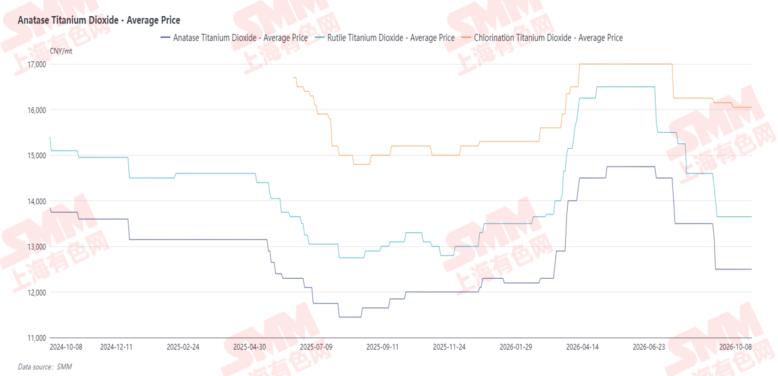
During the National Day holiday, China’s titanium market remained generally stable but under pressure. Upstream titanium concentrates were in the doldrums and stagnant, further highlighting the supply-demand imbalance. Titanium sponge stayed under pressure, with enterprises maintaining high operating rates, but end-use demand from downstream civilian sectors was weak, worsening inventory buildup across the industry. Mainstream transaction prices for grade 0 titanium sponge were 44,000-45,000 yuan/mt. The titanium dioxide segment held steady before the holiday, with relatively stable price spreads between products made by different processes: mainstream quotations for sulphate-process rutile were 12,500-14,800 yuan/mt, sulphate-process anatase 12,000-13,000 yuan/mt, and chloride-process titanium dioxide remained relatively firm, with mainstream quotations at 15,300-16,800 yuan/mt. On the first trading day after the holiday, quotations for titanium products across the entire industry chain stayed at pre-holiday levels, with no notable changes. Market sentiment was dominated by a wait-and-see attitude, and the price trend remains to be confirmed by actual downstream purchase orders after the holiday.
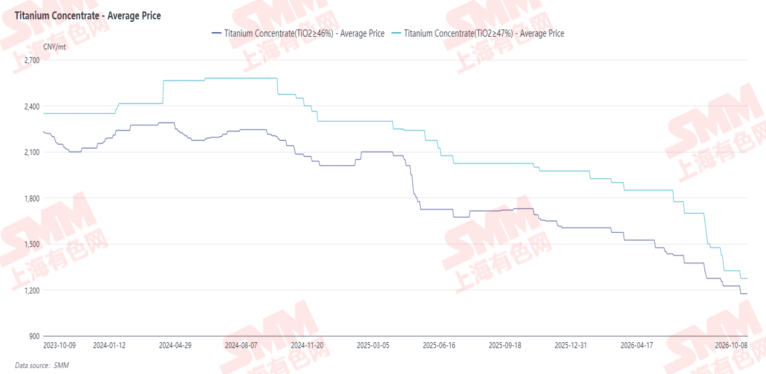
Raw material side, domestic titanium concentrate mines are generally loss-making, with overall low operating rates, but Xinjiang production growth is significant. Combined with large arrivals of imported ore, market supply is generally ample. Sulphuric acid and sulphur prices are under pressure and consolidating, making it difficult for the raw material side to provide strong cost support for the titanium industry chain.
On the first trading day after the holiday, the titanium market continued its pre-holiday trend. The "September peak season" expectations fell through, and the market turned cautious about the "October peak season" outlook. With raw material support remaining weak and downstream demand in China subdued, whether the titanium market can see a turnaround hinges on the boost from exports and marginal changes brought by macro policies.
On the export front, there are structural positives: during the National Day holiday, Shandong Jinhai Titanium ran at full capacity to fulfill export orders, with daily production of 700-800 mt and exports of around 1,000 mt/day, providing phased support from export orders. Titanium material prices in Northwestern Europe rose over 3%, benefiting from recovering demand in aviation and national defense, and expectations for high-end titanium materials outside China are improving. In January-August 2026, China's cumulative titanium dioxide exports reached 1.357 million mt, up 14.02% YoY. As the titanium dioxide market recovers, exports are the key indicator to watch. However, there are also disruptions on the export side: titanium dioxide exports in August were 144,100 mt, pulling back slightly by 0.21% MoM, indicating some weakening in external demand. The EU, Brazil, the UK, and other regions continue to maintain anti-dumping policies, keeping export space constrained, and growth from any single market is unlikely to fully offset the weakness in China's domestic demand.
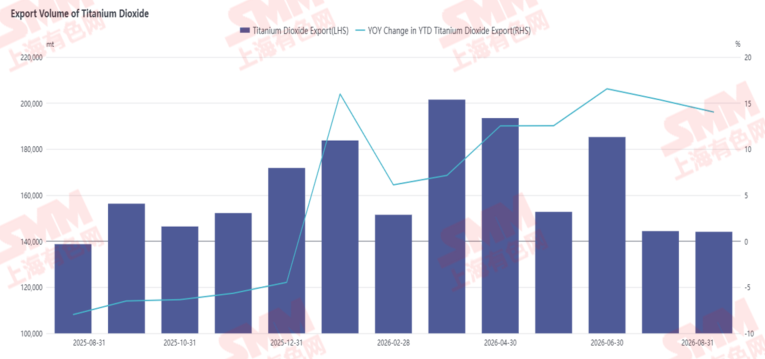
On the macro policy front: On September 21, the Eurasian Economic Commission decided to suspend anti-dumping measures against Chinese titanium dioxide, effective until August 10, 2027. After Russian domestic titanium dioxide enterprises faced production constraints in June, they proactively applied for a suspension of the duties, opening up China's export channel to Russia. By August, Russia had become China's second-largest export destination for titanium dioxide, accounting for 7.89%. Starting October 1, a mortgage interest subsidy policy for home purchases took effect, primarily targeting first-time homebuyer demand in second- and third-tier cities. If housing deliveries accelerate, post-renovation demand is expected to improve marginally, and titanium dioxide, as a raw material linked to the completion cycle, has expectations of demand recovery.
Market outlook: The titanium market is currently in a bottoming pattern characterized by weak cost support, ample supply, and sluggish end-use demand. The suspension of Eurasian anti-dumping measures, the mortgage interest subsidy policy, and growth in export orders are short-term positives, while the supply-demand imbalance in titanium concentrates, continued inventory buildup in titanium sponge, and slow recovery in end-use demand remain the core restraining factors. After the holiday, the market is likely to remain in a stalemate of "limited downside but lacking upward momentum." If end-use orders in mid-to-late October fall short of expectations and inventory destocking stalls, titanium product prices still face the risk of weakening again.
![[SMM Analysis] Canada's Sulphur and Sulphuric Acid Import and Export Data for August](https://imgqn.smm.cn/usercenter/xLlnY20251217171724.jpeg)