During the National Day holiday, China’s platinum group compounds market continued the recovery trend seen since September, with improved trading activity in the spot market. Over the past two weeks, upstream platinum group raw material prices have gradually stabilized. Downstream enterprises that previously adopted a wait-and-see attitude have launched phased inventory replenishment. Coupled with the transmission of the traditional "Golden September and Silver October" peak-season effect, the overall shipment pace of platinum group compounds has accelerated markedly. Structural divergence exists across varieties, with ruthenium, rhodium and iridium compounds outperforming platinum and palladium-based products by a notable margin.
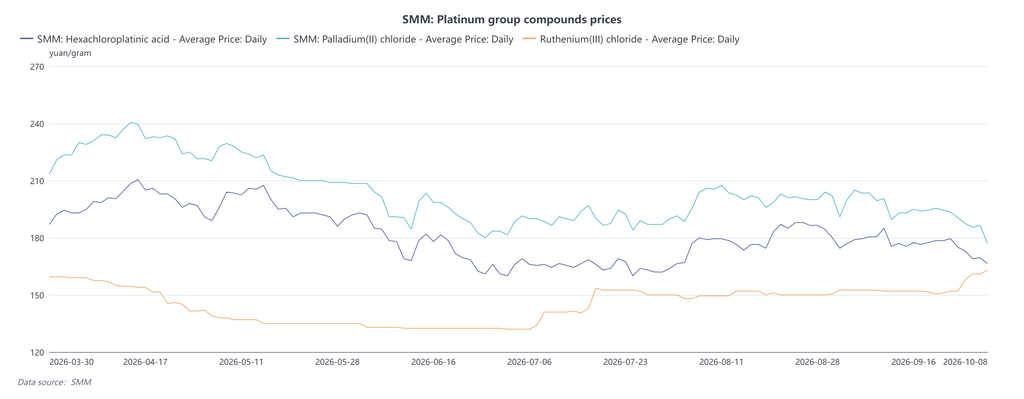
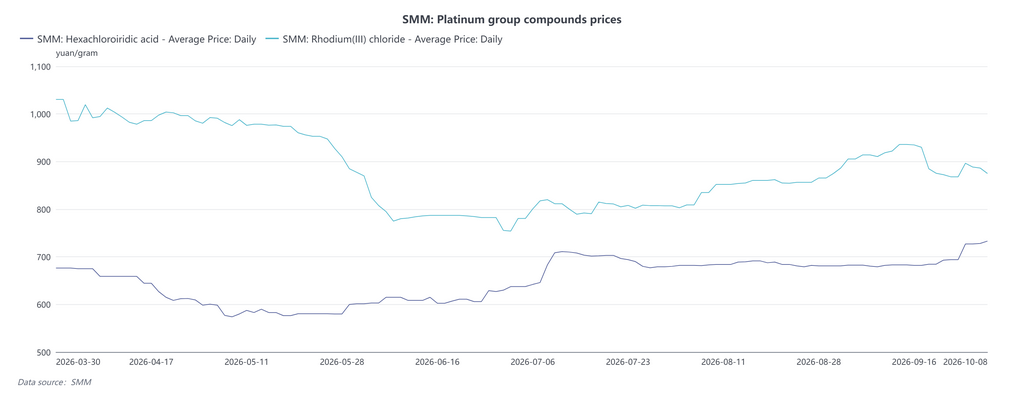
In terms of chemical demand, major domestic refining, PX, PDH and other core chemical units wrapped up their annual maintenance in a concentrated manner from late August to September and resumed production successively. The operating rate of the chemical sector kept rising, bringing about concentrated release of catalyst procurement demand and directly driving order growth for platinum group compounds. Chemical processes such as PDH and aromatics production extensively deploy ruthenium-, rhodium- and iridium-based catalysts. Demand for catalyst top-ups and replacements was unlocked after unit restarts, boosting shipments of ruthenium, rhodium and iridium compounds. While demand for platinum and palladium compounds also recovered, it saw steady improvement mainly tied to conventional automotive catalysis and general chemical supporting sectors, with relatively limited elasticity.
On the demand side, ruthenium, rhodium and iridium are driven by dual forces of industrial demand and investment demand. Industrially, besides higher catalyst consumption from restarted refining facilities, emerging sectors including semiconductors, optical communications and electrochemistry keep generating incremental demand to underpin rigid consumption of ruthenium, rhodium and iridium compounds. On the investment front, market recognition of the scarcity of ruthenium, rhodium and iridium has risen. Increased spot stockpiling and value-preservation purchases have further pushed up prices of upstream metal feedstocks. Rising raw material costs in turn support compound quotations, forming a positive feedback loop between demand and cost.
Platinum and palladium-based compounds only saw mild recovery. Following raw material price stabilization, downstream catalyst manufacturers replenish inventories as needed, yet lack strong incremental drivers. Transactions are dominated by rigid-demand orders, and their price volatility is lower than that of ruthenium, rhodium and iridium. Upstream raw material inventories remain generally adequate, speculative purchasing in the market stays relatively restrained, and spot premiums/discounts move within a narrow range.
Market outlook: In the short run, platinum group compounds will likely remain firm backed by high operating rates of chemical units. Key monitoring points include the operational stability of domestic refining plants and upstream platinum group raw material supply. It should be noted that ruthenium, rhodium and iridium feedstocks feature low supply elasticity. Related compound prices face correction risks if investment buying fades rapidly or chemical operating rates decline. Platinum and palladium compound prices are more subject to macro expectations and automotive catalyst demand, and are expected to fluctuate sideways.
![Platinum futures fell after the holiday, spot trades recovered [SMM Daily Review]](https://imgqn.smm.cn/usercenter/kLgYV20251217171736.jpg)