Zinc Market Review During the Holiday
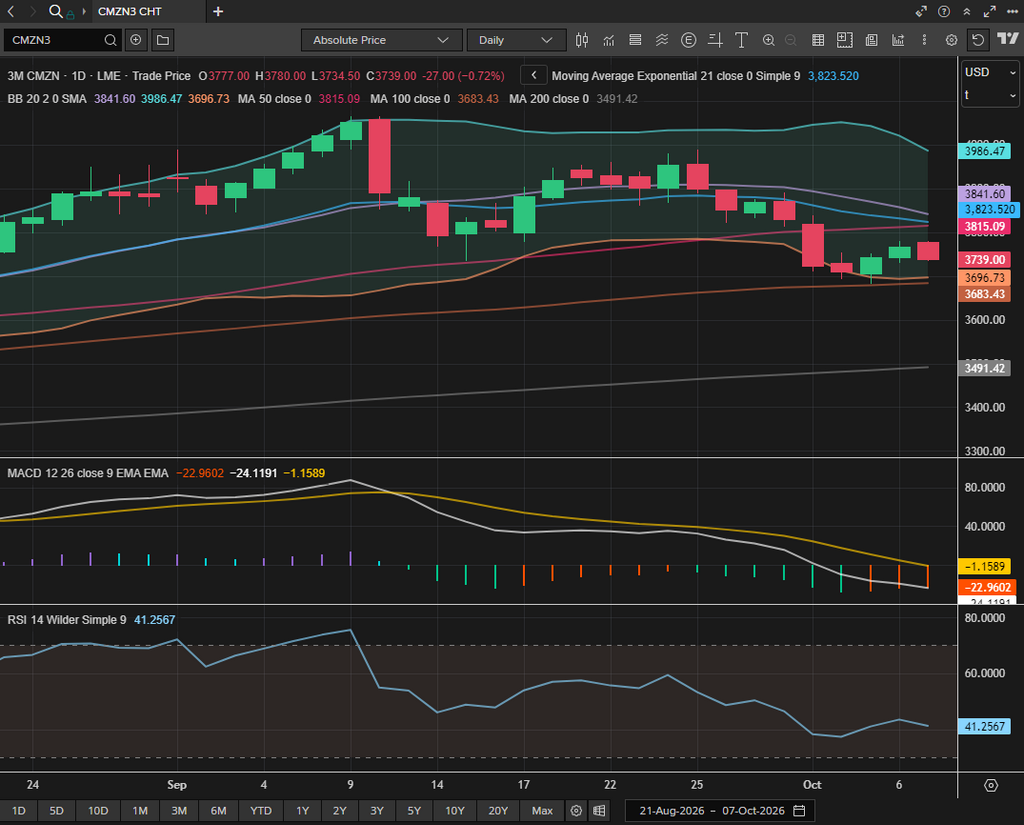
During China's National Day holiday, SHFE zinc trading was suspended, while LME zinc followed an overall 'down first, then up' trajectory.
On October 1, LME zinc opened at $3,820/mt and fell sharply by 2.28% to $3,728.5/mt, its lowest level since late August. The decline continued on October 2, when the electronic contract briefly broke below the $3,700/mt support level and touched approximately $3,693/mt before closing at $3,701.5/mt.
Following the release of the NFP data on the evening of October 2, LME zinc recovered above $3,700/mt and closed at $3,740.5/mt on October 5 before extending its rebound to $3,772.5/mt on October 6.
During Asian trading hours on October 7, LME zinc opened at $3,777/mt and initially fell to an intraday low of $3,735/mt before recovering amid volatile trading. The contract returned above $3,740/mt and stood at $3,763/mt as of 18:00 Beijing time. Following its correction and modest recovery, the price gradually stabilised while awaiting direction from the reopening of the SHFE market. LME zinc recorded a cumulative decline of 2.7% during this year’s National Day holiday.
In terms of LME market structure and inventories, the C-3M spread remained in backwardation but narrowed significantly. On September 30, LME cash zinc traded at a premium of approximately $85.77/mt over the three-month contract. The backwardation narrowed throughout the holiday and had fallen sharply to $39.10/mt by October 6.
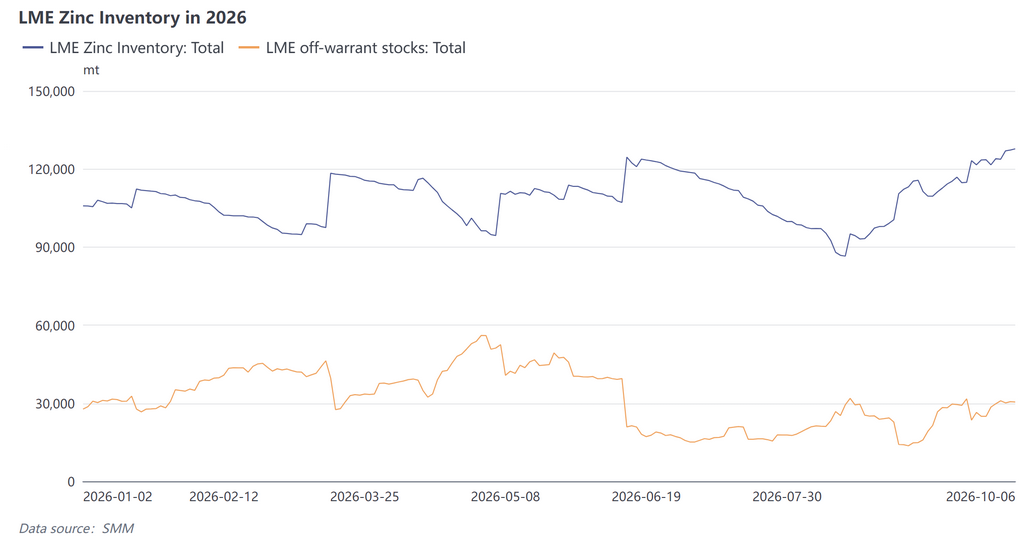
LME zinc inventories also continued to rise, increasing gradually from 124,000 mt on September 30 to 127,800 mt on October 6, a net gain of 3,800 mt. The increase was mainly recorded at warehouses in Hong Kong, China, and Kaohsiung, Taiwan, China. Off-warrant inventories remained broadly unchanged over the same period.
Rising inventories and a narrowing backwardation indicate that tightness in the overseas physical market has eased at the margin. However, absolute inventory levels remain low, while the pace of accumulation has slowed markedly. China’s latest zinc export window has now closed, but support from the current inventory structure has not disappeared.
On the macroeconomic front, a series of developments surrounding interest-rate expectations dominated LME price movements during the holiday.
At the end of September, immediately before the holiday, market sentiment was strongly hawkish. The US PMI rose to a multi-year high, while Federal Reserve officials made a series of hawkish comments. Williams said that one further rate increase might be needed this year, although there was no urgency to act.
The five-year US Treasury yield rose above 5% for the first time since 2007, while the ten-year yield climbed as high as 5.344%, its highest level since 2002. The US dollar index also strengthened to a 17-month high. Base metals came under broad pressure, and LME zinc closed at $3,701.5/mt on October 2, its lowest level in approximately six weeks.
Subsequently, the unexpectedly weak NFP data reversed market expectations and became the main catalyst for a broad rebound across base metals. Data released on the evening of October 2 Beijing time showed that the US economy added only 29,000 jobs in September, compared with expectations of 90,000 and the previous reading of 133,000. The increase was less than one-third of the market forecast, while the unemployment rate rose to 4.2%.
The July figure was revised down to a contraction of 10,000, while the August reading was lowered from 162,000 to 133,000. The two months were revised down by a combined 60,000. Average hourly earnings rose by only 0.1% month on month and 3.0% year on year.
According to CME data, the probability of an October rate hike plunged to 15–28%, after approaching 70–80% a week earlier. The US dollar retreated from its 17-month high, while Treasury yields moved lower.
When markets reopened on Monday, October 5, LME base metals rebounded across the board. Gold also briefly climbed above $4,220/oz before retreating. Although rate-hike expectations cooled sharply, the market continued to price in the possibility of a December increase, with the prevailing view shifting towards postponing action and reassessing conditions in December. The US dollar index remained elevated, indicating that macroeconomic pressure had not fundamentally reversed.
In terms of positioning, the LME COTR published on October 6 showed that LME zinc fell by more than 4.9% in the week ended October 2. During the same period, investment funds reduced long positions by approximately 4,900 lots and added around 2,500 lots of short positions. Their net-long position as a percentage of open interest fell from 13.4% to approximately 11.4%, while total open interest showed no significant change.
This alignment suggests that the decline during the first two days of the holiday was partly driven by trend-following and momentum funds selling into the technical breakdown, rather than solely by adverse macroeconomic developments.
Review of China's Domestic Fundamentals
On the supply side, tightness in the zinc concentrate market persisted but eased marginally, while widening smelter losses continued to constrain refined zinc output growth.
In the week before the holiday, the weekly average of the SMM Zn50 domestic zinc concentrate TC fell by 250 yuan to -2,350 yuan/metal mt. The imported zinc concentrate index declined by $5.32 to -$135.72/dmt. Both indicators remained weak, although the pace of decline gradually slowed.
With additional imported concentrate entering the market, smelters' raw-material inventories recovered slightly to more than 18 days. The downside potential for treatment charges is therefore expected to be limited going forward.
However, the combination of low TCs and weak sulphuric acid prices has widened smelting losses and dampened producers' willingness to operate. China's refined zinc output is expected to increase only modestly to approximately 564,000 mt in October, remaining below previous expectations.
On the demand side, orders from the transmission-tower sector and high-end small hardware manufacturers improved slightly, while most other order categories remained subdued. Weak ferrous-metal prices and elevated zinc prices constrained downstream purchasing, while export orders declined year on year.
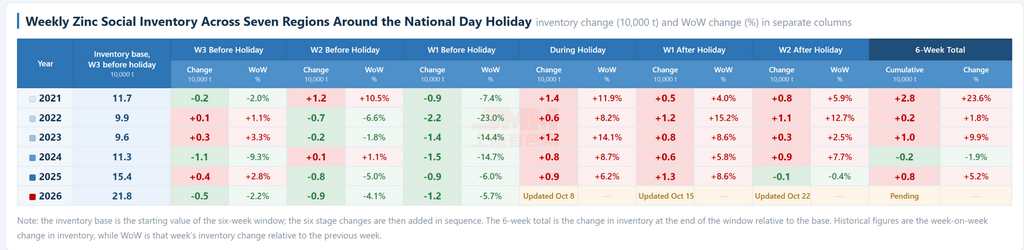
In terms of inventories, downstream users conducted relatively active pre-holiday restocking, pushing zinc ingot social inventories down further to 193,100 mt. Low inventories continue to provide downside support, although some accumulation pressure is expected after the holiday.
The SHFE/LME zinc price ratio remained around 6.8, with both the zinc import and export windows closed.
Post-Holiday Outlook
From a macroeconomic perspective, volatility in overseas markets is expected to remain elevated as expectations of further rate increases continue to fluctuate. The rebound on October 5 primarily represented a valuation recovery following the preceding decline. With the US dollar index remaining above 102 and the market still pricing in the possibility of a December rate hike, upside room for LME zinc remains constrained.
Looking ahead, the preliminary October Results of University of Michigan Surveys of Consumers, together with the preliminary October one-year inflation expectation, will be released at 22:00 Beijing time on Friday, October 9. September US CPI data will follow on October 14, providing the next set of evidence from the inflation side.
Risks associated with the LME market structure eased marginally during the holiday. Inventories accumulated to around 128,000 mt, while the Cash-to-three-month backwardation narrowed gradually to approximately $40/mt. However, the absolute inventory base remains low, meaning that structural tightness has not been fully resolved. Changes in LME inventories and cancelled warrants therefore require continued monitoring.
China's export window is temporarily closed. Against the current backdrop of tight overseas energy supply, any production cuts by overseas smelters due to elevated energy costs could cause the backwardation to widen again.
Domestically, active downstream restocking before the holiday brought forward part of post-holiday demand, creating some inventory accumulation pressure after the market reopened. However, amid widening smelter losses, refined zinc output is expected to increase only to approximately 564,000 mt in October, below previous expectations.
The scale of post-holiday inventory accumulation will be a key factor to monitor. If inventories rise by less than expected, SHFE zinc may demonstrate relative resilience, while the SHFE/LME price ratio could continue to recover.
Before the holiday, a State Council executive meeting discussed policy measures aimed at stabilising the property market, supporting employment and raising household incomes. The policy focus remains on stimulating consumption and stabilising the real estate sector. For zinc, the main transmission channels are galvanised-steel demand associated with home appliances, automobiles and property construction. Attention should therefore be paid to the post-holiday policy response and the extent to which these measures translate into actual consumption.
The above information is based on market data collected and assessed by the Shanghai Metals Market research team and is provided for reference only. This article does not constitute direct investment advice. Clients should exercise caution and make independent decisions. Shanghai Metals Market accepts no responsibility for any decisions made on the basis of this information.