
Prices held steady, waiting for China's direction
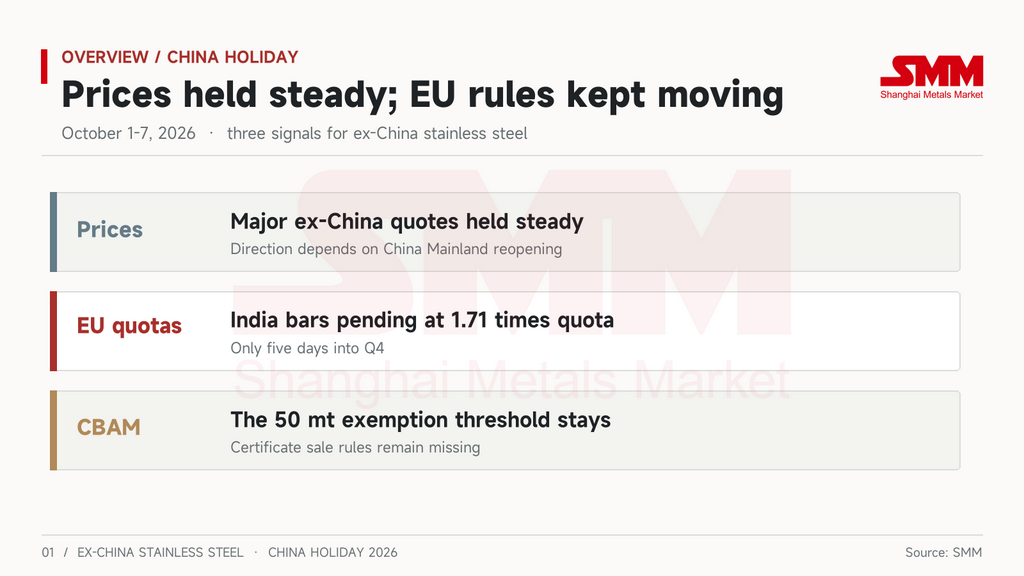
Ex-China stainless steel market held steady from October 1 to 7. Indonesian 304/2B FOB stood at $2,142.50/mt and CIF Belgium 304/2B at $2,740/mt.
With Wuxi, Jiangsu, China's main stainless spot hub, and the Shanghai Futures Exchange both shut, ex-China buyers and sellers had no reference price to follow. The post-holiday direction will depend on how China Mainland market reopens.
EU quotas: India's stainless long products overshot in five days
The EU's Q4 steel import quota period opened on October 1. According to European Commission data, within five days some quotas for Turkey, China Mainland, India, Australia, Taiwan (PoC), North Macedonia and "other countries" were already used up, most of them for carbon steel.
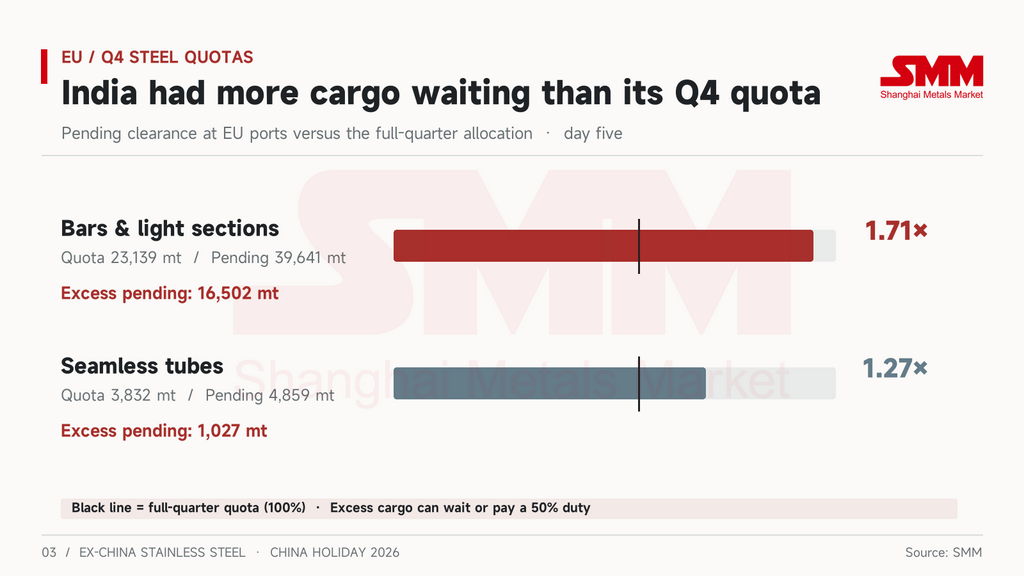
In stainless, India filled first. Its Q4 quota for stainless bars and light sections is 23,139 mt, yet 39,641 mt is already waiting for clearance at EU ports, 1.71 times the quarterly volume. For seamless stainless tubes, 4,859 mt is pending against a 3,832 mt quota, or 1.27 times.
Cargo beyond the quota either waits for the next quarter or pays a 50% out-of-quota duty on the excess. Most of it was shipped before the holiday. Indian 304 and 316 bright bar export offers had already eased in the week to September 29, as European buyers held back amid CBAM and quota uncertainty. With the quota full by day five, Indian stainless long product exports to Europe will be tightly capped in Q4.
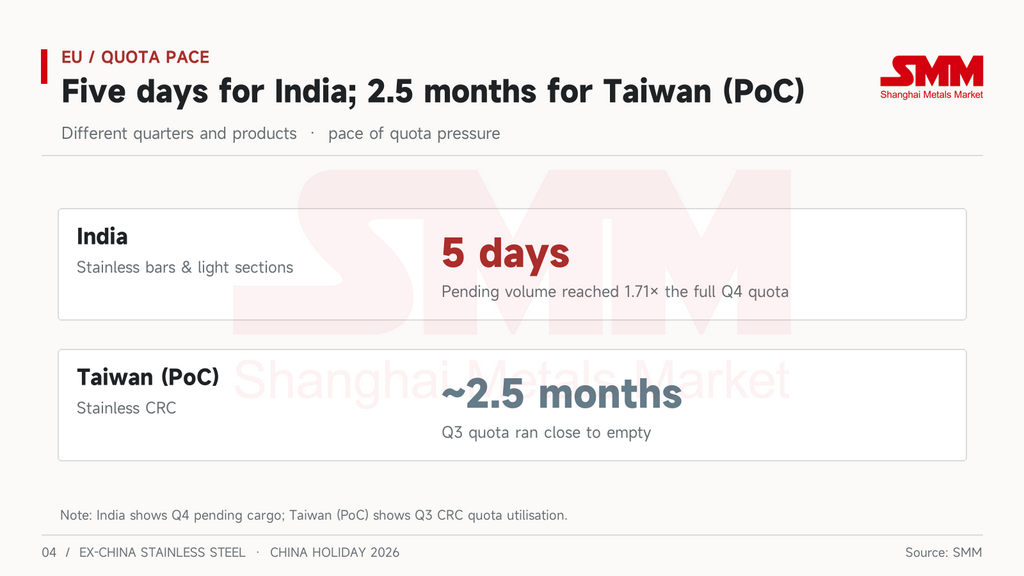
The pace has picked up sharply. In Q3, the tightest stainless quota, Taiwan (PoC)'s cold-rolled allocation, took two and a half months to run close to empty. This time India's long products took five days.
Brussels is collecting feedback, and slab is coming in through another door
On September 28, the Commission's trade and economic security directorate launched a targeted consultation on the first quarter of the new quota regulation (EU 2026/1384), closing on October 11. The questionnaire covers shortages, price changes, sourcing countries and the availability of specific grades. Complaints from downstream processors and traders about tight supply and higher prices will feed into the Commission's monitoring and could shape later quota adjustments.
On the cold-rolled side, the Commission opened an expiry review of countervailing duties on Indian and Indonesian cold-rolled coil (CRC) on September 30. That brings the number of concurrent proceedings on the same product to five. Under existing anti-dumping and countervailing duties, Indonesian CRC exports to the EU have fallen from their 2021 peak to almost nothing.
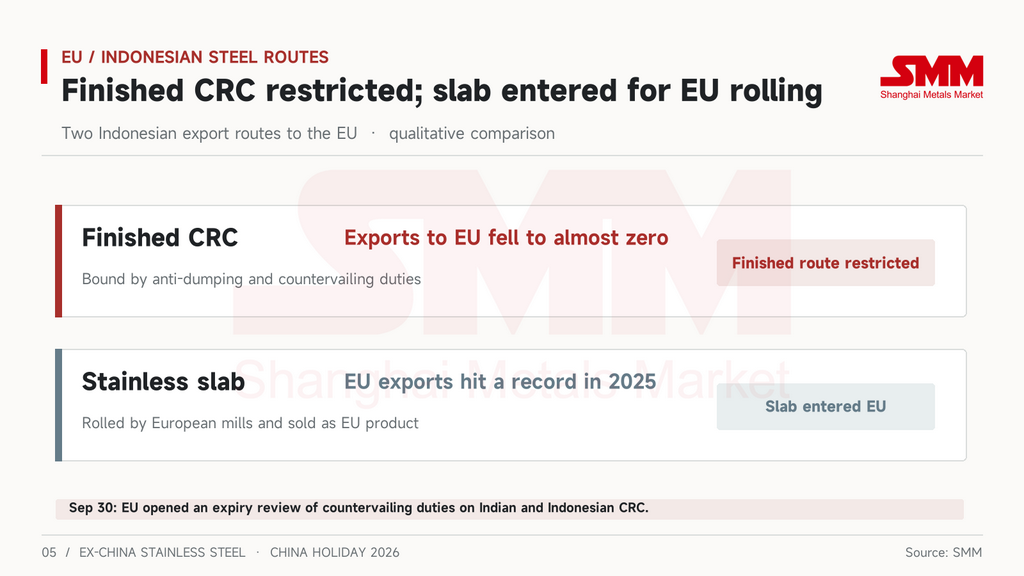
Indonesian stainless slab is not covered by those duties, and its exports to the EU hit a record in 2025. Once rolled by European mills, it is sold as EU product. Finished coil is kept out, while semi-finished steel comes in by another door. The next question is whether the reviews will take up subsidies on slab.
CBAM: the threshold stays, the certificate rules haven't arrived
On September 30, the EU's tax and customs directorate (DG TAXUD) published its review of the CBAM exemption threshold. CBAM is the EU's Carbon Border Adjustment Mechanism, which charges importers for the carbon embedded in steel and other goods. Over April 1, 2025 to March 31, 2026, the 50 mt annual import threshold exempted 0.87% of embedded emissions, below the 1% legal ceiling, so it stays unchanged.
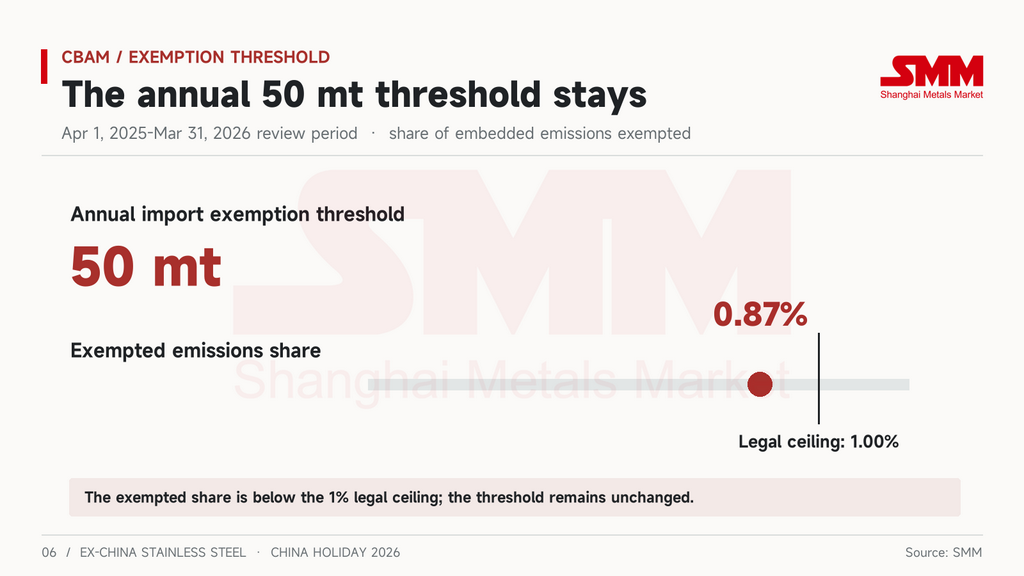
The review was due by April 30 and arrived 153 days late. It came as a single number, with no report, methodology or dataset, and no figure for how many importers it covered. Yet that threshold decides whether roughly nine in ten importers are exempt or face extra costs.
The bigger gap is certificates, where two pieces of legislation are still missing. The delegated act on how certificates are sold, bought back and priced was planned for Q2 and is now expected in Q4. Sales are due to open on February 1, 2027, and Parliament and Council have up to four months to object, so the rules risk missing the start date. The Article 9 implementing regulation, which would let importers deduct carbon prices already paid in the country of origin, has been in draft since May 13 and has not been adopted.
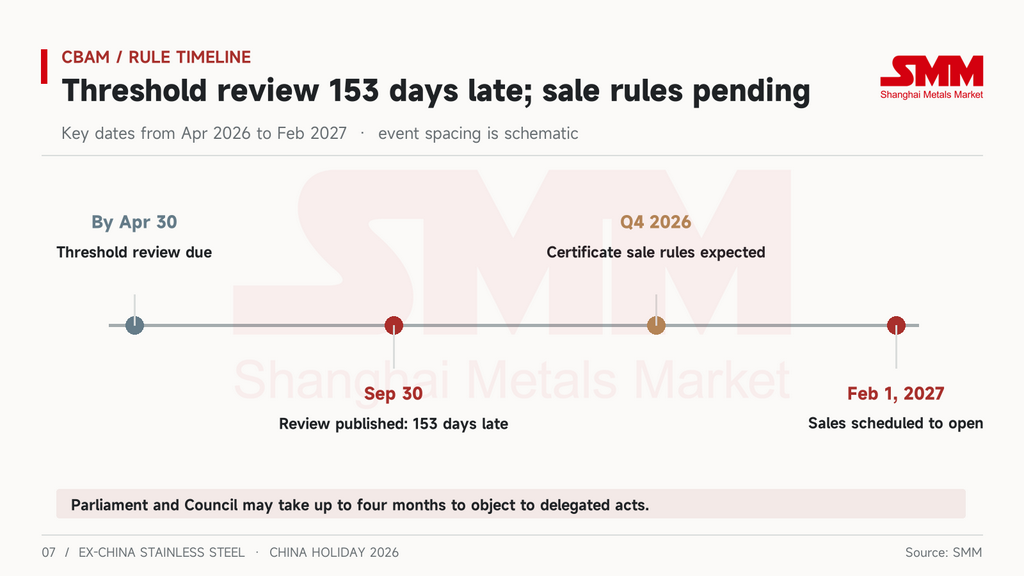
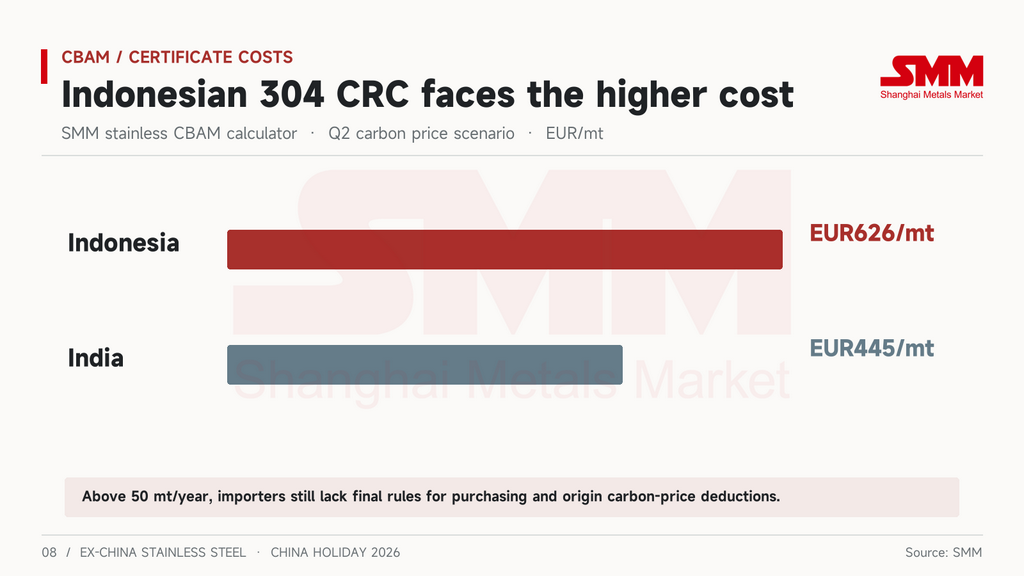
For stainless importers, the cost can be calculated but not yet paid. Under the Q2 carbon price scenario in SMM's stainless CBAM calculator, a tonne of Indonesian 304 CRC entering the EU carries about EUR626 in certificate costs, and Indian material about EUR445. Companies importing more than 50 mt a year still don't know how they will buy certificates, or whether carbon prices paid at origin will count.
Taiwan (PoC): a third list price rise faces its test
Yieh United and Tang Eng both raised October 304 flat product list prices, the third monthly increase in a row. Yieh United left 316L surcharges and 430 unchanged.
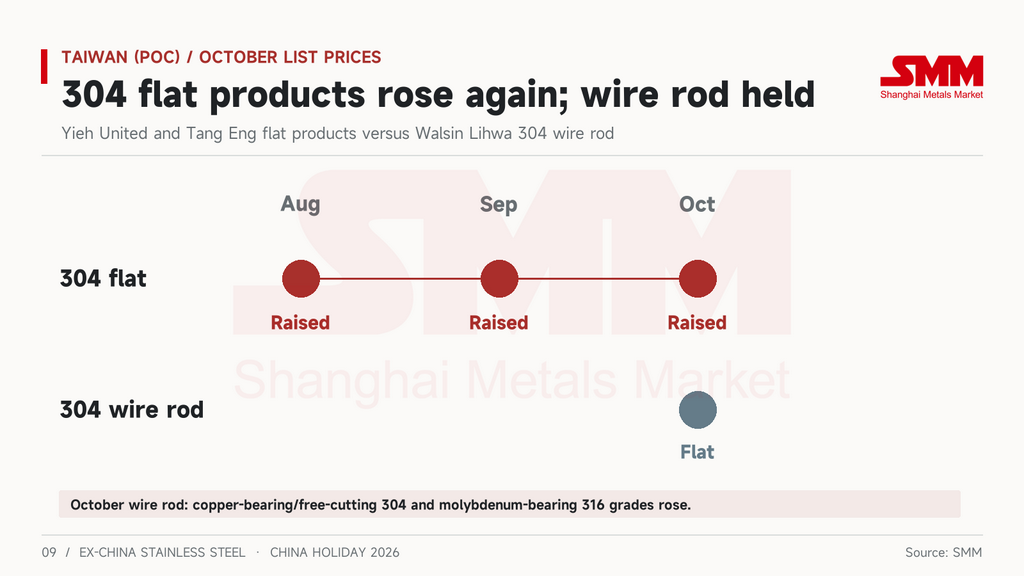
Wire rod went the other way. Walsin Lihwa held 304, 200-series and 400-series wire rod flat, raising only copper-bearing and free-cutting 304 and molybdenum-bearing 316 grades. It cited higher local scrap costs, but after a sharp September increase it held 304 to protect downstream export competitiveness. Taiwan (PoC)'s stainless wire rod export prices are at their highest in more than a year, while January–August export volume is still below last year.
The new flat product prices now have to get past distributors. Distributors have cut back on low-priced sales as their stock costs rise, so cheap material is getting scarcer, but deals will depend on how China Mainland trades after the holiday. Spot prices failed to follow list increases twice in Q3, and this is the third test. The preliminary injury determination in the anti-dumping case on Vietnamese CRC has been pushed back to October 16.
Pipe makers are moving closer to Europe. Froch plans trial runs at its Moroccan plant by year-end and commercial output in Q1 2027, aimed at European customers. YC Inox is lifting monthly output at its Turkish cold-rolling line by about another third, partly to avoid Turkey's duty on imported coil. Under the EU's melt-and-pour origin rule, though, where that coil was melted will decide what origin their products carry into the EU and which quota they use.
India: Europe tightens on scrap imports and finished exports
In the week to October 1, Indian 304 stainless scrap prices eased slightly in both domestic and import markets, while 316 held steady. Weaker LME nickel weighed on 304 during a quiet festival period, while tight 316 supply limited the downside. The government relaxed its pre-shipment inspection certificate (PSIC) requirement, but with little time left to comply and extra import costs, some mills are considering billets, slabs and NPI as substitutes for scrap.
Scrap supply may narrow further. Under its new Waste Shipment Regulation (WSR), the Commission proposes to drop India from the list of countries allowed to receive EU scrap metal. India's Material Recycling Association (MRAI) plans to file a formal request by October 15, including a proposal for a separate HS code for material that meets end-of-waste standards. The WSR takes effect in May 2027, with the first list of approved importers expected by year-end.
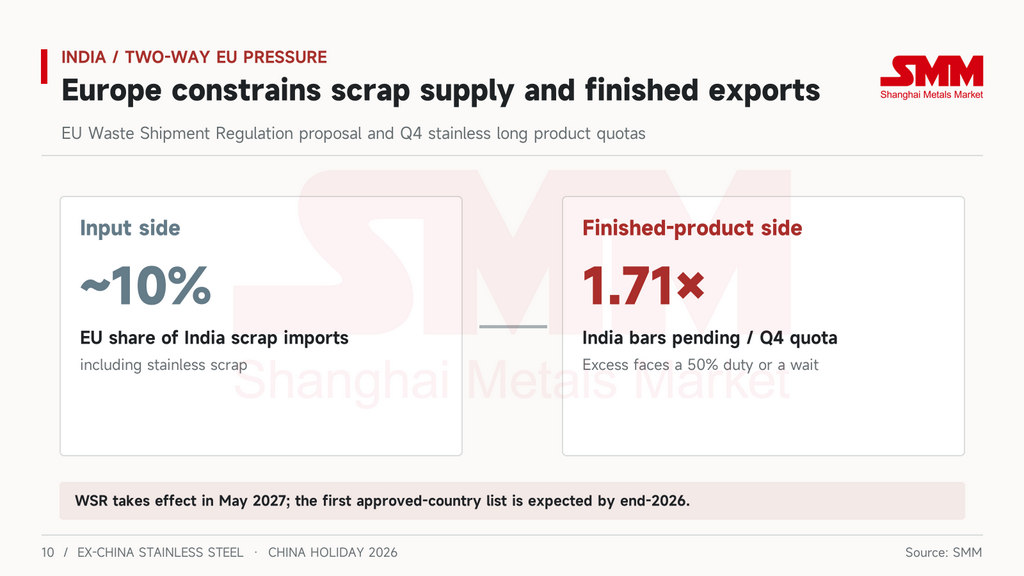
EU sources make up about a tenth of India's scrap imports, stainless included, so the overall hit is limited. Combined with the full long product quota, weak UAE demand and high freight, though, Europe is now tightening on India's scrap imports and its finished exports at the same time.
Elsewhere
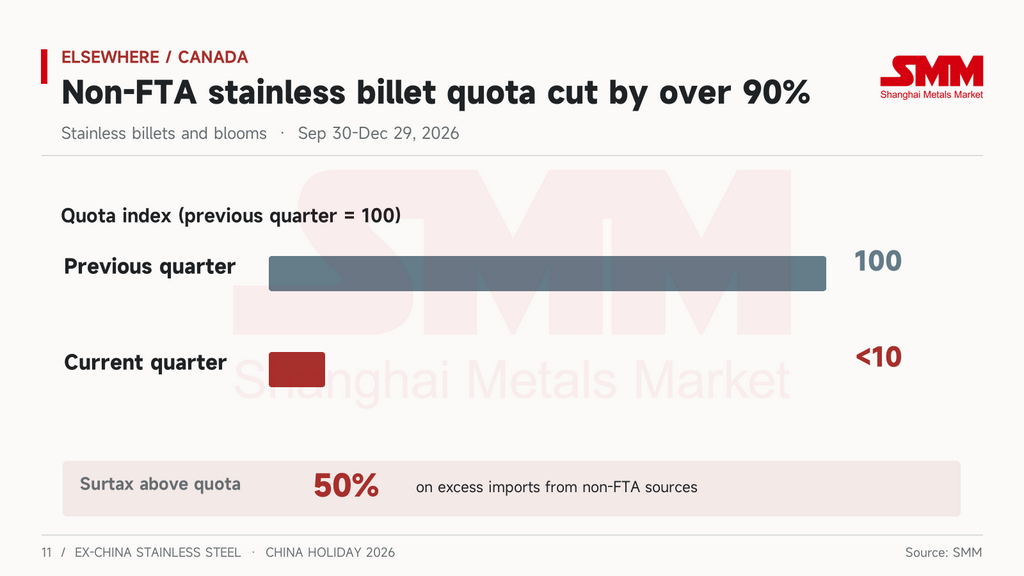
Canada's steel import quotas entered a new quarter on September 30, running to December 29. The non-FTA quota for stainless billets and blooms has been cut more than 90% to a token level, with a 50% surtax beyond it, which all but closes Canada to non-FTA semi-finished stainless.
In the UAE, GMI plans a special steel and pipe complex in Abu Dhabi that includes stainless, with phased start-up from 2028. The company expects the UAE to start importing scrap in early 2027.
In Indonesia, Bahlil Lahadalia was appointed Coordinating Minister for Downstreaming and Energy Transition on October 1 while keeping the energy and mineral resources portfolio. The official in charge of RKAB mining quotas and smelter investment policy is unchanged, but his remit is now wider.
Outlook
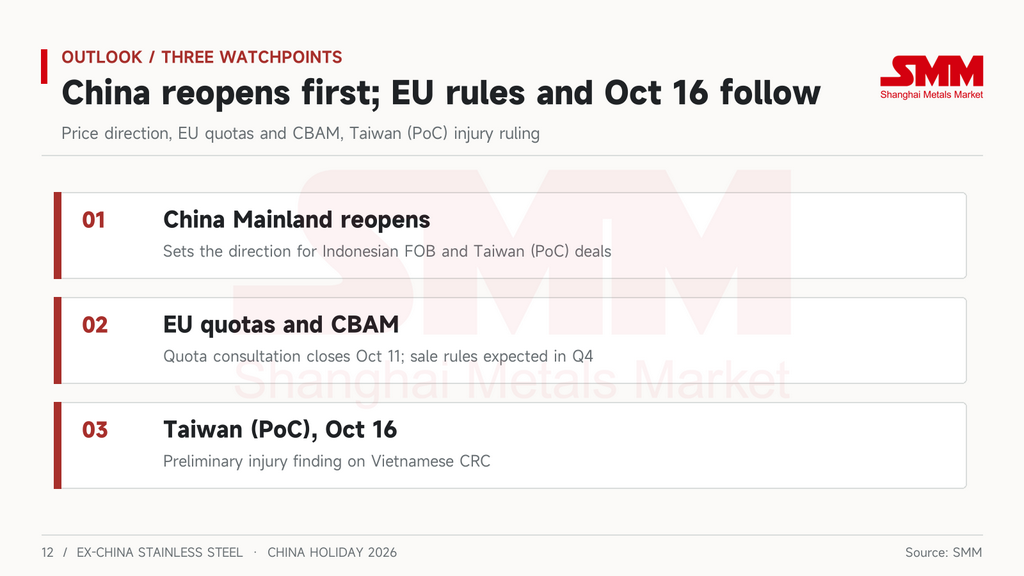
The first thing to watch is Wuxi's reopening. The direction of Chinese prices after the holiday will decide whether Indonesian FOB moves and whether Taiwan (PoC) distributors accept the new list prices.
In Europe, Indian long products stuck at port must choose between waiting for Q1 and paying the 50% duty, and the quota consultation closes on October 11. Whether the CBAM certificate rules arrive in Q4 will decide if sales can open on schedule in February 2027. Taiwan (PoC)'s preliminary injury ruling on Vietnamese CRC on October 16 will show whether local mills' list prices get the import protection they are counting on.
![[SMM Analysis] Nickel Sulphate Market Stays Quiet During National Day, Faces Price Pressure Amid Weak Demand](https://imgqn.smm.cn/usercenter/KFwsY20251217171734.jpg)
![[SMM Analysis] MHP Transactions in China Face Rebound Pressure; Cost and Supply Constraints Limit Downside](https://imgqn.smm.cn/usercenter/Btmsv20251217171733.jpg)