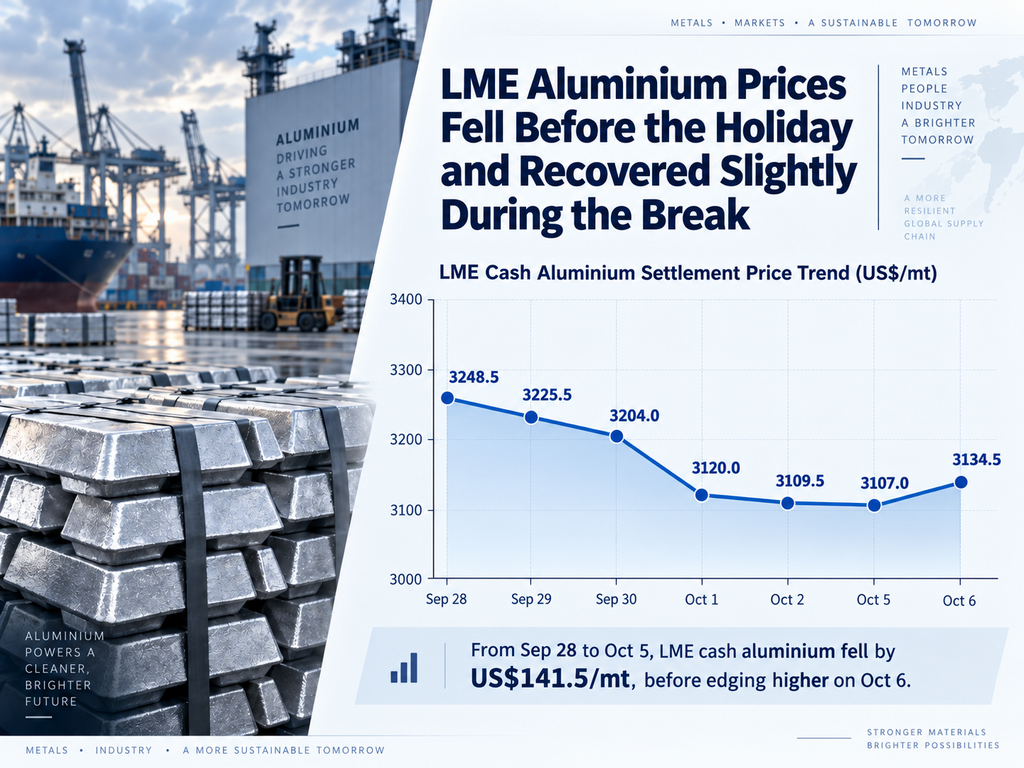
LME aluminium prices retreated sharply from late September into early October, reversing part of the gains built up during the previous rally.
The LME aluminium cash settlement price fell from $3,248.5/t on September 28 to $3,204/t on September 30. The decline accelerated after the start of October, with prices dropping $84/t in a single session to $3,120/t on October 1, before slipping further to $3,109.5/t on October 2.
By October 5, the cash settlement price had fallen to $3,107/t, down $141.5/t, or 4.36%, from September 28. Compared with the earlier stage high of around $3,350/t, the correction exceeded $240/t, or roughly 7%.
Prices recovered modestly to $3,134.5/t on October 6, but remained well below the previous highs.
The correction does not appear to reflect a sudden deterioration in the current physical balance alone. Instead, the market is increasingly shifting from pricing supply disruption risk toward pricing supply recovery and a potentially looser future balance.
Macro pressure amplified the correction
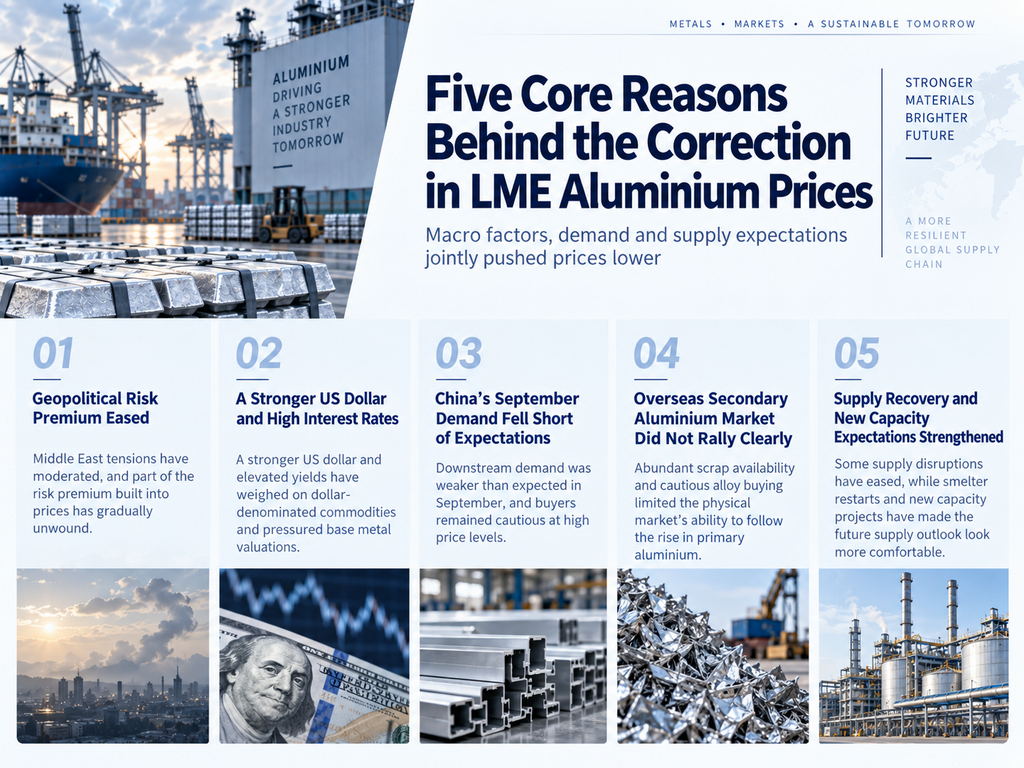
A stronger US dollar and elevated interest rates were among the key drivers of the recent decline.
After aluminium had already rallied to relatively high levels, a stronger dollar reduced the attractiveness of dollar-denominated commodities, while high interest rates continued to weigh on broader risk appetite and manufacturing expectations.
At the same time, some investors took profits following the earlier rally, adding momentum to the sell-off.
By October 6, upward momentum in the dollar had eased somewhat, helping aluminium stabilise around the $3,100/t level. However, the broader macro environment remains a headwind, particularly if high interest rates continue to limit global industrial demand.
Geopolitical risk premium begins to unwind
Earlier gains in aluminium were partly supported by supply concerns linked to geopolitical tensions in the Middle East.
The Gulf remains an important production and export hub for primary aluminium, and the market had been closely watching shipping risks, energy supply and smelter operations. These concerns pushed a meaningful supply-risk premium into aluminium prices.
As some production and logistics conditions gradually normalised, fears of an extreme supply shortage began to ease.
The market is therefore no longer focused only on whether additional disruptions could occur. Attention is increasingly shifting toward how quickly affected supply can recover and when new capacity will be brought online.
This change in expectations has contributed to the unwinding of part of the premium accumulated during the previous rally.
China's weaker peak-season demand added to bearish sentiment, but was not the main driver
China's traditional "Golden September and Silver October" demand recovery also fell short of earlier expectations.
Downstream buyers remained cautious at high prices, with procurement still largely driven by immediate needs. Domestic aluminium prices also came under pressure, with the SHFE nearby continuous contract settlement price declining from around RMB 24,225/t on September 24 to RMB 24,035/t on September 29.
As China remains one of the world's largest aluminium-consuming markets, weaker domestic demand expectations added to bearish sentiment in the global market.
However, the correction in LME aluminium was noticeably larger than that in SHFE aluminium, suggesting that China demand was not the dominant force behind the overseas decline.
Instead, weaker Chinese demand acted more as an additional drag, while the deeper LME correction was driven mainly by overseas macro pressure, profit-taking, the unwinding of geopolitical risk premium and insufficient physical support at elevated price levels.
Physical markets did not fully confirm the earlier rally
The physical market also showed limited willingness to chase the previous rise in primary aluminium prices.
In Asian secondary aluminium markets, UBC availability remained relatively ample in some regions, while Tense trading was still slow and buyers of secondary aluminium alloys remained cautious about accepting higher prices.
Labour-related disruptions at some major South Korean aluminium producers also contributed to higher UBC inventories in parts of Japan and South Korea, prompting some suppliers to look for alternative export markets.
Meanwhile, downstream die-casting demand did not improve strongly enough to allow secondary aluminium producers to fully pass higher raw-material costs through to customers.
This created a widening gap between financial-market strength and actual physical demand.
In other words, the earlier rise in primary aluminium prices was not fully validated by downstream purchasing conditions.
Low inventories have not prevented prices from falling
One notable feature of the current correction is that it has occurred while visible overseas aluminium inventories remain relatively low.
That means the market is not yet showing a clear physical surplus.
Under normal circumstances, low visible stocks would be expected to support prices. But the latest move highlights an important distinction: financial markets do not trade only on today's inventory position.
They also price expectations for the next three to six months.
If investors expect Middle East supply to recover, overseas smelters to restart, new capacity to ramp up and more aluminium products to reach international markets, prices can weaken even before inventories begin to rise materially.
This suggests that the current correction is being driven more by expectations of a less tight future balance than by evidence of an immediate physical oversupply.
Market focus shifts from supply disruption to supply recovery
This is becoming one of the most important changes in the current aluminium market.
During the earlier rally, the market was largely focused on:
Where could supply be disrupted next?
The question is now shifting toward:
Which disrupted supply can return, and how quickly can new capacity be added?
Higher aluminium prices have improved the economy of restarting some previously curtailed or high-cost smelting capacity.
At the same time, new aluminium projects in Indonesia, the Middle East, Central Asia and other emerging markets are becoming increasingly relevant to the medium-term supply outlook.
Indonesia is particularly important. Investment across its alumina, primary aluminium and supporting energy sectors continues to expand, and future ramp-ups could alter the structure of Asian aluminium supply.
Even if the physical market remains relatively tight today, expectations of improving supply over the coming months can place downward pressure on prices in advance.
China's aluminium exports and global trade flows remain another key variable
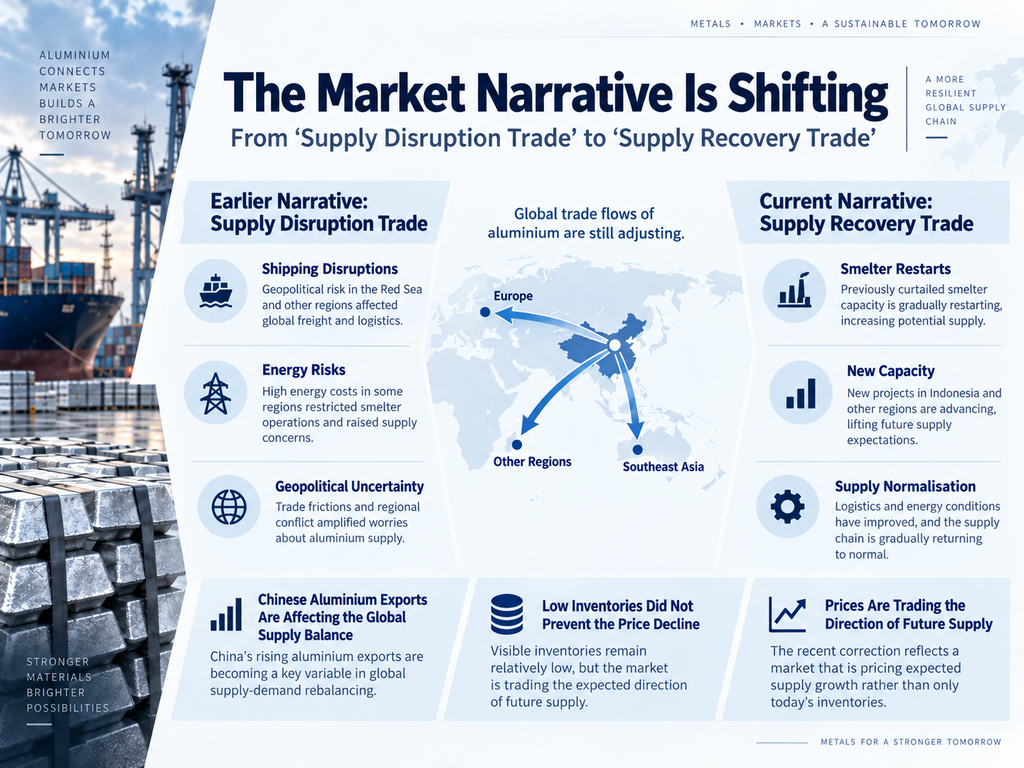
China’s aluminium exports are also becoming increasingly important for the global balance.
If domestic demand remains relatively soft while production stays high, more aluminium products may move into overseas markets.
With regional premiums and price differentials still elevated in some markets, changes in Chinese export competitiveness could affect the amount of effective supply available internationally.
For the global aluminium market, the key issue is therefore not only how much metal is produced, but also where it flows.
Trade patterns between Asia, the Middle East, Europe and North America are increasingly shaped by tariffs, regional premiums, energy costs and geopolitical risks.
As regional price gaps widen, metal is likely to move toward markets offering better returns.
LME aluminium stabilises near $3,100/t, but the rebound remains tentative
After the sharp fall on October 1, downward momentum began to slow.
The LME aluminium cash settlement price remained around $3,107–3,110/t between October 2 and October 5, before recovering to $3,134.5/t on October 6.
The move suggests that some buying interest has emerged around the $3,100/t level, while profit-taking by short positions may also have contributed to the rebound.
However, the recovery should still be viewed as a low-level stabilisation after a sharp correction, rather than confirmation of a new upward trend.
China remained in its National Day holiday on October 7, meaning that domestic physical demand had not yet fully returned to the market.
The strength of post-holiday procurement will therefore be an important test for the next stage of price direction.
Market Outlook: aluminium is entering a broader repricing phase
SMM believes the recent decline in LME aluminium reflects a combination of factors rather than a single bearish trigger.
Macro pressure from the strong dollar and high interest rates weakened investor appetite, while geopolitical and supply-risk premiums began to unwind.
China's weaker-than-expected peak-season demand added to the negative tone, but was not the main driver of the LME correction.
At the same time, physical markets did not provide enough support for the earlier high prices, while expectations for supply recovery and new capacity additions have become increasingly important.
The key point is that the market is beginning to price a potentially looser future balance even though visible inventories remain relatively low today.
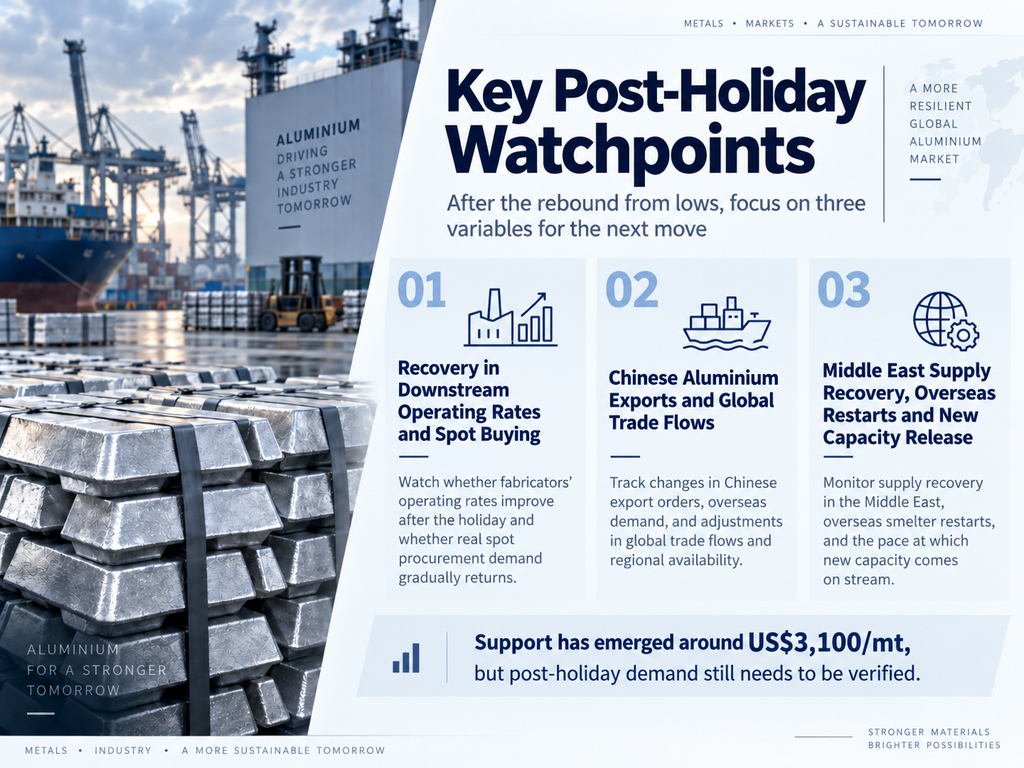
In the short term, the $3,100/t level has shown some support, but whether the rebound can extend will depend on three factors:
- whether Chinese downstream demand and physical procurement recover after the holiday;
- whether Chinese aluminium exports and global trade flows continue to increase effective overseas supply;
- how quickly Middle East supply, overseas smelter restarts and new capacity in Indonesia and other regions materialise.
If physical demand improves while supply recovery is slower than expected, low inventories could once again provide support to prices.
If demand remains soft while supply expectations continue to improve, LME aluminium may continue to unwind part of the premium built up during the previous rally.
Overall, aluminium is moving away from a relatively one-dimensional supply-risk trade and into a broader repricing phase driven by macro conditions, physical demand, supply recovery and global trade flows. Short-term volatility is likely to remain elevated.
![[SMM Analysis] LME Aluminum Price Pulls Back Rapidly Before the Holiday, Then Recovers from Lows: Why Did It Fall Below $3,150/mt?](https://imgqn.smm.cn/usercenter/RLjGN20251217171652.jpg)