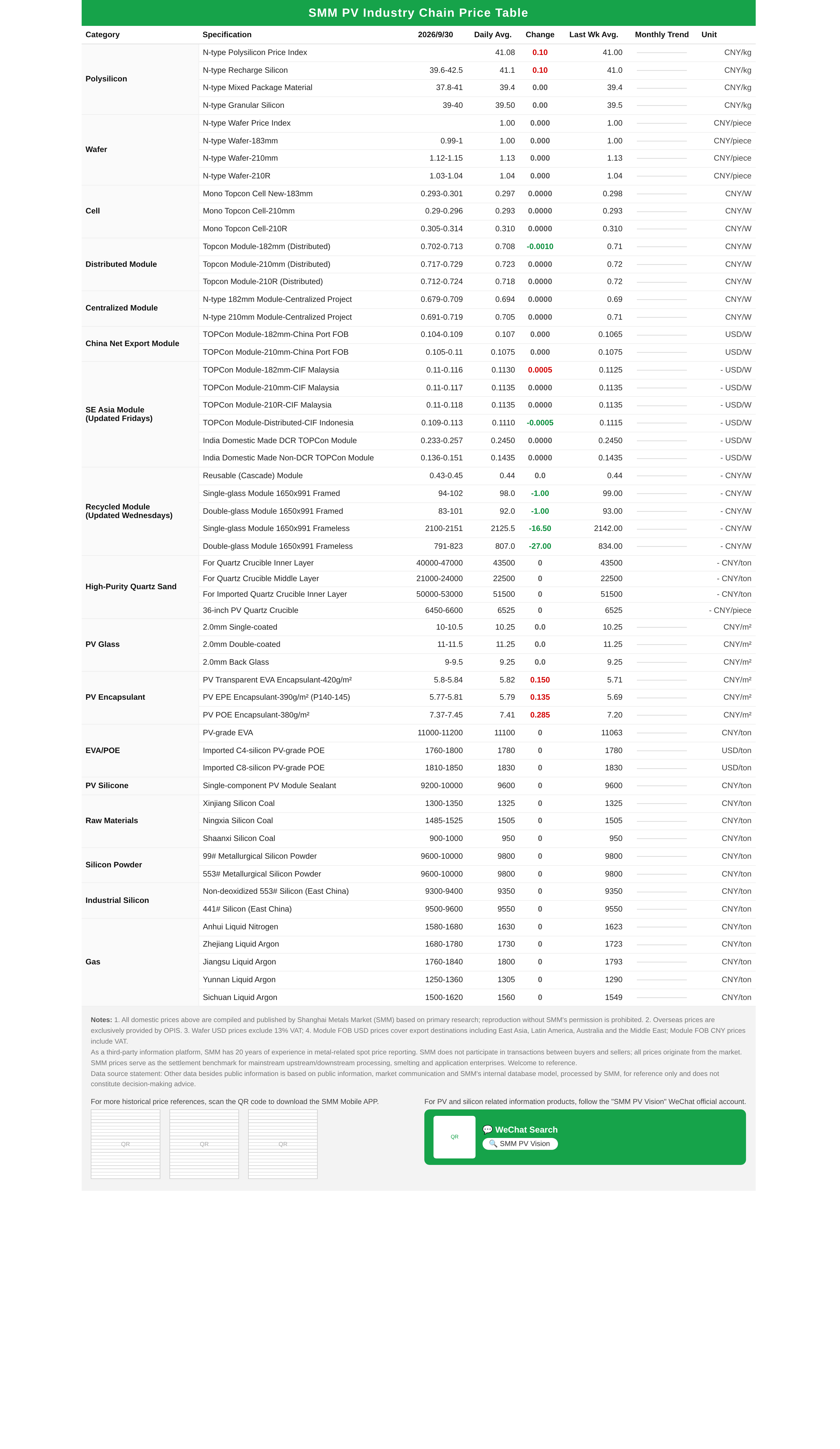
Polysilicon: This week, the polysilicon price index stood at 41.08 yuan/kg, with N-type recharging polysilicon quoted at 39.6-42.5 yuan/kg and granular polysilicon quoted at 39-40 yuan/kg. Market quotes edged up this week, mainly driven by large-order transactions from a few top-tier players in the latter half of the week. The number of transactions remained weak, and a wait-and-see sentiment persisted between upstream and downstream. Expectations for polysilicon production cuts in October are significant, with production expected to fall nearly 20% MoM, mainly due to production-cut meetings and the dry season. The reductions are concentrated in the Southeast, Inner Mongolia, and Xinjiang.
Wafer: Wafer prices remained stable this week. N-type 183 wafers were priced at 0.994-1.002 yuan/piece, 210R wafers at 1.026-1.044 yuan/piece, and 210mm wafers at 1.119-1.145 yuan/piece. As the holiday approaches, pre-holiday stockpiling has largely wound down, with strong wait-and-see sentiment on both sides and a decline in actual market transaction activity. Overall, wafer prices are expected to remain stable in the short term. Going forward, attention should focus on polysilicon price changes, the recovery of downstream purchases after the holiday, and the pace of wafer inventory digestion.
Solar cell: The solar cell market was generally stable this week. Producers broadly held quotes steady ahead of the holiday, while industry supply continued to contract. However, demand from the module side showed structural divergence, with limited release of overall rigid demand from modules, and the tug-of-war between upstream and downstream persisted. The overall market was dominated by pre-holiday price-stability sentiment, maintaining a consolidating and stable trend in the short term, though fundamentals varied by size. Pre-holiday market sentiment was cautious, with solar cell prices across all sizes basically stable and fluctuations minimal. Fundamentals by size diverged notably: 183 prices held steady in the range of 0.293-0.301 yuan/W, with weak demand both in China and overseas and overall sluggish transactions; 210R prices remained in the range of 0.305-0.314 yuan/W, supported only by export orders outside China, showing relatively strong price resilience, but at current elevated levels, domestic module producers showed insufficient acceptance and cautious purchasing, resulting in weak domestic sales and a clear pattern of "stable outside China, weak in China"; 210N prices fell within 0.29-0.296 yuan/W, benefiting from concentrated pre-holiday stockpiling by downstream module producers, with demand clearly improving. At this stage, downstream module enterprises are only selectively stockpiling 210N, while most enterprises remain in a wait-and-see mode overall. Price bargaining between upstream and downstream continues, and with strong pre-holiday market sentiment to maintain stability, solar cell prices across all sizes are likely to remain stable in the short term. Industry supply continued to contract, with overall production in September pulling back notably from August. Looking ahead to October, industry production schedules are expected to decline further. On one hand, several producers plan to use the National Day holiday for production line maintenance shutdowns; on the other hand, some enterprises continue to advance technological transformation and upgrades of production lines. With these dual reduction factors combined, overall industry supply will continue its downward trend, gradually easing supply-side pressure. This week, solar cell inventory continued to pull back slightly. Pre-holiday stockpiling coupled with overseas demand support drove a phase of industry-wide destocking, with notable structural divergence by size. Among them, 210R continued to destock on the back of overseas export orders, with producer inventory remaining tight and inventory pressure the lowest. 210N benefited from the release of pre-holiday restocking demand from domestic modules, with an improved pace of shipments and solid destocking performance. 183 saw mediocre overall demand in China and overseas, with relatively low sell efficiency and a slower destocking speed. Overall, pre-holiday inventory pressure was alleviated in phases, but this round of destocking was driven by short-term holiday effects. After the holiday, downstream stocking demand is expected to fade and purchases return to mediocre levels, leaving a high risk of renewed industry inventory buildup, which remains a key market variable to track going forward.
China modules: In the final week of September, China module prices finally halted the downward shift in price center seen over previous weeks, with quotes across all specifications largely flat. On the distributed side, enterprise guidance prices remained unchanged. Among the six specifications, only 182mm pulled back slightly by 0.001 yuan/W to 0.7075 yuan/W, while the rest held steady. Cost support locked in the downside for prices, with short-term consolidation expected to persist and no trend-like downward move likely. On the centralized side, after concentrated cuts last week, the market shifted to a wait-and-see stance. Quotes across all three specifications were flat this week, with deliveries still dominated by execution of earlier orders. Marginal improvement on the demand side has yet to translate into price elasticity. As of now, the average price of China Topcon module-182mm (distributed) is 0.7075 yuan/W; Topcon module-210mm (distributed) is 0.723 yuan/W; Topcon module-210R (distributed) is 0.718 yuan/W; Topcon module-210R high-power (distributed) is 0.757 yuan/W; BC module-210R (distributed) is 0.7635 yuan/W; HJT module-210mm (distributed) is 0.732 yuan/W. On the centralized side, the 182 module price is 0.694 yuan/W, the 210 module price is 0.705 yuan/W, and the 210R module price is 0.7 yuan/W. On the inventory front, month-end destocking accelerated somewhat. Domestic module producer finished-goods inventory has fallen to below 27 GW, declining continuously since mid-September. Inventory is expected to rebound during the holiday due to reduced downstream purchases, but is expected to continue declining after the holiday under the impact of centralized batch deliveries.
Module FOB exports:
This week, module FOB export prices were largely stable. Market inquiries and transactions turned further subdued. Most producers have no plans to adjust prices for now, with actual orders mainly negotiated on a case-by-case basis and limited trading volume. Current low-priced supply is concentrated in 610-625W inventory and some non-mainstream grade products, with individual transaction prices falling to $0.103-0.104/W, exerting some impact on price-sensitive markets. High-power TOPCon modules maintained their premium overall, with only a few products above 645W seeing slight downward quote adjustments of $0.001/W; BC module prices remained stable. Looking ahead to October, top-tier producer quotes are expected to remain largely stable, while some second-tier producers may attempt modest price increases. However, before the new national standards take effect in China, the practice of sacrificing margins to secure orders is unlikely to fully subside. As of today, PV module export FOB prices are as follows: TOPCon 182mm modules at $0.104–0.109/W, 210mm modules at $0.105–0.110/W, and 210R modules at $0.105–0.110/W; high-power TOPCon 210R modules at $0.110–0.116/W; BC 210R (66/72-cell) modules at $0.115–0.126/W, and BC 54-cell modules at $0.131–0.142/W.
Module CIF Southeast Asia:
This week, the Southeast Asian module market continued to move sideways. Some distributors kept clearing inventory of 620W and below at low prices, with competition in low-power product sales remaining relatively evident; demand for standard and high-power modules was relatively weak, while end-user procurement remained dominated by low-priced small orders, resulting in limited overall trading volume growth. As of today, TOPCon module CIF prices across Southeast Asian markets are as follows:
In Malaysia, 182mm module CIF prices were $0.110–0.116/W, 210mm modules at $0.110–0.117/W, and 210R modules at $0.110–0.117/W;
In Indonesia, distributed TOPCon module CIF prices were $0.109–0.113/W;
In Thailand, 182mm module CIF prices were $0.109–0.115/W, 210mm modules at $0.109–0.116/W, and 210R modules at $0.109–0.116/W;
In Vietnam, 182mm module CIF prices were $0.107–0.113/W, 210mm modules at $0.107–0.114/W, and 210R modules at $0.107–0.114/W.
By market, Malaysia saw only a small number of low-priced orders concluded, with overall procurement growth still not evident; the Indonesian market continued to await the release of project demand. According to SMM, the latest PLN project guidelines require Tier 1 qualification for modules, meaning relevant projects must in principle use modules supplied by Tier 1 manufacturers. Attention should be paid to how this requirement is implemented in specific tender projects. Trading volume in the Thai market remained limited; if the PDP 2026 draft is formally implemented, its installation plans and project arrangements will become an important driver of local demand. The Vietnamese market continued to operate steadily.
India modules: This week, the Indian module market saw limited overall changes, with DCR and non-DCR modules continuing to operate on a dual-track basis and prices remaining stable. As of today, India-made DCR TOPCon module prices are $0.233–0.257/W, while non-DCR TOPCon module prices are $0.136–0.151/W. DCR modules continue to be supported by year-end local project delivery demand, while external demand for non-DCR modules maintains a certain momentum, with no notable change in market transaction pace. On the inventory side, India DCR module inventory pulled back slightly to 13.48 GW, and DCR solar cell inventory further declined to 3.62 GW. It is understood that after the new US "Section 232 policy" takes effect, its impact is expected to gradually transmit to India module orders and shipments. With import volume controls and stricter scrutiny of abnormal volume releases, enterprises may gradually turn more cautious about the pace of stockpiling for the US. Subsequently, export demand from India's non-DCR modules to the US may face some pressure.
Europe module:
This week, the European module market continued its weak recovery trend, with transactions still dominated by urgent restocking and small distribution orders, while low-price competition for large centralized orders has yet to ease. Some distributors continued to clear 610–625W inventory. Against the backdrop of poor project returns, low-priced inventory products are expected to impact shipments of some conventional modules, while most top-tier producers maintained stable quotes. The Solar & Storage Live in Birmingham, UK, also concluded last week. The exhibition has not yet released notable large-scale incremental orders, but driven by policy, UK distributed market demand showed marginal growth this year, and the shipment performance of local distribution channels overall was relatively good. Actual transaction prices were similar to those in other mainstream European markets, providing still limited support for overall prices outside China. As of now, the DDP Ex-warehouse Rotterdam TOPCon module prices are as follows: distributed 210R (48-cell) modules at €0.1084–0.1170/W, distributed 210R (66/72-cell) modules at €0.1017–0.1117/W; centralized 210R (66/72-cell) modules at €0.0993–0.1092/W, and centralized 210mm (66/72-cell) modules at €0.0997–0.1096/W. Based on average prices by version, Portugal and Greece warehouse prices are both about 2.2%–2.4% higher than Rotterdam.
End-user: This week, PV modules showed a situation of falling prices and declining volumes. According to SMM statistics, from September 21 to September 27, 2026, domestic enterprises won bids for 41 PV module projects, with a single-week weighted average price of 0.71 yuan/W, down 0.02 yuan/W from the previous statistical period; total awarded procurement capacity was 1,291.42 MW, a decrease of 4,153.02 MW from the previous statistical period.
According to SMM analysis, the main awarded capacity in the current statistical period fell within the 200MW–500MW range, accounting for 87.50% of the total disclosed awarded capacity. The specific conditions of each capacity range are as follows:
For the 0MW-1MW section, there were 7 projects, accounting for 0.17% of capacity, with an average price of 0.705 yuan/W;
for the 1MW-6MW section, there were 5 projects, accounting for 0.83% of capacity, with the average price undisclosed;
for the 6MW-50MW section, there were 4 projects, accounting for 3.78% of capacity, with an average price of 0.873 yuan/W;
for the 50MW-100MW section, there was 1 project, accounting for 7.73% of capacity, with an average price of 0.688 yuan/W;
for the 200MW-500MW section, there were 4 projects, accounting for 87.50% of capacity, with the average price undisclosed.
According to SMM analysis, the weighted average price for the current statistical period was 0.71 yuan/W, down 0.02 yuan/W from the previous week.
In terms of total awarded procurement capacity, the week recorded 1,291.42MW, a decrease of 4,153.02MW from the previous statistical period. The main reason was that two framework procurement projects were opened in the previous statistical period: the 3,000MW section of the "China Railway Construction Network Information Technology Co., Ltd. 2026-2027 PV Module" project awarded to TrinaSolar Co., Ltd., as well as the 1,000MW Section 1 of the "China South-to-North Water Diversion Group Co., Ltd. 2026-2027 PV Module" project awarded to TrinaSolar Co., Ltd. at 0.710 yuan/W, and the 300MW Section 2 of the same project awarded to LONGi Solar Technology Co., Ltd. at 0.782 yuan/W.
In terms of regional distribution, Shanghai had the highest awarded capacity this week, accounting for 68.37% of the total, followed by Jiangsu province and Anhui province, which accounted for 19.97% and 7.73% of the total, respectively.
During the statistical period (September 21 to September 27), the main awarded information was as follows:
In the "Malaysia EDRA Selangor 300MWac PV EPC Project PV Module" project, Tongwei Co., Ltd. was awarded two sections totaling 600MW.
In the "Philippines Tuy 283MW PV Project PV Module" project, LONGi Solar Technology Co., Ltd. was awarded 283MW of PV modules.
In the "Jiangsu Huadian Yizheng Chenji 100MW Fishery-Solar Hybrid Project and Jiangsu Huadian Yizheng Liuji 100MW Fishery-Solar Hybrid Project Module Procurement" project, Zhejiang AIKO Solar Energy Technology Co., Ltd. was awarded 246.99MW of PV modules.
PV glass: September closed with PV glass prices failing to sustain the previous upward pace, showing a divergent trend for the full month of "3.2mm consolidating and 2.0mm posting modest catch-up gains." As of September 30, the average price of 3.2mm double-layer coating was 17.3 yuan/square meter, unchanged for the entire month; the average price of 2.0mm double-layer coating was 11.25 yuan/square meter, flat from the previous week, while actual transaction prices for top-tier players still fell within 11-11.3 yuan/square meter due to volume and preferential policies. PV glass still has upside in October, but the increase will be milder than in August-September. Rigid supply and continued industry destocking provide bottom support for prices; therefore, October is still expected to see price increases, but these will be reflected in a higher center and a narrower range rather than an across-the-board rise. Discounted cargoes offered at low prices to win orders will gradually be cleared, and 2.0mm single-layer coating below 10 yuan/m² will be hard to find again, while a break above 10.5 yuan/m² will also be difficult—module cost pressure remains the key factor capping glass prices.
Film: This week, film package prices were 28,600-28,800 yuan/mt, and monthly negotiated film prices moved higher. Most enterprises have largely finalized their monthly pricing. With relatively good month-end film orders recently, downstream procurement pace has accelerated somewhat, and combined with higher EVA resin prices and continued expectations of further increases, this round of film pricing has risen under the joint support of the cost side and the demand side. Going forward, attention should remain on upstream EVA resin prices and order follow-through.
EVA: This week, spot prices of PV-grade EVA resin were 11,000-11,200 yuan/mt, with EVA resin prices extending their rise. On the cost side, raw material prices have gradually stabilized recently. Support from earlier cost increases remains, but room for further cost-side gains is already relatively limited, and upward momentum in EVA prices has weakened compared with earlier. On the demand side, film makers maintained just-in-time procurement, and moderate pre-holiday stockpiling provided some support to the market. Overall, short-term PV-grade EVA prices are still expected to hold up well, but the pace of increase may slow noticeably. Future price trends will depend more on changes in the supply-demand pattern for EVA resin and downstream procurement pace.
POE: This week, China delivered prices of POE were maintained at 13,000-13,100 yuan/mt, and market prices were generally stable. Earlier, driven by higher raw material costs and stronger EVA resin prices, POE producers raised their quotes, but downstream acceptance of high-priced cargoes remained relatively limited. A certain price spread still exists between market quotes and transaction prices, and upward price transmission still faces some resistance. The short-term POE market is expected to consolidate.
High-purity quartz sand: This week, the high-purity quartz sand market continued to consolidate, with quotes for all specifications exactly the same as last week—inner-layer sand at 40,000-47,000 yuan/mt, middle-layer sand at 21,000-24,000 yuan/mt, outer-layer sand at 12,500-18,000 yuan/mt, and imported sand spot orders at 51,500-53,000 yuan/mt. For crucibles, 33-inch crucibles were 5,400-5,700 yuan/piece, and 36-inch crucibles were 6,450-6,600 yuan/piece. After the lower end of crucible prices loosened last week, they did not extend their decline this week. The core reason for prices stopping falling is still cost support rather than a demand recovery. With sand prices finding support near the cost line, room for further concessions to downstream buyers has been significantly compressed, and the likelihood of another substantial price cut going forward is relatively small. The contraction on the supply side is already reflected in production. The root cause of the current price weakness remains that crucible makers are still in an oversupply situation. Some leading crucible enterprises are matching supply to demand, thereby slowing down their procurement pace of quartz sand.
Module recycling: Last week, prices in China's PV module recycling market pulled back somewhat.
Early small-format modules with frames fell by about 1 yuan/unit, with first-hand single-glass prices landing in the 97-114 yuan/unit range. Frameless models dropped by 16-27 yuan/mt, with first-hand single-glass prices landing in the 2,100-2,151 yuan/unit range. Besides early small-size modules, large-size prices also showed a pullback trend. Models with frames fell by about 0.5 yuan/unit, while frameless models dropped by about 18-23 yuan/mt.
This round of price pullback was affected by the pullback in spot prices of major recycled metals. Last week, spot silver drifted lower, while aluminum prices continued to consolidate at highs. According to SMM, the #1 silver spot price fell from 16,161 yuan/kg on September 23 to 14,828 yuan/kg on September 30. A00 aluminum prices continued to consolidate at highs, fluctuating from 24,240 yuan/mt on September 23 to 24,030 yuan/mt on September 30.


![[SMM Chromium Flash] Chromium Ores and Ferrochromium Made Up Nearly 29% of Zimbabwe's August EU Exports](https://imgqn.smm.cn/usercenter/LYGyd20251217171725.jpg)
![Cost support keeps spot cargo stable; ADC12 market cautious before National Day [ADC12 Price Daily Review]](https://imgqn.smm.cn/usercenter/gKDYO20251217171723.jpeg)