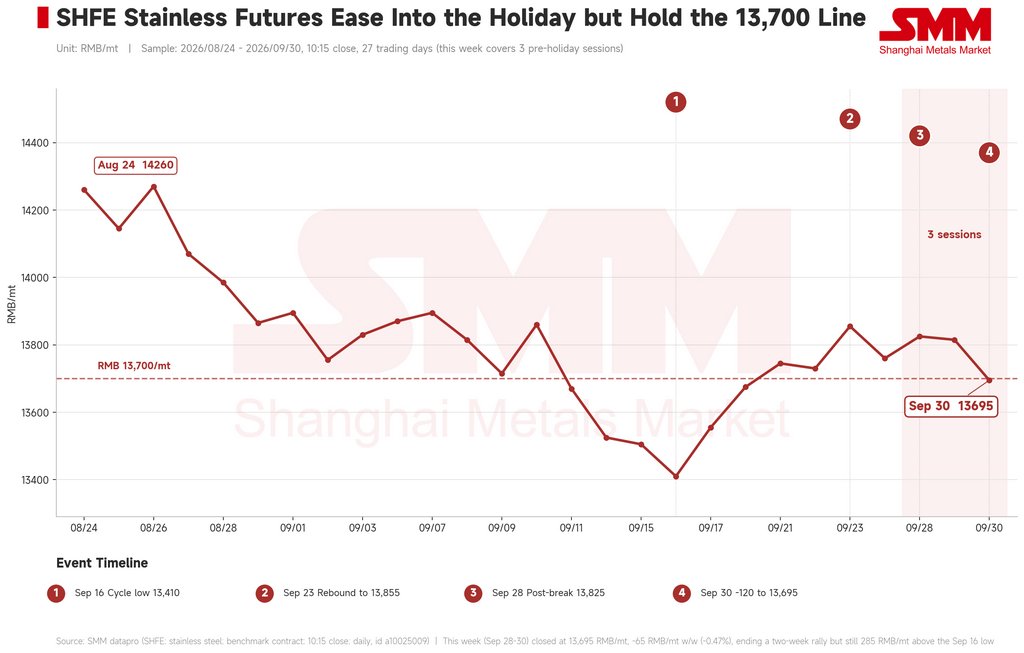
SMM data shows that during the three pre-holiday sessions of September 28–30, 2026, the stainless steel benchmark contract SS2611 traded in a weak but resilient range under pressure from a sustained slide in SHFE nickel, without breaking down. At the 10:15 close on September 30, the contract settled at RMB 13,695/mt (about $2,040/mt), down RMB 65/mt, or 0.47%, from the previous Friday, ending a two-week run of gains but still holding RMB 285/mt above the September 16 cycle low of RMB 13,410/mt and broadly defending the RMB 13,700/mt line. The defining feature of the week was a two-sided weak equilibrium between futures and spot: the board fell far less than the wider base metals complex, while spot quotes traded flat as pre-holiday restocking finished and transactions thinned out, leaving neither leg with direction.
From the macro and news perspective, domestic and external forces offset one another and sentiment shifted from pressured to neutral. Overseas, Fed commentary lost its single direction: Williams suggested another hike this year may be appropriate but saw no urgency, while Barr and Musalem read policy as still modestly accommodative, and the resulting churn in rate expectations kept the dollar firm and commodity sentiment soft. Middle East tensions and a record low in the Iranian rial added a further risk-off layer that weighed on base metals generally. Domestically, policy moved decisively the other way. The State Council meeting explicitly called for stronger counter-cyclical adjustment; the PBoC cut the PSL rate by 25 basis points and expanded relending quotas by RMB 200 billion for technology upgrading — with the support ratio raised from 60% to 100% — and a further RMB 500 billion for agriculture and small business; the Ministry of Finance and two other departments introduced a mortgage interest subsidy of one percentage point annually for up to five years, capped at RMB 1 million per household. China–US trade consultations produced an eight-point set of agreed outcomes alongside a "300-for-300" reciprocal tariff reduction framework. On balance, the macro overhang that had suppressed the board through most of September appears to have been discharged, shifting the macro from a drag to a mild support.
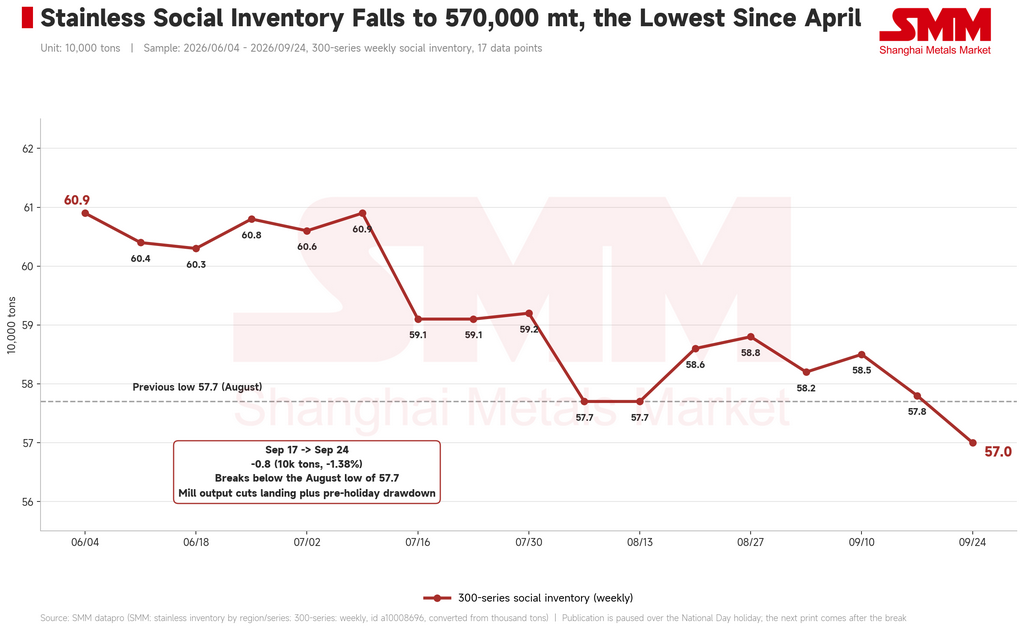
From a fundamentals perspective, destocking accelerated and spot resilience held up even as trading thinned. SMM's 300-series social inventory fell to 570,000 mt in the week to September 24, down 8,000 mt, or 1.38%, breaking below the August low of 577,000 mt to reach its lowest level since April. Against a backdrop in which the traditional September peak season has clearly failed to materialise and end-use demand keeps undershooting, a drawdown of that size lends real support to spot prices. The resilience rests on three things: mill output cuts continuing to gain traction, which has kept actual arrivals manageable; spot prices already sitting near the low end of the year's range, leaving traders with modest stock and little appetite to discount; and daily rigid-demand collection holding up even though pre-holiday restocking is complete and no new buying has emerged. Cold-rolled 201/2B, 304/2B, 316L/2B and 430/2B quotes in both Wuxi and Foshan were unchanged on the week, with the Wuxi 304/2B premium over futures steady in the RMB 525–875/mt range, while the trade drifted into holiday mode from midweek and both enquiries and confirmed deals stayed sparse — the main cap on spot prices this week.
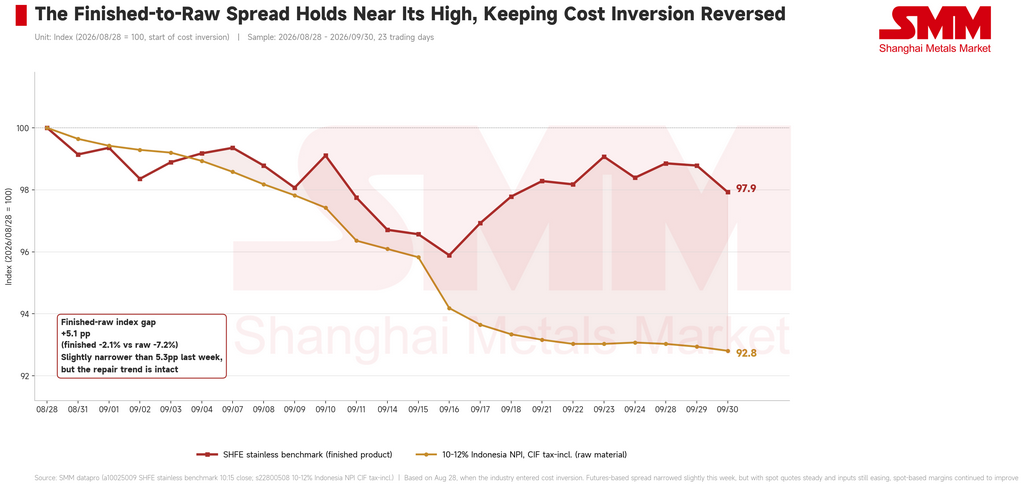
From the cost and supply side, raw materials kept easing and the margin repair remained intact. On chrome, the Inner Mongolia high-carbon ferrochrome weekly average came in at RMB 7,837.5 per 50mt basis ton (about $1,167), down RMB 12.5 week-on-week, with mill tender prices still depressed and cost pressure easing further. On nickel, 10-12% Indonesian NPI CIF tax-inclusive was quoted at RMB 1,045/nickel point (about $156), down RMB 3, or 0.29%, as the SHFE nickel benchmark fell RMB 3,320/mt, or 2.65%, to RMB 121,860/mt over the week; the decline in nickel-bearing inputs has slowed but not changed direction. Indexed to August 28, when the industry formally entered cost inversion, finished product now stands at 97.9 against inputs at 92.8, leaving the finished-to-raw gap at a high 5.1 percentage points, marginally below the 5.3 points of a week earlier. Finished-product futures fell slightly more than inputs this week, so the futures-based spread tightened for the first time in this repair cycle; on a spot basis, however, with quotes flat and inputs still falling, ex-works margins continued to widen. Mill profitability remains positive and the earlier cost inversion continues to unwind, though the recovery has yet to translate into higher production schedules, and output cuts are still progressing.
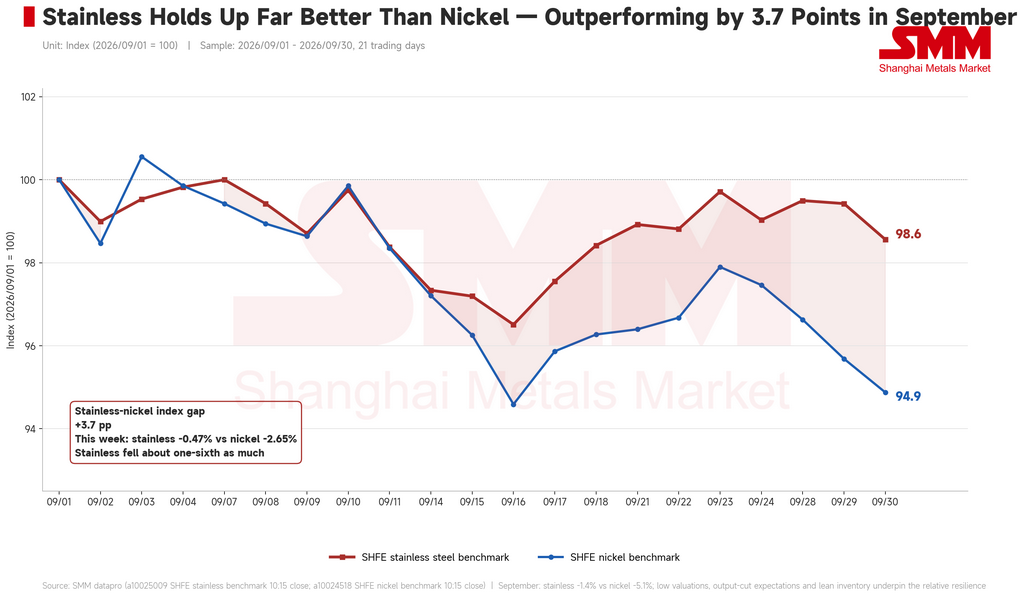
Overall, the market settled into equilibrium this week between two opposing forces — pressure from weakening offshore nickel on one side, and a floor built from lean inventory and output-cut expectations on the other — leaving the board in a range that is hard to push either way. Stainless is down 1.4% so far in September against nickel's 5.1%, an outperformance of 3.7 percentage points that rests on low valuations, expectations of supply cuts and thin social inventory rather than on any demand evidence. Looking ahead, persistently soft end-use demand and weak confidence leave little for prices to build on, and fundamentals offer no strong upside driver; but with the macro overhang largely discharged, output cuts progressing steadily, inventory at a reasonable low and spot prices in the lower part of the year's range, the room to fall is equally constrained. The benchmark contract is expected to keep grinding sideways near the lower end after the break. Industry participants are advised to take a measured view of how nickel moves during the long holiday feeds into sentiment on the first session back, to watch the pace of demand recovery, the follow-through on mill output cuts and the actual cost pass-through from raw materials, and to maintain steady operations.
![[SMM Analysis] Downstream Demand Shows No Significant Recovery, Nickel Intermediate Product Payables in the Doldrums This Week](https://imgqn.smm.cn/usercenter/WNjzM20251217171732.jpeg)
![[SMM Analysis] September Korea Nickel Sulphate Market: China-Bound Price Pressure Persists as Export Mix Shifts](https://imgqn.smm.cn/usercenter/UruWE20251217171732.jpg)