Copper’s low-carbon attributes are beginning to be separated from physical metal trade.
On September 22, BHP and Amazon announced a low-emissions copper pilot that will create environmental attribute certificates (EACs) for copper concentrate and copper cathode produced at the Escondida mine. Amazon can purchase and retire these certificates to account for supply-chain emission reductions associated with copper used in its data-center infrastructure.
The pilot will not directly change physical copper flows, but it could alter how the environmental value of copper is recognized. If primary copper can also obtain separately traded low-carbon attributes, will recycled copper’s traditional emissions advantage be weakened?
Separating Environmental Attributes from Physical Copper
Copper passes through multiple trading and processing stages, and material from different sources is often mixed. This makes it difficult for end users to trace the origin and carbon footprint of a specific tonne of copper.
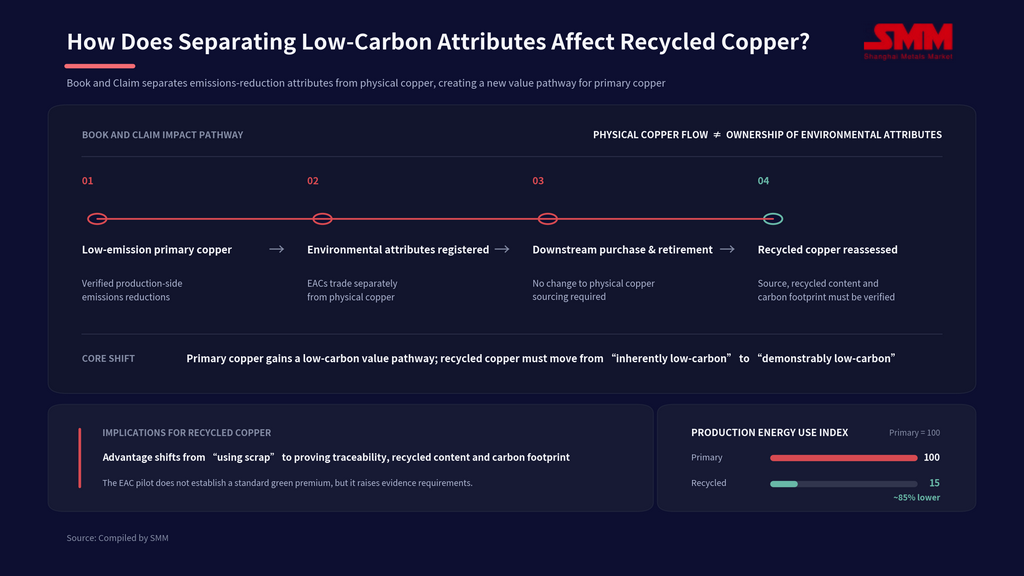
The pilot uses a Book and Claim model, under which verified emissions-reduction attributes are traded separately from physical copper. A company can therefore purchase EACs and support low-emissions production without physically buying copper from Escondida.
However, an EAC does not mean the copper consumed by the buyer originated from a particular mine. The mechanism should complement physical traceability rather than replace it. Emissions baselines, third-party verification, registries and double-counting controls will remain important.
Will Recycled Copper’s Low-Carbon Advantage Be Weakened?
Recycled copper avoids upstream mining and beneficiation and requires approximately 85% less energy than primary copper production on average.
However, not all scrap has the same environmental value. High-grade material such as Millberry can return to production through relatively short processing routes, while mixed scrap, complex copper-bearing material and electronic waste require additional dismantling, sorting, smelting and refining.
If low-emissions primary copper can meet part of downstream companies’ decarbonization needs through EACs, recycled copper will no longer be the only low-carbon procurement option. Its environmental value may increasingly depend on verified origin, recycled content, processing energy use and carbon footprint.
Could Copper Scrap Develop a Dual-Pricing Structure?
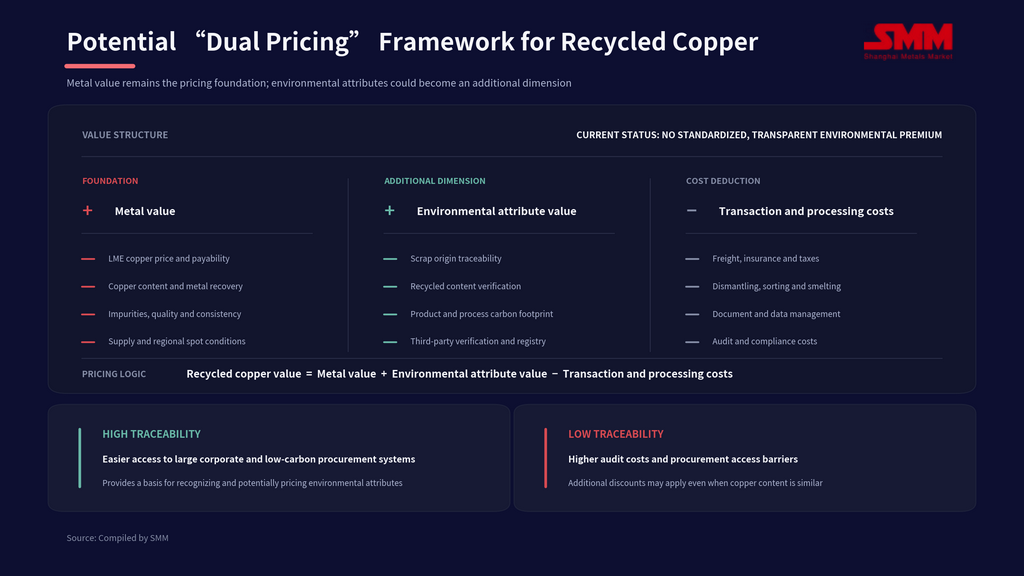
In the short term, the pilot is unlikely to directly raise copper scrap prices. Scrap pricing will continue to depend mainly on copper content, recovery rates, impurities, freight, taxes and market supply and demand. A standardized green premium has not yet emerged.
Over the longer term, however, recycled copper could carry two types of value: its underlying metal value and an environmental attribute value based on traceability, recycled content and verified emissions.
Material with clear origins, stable quality and reliable carbon data will be better positioned to enter the supply chains of major copper fabricators, automakers, power-grid equipment manufacturers and data-center operators. Material with unclear origins or insufficient documentation may face higher verification costs or procurement restrictions, even when copper content is similar.
This could also encourage more long-term procurement agreements and closed-loop recycling. Global scrap generation may not decline, but the volume of high-grade, traceable material available in the open market could shrink.
From “Inherently Low-Carbon” to “Demonstrably Low-Carbon”
SMM believes the BHP-Amazon pilot will not eliminate recycled copper’s emissions advantage, but it may raise the standard of evidence required to support low-carbon claims.
The competitiveness of recycled copper will increasingly depend not only on quality and price, but also on whether companies can verify feedstock origin, recycled content, processing routes and carbon emissions.
What may ultimately be reassessed is therefore not copper scrap itself, but the traceability and environmental attributes behind it. Traditional metal value will remain the pricing foundation, while environmental attributes could gradually become an additional pricing dimension.
![[SMM Analysis] The U.S. Copper Tariff Trade Is Fading — but It Isn’t Over Yet](https://imgqn.smm.cn/production/admin/votes/imagesMbCUq20260929144044.png)
![Copper Prices Rise Before the Holiday, Suppressing Stockpiling Sentiment at Secondary Copper Rod Enterprises [SMM Secondary Copper Daily Review]](https://imgqn.smm.cn/usercenter/IHqPw20251217171709.jpg)