London-listed, Swiss-headquartered pellet producer Ferrexpo plc, whose assets are in Ukraine, released its interim results for the six months ended 30 June 2026 on 25 September 2026:
Ferrexpo 1H 2026 results summary
Production and sales
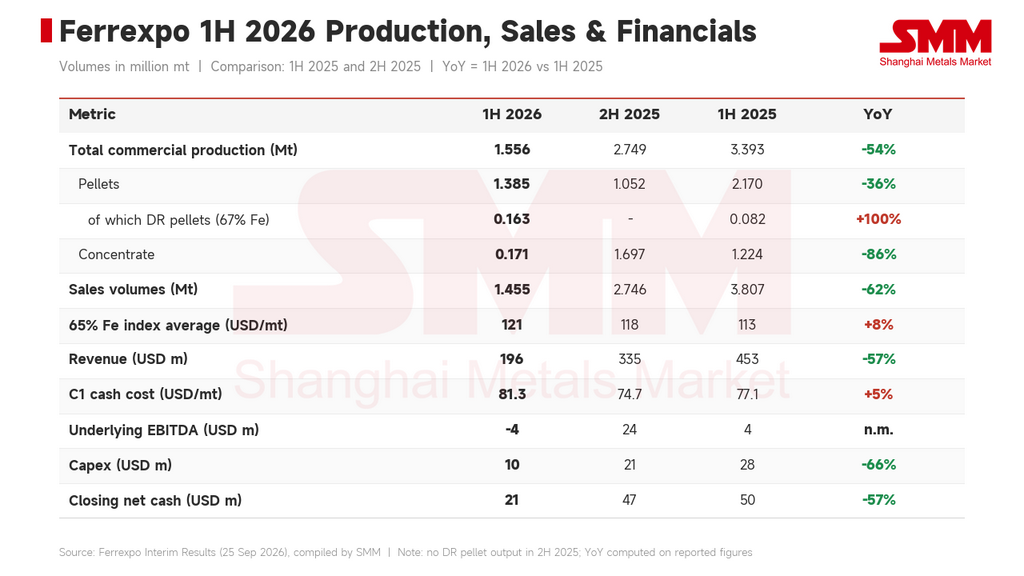
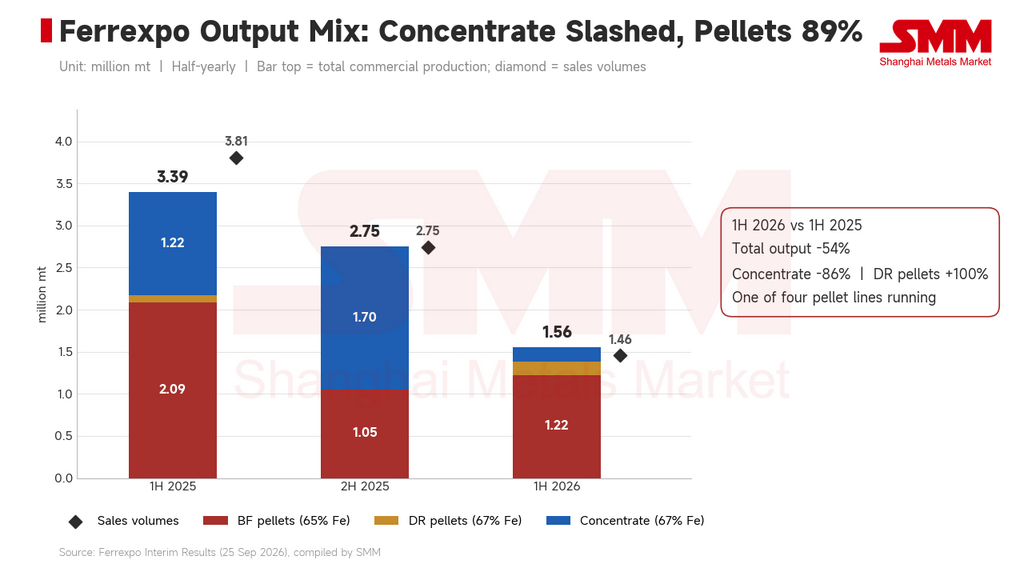
Total commercial production: 1.556 million mt, down 54% year on year and 43% from 2H 2025. Attacks on Ukraine's power grid largely halted production in January. After the restart in late February, the company ran only one of its four pelletising lines. Power supply improved in the second quarter, and pellet output rose 64% quarter on quarter to about 0.86 million mt.
Pellet production: 1.385 million mt, down 36% year on year. Output of 65% Fe blast furnace pellets fell 41% to 1.222 million mt, while 67% Fe direct reduction (DR) pellets doubled to 0.163 million mt.
Concentrate production: 0.171 million mt, down 86%. Pellets accounted for 89% of output, up from 64% a year earlier.
Sales volumes: 1.455 million mt, down 62%, comprising 1.248 million mt of pellets and 0.206 million mt of concentrate.
Costs and financial performance
Revenue: USD 196 million, down 57%, mainly on lower sales volumes. The 65% Fe index averaged USD 121.3/mt, up 8%, and the average Atlantic blast furnace pellet premium rose 4%, partly offsetting the volume decline.
Costs: C1 cash cost for pellets rose 5% to USD 81.3/mt, which the company attributed mainly to lower production volumes spreading fixed costs over fewer tonnes. Ukrainian electricity prices averaged USD 174/MWh in the half, up 19%, and electricity's share of C1 costs rose from 34% to 39%.
Earnings and cash: Underlying EBITDA was minus USD 4 million, against USD 3.9 million a year earlier. The loss after tax was USD 14.9 million, compared with USD 196 million in 1H 2025, which included a USD 154 million impairment. Cash stood at USD 30.4 million at period end and net cash at USD 21.4 million. Capital expenditure was cut to USD 9.8 million from USD 28.5 million.
Sales destinations and logistics
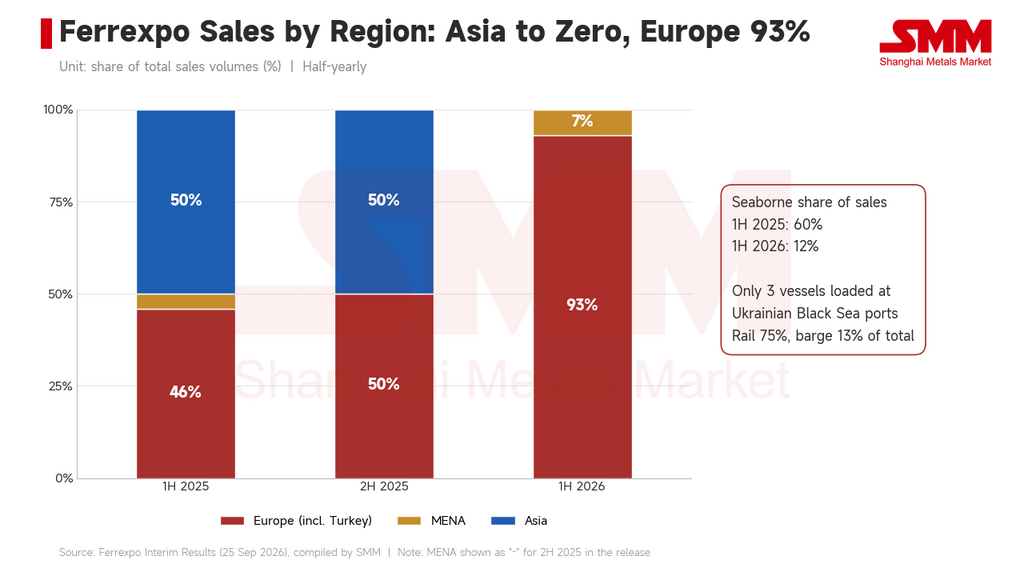
Seaborne: Seaborne sales were just 0.175 million mt, or 12% of the total, compared with 60% a year earlier. Only three vessels were loaded at Ukrainian Black Sea ports during the period. Rail and river barge carried 75% and 13% of total sales respectively.
Regions: Europe, including Turkey, took 93% of sales and MENA 7%. Asia's share fell from 50% a year earlier to zero. The company said higher long-haul freight rates hurt the economics of sales to Asia, and that concentrate output was cut to prioritise pellet supply to European customers, so volumes shifted to Europe and MENA. DR pellets made up 7% of sales volumes, up from 2% in 2025.
Logistics costs: Congestion at border crossings slowed wagon turnaround, and the company hired additional third-party wagons. Ukrainian rail tariffs rose by an average of about 36% from 1 August, and access to Black Sea ports became severely restricted again after the period end.
Other key information
Fundraise and trading: On 3 September the company announced a USD 100 million equity raise, comprising a placing of about USD 60 million and a subscription of about USD 40 million by its largest shareholder. Shareholders approved it on 21 September, and trading in the shares on the London Stock Exchange resumed on 7 September. The board considers that the group has sufficient resources to operate on a reduced basis for the next 18 months, subject to operating and market conditions and ongoing legal matters.
VAT and legal matters: Gross VAT receivables in Ukraine stood at USD 102.2 million at end-June. As of the date the report was approved, USD 86.9 million of refund claims had been formally refused. No interim dividend was declared. The company still faces multiple legal proceedings in Ukraine, and its auditor highlighted a material uncertainty over its ability to continue as a going concern.
Outlook: The company said a recovery in production capacity depends mainly on the availability and price of electricity, the security of logistics routes, the resumption of VAT refunds and the outcome of legal proceedings in Ukraine.
SMM View
Before the full-scale invasion, Ferrexpo was the world's third-largest pellet exporter, and it still produced 6.14 million mt in 2025. The fundraise eases liquidity, but VAT refunds have not resumed, the legal proceedings remain unresolved and logistics deteriorated further after the period end. Conditions for a sharp production recovery in the second half are not yet in place. For China, the company's sales there tripled in 1H 2025, while its sales to Asia fell to zero in 1H 2026, so Ferrexpo's supply to China has effectively stopped. In high-grade pellets, the Middle East conflict disrupted pellet supply in the Gulf region, and the spread between DR and Atlantic blast furnace pellet premiums widened by more than USD 6/mt from the 2025 average. Ferrexpo raised the share of DR pellets in its sales, but with capacity constrained, its marginal impact on global high-grade pellet supply is limited.
![[ voestalpine Receives EAF Components Advancing 1.6 Million Tonne Green Steel Project ]](https://imgqn.smm.cn/usercenter/zbJUC20251217171718.jpg)
![[ Bharat Coking Coal and SAIL Advance Joint Development of Coking Coal Blocks ]](https://imgqn.smm.cn/usercenter/wSpkX20251217171718.png)
![[ Jacobs Extends Management Role for thyssenkrupp Duisburg DRI Plant ]](https://imgqn.smm.cn/usercenter/UqlZJ20251217171717.jpg)