[SMM Analysis] Global Copper Scrap Offers Decline in Both Volume and Quality—Why Are Payabilities Still Flat?

Published: Sep 28, 2026 16:29 (GMT+8)
[SMM Analysis: Global Copper Scrap Offers Decline in Both Volume and Quality—Why Are Payabilities Still Flat?] Global copper scrap payabilities remain elevated and stable as overseas offers decline in both volume and quality. Tight availability supports prices, while high copper prices, weak margins and rising working-capital needs cap further gains. SMM expects subdued holiday trading and limited short-term movement in payabilities.

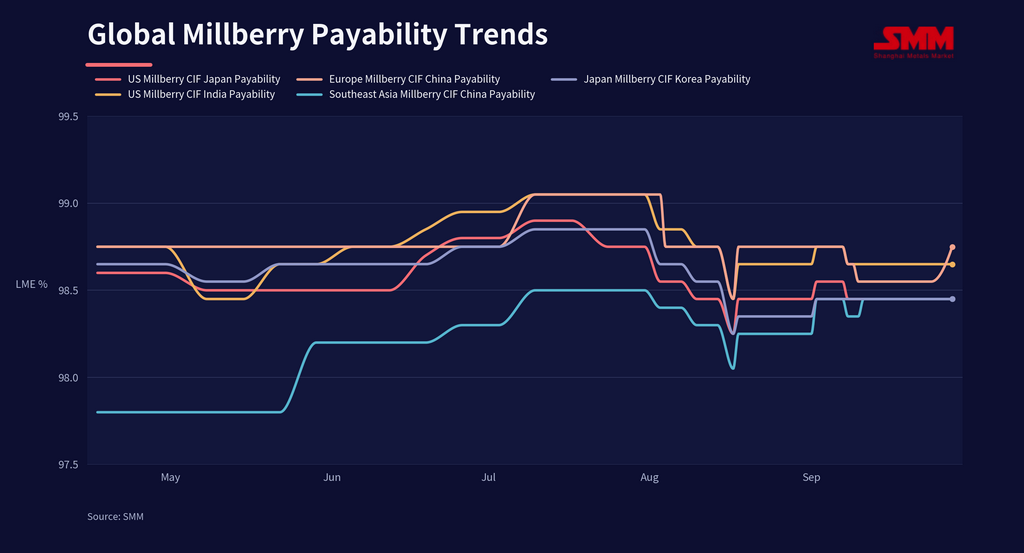
Global copper scrap LME payabilities have remained elevated and broadly stable in recent weeks, with no significant adjustments across major grades. This stability does not indicate a balanced market. Instead, tight supply, high copper prices and pressure on downstream margins have left payabilities caught between firm downside support and limited upside potential.

Global Offers Decline in Both Volume and Quality

According to SMM market research, the number of global copper scrap offers has declined noticeably, while the overall quality of available material has also deteriorated. High-grade material with stable composition and suitable specifications for Chinese buyers has become increasingly scarce. Some recent offers contain higher impurities, mixed grades or uncertain metal recovery rates.

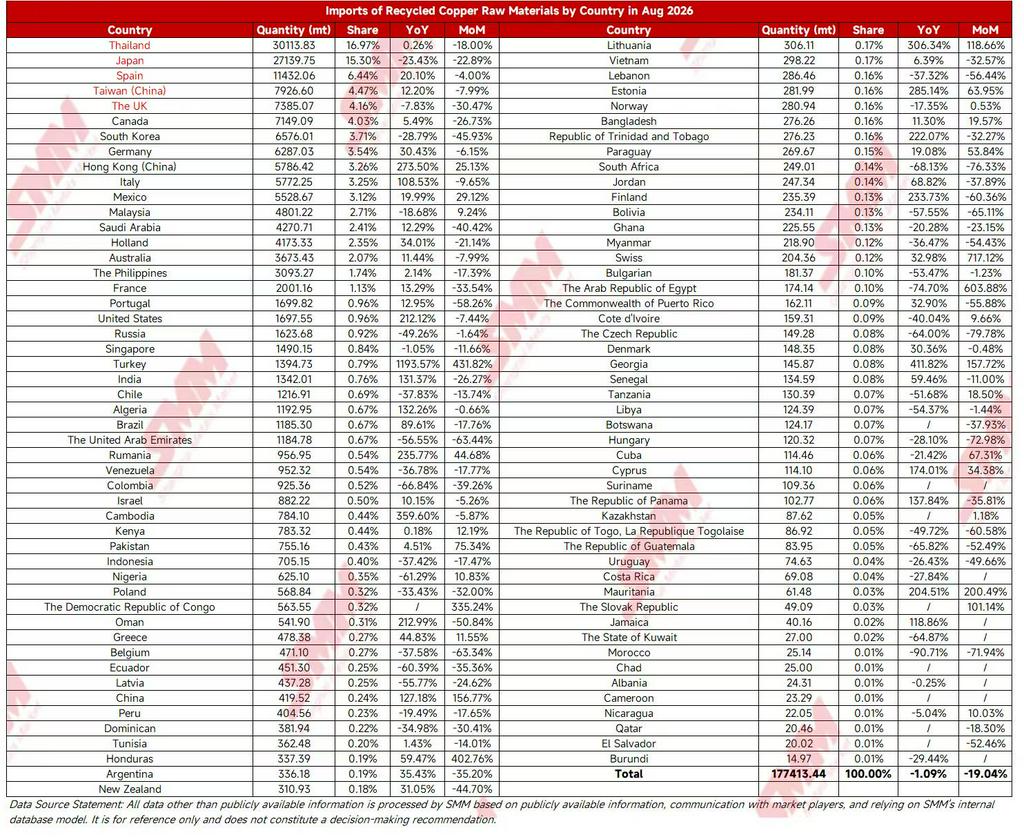
China’s import data also point to tighter overseas availability. According to customs data compiled by SMM, China’s imports of recycled copper raw materials fell by nearly 20% MoM in August 2026. Given that Chinese companies continue to require compliant, VAT-invoiced imported material, the sharp decline suggests that the effective overseas supply available to Chinese buyers has decreased.

As a result, suppliers have little incentive to reduce payabilities despite subdued trading activity. Tight availability continues to provide strong support for Millberry and No. 1 copper scrap with stable quality.
High Copper Prices Limit Further Payability Gains
While tight supply supports payabilities, elevated copper prices have significantly increased buyers’ procurement costs and working-capital requirements.

Current payabilities are already near the upper end of what most downstream companies can accept. Any further increase would narrow the cost advantage of copper scrap over copper cathode and place additional pressure on processing margins. Buyers are therefore maintaining need-based procurement and remain reluctant to build inventories at current price levels.

Suppliers are unwilling to lower offers because of limited availability, while buyers are unwilling to chase higher prices due to cost pressure. This standoff has kept payabilities broadly unchanged.

Pre-Holiday Restocking Fails to Lift Trading Activity

With China’s National Day holiday approaching, some downstream companies have conducted limited pre-holiday restocking. Elevated copper prices have also strengthened overseas suppliers’ willingness to sell. However, restocking has remained largely demand-driven and has not developed into large-scale procurement.

Rising copper cathode spot premiums have also widened pricing differences between buyers and sellers. Suppliers believe the higher substitution value of copper scrap relative to cathode justifies maintaining or raising offers. Buyers, however, remain constrained by processing margins and working-capital pressure and are unwilling to increase bids further.

Market inquiries have continued, but actual trading activity remains subdued.

Payabilities Expected to Remain Elevated and Stable

As China enters the National Day holiday, downstream inquiries and procurement activity are expected to slow, potentially weakening overseas copper scrap trading further.

SMM expects the decline in both the volume and quality of overseas offers to continue supporting high-grade copper scrap payabilities. However, elevated copper prices, squeezed downstream margins and higher procurement costs will limit further gains. Global copper scrap LME payabilities are therefore expected to remain elevated and broadly stable in the short term.


Data Source Statement: Except for publicly available information, all other data are processed by SMM based on publicly available information, market communication, and relying on SMM's internal database model. They are for reference only and do not constitute decision-making recommendations.

For any inquiries or for more information, please contact: lemonzhao@smm.cn
For more information on how to access our research reports, please contact:service.en@smm.cn
Related News
KCM Restarts Chingola B Mine, Targets Over 200,000 mt/month of Ore Productio
1 min ago
KCM Restarts Chingola B Mine, Targets Over 200,000 mt/month of Ore Productio
Read More
KCM Restarts Chingola B Mine, Targets Over 200,000 mt/month of Ore Productio
Konkola Copper Mines (KCM) has restarted mining operations at its Chingola B Mine in Zambia, bringing the previously dormant operation back into production as part of the company's wider expansion programme across its Nchanga and Konkola operations.​ Chingola B, which forms part of the Nchanga mining complex, is projected to produce more than 200,000 mt of ore per month, compared with around 60,000 mt/month before its closure. The additional mine output is expected to increase ore feed available to KCM's processing operations.​ KCM Group Chief Executive Officer Deshnee Naidoo said the restart forms part of the company's broader programme to increase production across its operations and will add production at Nchanga underground. According to Naidoo, Chingola B is expected to contribute another 200,000 mt/month of ore as the company rebuilds its mining operations.​ The restart comes as KCM targets annual copper production of 300,000 mt by 2030. The company said its expansion programme is supported by more than US$1 billion of investment from Vedanta Resources across its operations.​ The development also comes amid Zambia's broader target of increasing national copper production to 3 million mt/year by 2031. KCM said the reactivation of dormant assets such as Chingola B is expected to contribute to efforts to increase domestic mine supply.​ The restart of Chingola B could strengthen ore availability across KCM's Nchanga operations, with planned output of more than 200,000 mt/month representing a substantial increase from the approximately 60,000 mt/month reported before closure. The additional mine feed is particularly relevant following KCM's recent rehabilitation and restart of the Nchanga Smelter. However, the 200,000 mt/month figure refers to ore production rather than contained or refined copper output, meaning the ultimate contribution to KCM's copper production will depend on ore grades, recoveries and processing performance. Progress at Chingola B will therefore be an important component of KCM's wider target of reaching 300,000 mt/year of copper production by 2030.
1 min ago
BHP's Escondida Copper Mine Gradually Resumes Operations Following Fatal Accident
4 mins ago
BHP's Escondida Copper Mine Gradually Resumes Operations Following Fatal Accident
Read More
BHP's Escondida Copper Mine Gradually Resumes Operations Following Fatal Accident
BHP's Escondida copper mine in Chile has begun progressively resuming operations following a temporary suspension after a fatal accident involving a worker performing maintenance activities at the operation.​ The incident occurred on September 23, prompting Escondida to suspend operations while emergency procedures and initial assessments were carried out. BHP subsequently said operations were being progressively resumed, while investigations into the circumstances surrounding the accident continued.​ Escondida is one of the world's largest copper operations and produces both copper concentrate and cathode. BHP holds a 57.5% interest in the mine, while Rio Tinto owns 30% and Japan Escondida Corporation (JECO) holds the remaining 12.5%.​ The temporary interruption comes as Escondida is also undergoing separate collective bargaining negotiations with its unionised supervisors. The supervisors' union is scheduled to vote between September 28 and September 30 on BHP's latest contract offer, with union leadership recommending that members reject the proposal. The labour negotiations are separate from the September 23 accident and subsequent operational suspension.​ If the offer is rejected, the collective bargaining process could move toward further mediation and potentially strike action. However, no strike has begun and no production impact from the labour negotiations has been reported at this stage. The progressive resumption of operations at Escondida reduces the immediate supply risk created by the temporary suspension, although the extent and timing of a return to normal operating levels remain important to monitor. Meanwhile, the ongoing supervisors' collective bargaining process represents a separate potential operational risk. Attention will turn to the September 28–30 vote and any subsequent negotiations, while the copper market will also monitor Escondida's production recovery following the temporary shutdown.
4 mins ago
Data: SHFE, DCE market movement (Sep 28)
58 mins ago
Data: SHFE, DCE market movement (Sep 28)
Read More
Data: SHFE, DCE market movement (Sep 28)
The following table shows the ferrous and nonferrous metals movement on the SHFE and DCE on 28 Sep , 2026
58 mins ago