[SMM Analysis] Macro Support vs. Fundamental Pressure, Iron Ore Prices Continue to Move Sideways at Low Levels

Published: Sep 28, 2026 10:37 (GMT+8)

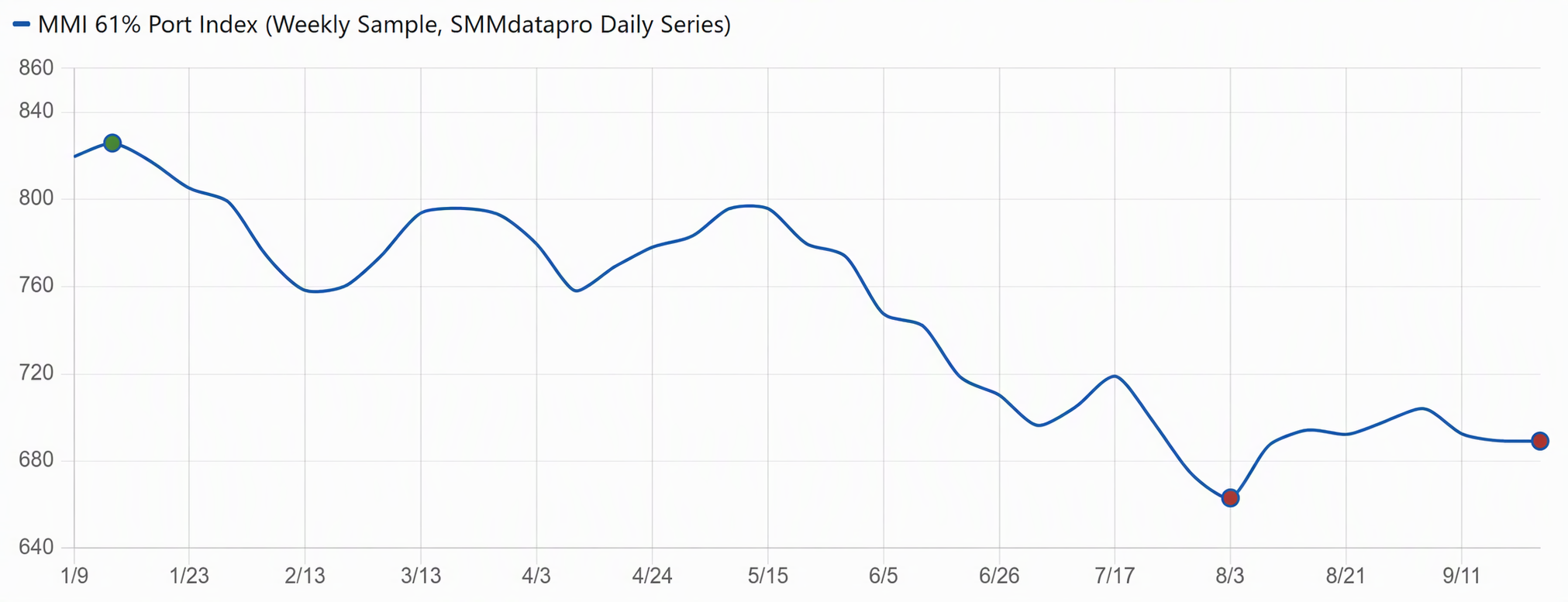
Last week, iron ore prices consolidated on a weak note within a narrow range, with fluctuations in both domestic and overseas markets not exceeding 1.5%. Three main drivers were at play: First, pre-holiday restocking neared its end. With the Mid-Autumn Festival and National Day holidays approaching, steel mills had completed most of their raw material stockpiling, purchase willingness pulled back, and spot transactions were sluggish. Second, hot metal production continued to pull back. Steel mill losses intensified, leading to more blast furnace maintenance, and hot metal production extended its decline, suppressing ore demand. However, Brazil's ocean freight rates continued to shoot up, curbing shipments from some small mines, and market chatter increased, providing support to ore prices. Under these combined influences, iron ore prices maintained a "consolidate on a weak note" pattern.

Chart- MMI 61% Port Spot Index
Source: SMM


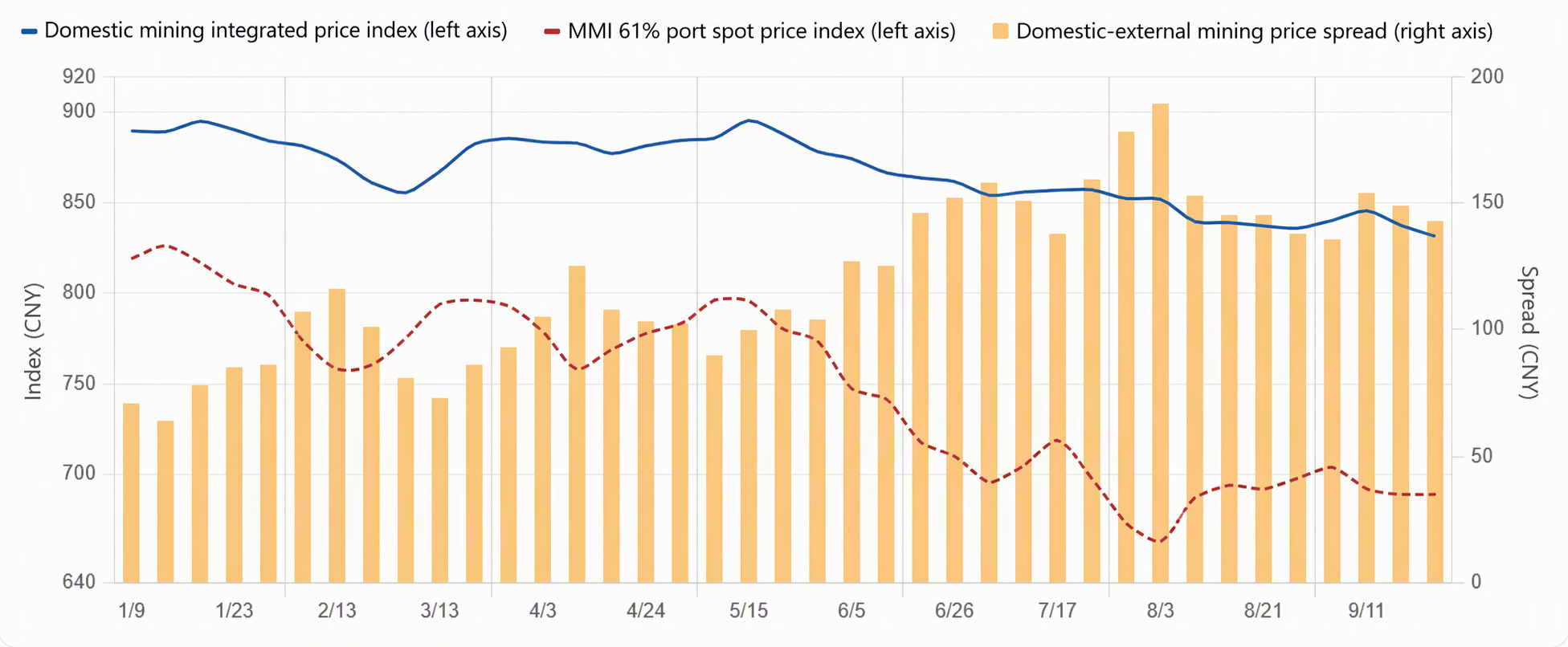
Chart- Domestic and Imported Ore Price Spread Widened Then Narrowed This Week, Expected to Widen Next Week
Outlook for Next Week

Outlook for This Week, pre-National Day holiday stockpiling gradually winds down, and steel mill restocking momentum tends to fade. In the first week after the holiday, although some restocking expectations remain, overall restocking volumes are expected to be notably lower than pre-holiday levels, providing weak support for ore prices. Based on SMM blast furnace maintenance tracking data, blast furnace maintenance volumes continue to increase in October, the decline in hot metal production is widening, and overall iron ore demand continues its downward trend. On the supply side, although high ocean freight rates in Brazil have somewhat curbed shipments from small mines in the region, considering that mainstream mines had end-of-quarter shipment pushes in September, coupled with growth in shipments from Guinea, overall iron ore supply growth is expected to expand, and port inventory buildup is likely to accelerate, pressuring ore prices. Additionally, pre-holiday capital withdrawal has led to shrinking liquidity, and overall sentiment in ferrous metals is bearish. However, the neutral-to-positive tone of China-US consensus may provide some boost to market sentiment and support ore prices. Overall, iron ore prices are expected to maintain a weak, narrow-range consolidation pattern before and after the National Day holiday. Going forward, close attention should be paid to whether hot metal production declines as expected, changes in end-use demand, and policy-related news disruptions.


Data Source Statement: Except for publicly available information, all other data are processed by SMM based on publicly available information, market communication, and relying on SMM's internal database model. They are for reference only and do not constitute decision-making recommendations.

Images in this article contain AI-translated captions for reference only.

For any inquiries or for more information, please contact: lemonzhao@smm.cn
For more information on how to access our research reports, please contact:service.en@smm.cn
Related News
[SMM survey] Mines and beneficiation plants are producing as planned, with iron ore concentrates production relatively stable.
13 mins ago
[SMM survey] Mines and beneficiation plants are producing as planned, with iron ore concentrates production relatively stable.
Read More
[SMM survey] Mines and beneficiation plants are producing as planned, with iron ore concentrates production relatively stable.
[SMM survey] Mines and beneficiation plants are producing as planned, with iron ore concentrates production relatively stable.
According to the latest SMM statistics, China's overall mine capacity utilization rate this week was 58.1%, down 0.1 percentage points WoW. Iron ore concentrate production was 898,000 mt, down 2,000 mt WoW. Over the same period, mine concentrate inventory fell by 5,000 mt to approximately 248,000 mt.
13 mins ago
[Steel industry profits reach 29.43 billion yuan in January-August]
52 mins ago
[Steel industry profits reach 29.43 billion yuan in January-August]
Read More
[Steel industry profits reach 29.43 billion yuan in January-August]
[Steel industry profits reach 29.43 billion yuan in January-August]
From January to August, industrial enterprises above designated size nationwide achieved total profits of 5.27198 trillion yuan, up 15.7% YoY. From January to August, among industrial enterprises above designated size, state-controlled enterprises achieved total profits of 1.67599 trillion yuan, up 10.3% YoY; joint-stock enterprises achieved total profits of 4.07146 trillion yuan, up 20.4%; foreign-invested and Hong Kong, Macao, and Taiwan-invested enterprises achieved total profits of 1.17947 trillion yuan, up 2.3%; private enterprises achieved total profits of 1.32132 trillion yuan, up 10.4%. From January to August, the ferrous metal smelting and rolling processing industry achieved total profits of 29.43 billion yuan, down 62.4% YoY. From January to July, the ferrous metal smelting and rolling processing industry achieved total profits of 29.09 billion yuan. Based on this calculation, the steel industry achieved profits of 340 million yuan in August alone. In July alone, the steel industry recorded losses of 2.68 billion yuan.
52 mins ago
[Institutions: Over 280 real estate policies introduced nationwide in Q3]
53 mins ago
[Institutions: Over 280 real estate policies introduced nationwide in Q3]
Read More
[Institutions: Over 280 real estate policies introduced nationwide in Q3]
[Institutions: Over 280 real estate policies introduced nationwide in Q3]
According to monitoring data from the China Index Academy, as of September 24, a total of over 870 real estate-related policies had been introduced nationwide, of which more than 280 were rolled out in Q3, continuing the high-frequency policy implementation trend seen in H1. Local policies mainly focused on three directions: activating demand, optimizing supply, and urban renewal, primarily involving the optimization of restrictive policies, adjustment of housing provident fund policies, issuance of home purchase subsidies, revitalization of existing housing stock, construction of "quality housing," and the implementation of supporting policies for urban renewal.
53 mins ago
Register to Continue Reading
Gain access to the latest insights in metals and new energy
Already have an account?Sign in here