Sulphuric Acid Shortage: A Key Constraint on Zambia’s Copper Growth

Published: Sep 25, 2026 16:43 (GMT+8)
Zambia’s sulphuric acid shortage is becoming a growing constraint on copper production and refining. Jubilee Metals reported acid costs rising by more than 200% in Q4 FY2026, while Sable cathode output fell to 250 t from 361 t in Q3. Government data also showed small-scale copper production down 35.2% YoY in H1 2026, highlighting the sector’s exposure to tight acid availability and higher processing costs.

━━━━━━━━━━━━━━━━━━━━━━━━━━━━━━━━━━━━━━━━━━━━━━━━━━━━━━━━━━━━━━━━━━━━━━━━━━━━━━━━━━━━━━━━━━━━━━━━━━━

SMM ANALYSIS  |  AFRICA COPPER

Sulphuric Acid Shortage Emerges as a Constraint on Zambia’s Copper Growth

Tight domestic acid availability is already showing up in policy action, small-scale mining weakness and refinery cost pressure, with Jubilee Metals reporting a more than 200% increase in acid costs during Q4 FY2026.

25 September 2026  |  SMM Analysis

>200%

Q4 FY2026 acid cost increase

Jubilee Metals

250 t

Sable Q4 cathode output

down from 361 t in Q3

-35.2%

Small-scale copper production

Zambia H1 2026 YoY

~1.1 Mt

Kansanshi acid output

2025 production


Zambia’s copper sector is expanding investment and processing capacity, but sulphuric acid availability is becoming a visible constraint for parts of the domestic value chain. Ministry of Mines data show national copper production rising only 0.45% year on year to 447,181 t in H1 2026, while small-scale copper production fell 35.2%. The Ministry attributed the small-scale decline partly to inadequate domestic sulphuric acid supply and the delayed end of the rainy season.

Recent company disclosures add a more immediate operating signal. Jubilee Metals reported that domestic acid availability in Zambia reduced significantly during Q4 FY2026, with acid costs rising by more than 200% and diesel costs increasing by 90%. The company said these conditions had a marked impact on production at its Sable Refinery and contributed to temporary closures among some metal processors in its operating area.

┃ Jubilee data show pressure reaching the refining stage

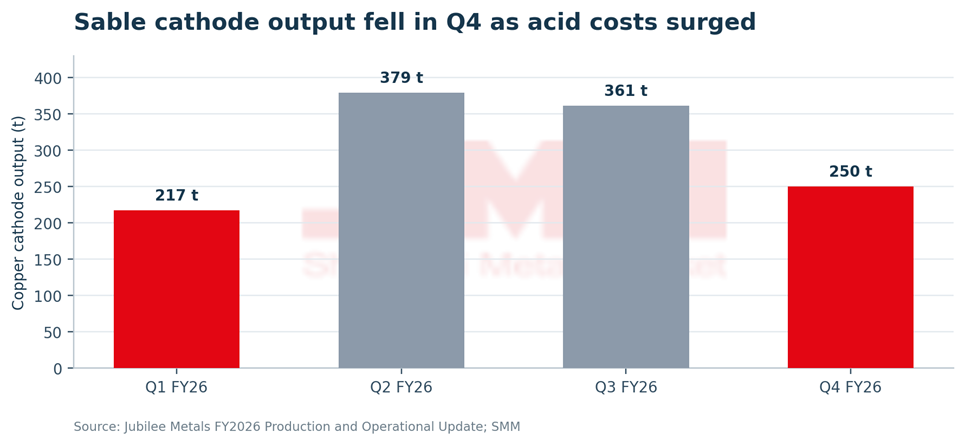
Sable produced 1,207 t of copper cathode in FY2026, up 17.5% from 1,027 t in FY2025. However, the quarterly profile weakened toward year-end: cathode output rose from 217 t in Q1 to 379 t in Q2, eased to 361 t in Q3 and then fell to 250 t in Q4. Q4 production was therefore about 31% below Q3 and 34% below the Q2 peak.

The Q4 fall should not be attributed to acid alone. Jubilee also reported operational factors including extended maintenance at Roan and pre-stripping work at Molefe. The more defensible conclusion is that acid availability and cost pressure became one of several operating constraints, and one that Jubilee explicitly linked to Sable’s performance during the quarter.
┃ The constraint is uneven across Zambia’s copper producers

The impact of tight sulphuric acid supply is not uniform. Large integrated operations with captive smelting and acid production are less exposed to the merchant market than smaller leach operators and independent processors. This helps explain why national copper production still edged higher while small-scale output fell sharply.

First Quantum’s disclosures illustrate the difference. Kansanshi generated approximately 1.1 million t of sulphuric acid in 2025, almost all of which was consumed on site in leaching circuits for cathode production. Following the smelter expansion, Acid Plant 5 could generate supplementary acid for internal use or external sale, depending on mine geology and processing requirements.

This means Zambia can be a significant acid producer and still have a shortage in the merchant market. Installed acid capacity is not the same as freely available supply. Internal consumption, ore type, smelter availability, contractual allocation, transport economics and local pricing all affect how much acid reaches third-party consumers.

┃ Upstream copper units are growing faster than saleable output

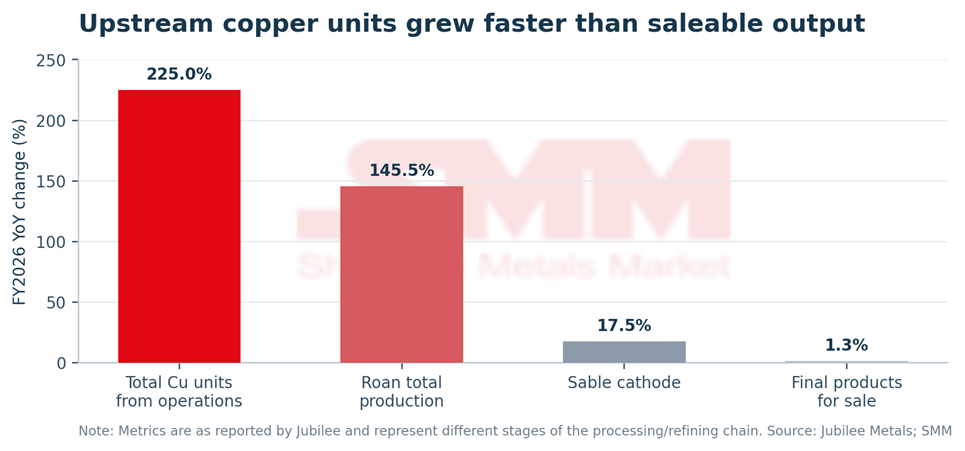
Jubilee’s production mix also shows why copper growth is not only a mining issue. Combined copper units from Roan and Molefe reached 3,739 t in FY2026, up 225.0% year on year. Roan total production increased 145.5% to 2,823 t. Yet final copper products produced for sale increased only 1.3% to 2,120 t, while Sable cathode production rose 17.5%.

Part of this gap reflects the build-up of oxide concentrate fines awaiting processing through Roan’s newly commissioned dewatering circuit and the fact that Jubilee reports different streams at different stages of the value chain. Even so, the contrast highlights the broader issue: converting mined or concentrated copper units into saleable metal depends on refinery availability, reagents, energy and logistics, not only ore supply.
┃ SMM outlook

Through the remainder of 2026, sulphuric acid availability is likely to remain an important variable for Zambia’s oxide and mixed-ore copper producers. The March export-permit system may help retain more acid for domestic users, but it does not create additional supply. In the near term, the market balance will depend on smelter operating rates, internal acid consumption at integrated mines and the amount of surplus product that producers are willing and able to release into the merchant market. For smaller leach operators, delivered availability and price could therefore remain more important than Zambia’s headline installed acid capacity.

There are signs that the supply side could improve. First Quantum has said the Kansanshi smelter expansion and Acid Plant 5 provide the potential to generate supplementary sulphuric acid, depending on mine geology and internal processing requirements. The expanded smelter is configured for around 1.5 million tonnes per year of acid capacity, including Acid Plant 5 at approximately 900 tonnes per day. However, Kansanshi consumed almost all of the roughly 1.1 million tonnes it produced in 2025 on site, which means additional capacity will not automatically translate into an equivalent increase in merchant supply.

The restart of KCM’s Nchanga Smelter in September also introduces a potential source of relief. The 311,000-tonne-per-year smelter returned after a 106-day rehabilitation programme, and KCM identifies sulphuric acid as one of the products manufactured at the Nchanga complex. If the smelter and associated acid systems operate consistently, additional output could improve domestic availability. The extent of that benefit will depend on KCM’s own leach requirements, operating rates and how much acid is ultimately made available to third-party customers.

Demand for acid could rise at the same time. Jubilee expects Sable to receive feed from a growing portfolio of Jubilee-controlled sources as Molefe develops and Project G moves toward targeted development from February 2027. Higher oxide and mixed-feed throughput would increase the importance of reliable reagent supply. Unless merchant acid availability expands alongside this processing growth, the market could remain vulnerable to renewed price spikes or temporary throughput constraints even as Zambia’s mined copper base increases.

Looking ahead to 2027, the acid balance could become an increasingly important differentiator between integrated and merchant-dependent producers. A sustained improvement in smelter uptime, additional third-party acid sales and effective domestic allocation could allow smaller mines and independent processors to recover output and participate more fully in Zambia’s copper-growth cycle. If the market remains tight, however, production growth is more likely to remain concentrated among large integrated operators that can secure acid internally. Key indicators to watch will be merchant acid prices, smelter operating rates, export-permit flows, third-party acid sales and Sable’s ability to convert rising upstream feed into saleable copper products.

Sources: Jubilee Metals Group, FY2026 Production and Operational Update, 14 September 2026; Zambia Ministry of Mines and Minerals Development, H1 2026 mining-sector update; First Quantum Minerals, Q1 2026 results and Zambia operations presentation; Zambia Ministry of Commerce, Trade and Industry, Sulphuric Acid Export Permit notice; Konkola Copper Mines corporate information and ZNBC report on the September 2026 Nchanga Smelter restart; SMM calculations based on public source data.

Data Source Statement: Except for publicly available information, all other data are processed by SMM based on publicly available information, market communication, and relying on SMM's internal database model. They are for reference only and do not constitute decision-making recommendations.

For any inquiries or for more information, please contact: lemonzhao@smm.cn
For more information on how to access our research reports, please contact:service.en@smm.cn
Related News
China's Refined Copper Output Growth Expected to Slow Sharply in 2026 Amid Feedstock Constraints
8 hours ago
China's Refined Copper Output Growth Expected to Slow Sharply in 2026 Amid Feedstock Constraints
Read More
China's Refined Copper Output Growth Expected to Slow Sharply in 2026 Amid Feedstock Constraints
China's refined copper production growth is expected to slow sharply in 2026 as smelters face tightening copper concentrate and scrap availability alongside weaker sulphuric acid prices, according to foreign media reports. Wood Mackenzie and Zijin Tianfeng Futures expect China's refined copper output to increase by around 3–3.4% in 2026, compared with growth of 10.4% in 2025. Reuters said this would represent the slowest annual growth rate since at least 2000 based on its review of official production data. Refined copper output growth stood at approximately 4% year on year during January-August.​ The slowdown is expected to become more pronounced in the fourth quarter as tighter scrap copper supply adds to the existing shortage of copper concentrate. Reuters reported that a tax crackdown is expected to reduce scrap availability, further limiting smelters' ability to substitute secondary raw materials for concentrate when feedstock conditions tighten.​ Smelter economics have also come under pressure from lower sulphuric acid prices. Sulphuric acid, a major by-product of copper smelting, had previously helped offset extremely low copper concentrate treatment charges. According to Oilchem data cited by Reuters, Chinese sulphuric acid prices declined by around 11% during September.​ Seven Chinese copper smelters are reportedly planning equipment maintenance lasting between 30 and 60 days during October and November. Analysts at Zhuochuang estimate that the planned maintenance could reduce refined copper supply by approximately 80,000 mt.​ The concentrate shortage reflects a broader imbalance between rapidly expanding global smelting capacity and comparatively slower growth in mined copper supply. Recent temporary disruptions at major copper mines including Escondida, Las Bambas and El Teniente have added further pressure to concentrate availability.​ Slower refined copper production growth in China could reduce refined copper supply growth during the fourth quarter, particularly if planned smelter maintenance coincides with continued constraints in concentrate and scrap availability. The simultaneous decline in sulphuric acid prices is also weakening an important source of smelter revenue at a time when treatment charges remain under pressure. Attention will therefore remain on concentrate availability, scrap supply conditions and the scale of planned smelter maintenance during October and November.
8 hours ago
Eldorado Gold Completes Skouries Grid Energization Ahead of Q4 Commercial Production
8 hours ago
Eldorado Gold Completes Skouries Grid Energization Ahead of Q4 Commercial Production
Read More
Eldorado Gold Completes Skouries Grid Energization Ahead of Q4 Commercial Production
Eldorado Gold has completed the permanent grid connection and energization of its Skouries copper-gold mine in northern Greece, marking another key commissioning milestone as the project advances toward commercial production expected in the fourth quarter of 2026. The site was successfully energized following final inspection, testing and approval by the Greek transmission authority. Eldorado said the permanent connection to the national grid provides the long-term power infrastructure required to support continued commissioning and ramp-up of processing and mining systems across the operation. The milestone follows the recent achievement of first copper-gold concentrate production at Skouries on September 8. The company is now progressing commissioning and ramp-up activities as it moves toward steady-state operations and commercial production later this year. Skouries is a copper-gold operation being developed using a combination of conventional open-pit and underground mining methods. Based on the company's current mine plan, the operation is expected to produce an average of approximately 67 million lb, or around 30,400 mt, of copper per year over its mine life, alongside approximately 140,000 oz/year of gold. The permanent grid connection is particularly important for the operation of major process systems, including crushing, grinding, flotation, concentrate handling and tailings disposal, which require full site energization as commissioning advances. Completion of permanent grid energization removes an important infrastructure constraint at Skouries and supports the continued ramp-up of the project following first concentrate production earlier in September. With commercial production still targeted for Q4 2026, attention will now turn to the pace of commissioning and the transition toward steady-state operations. Once fully ramped up, Skouries is expected to become a meaningful new source of European copper supply, with average annual copper production of approximately 30,400 mt over the mine life.
8 hours ago
Centinela Copper Mine Workers Approve Strike as Labour Talks Move to Mediation
8 hours ago
Centinela Copper Mine Workers Approve Strike as Labour Talks Move to Mediation
Read More
Centinela Copper Mine Workers Approve Strike as Labour Talks Move to Mediation
Workers represented by two unions at Antofagasta Minerals' Centinela copper mine in northern Chile have voted overwhelmingly in favour of strike action after rejecting the company's latest collective bargaining offer. According to foreign media reports, 98.73% of union members voted in favour of a strike, with all eligible members participating in the vote. The Minera Esperanza and Distrito Centinela unions had previously urged their members to reject the company's proposal amid disagreements over employee benefits. The unions have argued that Antofagasta Minerals has declined to discuss equalising benefits for workers regardless of their union affiliation. Antofagasta Minerals does not comment on its ongoing collective bargaining negotiations. Despite the vote, a strike has not yet begun. The company and unions must now enter a mandatory five-day government-led mediation process before workers can legally begin strike action. The mediation period can be extended by another five days if both sides agree. Centinela is a major copper operation in Chile and produced 240,400 mt of copper in 2025. The outcome of the mediation process will therefore be closely watched for any potential impact on operations and copper supply. The 98.73% vote in favour of strike action represents an escalation in the labour negotiations at Centinela, but there has been no reported disruption to copper production at this stage. The mandatory mediation period provides an opportunity for the company and unions to reach an agreement before industrial action begins. Given Centinela's 2025 copper production of 240,400 mt, an extended work stoppage could create additional supply uncertainty, although the scale of any potential production impact cannot be estimated unless a strike begins and its duration becomes clearer.
8 hours ago