
Lead: The hottest card has the least clear pricing
In China's compute hardware channel during the third week of September, the card type with the highest quote activity was not the H200, nor the 5090, but the PRO6000 series. After sorting through channel messages one by one, SMM confirmed that the PRO6000 series (including Pro5000 and PRO6000D) had the highest quote activity among all GPU categories in the channel from September 14 to 22.
But the dense quoting did not produce clear pricing. Under the same name "PRO6000," channel quotes ranged from 68,300 yuan/piece to 166,000 yuan/piece,a difference of 2.43 times. After re-sorting these quotes by memory capacity and board type, it becomes clear: this is neither wild price swings nor sellers shouting arbitrary prices, but rathera mismatch in specification definitions—four different products sharing one name in channel parlance.
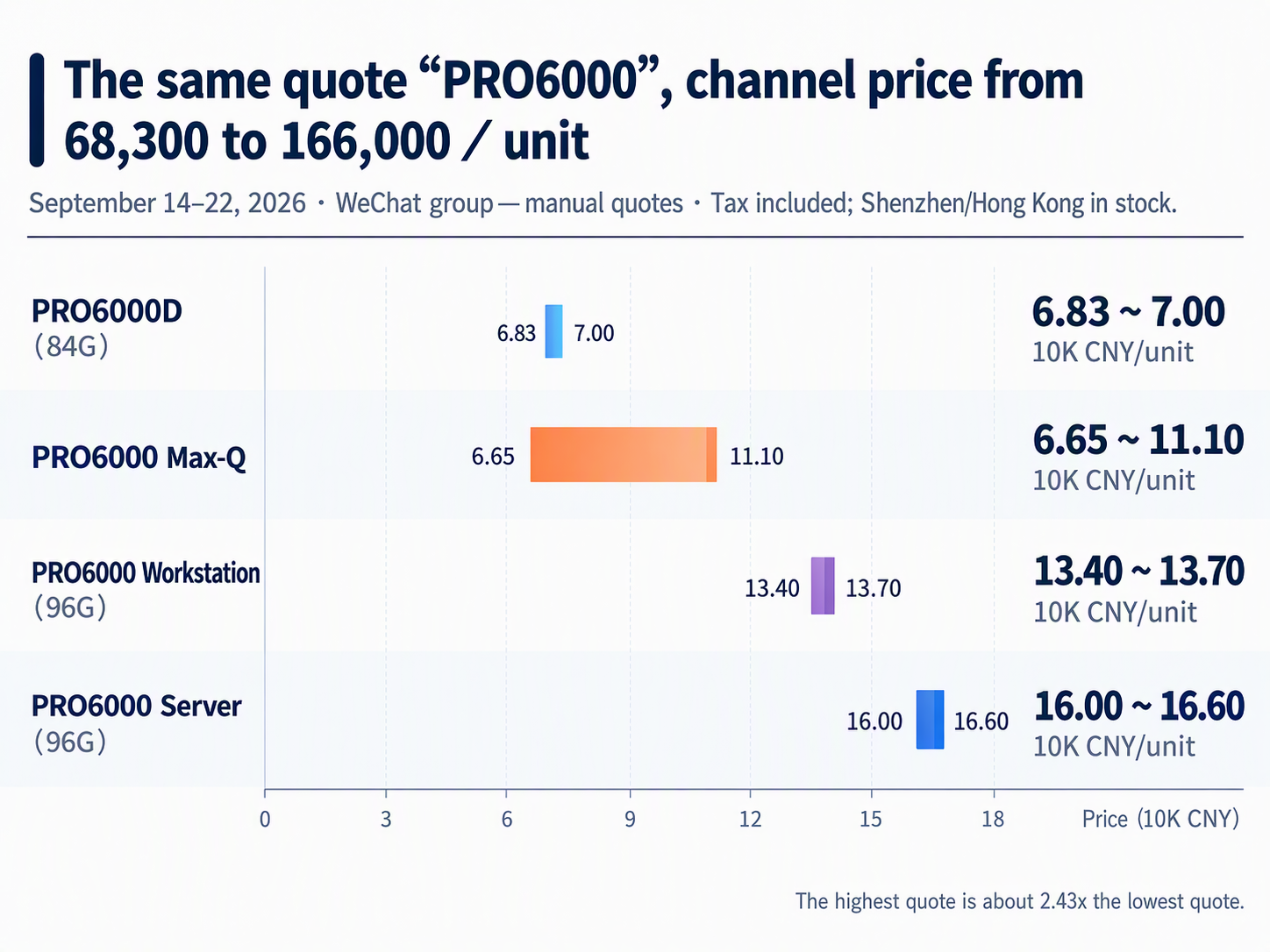
I. One "PRO6000," Four Prices
SMM regrouped this week's collected PRO6000 series listed quotes by specification (all tax-inclusive RMB, Shenzhen/Hong Kong spot basis):
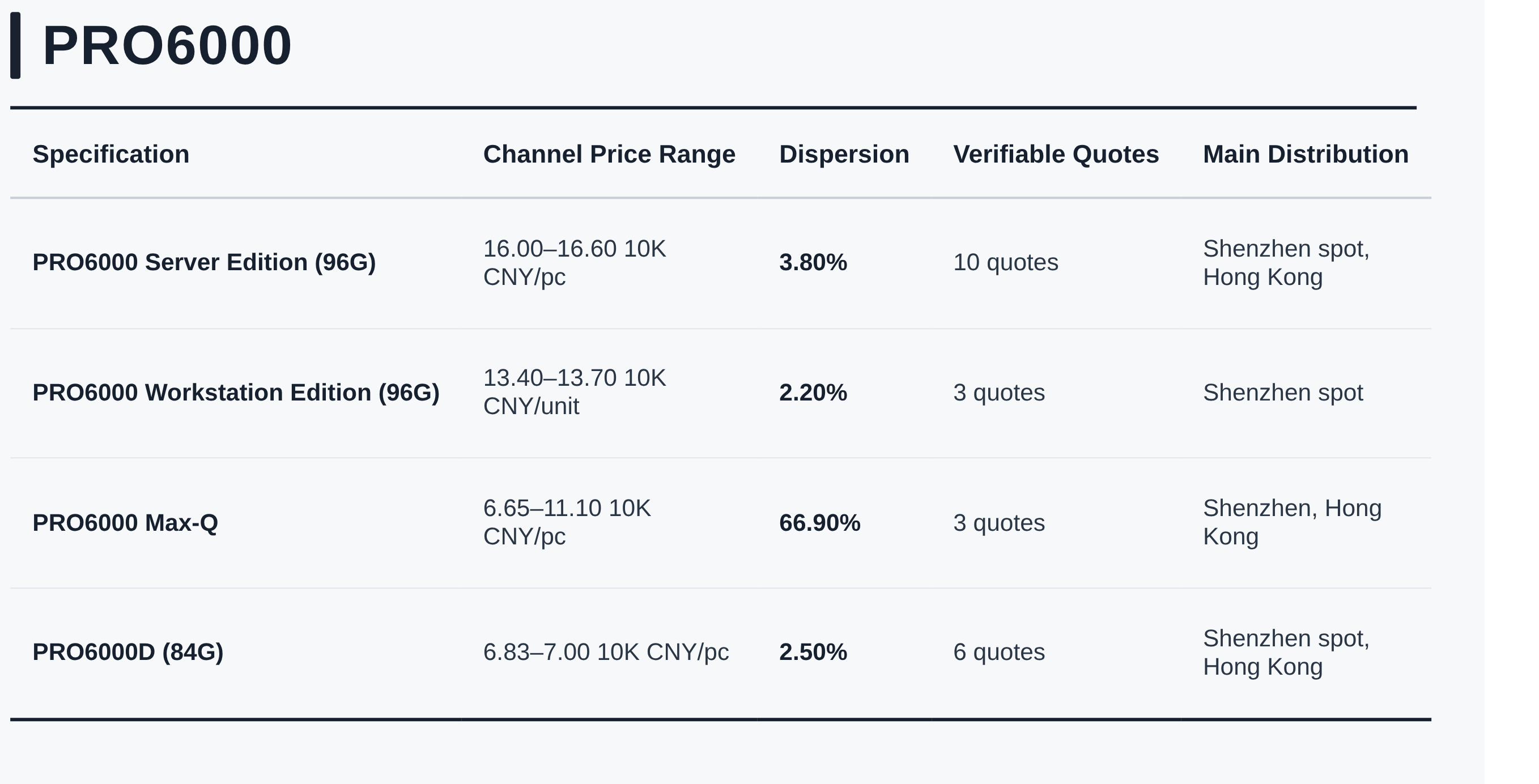
Note: Dispersion = (highest price - lowest price) / lowest price; the quote count only includes quotes with explicit price figures, while masked channel notations (6.X wan, 68X00, etc.) are not counted, though their values fall within the same range and can serve as corroboration; Pro5000 is an adjacent model in the same series, listed for reference.
The pair most easily confused is the 96G server version (range midpoint approximately 163,000 yuan) and the 84G PRO6000D (range midpoint approximately 68,700 yuan): only a 12GB memory difference, yet a 2.37x price gap (based on respective range midpoints; 2.43x if using extreme values at both ends). And these two are often referred to by the same term in channel parlance—from September 14 to 17, stable quotes for "PRO6000 server version" were at 160,000-166,000 yuan; by September 18, the "PRO6000 server version 6.X wan, 69,000 yuan (84G, 100 pieces)" appearing in the same channels actually referred to the PRO6000D. On the same day, another channel quoted "PRO6000D brand new 32 pieces 68X00 tax-inclusive"—both pointing to the same batch of goods, but using two different names.
Third-party sources show the same definitional mismatch. In September 2026, the Financial Times cited domestic chip traders saying that RTX 6000 Pro prices had risen from around 50,000 yuan at the start of the year to 130,000 yuan in recent transactions—a figure that closely matches the workstation version at 134,000-137,000 yuan collected by SMM, while the server version is already at the 160,000 yuan level. In other words, the “PRO6000 price” circulating in public discussions actually covers only one of the specifications.
2. Breaking down the specifications: each of the three specifications has a dispersion of less than 4%
When arranged by day, it can be seen that each specification’s own price band is quite narrow:
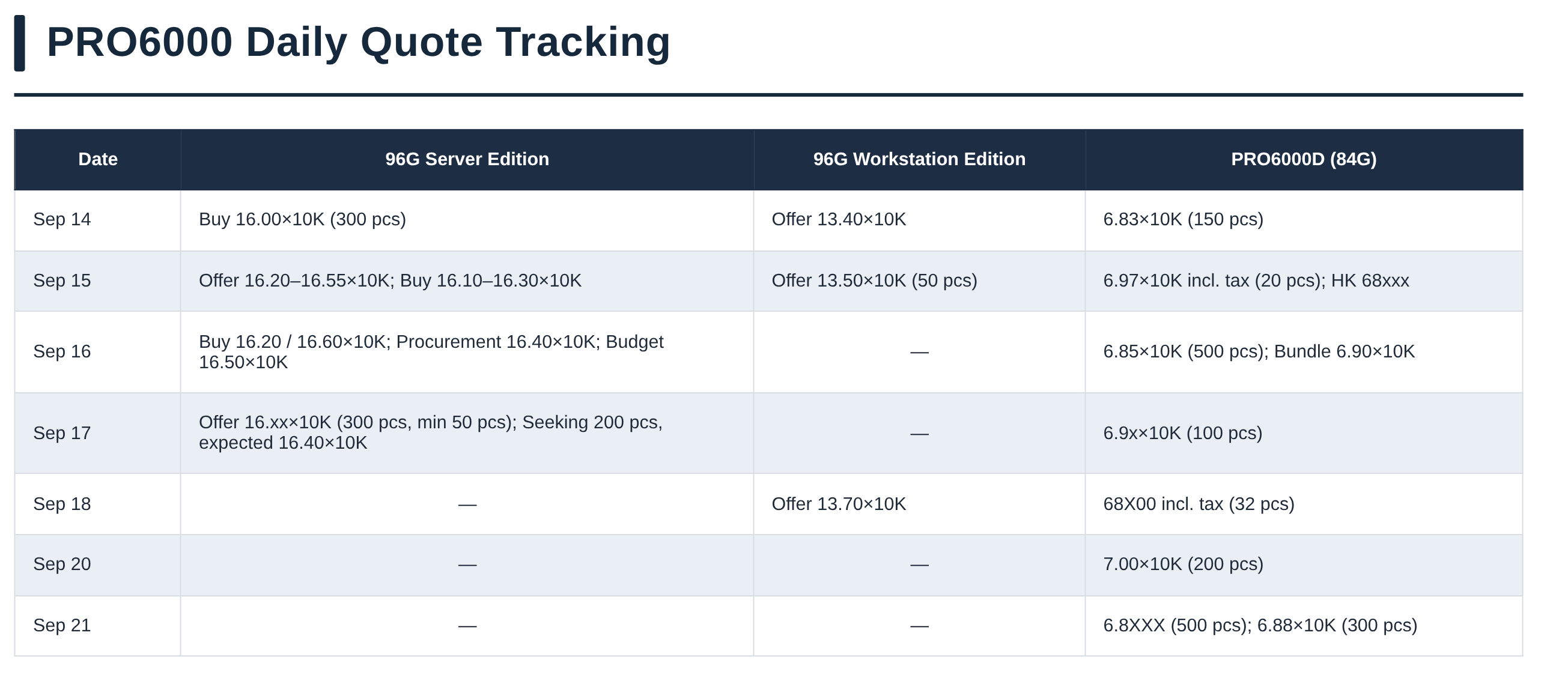
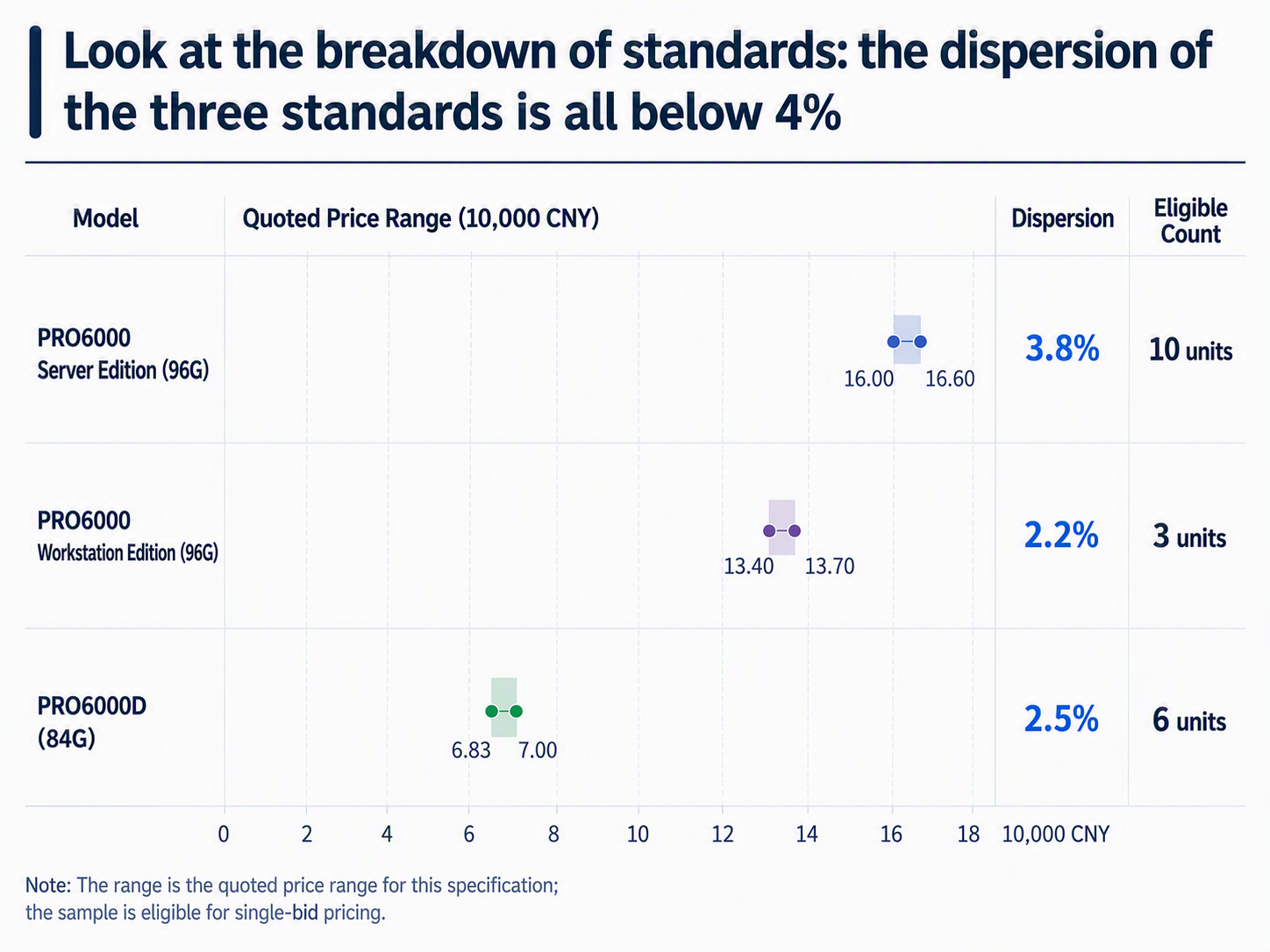
Two readings are worth noting:
-
Channels have a consensus on “how much the batch in their hands is worth.” Server version 3.8%, workstation version 2.2%, PRO6000D 2.5% - the price bands of all three specifications are tightly converged. The confusion does not occur at the quotation stage, but at the stage of cross-specification relay.
-
The bid and ask prices for the 96G server version have already overlapped. This week’s bid price range was 160,000-166,000 yuan, and the ask price range was 162,000-165,500 yuan. On September 17, a two-way alignment appeared: “300 units of Shenzhen spot, tax-inclusive 16x,xxx yuan, minimum 50 units” and “seeking 200 new cards, expecting around 164,000 yuan, must be spot,” marking the first clear price alignment in this round of collection for that specification. For this specification, price discovery is effective.
3. The cost of confusion: buyers can state volume, but sellers cannot state prices
The direct consequence of inconsistent specification definitions is that the demand side and the supply side cannot align their tables.
-
The demand side’s volume readings are large. This week’s identifiable PRO6000-series procurement demand includes: 312 units (09-14), 200 units (09-17, with the triple conditions of “new cards + expected 164,000 yuan + must be spot”), 80 units (09-17, an internet enterprise in Shanghai, requiring contract-based inspection and explicitly excluding Hong Kong goods), 100 units (09-19), and 2,060 units (09-20).
-
The supply side’s per-transaction executable scale is much smaller. The quantities corresponding to public quotations are mostly in the 20-500 unit range (20, 25, 30, 32, 50, 100, 200, 300, 500 units), and large-volume demand generally comes with the fourfold conditions of “new cards + spot + inspection + contract,” excluding Hong Kong-sourced goods.
-
Sellers generally do not quote prices. Among PRO6000-series quotations, only about 10% gave verifiable specific figures, with a public quotation rate of 12.8% ; the rest either used obscured wording (6.X ten-thousand yuan, 68X00, 6**00), or were passed over with “have stock, private chat,” “attractive price,” or “no contact if price is too high.”
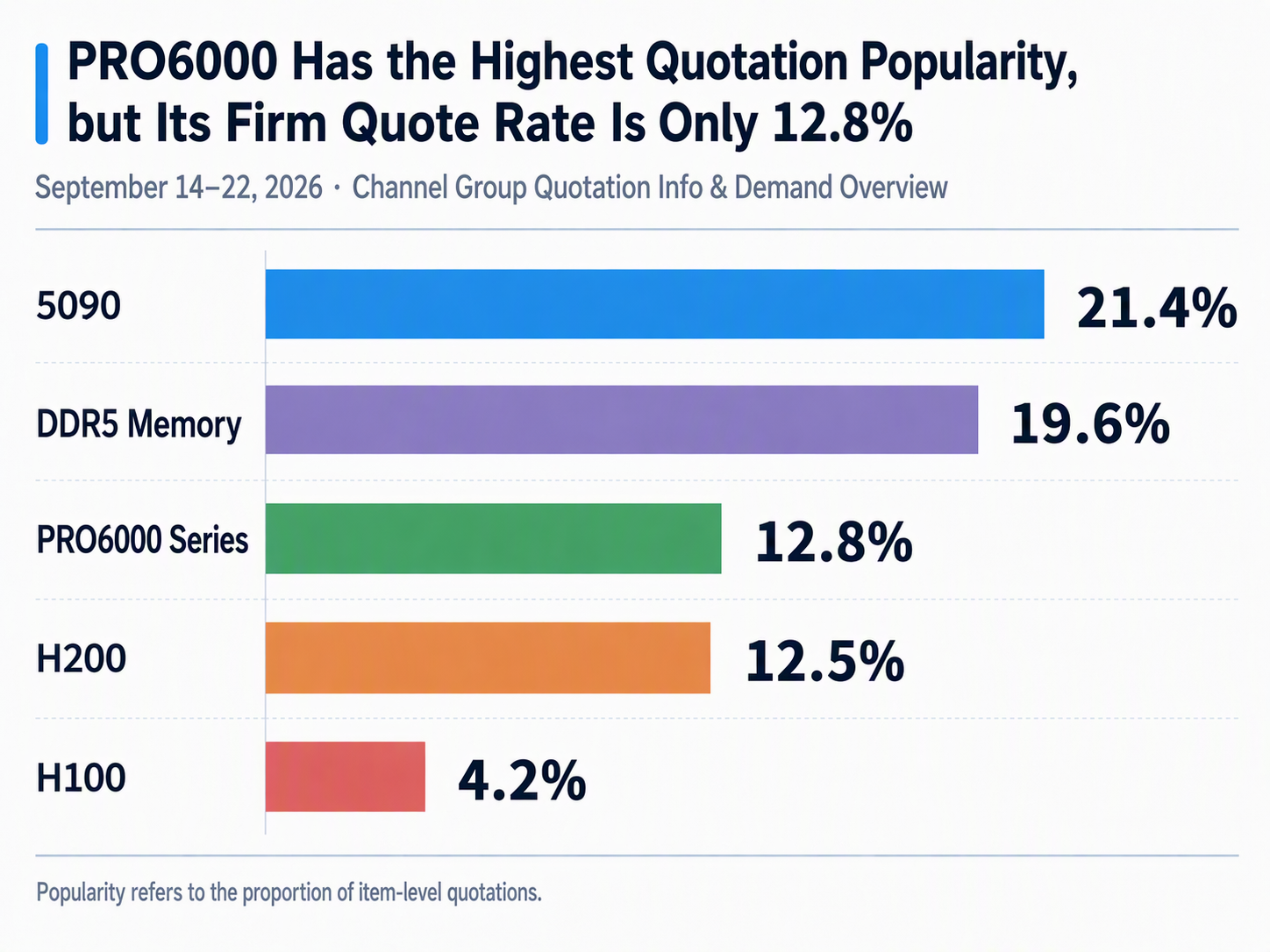
For comparison, the open-quote rate for DDR5 server memory over the same period was 19.6%, and for the 5090 it was 21.4%. Among mainstream card models, the PRO6000 is the one with the highest quotation activity but the lowest price information efficiency: the loudest calls, yet the least information that can actually be used for pricing.
IV. Why there is no price anchor
Three structural reasons:
-
There is no official direct supply channel in China. Public reports indicate that this series is subject to export controls, and conventional domestic channels cannot purchase it directly. It can only be obtained through branded workstation systems or authorized integrators via special procurement, with long supply lead times. In markets outside China, third-party sources cite an official price of $13,250 for the RTX 6000 PRO, while the quoted price in the Chinese market is around $20,000.
-
E-commerce listings do not match channel quotes, and listing pages do not specify configurations. Quotes collected by ZOL on September 7 showed: the RTX PRO 6000 Blackwell server version was listed at 88,299 yuan on the market, a Chengdu merchant offered a promotional price of 61,809 yuan, and a mall spot quote was 75,054 yuan (inventory of 20 units); the workstation version was 79,042 yuan; and the Max-Q workstation version was 76,899 yuan. These listings differ from the 160,000-yuan-level channel price for the 96G server version collected by SMM by 81%-169%, yet differ from the 84G PRO6000D (68,300-70,000 yuan) by only 7%-10%.SMM cannot confirm the specific configurations corresponding to the above e-commerce listings (the pages do not indicate memory capacity or board type), and these are listed here as pending verification. In addition, according to public reports, in May 2026 a third-party e-commerce store listed this series at 91,999 yuan (server version) and 76,999 yuan (desktop version), but the listings were removed after exposure.
-
The supply side is already pricing in a long-term shortage (circumstantial evidence). On September 21, PRO5500 futures appeared in the channel: minimum order of 100 units, delivery before end-January 2027, with a 10% deposit upon contract signing. The PRO5500 is an adjacent model in the same series rather than the PRO6000 itself. SMM has not obtained futures quotes for the PRO6000, so this item serves only as circumstantial evidence of the supply side's judgment on near-term availability and is not directly used in the PRO6000 pricing conclusion.
V. Comparison: in the same channel, memory presents a different market structure
It is worth noting that the PRO6000's "high circulation + low open-quote rate" is not the general state of the channel. SMM's monitoring over the same period shows that the channel side of DDR5 server memory is moving in the opposite direction: seller shipment activity rose 57.3% in one week, the median shipment asking price fell 5.9%, and the bid-ask spread narrowed from 2,433 yuan to 1,157 yuan, nearly halving, with an open-quote rate of 19.6%.
Two market structures coexist within the same channel network—memory is a perfectly competitive market, where quotes are final and the bargaining margin is compressed to just over a thousand yuan; the PRO6000 is a classic seller's market, where quotes are merely the starting point for negotiation, and often even that starting point is not given. The difference lies not in the habits of participants, but in whether there is a publicly referenceable price anchor: memory has original factory contract prices and public spot market quotes as references, while the PRO6000 has none.
VI. SMM View
-
The concept of a "PRO6000 price" is currently invalid. Before any price discussion can cite a number, the memory capacity (96G / 84G / 72G) and form factor (server / workstation / Max-Q) must first be locked down. The highest price difference among the four specifications is 2.43 times, so mixing them in discussion is meaningless.
-
The channel is not quoting prices chaotically; what is chaotic is the naming. The dispersion for each of the three mainstream specifications is less than 4%, indicating that holders are highly consistent in their assessment of their own inventory value; the gap lies in the cross-specification relay process and the lack of a public list price as a benchmark.
-
The 96G server version is the most efficient of the four specifications in terms of price discovery. Bid and ask prices have already overlapped, and a two-way match of 300 units against 200 units has emerged, making it a suitable benchmark specification for subsequent tracking of this category.
-
A transparent pricing rate of 12.8% means that the bargaining nature of quotes far outweighs their informational nature. For buyers, when receiving a quote starting with "6" or "16," the first step should be to confirm the specification rather than compare prices; for holders, transparent quotes can significantly improve transaction efficiency in the current market.
-
Futures scheduling for the same series has already extended to January 2027 (corroborating evidence). This does not contradict the price convergence on the spot side: spot price convergence reflects "consensus among those holding inventory," while futures scheduling reflects "insufficient total supply," but the two pertain to different models and should not be directly equated.
![[SMM Computing Power Weekly Review] Indexes Edge Up for Two Cards; H200 Rental at 98,000](https://imgqn.smm.cn/usercenter/obeMy20251217171735.jpg)
![[SMM Computing Power Weekly Review] Index consolidates throughout the week; H200 long-term contract breaks 100,000](https://imgqn.smm.cn/usercenter/QnbfL20251217171735.jpeg)