Key points: This week, SMM solid-state battery material prices remained weak. The average price of lithium sulfide was RMB 1.3 million/t, revised down from RMB 2 million/t but still far from the RMB 500,000/t target—this is the core contradiction. Sinocera’s sulfide automated production line was completed; Dowstone’s silicon-carbon anode shipped in batches; Ion Energy’s 51Ah automotive-grade solid-state battery went into production; Dongfeng’s solid-state battery mass production was postponed to Q4. Overseas, Factorial partnered with Mitsui Kinzoku, and WeLion’s 150MWh semi-solid-state energy storage project went overseas. The equipment segment has the highest certainty.
I. Preface: Price Signals and Industry Stage
This week (September 18–24, 2026), SMM solid-state battery material prices remained weak, with pressure concentrated in the sulfide segment. LPSC averaged RMB 3,400/kg; battery-grade lithium sulfide was RMB 1.3 million/t, but still far from the RMB 500,000/t cost target—this is the core contradiction. Oxide LATP and LLZO held steady at RMB 99/kg and RMB 630/kg, respectively. Anode silicon-carbon (resin-based/bio-based) held at RMB 525,000/t and RMB 298,000/t; lithium metal held steady. Cathode high-nickel ternary materials weakened overall: 8-series fell within the RMB 180,000–190,000/t range, 9-series consumer-grade fell to RMB 188,000/t, and the premium for solid-state-specific cathodes has not yet become independent. New quotes for lithium-rich manganese-based materials were added, but transactions await verification.
This week, SMM announced that starting September 29, it will add four price points: lithium-rich manganese-based materials (high, medium, and low voltage), hydrogen sulfide, and nano titanium dioxide, covering three key links: solid-state battery cathode materials, sulfide electrolyte precursors, and oxide electrolyte raw materials. The expansion of this pricing system is itself a signal: more solid-state battery materials are moving from “lab” to a “quotable, tradable” stage, but most varieties remain in small-batch or pilot stages. Public transactions are sparse, and the reliability of price signals is limited.
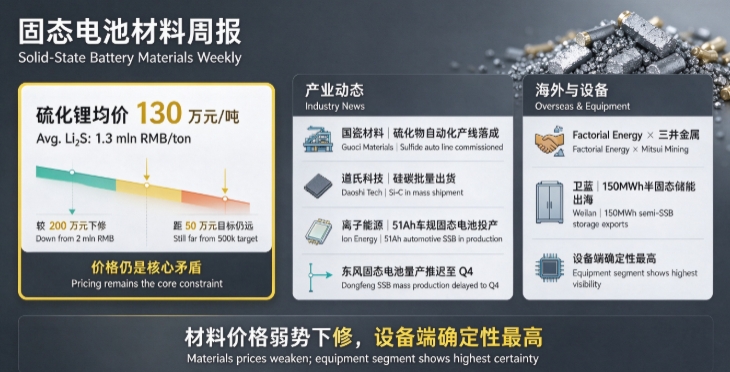
Core judgment: The core contradiction on the price side is not in the cathode or anode, but in lithium sulfide. The current battery-grade lithium sulfide price of RMB 1.3 million/t is still four times away from Gotion High-tech’s cost target of “lithium sulfide down to RMB 500,000/t and solid electrolyte down to RMB 300,000/t, entering the RMB 1/Wh era.” Several developments in this week’s documents—Sinocera’s sulfide electrolyte automated production line completed, Tengyuan Cobalt and Hunan Liuli jointly building a lithium sulfide pilot line—point precisely to attacking this bottleneck.
II. Materials: Cathode, Anode, Electrolyte
2.1 Electrolyte: Sulfide Production Lines Completed in Clusters; Oxide Thousand-Ton Capacity Already Appears
Sinocera disclosed this week that it has laid out both oxide and sulfide solid-state electrolytes, strategically focusing on the sulfide route. Its sulfide automated production line has been successfully completed, and product performance has been highly recognized by customers. This means domestic sulfide electrolyte capacity construction is transitioning from “pilot line” to “automated mass production line.” Shenzhen Xinyuanbang, in which Senior Technology holds a stake, already has thousand-ton oxide electrolyte capacity and hundred-ton shipments. Its “Guru” series achieved global mass production first in 2025, and it disclosed that global solid-state battery shipments will approach 750GWh in the next five years, with semi-solid-state accounting for over 80%, corresponding to an electrolyte membrane market of about 9.7 billion square meters.
But capacity does not equal effective supply. SMM data show that China’s cumulative sulfide electrolyte output from January to August 2026 was less than 100 tons. Although up 119.7% year-on-year and already exceeding total 2025 output, the absolute volume remains very small. The pull of large-scale all-solid-state battery production on lithium sulfide cannot yet be verified from output data at this stage.
2.2 Cathode: Ultra-High-Nickel Exceeds 240mAh/g; Lithium-Rich Manganese-Based Pricing System Starts
Sichuan University released ultra-high-nickel all-solid-state battery results this week: ultra-high-nickel cathode material 0.1C discharge specific capacity exceeded 240mAh/g; solid-state battery energy density exceeded 400Wh/kg; cycle life reached over 800 cycles. This data is reference-significant in the cathode specific capacity dimension, but from lab indicators to mass production consistency, there is usually a 6–18 month engineering cycle. SMM added three lithium-rich manganese-based price points (high voltage 4.6–4.8V, medium voltage 4.45–4.55V, low voltage 4.25–4.4V), indicating that lithium-rich manganese-based materials, as one of the candidate solid-state battery cathode routes, have begun to form a quotable market prototype, but current trading activity is expected to be extremely low.
2.3 Anode: Silicon-Carbon Shipped in Batches; Dowstone Enters Cashing-In Period
Dowstone confirmed this week that silicon-carbon anode has achieved batch shipments, and single-walled carbon nanotube-related products are supplied in batches to multiple cell manufacturers. This is the signal closest to “industrialization landing” on the material side this week—silicon-carbon anode’s leap from sample verification to batch shipment is substantially meaningful in the anode material field. But note: its solid electrolyte is only supplied in small batches to some customers, and the company is positioned as a “third tier” in the industry, with technical depth still lagging behind leading enterprises.
III. Batteries and Projects
3.1 Ion Energy Wuhan Base Goes into Production: Key Node for Polymer Route
Ion Energy’s Wuhan R&D and production base officially went into production on September 21, marking the transition of domestic polymer-based all-solid-state batteries from pilot verification to large-scale production. Its self-developed 51Ah automotive-grade solid-state battery has an energy density of 520Wh/kg, supports 6-minute ultra-fast charging, has a cycle life of over 3,500 cycles, and has fully passed all GB38031-2025 tests. It is the first domestic polymer-based solid-state battery of its type produced on a mass production line. The Yancheng base has an annual capacity of 2.5 million kWh (about 0.25GWh), and the Wuhan base undertakes core R&D and management functions.
This information needs restrained interpretation. The 520Wh/kg energy density is leading among current solid-state battery systems, and full GB38031-2025 passage means safety performance meets standards, but the 2.5 million kWh capacity scale (about 25 vehicles at 100kWh per vehicle) still has an order-of-magnitude gap from large-scale automotive application. Ion Energy’s path is more suitable for landing first in consumer electronics, mining high-safety batteries, satellite batteries, and other segmented scenarios that are price-insensitive and extremely safety-sensitive.
3.2 Dongfeng 350Wh/kg Solid-State Battery: Wording Adjustment Needs Attention
Dongfeng previously announced that its 350Wh/kg solid-state battery would be mass-produced and installed in vehicles in September 2026. The latest wording was adjusted to “released in October, mass-produced and installed in Q4.” The 0.2GWh pilot line has been put into use, and the vehicle range target is 1,000 km. A slight delay in schedule is normal fluctuation in engineering development, but the capacity gap between “mass production and vehicle installation” and “pilot line output” remains a key variable to track continuously.
3.3 Gotion High-Tech Low-Altitude Battery Release: Epitome of Solid-State Battery Application Scenarios Spilling Over
Gotion High-Tech released the low-altitude high-power Xingchen battery at the World Manufacturing Convention on September 21, and simultaneously exhibited full-scenario solutions covering sea, land, and air. Gotion’s solid-state battery layout has large capacity plans in both electrolyte and lithium sulfide. Low-altitude economy demand for high-power, high-safety batteries is becoming a second growth curve for solid-state batteries beyond automotive use.
IV. Projects and Financing Cooperation
Guning Jiyuan received angel round investment; zirconium-based oxychloride route starts. The company focuses on the zirconium-based oxychloride all-solid-state battery route. This round of funds will be used for material and cell industrialization verification and pilot testing. Zirconium-based oxychloride is a sub-branch of the oxide route. Angel-round projects are more suitable as observation samples for technological route diversity, not industrialization signals.
Oriental Zirconium’s zirconia powder received preliminary recognition. The zirconia powder samples provided by the company have received preliminary recognition from some solid-state battery material manufacturers for R&D trials. As one of the main raw materials for oxide electrolyte LATP, Oriental Zirconium’s progress in solid-state battery raw materials is in the first tier.
V. Overseas Progress
Factorial Energy and Mitsui Kinzoku signed a joint development agreement. Mitsui Kinzoku is one of the few companies globally with basic sulfide solid-state electrolyte technology. Its A-SOLiD™ sulfide electrolyte was released in 2016 and is being mass-produced at a dedicated factory in Saitama, Japan. Factorial is responsible for cell design, process development, and manufacturing verification, while Mitsui Kinzoku provides electrolyte material technology. Factorial CEO Siyu Huang’s statement is noteworthy: “Battery innovation cannot be completed by one company; it is driven by the entire supply chain and increasingly by entire industry alliances.” This cooperation model—deep binding between material supplier and cell maker—may accelerate the engineering of the sulfide route more than a simple procurement relationship.
TrendForce: All-solid-state batteries enter engineering verification period. In 2026, the technological maturity of the ASSB industry has made major progress. Toyota, Honda, Nissan, and Samsung SDI’s small-scale trial production progress is slightly ahead. Japanese manufacturers’ automotive-grade products have been verified and confirmed in some performance indicators and are accelerating performance evaluation of automotive ASSB modules. Nissan’s thick 23-layer stacked automotive ASSB cell has completed charge-discharge testing, with capacity retention performance superior to traditional liquid lithium-ion batteries. Chinese manufacturers CATL, BYD, and FAW are accelerating upgrades to TRL4–5 on ASSB small-scale pilot lines. Application scenarios are spreading from electric vehicles to drones/eVTOL, microelectronics, construction machinery, and embodied robots.
[Solid-State Battery: WeLion New Energy signs 150MWh semi-solid-state energy storage project framework cooperation agreement with Hungary’s Szermann Kft, formally entering the Central and Eastern European market] On September 19, 2026, WeLion stated: WeLion New Energy signed a 150MWh energy storage framework agreement with Szermann Kft. The overseas expansion of semi-solid-state energy storage batteries into Central and Eastern Europe is another case of semi-solid-state batteries achieving large-scale commercial landing first in energy storage scenarios. Energy storage has lower energy density requirements than power batteries and higher requirements for safety and cycle life, which matches well with the current technical characteristics of semi-solid-state batteries.
Schaeffler: Solid electrolyte is one of the most expensive components in all-solid-state batteries. This judgment is consistent with the price reality of lithium sulfide at RMB 1.3 million/t. Schaeffler’s coating process progress is directionally correct—reducing electrolyte layer thickness can directly reduce material usage per unit area—but the “development stage” characterization means it has not yet entered capacity competition.


**Note:** For further details or inquiries regarding solid-state battery development, please contact:
Phone: 021-20707860 (or WeChat: 13585549799)
Contact: Chaoxing Yang. Thank you!
![[Solid-state battery: Jinyu New Energy predicts that the demand for batteries in the low-altitude sector will be around 300 GWh by 2035]](https://imgqn.smm.cn/usercenter/ipFFo20251217171725.jpg)
![[Solid-State Battery: Wanbang's Yu Yanan Shares Progress on Materials Such as Lithium Sulfide and Silicon-Lithium Anodes]](https://imgqn.smm.cn/usercenter/nVnLo20251217171728.jpg)
![[Solid-State Battery: Wang Jiutian of Zhongke Yuanben Analyzes Sulphide All-Solid-State Battery Technology and Enterprise Layout at SMM SSBC Annual Conference]](https://imgqn.smm.cn/usercenter/WBREf20251217171728.png)