SMM, September 24, 2026:
Customs data shows that China's aluminum plate/sheet and strip exports totaled 31.19 mt in August 2026, down 3.3% MoM (a decrease of 1.07 mt from 322,700 mt in July), up 17.7% YoY. This marks the second consecutive monthly decline following July's 9.0% MoM pullback, though the pace of decline has narrowed notably, with exports overall still running on a historically high plateau. In January-August, China's cumulative aluminum plate/sheet and strip exports reached 2.427 million mt, up 19.3% YoY, with the export baseline systematically higher compared to the same period last year. Looking at the monthly export curve, aluminum plate/sheet and strip exports have risen markedly since April 2026, hitting a YTD high in May-June (354,544 mt in June), before entering a retreat-from-highs channel in July-August. August's 311,931 mt was equivalent to 88% of the June peak, but still 18% higher than the same period last year (265,096 mt).
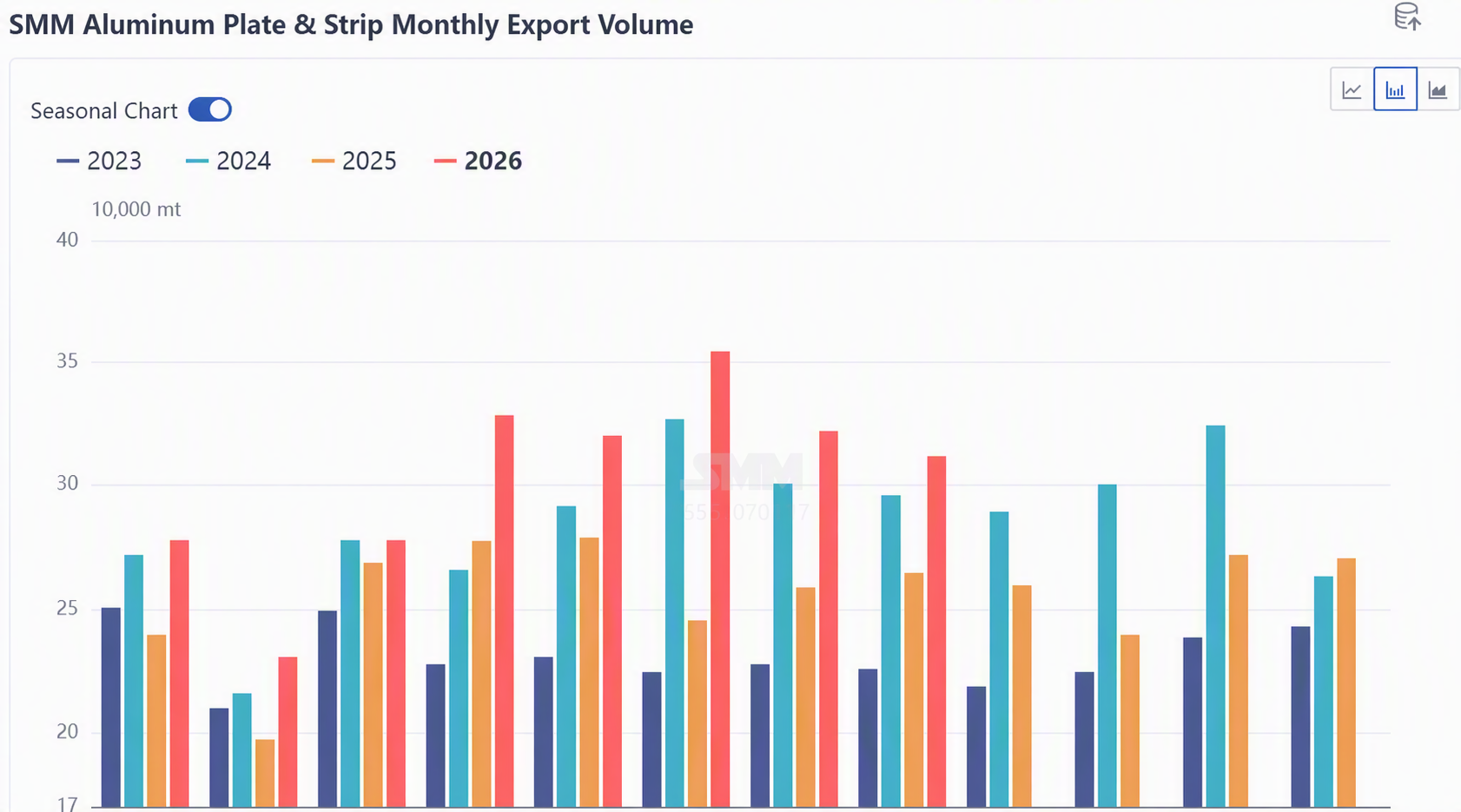
Regionally, North America (US + Canada + Mexico) overtook Southeast Asia with a 23.9% share to become the largest export region in August, mainly boosted by Mexico's strong +43.0% growth. Southeast Asia's share pulled back to 23.7%, while the Middle East and Europe fell 15.4% and 15.4% respectively, serving as the main sources of the overall monthly decline. By country, Mexico jumped to the top spot with 49,934 mt, up 43.0% MoM, making it the core growth driver in August. Meanwhile, US exports plunged from 16,240 mt in July to 7,192 mt (-55.7%).
Mexico's August exports surged 43.0% MoM to take the top spot, but the surge was not driven by demand expansion—rather, it was a concentrated front-running move amid expectations of a new round of tariffs on China. Since 2026, Mexico's tariffs on China have escalated in three stages: starting in January, tariffs of 10%-50% were imposed on approximately 1,463 tariff lines for countries without free trade agreements; on April 24, an additional 5%-35% was imposed on 185 tariff lines; and on August 18, Bloomberg reported that Mexico was considering further trade restrictions on products such as steel and automobiles, with the Ministry of Economy confirming consultations with enterprises. This ignited tariff hike expectations—exporters accelerated shipments before tariffs took effect, and Mexican importers front-loaded stockpiling before the hikes, resulting in a pulse-like surge in August exports. Against the backdrop of a 3.3% MoM decline in China's total exports, Mexico single-handedly bucked the trend, with its share jumping from 10.9% in July to 16.0%. Taking a longer view, cumulative exports to Mexico in January-August totaled 307,304 mt, down 4.3% YoY, underperforming the overall export growth (+19.2%) by 23 percentage points. The coexistence of a cumulative decline and a single-month surge is precisely the result of two opposing forces: tariff suppression in H1 and front-running driven by new expectations in August.
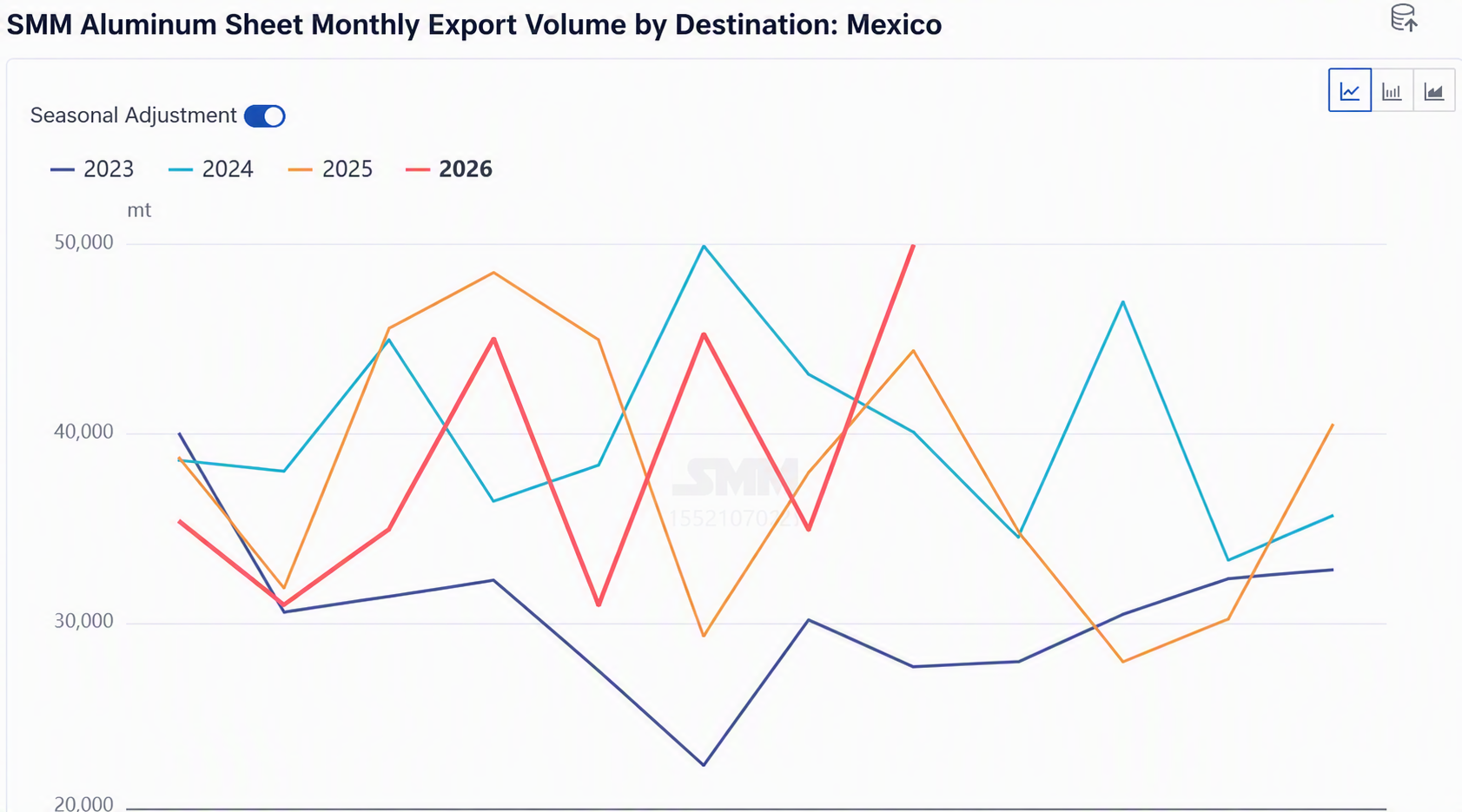
Looking ahead to H2, exports to the US are expected to pull back to low levels. The widening SHFE/LME price ratio will continue to weigh on new orders. Exports are expected to decline further from September, with Q4 monthly average exports falling within the 260,000-300,000 mt range. Given the solid base of 2.427 million mt in January-August, and a neutral estimate for September-December (monthly average of 270,000 mt, totaling about 1.08 million mt over four months), full-year exports are still expected to reach 3.45-3.6 million mt, exceeding the 3.07 million mt in 2025 and likely surpassing the 3.43 million mt in 2024. By market, Mexico's front-running effect is likely to persist until around the fourth round of US-Mexico Washington talks (end-September), with September exports to Mexico expected to remain at a high level of 45,000-50,000 mt. Entering Q4, if the US-Mexico framework agreement is finalized at year-end and Mexico imposes high tariffs on Chinese steel and aluminum in line with Section 232, exports to Mexico will come under significant pressure, with the monthly average potentially pulling back to 30,000-35,000 mt. In the medium and long term, Mexico's nearshoring manufacturing demand base remains intact, but the "transshipment to the US via Mexico" channel is being progressively blocked by smelting and casting rules. Combined with rising tariff walls, China's aluminum plate/sheet and strip share in Mexico is likely to trend downward, with exports increasingly dependent on genuine demand from Mexico's local processing.