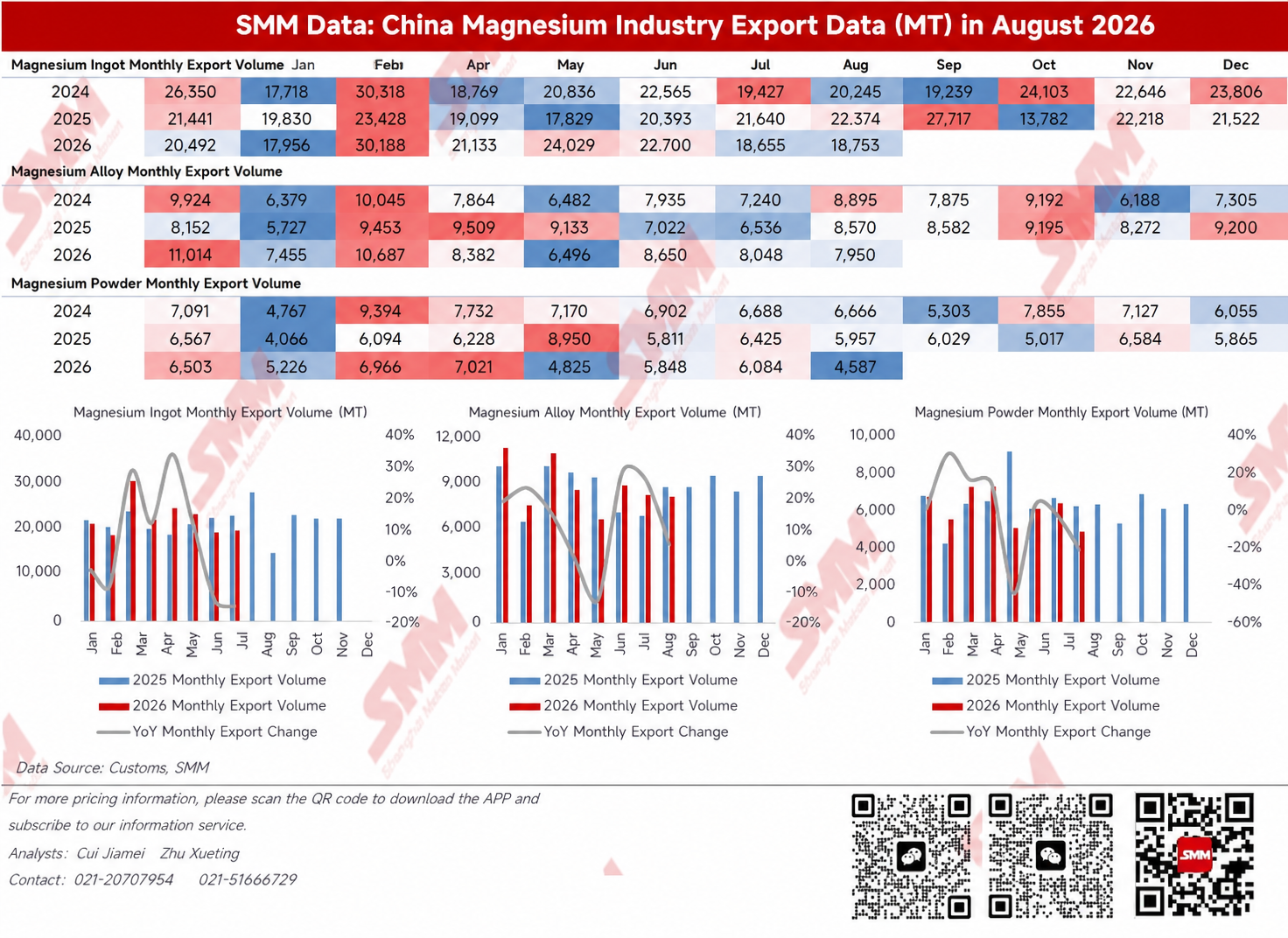
In August, China's total magnesium product exports reached 33,400 mt, down 3.5% MoM and down 13.7% YoY. By product type, magnesium ingot exports totaled 18,800 mt, up 0.5% MoM but down 16.2% YoY, ending a two-month streak of declining export volumes since May. The downward trend in magnesium powder exports intensified further, with August exports at 4,587 mt, a sharp pullback of 24.6% MoM. Magnesium alloy exports came in at 7,950 mt, down 1.2% MoM and down 7.2% YoY. Aside from magnesium powder, the fluctuations in magnesium ingot and magnesium alloy exports in August were relatively limited. Looking ahead, as the traditional September-October peak season gradually arrives, coupled with concentrated delivery of some foreign trade orders, magnesium product exports have the potential for a MoM recovery in September-October, though the actual extent of the rebound still requires continued observation and verification.
August magnesium product export volumes continued to pull back MoM, but cumulative exports in 2026 maintained an uptrend YoY
In August 2026, China's magnesium product exports totaled 33,400 mt, down 3.5% MoM from July and down 13.7% YoY from August last year. Cumulative exports of all magnesium products from January to August reached 307,000 mt, up 3.5% YoY.
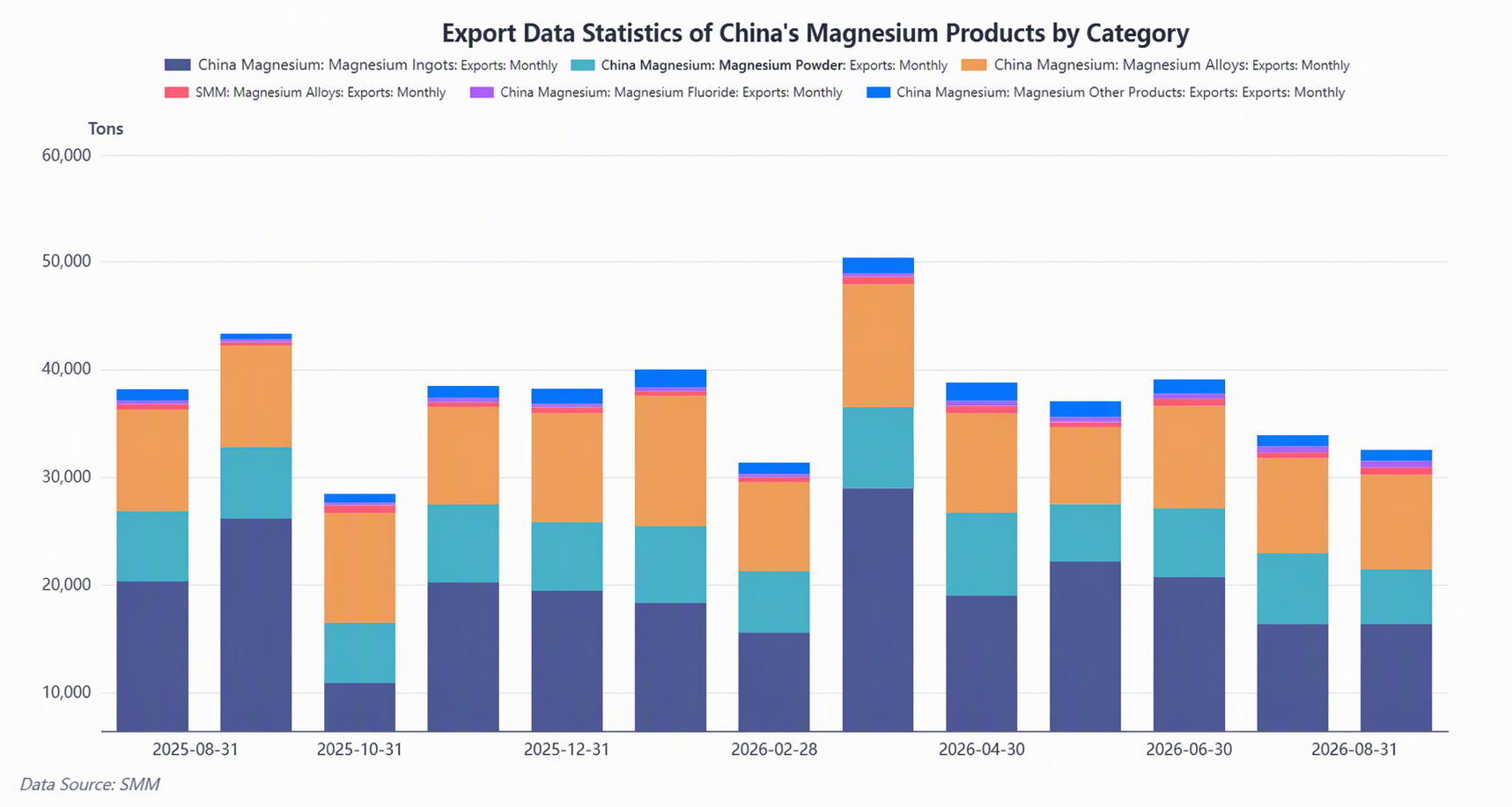
Despite the continued pullback in August monthly exports, cumulative export value from January to August reached approximately $748 million, up 5.97% YoY. The growth rate of China's magnesium product export value in January-August 2026 significantly outpaced the growth rate of export volume, reflecting the continuous optimization of China's magnesium product export structure. As the industry's trade model gradually transitions from low-end, low-value-added magnesium ingot raw material exports toward high-value-added magnesium alloys and high-end die-cast finished products, the per-unit export value has steadily risen, driving overall export value growth to outpace sales volume growth. This reflects the continuous improvement of China's magnesium industry's deep processing capabilities and global product premium capacity.
There are two main reasons for the continued decline in magnesium product export volumes in August: First, the traditional overseas summer break off-season continued to suppress demand, with signs emerging in July and deepening further in August. In July, major consumer markets such as Europe had already entered the summer break period, with downstream factory operating rates declining and procurement pace slowing. This seasonal factor continued to intensify in August. European clients were largely on holiday, with inquiries and actual orders noticeably reduced, and new order releases nearly stagnant. From the export data, magnesium ingot exports fell 16.2% YoY in August, and magnesium powder fell 23.00% YoY, with declines significantly larger than the 7.2% for magnesium alloys. This indicates that the summer break had a more direct impact on primary raw materials, while alloys, with deeper downstream production line integration and stronger rigid demand attributes, were relatively less affected. This structural difference confirms that the off-season suppression of exports was mainly concentrated in magnesium ingots and magnesium powder, which have stronger substitutability. Second, rising cost-side support strengthened magnesium producers' resolve to hold prices firm, creating a stalemate with overseas buyers' expectations of pushing for lower prices. In August, coal and semi coke price centers moved upward, driving up ferrosilicon costs, and ferrosilicon spot prices drifted higher. This round of raw material price increases mainly stemmed from supply-side tightening and fuel cost transmission, while downstream magnesium demand did not strengthen in tandem, creating cost-side pressure on magnesium smelting. In August, the average monthly Ex-works price of domestic magnesium ingots was 15,881 yuan/mt, edging up 35 yuan/mt from July, a gain of only 0.22%, but the absolute price level remained above overseas buyers' psychological price levels. The price gap between buyers and sellers was difficult to bridge, leading to sluggish export trading. Meanwhile, ocean freight rates remained elevated in August, with freight rates rising due to tight shipping capacity, and the added transportation costs further compressed traders' profit margins and downstream purchase willingness.
In August, export trends of major magnesium products continued to diverge, with magnesium ingot and magnesium alloy export volumes basically flat compared with July, while magnesium powder exports showed a notable pullback.
Specifically:Magnesium ingot exports posted the largest YoY decline, with August magnesium ingot exports at 18,753 mt, down 16.2% YoY, the largest YoY decline among the three major product categories. The core reason is that magnesium ingots, as a primary raw material, have the strongest substitutability, and overseas clients first cut magnesium ingot purchases during the summer break off-season. Combined with domestic producers holding prices firm amid losses, the price gap between buyers and sellers was difficult to bridge, and trading remained stagnant. Magnesium alloys showed the strongest resilience and were the only product category to achieve a YoY increase in average price.In August, magnesium alloy exports totaled 7,950 mt, down 7.2% YoY, with the decline less than half that of magnesium ingots.The core reason is that alloy products have deeper downstream integration, with die-casting enterprises in markets such as Canada, Mexico, and Germany having strong rigid demand attributes, giving them significantly better resistance to summer break seasonal factors than primary magnesium ingots. Magnesium powder exports saw the sharpest pullback, facing multiple demand pressures.In August, magnesium powder exports totaled 4,587 mt, down 23.0% YoY and down 24.6% MoM, making it the product category with the largest export volume decline for the month.Magnesium powder is mainly used in steel desulfurization. Overseas small and medium-sized steel mills saw slowing operations, while previously imported inventory was still being digested, and purchase willingness continued to weaken. Additionally, the current tightening of export controls on dual-use items further constrained magnesium powder product exports. Multiple factors combined to drive the notable decline in magnesium powder exports in August.
High-end magnesium product export demand was strong, with foreign trade structure continuing to optimize
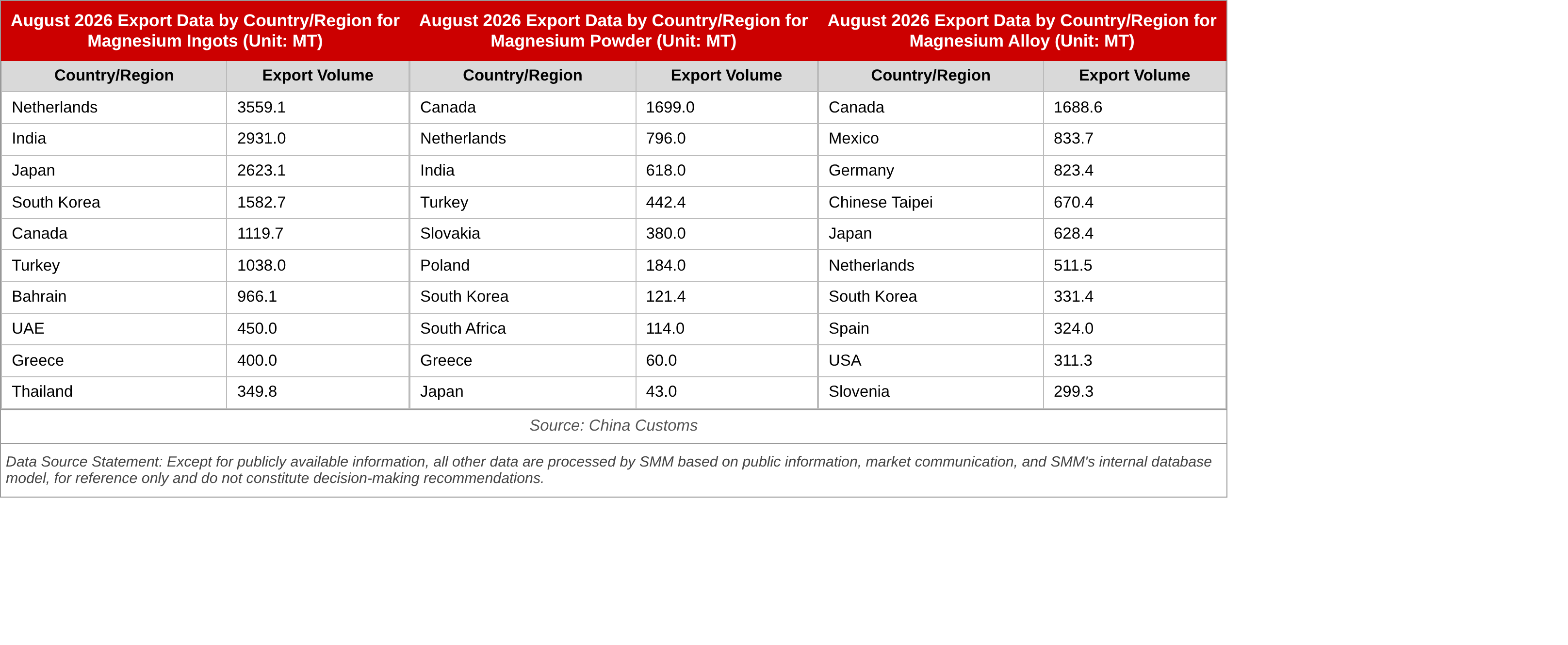
From the export data by destination, among the top three destinations for magnesium ingots, the Netherlands fell 8.6% MoM and 39.7% YoY, Germany fell 41.4% MoM and 47.0% YoY, and Spain, Italy, Poland, and other countries also generally declined. European clients' holidays led to a slowdown in procurement pace, while India grew 60.3% MoM and Japan grew 8.7% MoM, indicating that Asian markets have different holiday rhythms from Europe and relatively stable demand. The same was true for magnesium powder, with Türkiye plunging 70.4% MoM and the Netherlands down 31.9%, as European steel desulfurization demand contracted notably during the summer break.
Meanwhile, high-end magnesium product exports performed impressively, becoming the core growth driver of foreign trade.Among them, magnesium semi-finished product exports surged 148.5% YoY, with the growth mainly driven by the North American market. Exports to the US accounted for as much as 81.8%, up 187.9% YoY, while exports to Canada soared 261.5% MoM. Magnesium alloy exports also showed broad-based strength, with exports to Germany up 20.9% MoM and surging 162.8% YoY; exports to Taiwan, China grew 108.1% MoM and skyrocketed 451.6% YoY. This demonstrates that high-end magnesium alloy rigid demand has sufficient resilience and is relatively less affected by the overseas summer break off-season, fully confirming that China's magnesium product export demand structure is undergoing transformation, with foreign trade models continuing to upgrade. At the same time, magnesium product exports to Thailand rose sharply MoM, with the Southeast Asian market steadily emerging as a new growth pole for China's magnesium product exports. Overall, August export data reflects structural changes in global magnesium trade. The European off-season mainly affected primary raw material exports, while demand for alloys and deep-processed products in North America and some Asian markets maintained growth. The resilience of China's magnesium exports is more evident in high-end categories such as alloys and semi-finished products.
Magnesium export market outlook: Short-term exports are expected to gradually recover as the traditional peak season arrives, with total 2026 export volume still expected to show modest growth
After the European summer break ends, local downstream die-casting enterprises will gradually resume operations and production schedules, and phased restocking demand for magnesium ingots and magnesium alloys is expected to be gradually released. Although overall overseas demand has not yet shown a comprehensive market reversal and concentrated recovery, and overseas buyers have a strong desire to bargain down prices, coupled with firm domestic magnesium prices, the price spread between Chinese and overseas markets remains significant, and short-term foreign trade transactions may continue in a stalemate pattern. However, demand resilience in Asian markets such as India, Japan, and South Korea was evident in August. If this trend continues, it could effectively offset the pressure from slower European market recovery. Overall, with the traditional September-October peak season kicking off, the probability of MoM improvement in magnesium product exports is relatively high, but the market is likely to be dominated by restorative replenishment. The subsequent extent of the rebound will depend on the sustainability of overseas demand and the outcome of the price game between domestic and overseas markets.
In January-August 2026, China's total exports of all magnesium products reached approximately 307,200 mt, up 3.53% YoY, already reaching 68.6% of the 2025 full-year total of 447,600 mt. Although magnesium product exports have continued to weaken over the past two months, overseas clients' previously accumulated inventory has been gradually consumed and has pulled back somewhat. After October, the market is expected to see a restocking window, though further demand release will still require price levels to match overseas buyers' expectations. Moreover, overseas downstream magnesium lightweighting demand is growing steadily, and there are no large-scale new primary magnesium capacity additions overseas in the short term. Global primary magnesium supply remains highly dependent on Chinese sources, so China's overall magnesium product export volume still has upward potential.
![Magnesium Ingot Prices Hold Steady and Consolidate; Pre-Holiday Restocking Winds Down, Trading Thins [SMM Magnesium Ingot Spot Report]](https://imgqn.smm.cn/usercenter/LYGyd20251217171725.jpg)
![Pre-holiday Stockpiling Fails to Offset Strong Supply and Weak Demand; Magnesium Prices Consolidate on a Subdued Note in the Short Term [SMM Magnesium Ingot Spot Report]](https://imgqn.smm.cn/usercenter/znXdm20251217171724.jpeg)