SMM News, September 23:
Primary Aluminum Imports: According to data from the General Administration of Customs, domestic primary aluminum imports stood at approximately 186,000 tonnes in August 2026, up 0.2% month-on-month and down 14.6% year-on-year. Cumulative domestic primary aluminum imports from January to August 2026 reached roughly 1.657 million tonnes, a year-on-year decline of 3.4%.
Primary Aluminum Exports: Customs data showed domestic primary aluminum exports were around 22,000 tonnes in August 2026, dropping 30.7% month-on-month and 14.7% year-on-year. Cumulative primary aluminum exports between January and August 2026 totalled approximately 168,000 tonnes, representing a year-on-year increase of about 9.3%.
Net Imports of Primary Aluminum: Domestic net imports of primary aluminum were 164,000 tonnes in August 2026, rising 6.5% month-on-month and falling 14.6% year-on-year. Cumulative domestic net imports of primary aluminum from January to August 2026 came to roughly 1.49 million tonnes, down 4.7% year-on-year.
(The above import and export statistics are based on HS codes 76011090 and 76011010.)
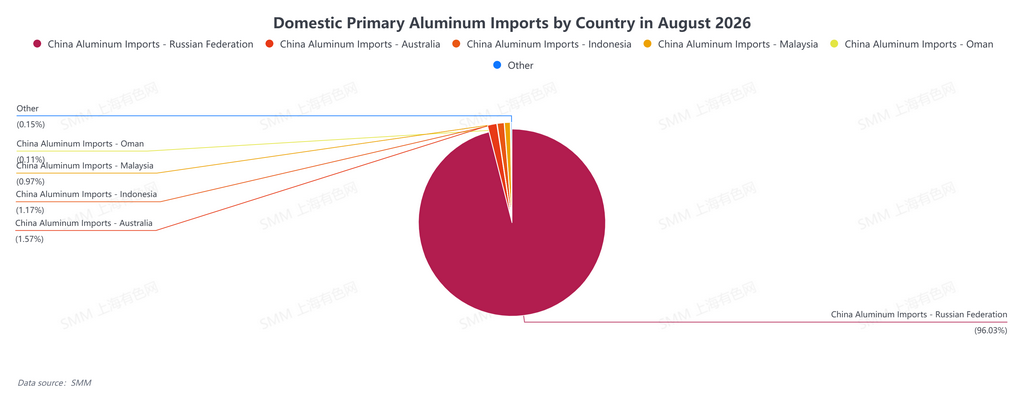
On the import side, aluminum ingots from Russia accounted for 96% of total imports. The general trade import window remains closed, processing trade orders under customs manuals are mediocre, and the share of aluminum ingots imported from other countries continues to decline.
On the export side, the overseas electrolytic aluminum market features a supply gap. Some bonded-zone aluminum ingots are re-exported to Japan, South Korea and India.
Although the overseas electrolytic aluminum market sees a supply gap and continuous inventory drawdowns, high aluminum prices curb demand. Meanwhile, exports of domestic aluminum semi-finished products, aluminum manufactures and end products partially offset overseas demand. Spot trading of overseas electrolytic aluminum is sluggish; spot premiums for electrolytic aluminum across Asia have trended downwards. Re-export trade activity remains weak, and the volume of domestic primary aluminum exports has contracted.
In the short term, re-export trade stays tepid and export volumes are expected to remain low. Overseas electrolytic aluminum spot trading is muted. Import volumes of Russian aluminum ingots are set to recover. Nevertheless, considering factors such as cargo in transit, domestic net imports of primary aluminum are projected to stay low in the near term, yet the trend points to a gradual recovery in domestic net imports of primary aluminum.