Diverged Supply‑Demand in Silicon‑Steel Industry: Exports Offset Domestic Capacity Pressure
China’s overall silicon‑steel capacity has continued to expand in recent years, bringing prominent structural contradictions to the industry. For non‑oriented silicon steel, overcapacity is conspicuous among low‑ and mid‑grade conventional grades. Domestic demand growth from traditional home appliances and general‑purpose industrial motors is limited. Driven solely by high‑grade demand from new‑energy vehicles, new output cannot be fully absorbed. Domestic supply remains ample with mounting supply‑demand pressure. Oriented silicon‑steel as a whole stays in a tight balance: low‑ and mid‑grade products are gradually saturated, while supply gaps persist for high‑magnetism, ultra‑low‑loss premium grades.
Benefiting from complete domestic steel‑industry upstream‑and‑downstream supporting chains, stable product quality and large‑scale cost advantages, domestically‑produced silicon steel has steadily gained global cost‑performance competitiveness. Alongside manufacturing relocation to Southeast Asia, Latin America, South Asia and other regions, plus rigid incremental demand brought by the popularization of high‑efficiency motors and energy‑saving transformers overseas, exports have become a critical outlet for digesting surplus domestic capacity. Low‑to‑mid‑grade non‑oriented silicon steel and conventional oriented silicon steel achieve regular capacity diversion via overseas sales. Going forward, the industry will further phase out inefficient capacity, optimize product mix, and pursue high‑quality development through coordinated domestic‑and‑overseas market deployment.
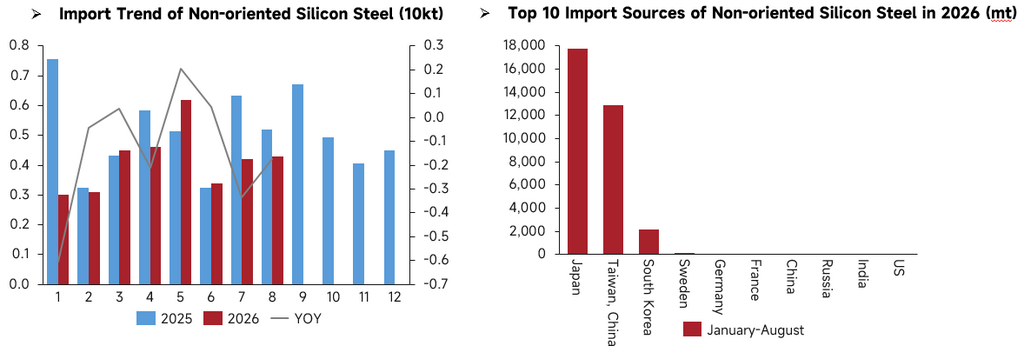
Non‑Oriented Silicon‑Steel Imports: Concentrated Sources from Japan and Chinese Taipei; Rising Domestic Self‑Sufficiency
In terms of monthly non‑oriented silicon‑steel import trends, imports stood at approximately 5,200 tons in August 2025 and fell to 4,300 tons in August 2026, registering a year‑on‑year decline with a notable month‑on‑month drop. From January to August 2026, import sources were highly concentrated: Japan recorded the largest import volume, followed by Chinese Taipei and South Korea. Import volumes from Sweden, Germany, France, Russia, India, the United States and other origins remained low, making imports heavily reliant on Japan and Chinese Taipei.
Shrinking August imports directly reflect advancing domestic substitution for non‑oriented silicon steel. With continuous domestic capacity release and technological breakthroughs for high‑grade products, domestic self‑sufficiency has improved and dependence on overseas products has gradually waned.
Data source: General Administration of Customs of the People’s Republic of China
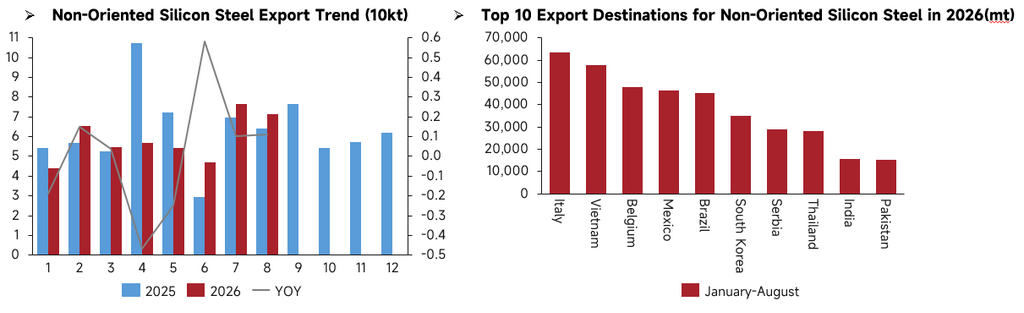
Non‑Oriented Silicon‑Steel Exports: Volatile Overseas Demand Triggers Mild Month‑on‑Month Export Drop
Looking at monthly non‑oriented silicon‑steel export performance, exports reached roughly 71,300 tons in August 2026, down from 76,700 tons in July 2026 yet still positive year‑on‑year. From January to August 2026, export destinations were widely dispersed: Italy ranked first, followed by Vietnam, Belgium, Mexico, Brazil, South Korea and others, mainly covering manufacturing‑intensive regions across Europe, Southeast Asia and Latin America.
Although August exports edged down month‑on‑month, absolute export volumes stayed relatively high, continuing the pattern of diverting surplus domestic capacity abroad. Rigid demand driven by overseas motor‑manufacturing relocation underpins domestic non‑oriented silicon‑steel exports. Nevertheless, monthly exports fluctuate amid shifting overseas demand, and exports serve as a key channel to ease loose domestic supply pressure.
Data source: General Administration of Customs of the People’s Republic of China
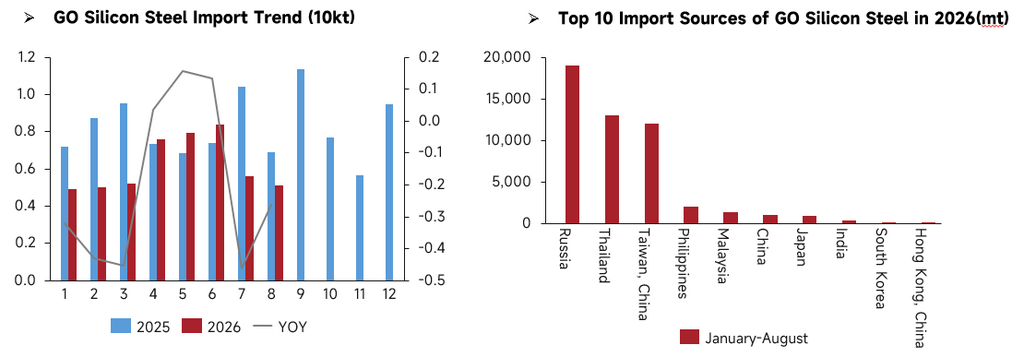
Oriented Silicon‑Steel Imports: Concentrated Supply from a Handful of Countries and Chinese Taipei
For monthly oriented silicon‑steel import trends, August 2026 imports totalled about 5,100 tons, falling from 6,900 tons in August 2025, posting both year‑on‑year and month‑on‑year contractions. From January to August 2026, oriented silicon‑steel imports mainly came from Russia, Thailand and Chinese Taipei, whose volumes far outpaced other suppliers. Import volumes from the Philippines, Malaysia, Japan and other origins stayed low.
Lower August imports signal progressing domestic substitution for oriented silicon steel. Domestic supply capacity for high‑magnetism grades keeps improving, lowering reliance on external imports. Still, rigid import demand remains for certain ultra‑high‑performance premium grades, and imports have not been fully eliminated.
Data source: General Administration of Customs of the People’s Republic of China
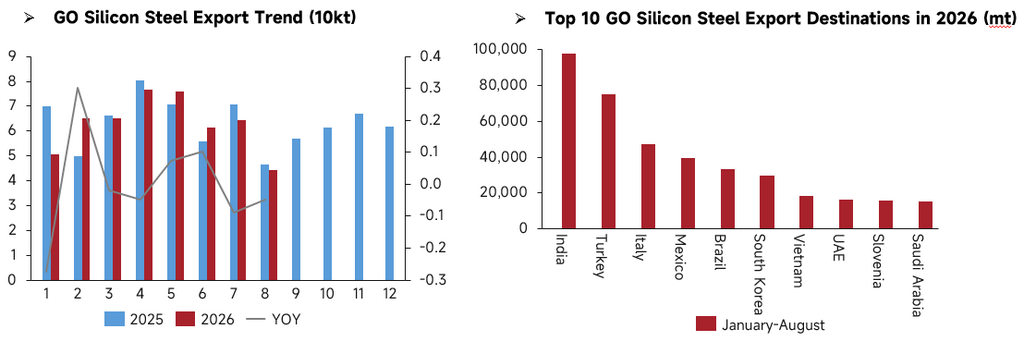
Oriented Silicon‑Steel Exports: Broad Overseas Reach with Marked Market Diversification
August 2026 oriented silicon‑steel exports hit approximately 44,300 tons, lower than 46,500 tons in August 2025, down both year‑on‑year and notably month‑on‑month. From January to August 2026, oriented silicon‑steel export destinations were diverse: India accounted for the largest volume, followed by Turkey, Italy, Mexico, Brazil and South Korea. Demand chiefly stems from overseas power‑infrastructure construction.
Despite weaker August exports, expanding domestic oriented silicon‑steel capacity and the cost‑performance edge of home‑grown products enable continuous participation in global transformer‑material competition, supported by overseas power‑grid investment.
Data source: General Administration of Customs of the People’s Republic of China
Conclusion
August 2026 silicon‑steel trade featured contracting imports and volatile exports, alongside ongoing domestic‑substitution progress. On the import side, both non‑oriented and oriented silicon‑steel imports recorded year‑on‑year declines in August. Non‑oriented silicon‑steel imports are heavily dependent on Japan and Chinese Taipei; oriented silicon‑steel imports mainly originate from Russia, Thailand and Chinese Taipei. While domestic self‑supply capability has strengthened, rigid import demand persists for certain premium grades.
On the export side, August non‑oriented silicon‑steel exports fell month‑on‑month but remained positive year‑on‑year. Flows cover Europe, Southeast Asia and Latin America, diverting surplus domestic capacity. August oriented silicon‑steel exports weakened both year‑on‑year and month‑on‑month. Its export markets are diversified, with India and Turkey as primary destinations, backed by overseas power‑infrastructure demand.
Overall, China’s self‑sufficiency for silicon steel keeps rising and import dependence continues to recede. Exports see amplified monthly swings due to external‑demand disturbances, and overseas sales constitute a vital lever to adjust domestic supply pressure.
![[SMM Steel]](https://imgqn.smm.cn/usercenter/JdqON20251217171718.png)
![[SMM Steel]](https://imgqn.smm.cn/usercenter/ikbxI20251217171718.jpg)