SMM, September 20:
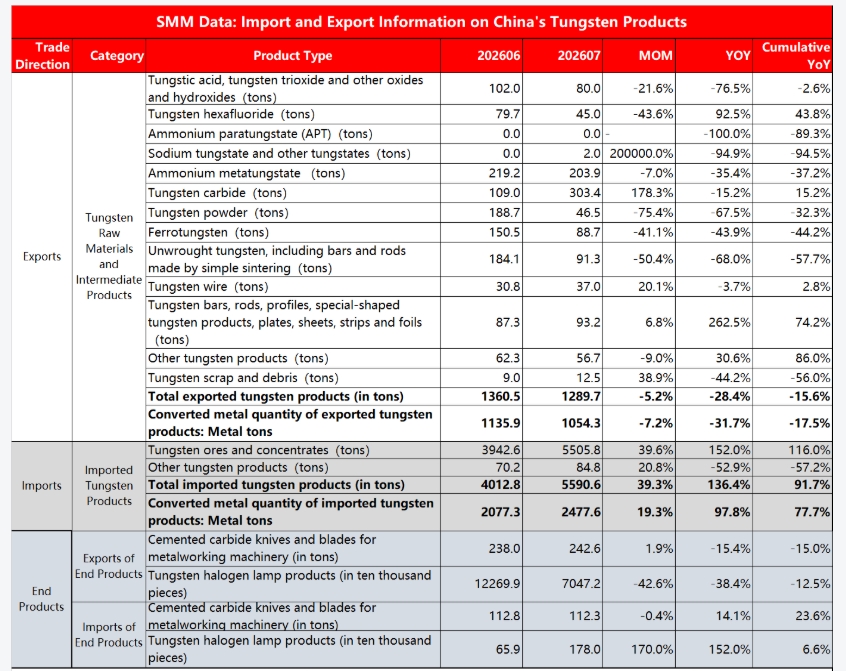
According to the latest customs data, China's total tungsten product imports in August 2026 reached 5,590.6 mt, up 39.3% MoM from July. Based on tungsten content of related products, SMM estimates August imports at 2,477.6 mt in metal content, up 97.8% YoY. Cumulative tungsten product imports in 2026 totaled 25,839.5 mt, up 91.7% YoY. On the export side, total volumes remained under pressure. August tungsten product exports totaled 1,289.7 mt, down 5.2% MoM and down 28.4% YoY. Exports in metal content were 1,054.3 mt, down 31.7% YoY. Cumulative tungsten product exports in 2026 reached 9,071 mt in metal content, down 15.6% YoY. Tungsten is a critical strategic rare metal for China and a core raw material for cemented carbide, semiconductors, high-end equipment, and military materials. Although China's tungsten reserves account for about 80% of global tungsten reserves, domestic ore grades are declining year by year, environmental protection and compliance rectification continue to tighten, incremental domestic concentrate output is limited, and many overseas countries are stepping up tungsten ore stockpiling. Against this backdrop, increasing imports of initial tungsten raw materials may hold longer-cycle strategic significance and importance for the sustainable development of the tungsten market.
In the import market:
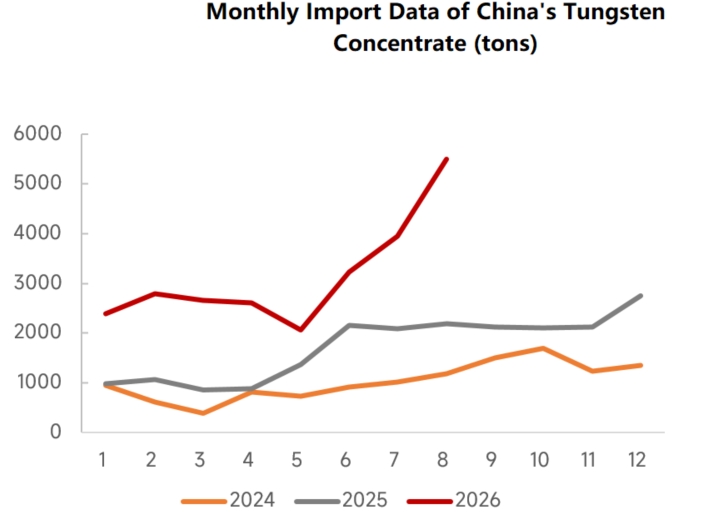
SMM customs data shows that in August 2026, China's tungsten concentrate imports in physical content reached 5,505.8 mt, up 39.6% MoM, with YoY growth as high as 152%. Cumulative tungsten concentrate imports in 2026 totaled 25,026.4 mt, up 116.0% YoY. The overseas rush for tungsten ore resources continued. China's large-scale absorption of overseas ore sources is essentially about using low-cost overseas ore to supplement smelting raw materials under the strategic tungsten resource control framework, thereby reducing consumption of high-quality domestic tungsten ore.
By supply source, August tungsten concentrate imports were dominated by Myanmar (46%) and Mozambique (26%), followed by Kazakhstan (14%). Most of the ore flowing into China from Myanmar and Mozambique is low-grade polymetallic associated ore, with low import unit prices. These regions lack supporting polymetallic beneficiation processes, while China's tungsten beneficiation and smelting technologies are relatively mature and can effectively process some overseas low-grade and associated tungsten resources. The diversification of overseas ore sources reduces supply risk from any single country. In the short term, tungsten concentrate imports show a volume increase with price decline pattern, as low-priced overseas ore continues to flow in, offsetting upward pressure on domestic tungsten concentrate prices. Since June, Mozambique tungsten ore imports have increased month by month, reaching 1,432 mt in August, mainly shipped to Hunan. This year, Hunan has strengthened economic and trade cooperation, and provincial ore traders have increased development and imports of Mozambique's mineral resources. Mozambique has no large single primary tungsten deposit; the tungsten ore flowing into China is essentially associated low-grade polymetallic ore, with tungsten as a by-product and the main minerals being heavy sand minerals such as zirconium, titanium, tantalum, and niobium.
Export market:
With strict controls in place, tungsten product exports are gradually shifting toward deep processing. In July, China's tungsten product exports rose 5.5% MoM to around 1,360 mt, with the main growth coming from non-dual-use items such as tungsten hexafluoride, ammonium metatungstate, and ferrotungsten. In January-July, China's total tungsten product exports reached 7,781 mt, down 13% YoY. Among these, APT, tungsten powder, and unwrought tungsten bar and rod saw the largest YoY declines. Tungstic acid, tungsten hexafluoride, and tungsten bar and rod led export growth.
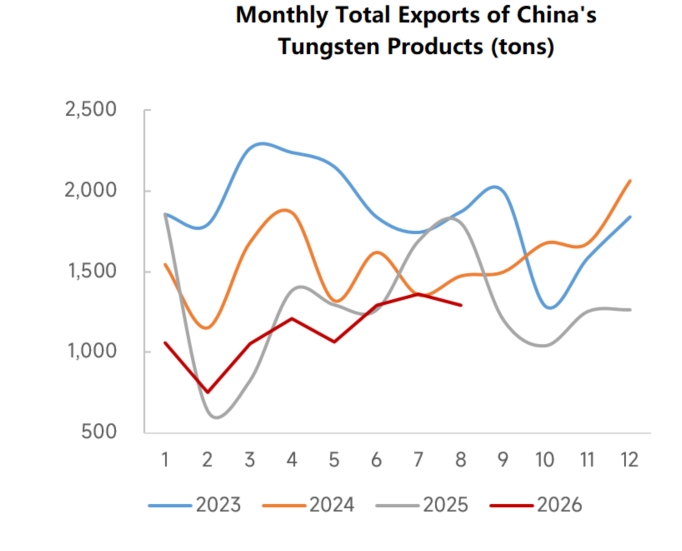
- APT exports in August were zero, with cumulative YoY volume pulling back sharply; ammonium metatungstate, tungstic acid, and tungsten trioxide and other oxides saw sharp YoY declines in the month, as primary tungsten chemical raw material exports continued to be compressed to prevent strategic resources from flowing out in the form of low-priced raw materials.
- However, high-end tungsten products showed structural highlights: tungsten carbide exports in August reached 303.4 mt, surging 178.3% MoM; tungsten bars, rods, profiles, and other shaped tungsten products rose 262.5% YoY in the month, with cumulative growth of 74.2% YoY; tungsten hexafluoride (a specialty tungsten material for semiconductors) was up 43.8% YoY cumulatively in 2026. Some tungsten carbide export orders to Japan were approved, driving a recovery in monthly export data, but overall domestic export approvals remained strict, and exports of dual-use items are unlikely to see significant growth in the short term. In addition, looking at tungsten carbide export unit prices, most tungsten carbide powder exported to Japan in August was high-end product, with unit prices mostly above 2,000 yuan/kg, while products exported to South Korea and other destinations were mostly concentrated at 1,100 yuan/kg. China's tungsten carbide export unit prices remain much cheaper than those in markets outside China. Over the same period, APT prices in the European market continued to consolidate around $3,000/mtu, while European tungsten carbide spot prices reached as high as $300/kg, creating a price spread of up to 900 yuan/kg with some of China's exported products.
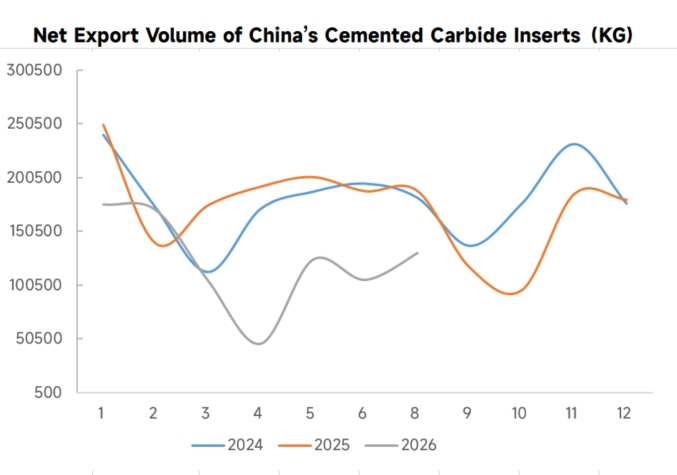
In end-use cemented carbide blade products, end-user products showed structural divergence. Cemented carbide metalworking blade exports edged up 1.9% MoM but fell 15.4% YoY, while imports were basically flat, reflecting weak end-use demand in overseas manufacturing. It is worth noting that while upstream tungsten carbide raw material exports rebounded sharply in the short term, finished tool exports did not improve in tandem, indicating that overseas cemented carbide enterprises were mostly restocking raw materials, and end-use machine tool cutting demand has yet to recover substantively. Halogen tungsten lamp exports shrank sharply by 42.6% MoM, reflecting the long-term trend of LED replacing traditional light sources, while imports surged 170% MoM. However, the absolute import volume was very small, representing only a short-term order pulse in industrial specialty lighting. This category accounts for a low share of tungsten consumption and has limited impact on the overall tungsten supply-demand pattern.
From the perspective of strategic risks and shortcomings, the current import and export structure still has two core pain points. First, the dependence on imported raw materials is rising rapidly, import sources are relatively concentrated, and fluctuations in overseas ore supply, logistics, and geopolitics can easily cause short-term shocks to China's industry chain, so the stability of resource supply needs to be further strengthened. Second, although the export share of high-end tungsten products has increased, some ultra-high-precision tungsten-based materials and special tungsten alloys still face technical barriers, and in the high-end market there is still competitive pressure from enterprises outside China, so the premium capability at the top of the industry chain has not yet been fully consolidated. At the same time, the contraction in total export volume has also compressed, to a certain extent, the overseas market space for China's midstream capacity, and the precision of supply-demand matching still needs to be optimized. Overall, the current adjustment of China's tungsten import and export structure is a benign change that aligns with national strategy, adapts to industrial upgrading, and conforms to the global landscape. In the short term, the pattern of expanding imports and shrinking exports may suppress domestic tungsten market prices for a while, but from the perspective that the transition period always needs time to trade for space, in the medium and long term, a high-end, high-premium export structure will continue to enhance the global competitiveness and pricing power of China's tungsten industry chain.