SMM, September 22:
I. Inventory Continues to Destock, Prices Struggle to Gain Traction
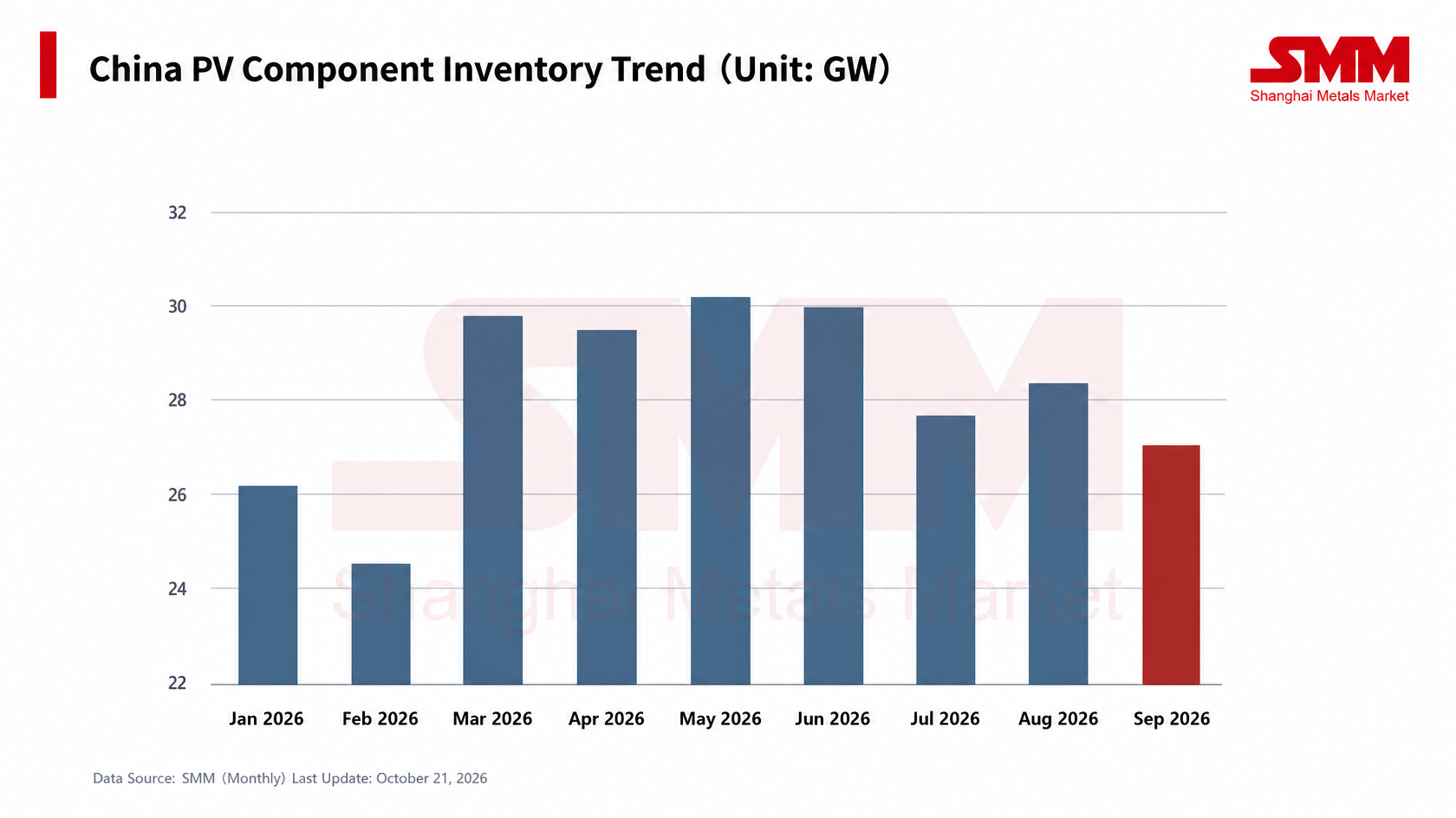
SMM data shows that China's PV module finished product inventories have entered a destocking trajectory, declining for four consecutive weeks by late September. However, module prices have not strengthened alongside the inventory decline; instead, after two rounds of price hikes in August, they have resumed a slight grind lower.
On the inventory side, module enterprises' on-hand finished product inventories tracked by SMM rose above 30 GW in mid-May 2026, marking the highest level of the year. They subsequently shifted into a volatile decline, briefly dropping to 27.5 GW in mid-July. A phase of inventory buildup occurred in late August, with a WoW increase of approximately 2.9% in the week of August 24. Entering September, inventories returned to destocking, declining WoW for four consecutive weeks since the week of August 31, with the latest level approaching 25 GW, down approximately 12.1% from the year's peak. From the phase high in late August, cumulative destocking over the past four weeks totaled approximately 5.3%.
This round of increases was not driven by a broad recovery in demand, but rather by a "defensive repair" resulting from rapidly rising upstream costs and narrowing module margins. SMM believes that module prices still have cost support in the short term, but whether the transaction center can continue to move higher will depend on whether high polysilicon and solar cell prices can be realized, as well as end-user acceptance of the price increases.
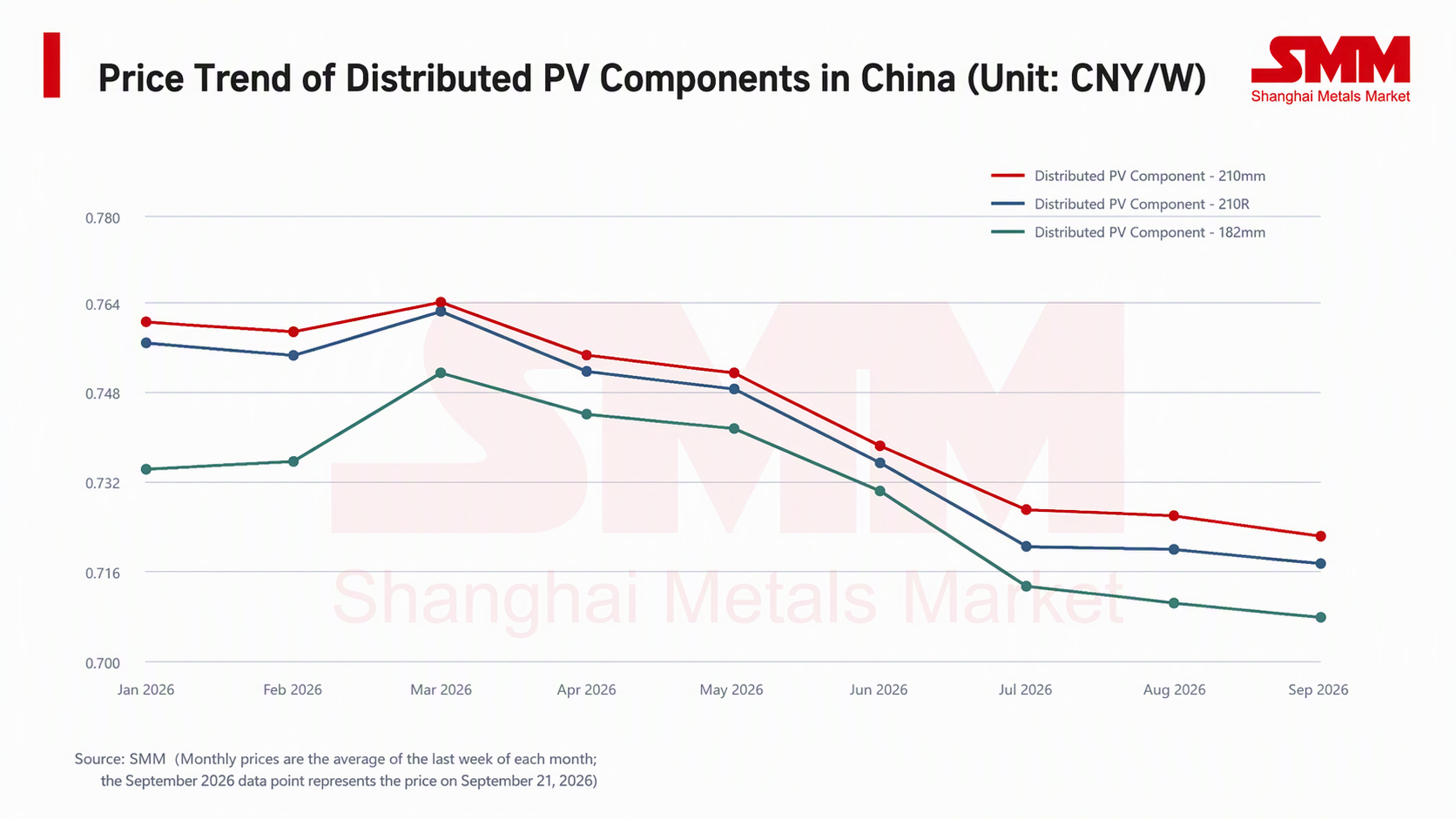
However, price-side performance has been notably weak. The average price of distributed PV modules tracked by SMM hit its yearly high in mid-March 2026, with the 210mm model peaking at 0.77 yuan/W, 210R at 0.767 yuan/W, and 182mm at 0.753 yuan/W. Prices then entered a sustained downward trajectory, falling to their yearly low range by end-July. Two rounds of price hikes occurred in August, with average prices stabilizing and rebounding in phases; the 210mm briefly returned to 0.7305 yuan/W in late August. But this rebound failed to sustain—as of September 21, the 210mm, 210R, and 182mm models stood at 0.723 yuan/W, 0.718 yuan/W, and 0.7085 yuan/W, respectively, down approximately 6.1%, 6.4%, and 5.9% from their yearly highs, and also pulling back approximately 0.6%–1.0% from the phase highs of late August.
II. Destocking and Price Strength Have Not Formed Their Usual Correlation
Volume-Price Divergence Indicates Modules Still at a Bargaining Disadvantage
In a normal demand-driven destocking cycle, inventory declines and price strength should occur simultaneously: end-use absorption accelerates, enterprise shipments flow smoothly, and bargaining power rises accordingly. The current situation is the exact opposite—inventories are falling, yet prices continue to grind lower.
SMM analysis indicates that since September, domestic demand has indeed shown some improvement. From the perspective of installation activity, end-use demand for modules has been rising in recent months, and earlier centralized projects have begun requiring module enterprises to proceed with production and delivery, driving module production to rebound modestly in recent months and causing inventory levels to decline week by week. Against this backdrop, SMM attributes the decline in module prices primarily to two factors.
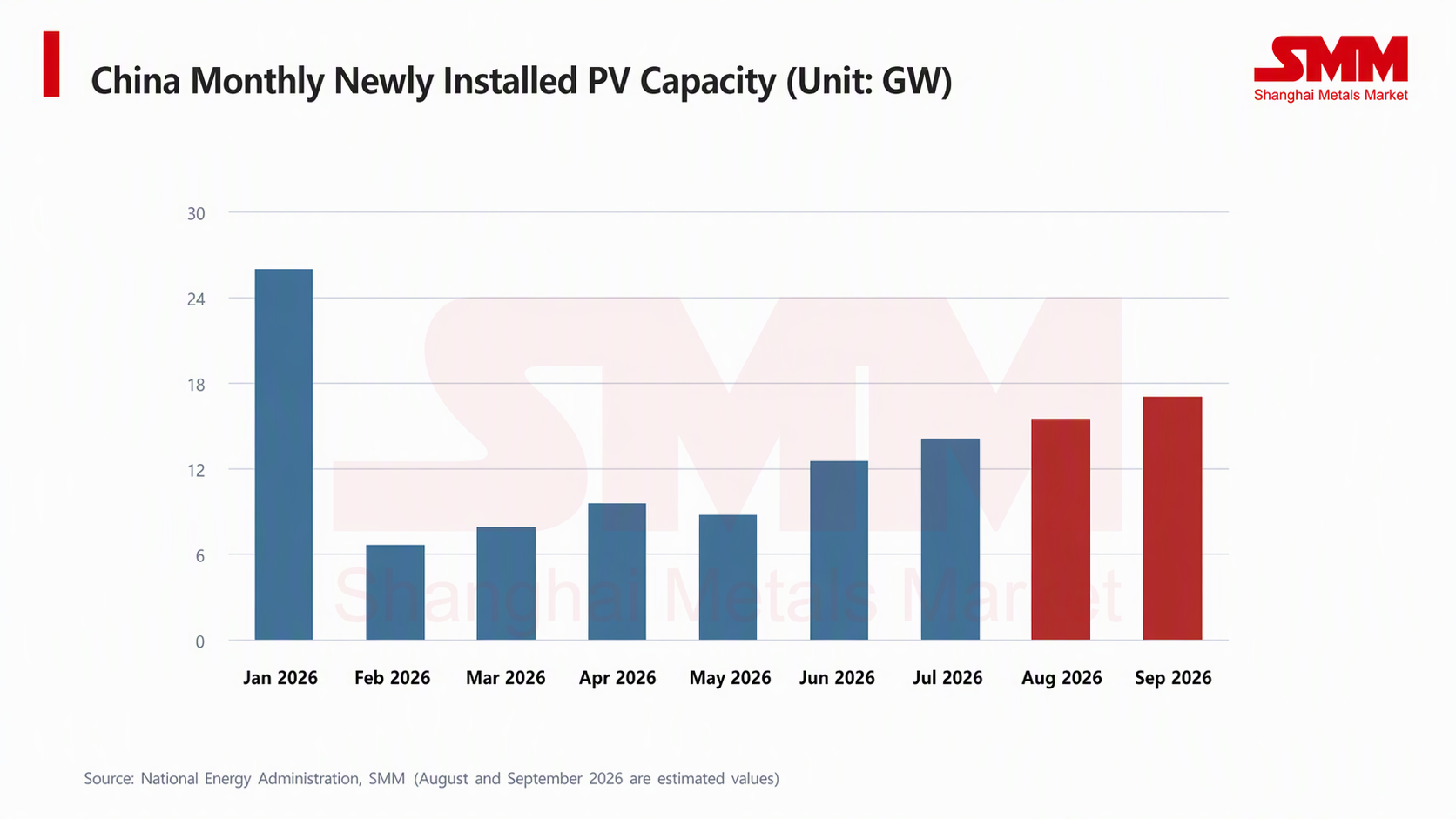
First, end-use demand has indeed recovered, but overall remains below expectations. September's estimated new installations are 17 GW, still falling short of the industry's prior expectations. Moreover, since mid-to-late July, domestic tender volumes have begun to decline, providing insufficient support for new delivery orders.
Second, module prices have been significantly impacted by low-efficiency modules, hindering efforts to stop falling and hold prices firm. With energy efficiency requirements taking effect, the period before January 2027 will be the final window for domestic sales of low-efficiency modules in China. SMM has learned that most top-tier module enterprises currently still hold some low-efficiency products in inventory, so shipments of low-efficiency modules have recently increased in the market, priced approximately 0.03-0.07 yuan/W lower than standard-efficiency modules, thereby impeding the firmness of domestic module prices.
III. Outlook: Q4 Demand Will Be the Decisive Factor
In the short term, destocking is expected to continue, but upward price momentum remains lacking. Module enterprises currently have a strong willingness to control production, and the supply side continues to exert downward pressure on inventories, with Q4 inventories likely to continue pulling back. However, before demand substantively picks up, prices are unlikely to stage an independent rally and are more likely to move sideways in a narrow range.
In the medium term, Q4 end-use demand is the decisive variable. If Q4 domestic installations accelerate and restocking volumes outside China, particularly in Europe, perform well, the current low inventory levels will translate into elasticity for price recovery, and module prices are expected to stabilize and rebound. However, if demand again falls short of expectations, the destocking process may stall once it reaches a certain level, and prices will continue to be pulled by both cost and loss-making thresholds.
Overall Assessment: SMM believes that the module segment is currently in an intermediate state where "destocking has begun, but price recovery has not materialized." Four consecutive weeks of inventory declines are a positive signal, but the fact that this is driven by supply contraction rather than demand recovery means that price repair will need to await substantive confirmation from the demand side. Key factors to monitor going forward include: whether destocking can continue, the alignment between module scheduled production and actual shipments, and the pace at which Q4 end-use installations and export orders are realized.
![[SMM PV Flash] JA Solar Technology Smart Energy helps the PV project of the China-Europe Cross-Border Procurement Industrial Park achieve grid connection, empowering the zero-carbon transition!](https://imgqn.smm.cn/usercenter/PkttC20251217171742.jpg)
![[SMM PV News] Huawei Smart PV 506KTL string inverter obtains the world's first 500kW-class VDE 4110/4120/4130 certificate.](https://imgqn.smm.cn/usercenter/Lttjf20251217171742.jpg)
![[SMM PV News] The only one in the province! Project led by UtmoLight selected for Jiangsu Province's proposed innovation consortium list](https://imgqn.smm.cn/usercenter/qQwIB20251217171741.jpg)