In August 2026, China's imports of rare earth metal ore stood at 1,034 tonnes, down 42% MoM from 1,787 tonnes in July but up 3,127% YoY from 32 tonnes a year earlier; imports of thorium ore and its concentrates reached 2,793 tonnes, up 67% MoM from 1,668 tonnes in July and down 3% YoY from 2,882 tonnes in the same month of last year. On a cumulative basis, rare earth metal ore imports for January–August 2026 totaled 8,469 tonnes, down 64% YoY, while thorium ore and its concentrates came to 41,486 tonnes, broadly flat YoY.
In terms of monthly trends, rare earth metal ore imports fluctuated markedly through the year: February was the year's low at just 377 tonnes, April rose to a high of 1,863 tonnes, and after another spike to 1,787 tonnes in July, August fell back to 1,034 tonnes. Thorium ore and its concentrates showed even sharper swings: January reached 9,824 tonnes and June climbed further to 11,625 tonnes, forming two arrival peaks for the year, while July plunged to the year's low of 1,668 tonnes before August recovered to 2,793 tonnes.
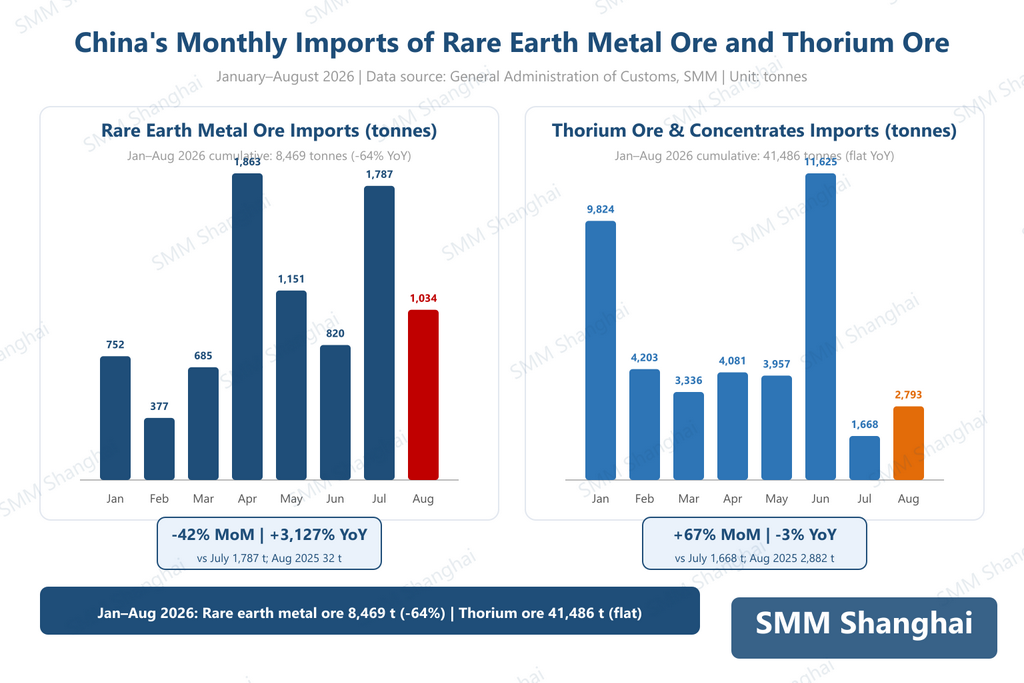
The two categories diverged clearly in August. Although rare earth metal ore posted a huge YoY gain, this was mainly due to the extremely low base a year earlier (just 32 tonnes); its cumulative January–August volume still fell 64% YoY, indicating that this category remains on a shrinking trajectory. By contrast, thorium ore and its concentrates maintained a relatively steady import rhythm, with cumulative January–August volume broadly flat YoY. At 41,486 tonnes, its cumulative imports were about 4.9 times those of rare earth metal ore, making it the dominant category of China's rare earth ore imports.
Both categories showed pronounced monthly volatility, particularly thorium ore and its concentrates, which saw concentrated arrivals in January and June followed by a sharp drop in July. This is related to overseas mine shipment schedules, vessel scheduling and the procurement rhythm of domestic smelting enterprises.
Looking ahead, as the operating rates of China's rare earth smelting and separation facilities stay high and demand for raw materials continues to be released, demand for rare earth ore imports is expected to remain considerable. Rare earth metal ore imports are unlikely to reverse the continued YoY decline in cumulative terms. Thorium ore and its concentrates, as the current import mainstay, will likely continue to show irregular monthly arrival patterns. Overall, the overseas rare earth ore supply landscape, changes in the international trade environment and China's domestic rare earth industry policies remain the key variables affecting rare earth ore imports.