India's domestic sponge iron market has climbed to its highest level in two years, with prices continuing to rise through mid-September. The recent price increase has been driven primarily by higher raw material costs, particularly rising thermal coal prices, while recovering procurement demand and some restocking activity have also provided support. Producers have been consistently passing rising costs on to buyers, making this round of price increases largely cost-driven, with speculative factors also emerging in the market over the past two weeks.
1. Bellary and Raipur lead the rally
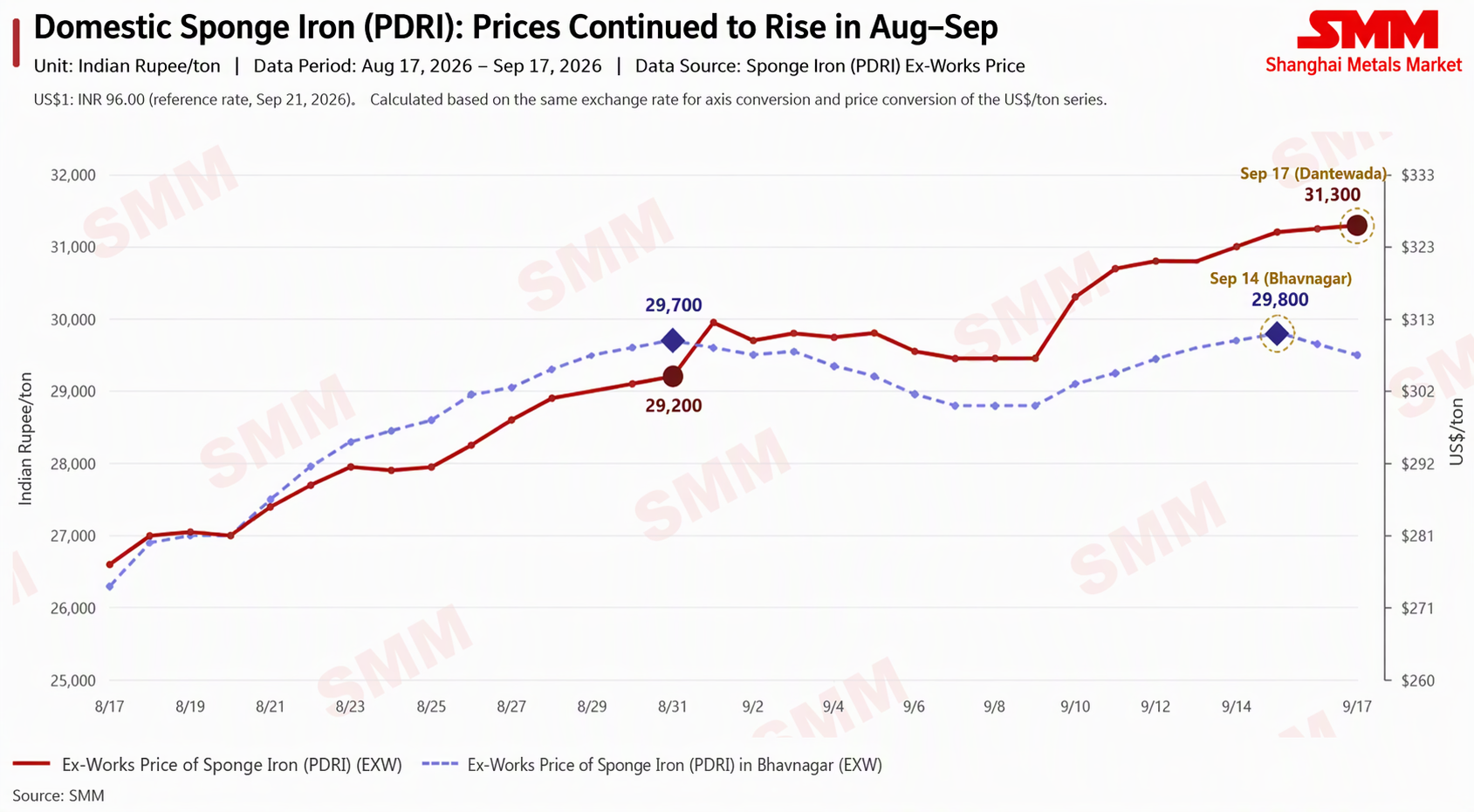
At end-August, PDRI sponge iron prices rose to a two-year high and continued climbing through mid-September, with gains across major markets of around $1-22/mt (Rs100-2,100/mt). Based on our tracked benchmark data, Raipur PDRI sponge iron ex-works prices hit a two-year high of $309/mt (Rs29,700/mt) on August 31, and reached $310/mt (Rs29,800/mt) on September 15. Bellary PDRI prices were assessed at $304/mt (Rs29,200/mt) on August 31, and by September 17, ex-works prices had been pushed further up to $326/mt (Rs31,300/mt).
On a monthly basis, Bellary PDRI prices rose $49/mt (Rs4,700/mt, Bellary ex-works), up 17.7%, from $277/mt (Rs26,600/mt) on August 17 to $326/mt (Rs31,300/mt) on September 17. Raipur PDRI prices rose $33/mt (Rs3,200/mt) MoM, up 12.2%, from $274/mt (Rs26,300/mt) on August 17 to $307/mt (Rs29,500/mt) on September 17. Over the same period, Raipur steel billet prices rose $57/mt (Rs5,500/mt) MoM, up 14.1%, from $406/mt (Rs39,000/mt) to $464/mt (Rs44,500/mt). The simultaneous rise in both PDRI and steel billet prices indicates that higher input costs are being partially passed through to billet buyers, and buyer acceptance of higher prices has provided some support to the market. However, this round of increases has been driven more by rising raw material costs than by any significant improvement in end-user demand.
Trading volume remained steady during the price rally, consistent with just-in-time procurement patterns—steel mills are still filling immediate raw material gaps, though some market participants have also been restocking in anticipation of further price increases. Downstream billet producer margins have also remained largely stable, suggesting that most of the cost increase pressure is being passed down the industry chain rather than absorbed by producers themselves.
2. Coal cost drivers
India is the world's largest sponge iron producer, with around 336 plants and annual production of about 50 million mt. The steel and sponge iron sector accounts for roughly 40% of India's total coal imports. India's sponge iron is produced primarily via the coal-based (rotary kiln) route, which uses non-coking (thermal) coal as the main fuel, sourced from domestic mining as well as imports from Indonesia, South Africa, and Russia.
Multiple factors have pushed coal prices higher this year:
- Higher freight and insurance costs: Escalating tensions in the Middle East have driven up marine fuel and insurance costs, raising the landed cost of imported coal into India and adding to overall procurement burdens for buyers.
- Firming global coal prices: Rising thermal coal prices have pushed up input costs for Indian sponge iron producers, further lifting domestic production costs. According to trade sources, thermal coal prices from major supplying countries have all risen since May: Indonesian thermal coal prices are up 18%-20%, while Russian and South African thermal coal prices have risen 14% and 19%, respectively. This has further intensified cost pressure in India's domestic sponge iron market.
- Tight domestic coal supply: During the summer peak power demand period, power plants were given priority coal allocation, while monsoon rains reduced coal production and hindered railway transportation—leaving sponge iron producers with little room to fall back on cheaper domestic coal.
Producers are maintaining low inventory levels, purchasing only what is immediately needed rather than stockpiling at current high prices. This is reflected in thermal coal import data for steel and sponge iron producers—imports fell 11% in June and 19% in July.
3. Scrap substitution
The buyers referred to here are induction furnace and electric arc furnace steel mills that use steel scrap or sponge iron as feedstock. Currently, most steel mills prefer sponge iron over steel scrap because the former is cheaper, and even with price increases, demand for sponge iron remains stable. Steel scrap remains an alternative raw material, but its supply stability is poorer, so most mills are sticking with sponge iron rather than switching to scrap.
4. Market commentary
Industry participants attribute part of the supply tightness to procurement patterns earlier this year—in June and July, imported coal prices were higher than domestic prices, prompting importers to cut back on coal purchases, ultimately creating a supply gap that pushed domestic coal prices higher. On the sponge iron side, buyers who had initially held back from purchasing in anticipation of a price correction have returned to the market to meet urgent needs, while sellers have kept offers firm on expectations of further price increases. Some transactions in the Bellary region were reported at around $325-326/mt (Rs31,200-31,300/mt), while higher Bellary ex-works offers near $328-329/mt (Rs31,500-31,600/mt) met resistance. Market views also noted that speculative behavior has played a role in the recent price rise—in a rising market, sellers tend to hold back from selling in anticipation of higher prices, while buyers rush to lock in supply, and this dynamic could reverse quickly once prices pull back. Meanwhile, most market participants expect the market to stabilize at some point in September, as persistently high raw material costs will eventually squeeze producer margins and cool demand.
5. Outlook
The market trajectory may depend on whether the price spread between sponge iron and steel scrap narrows further—which could shift some demand toward scrap—and whether procurement momentum remains strong enough to support current price levels.
Over the next two months, sponge iron prices are likely to remain firm near current levels. A significant pullback would require global coal prices to decline, freight costs to fall, or domestic coal supply to recover more quickly; however, seaborne thermal coal price movements have already shown that prices can pull back quickly once procurement demand from China and India weakens. India's ongoing push to replace imported coal with domestic supply could also put downward pressure on coal prices and, in turn, sponge iron costs.
Note: Prices and trading volumes mentioned herein are indicative spot data for market commentary purposes only and change daily; this content does not constitute any investment or trading advice.
Xe exchange rate conversion: $1 = Rs96, updated on September 21
![[SMM Coal Flash] ESDM Approves Bayan Resources’ 2026 RKAB Revision](https://imgqn.smm.cn/usercenter/LSkpO20251217171720.jpg)

![[Domestic Iron Ore Brief] Iron ore prices in the Tangshan area are likely to remain in the doldrums](https://imgqn.smm.cn/usercenter/fljuJ20251217171715.jpg)