Introduction: H200 is not just rising—it is accelerating its "disappearance"
In September 2026, a clear dividing line emerged in China's high-end computing power market:In early September, the market was still consolidating and waiting on the sidelines, but after September 14, quotes began to refresh on an hourly basis. Cross-checked feedback from SMM channel sources shows that the outright purchase price of H200 complete systems jumped from around 5.45 million yuan per unit to 5.75-5.78 million yuan per unit in just two weeks; at the same time, "spot supply is basically gone within a few hours" has become a common sentiment across multiple channels. The price increase is only the surface; the real signal is thatspot order liquidity is drying up.
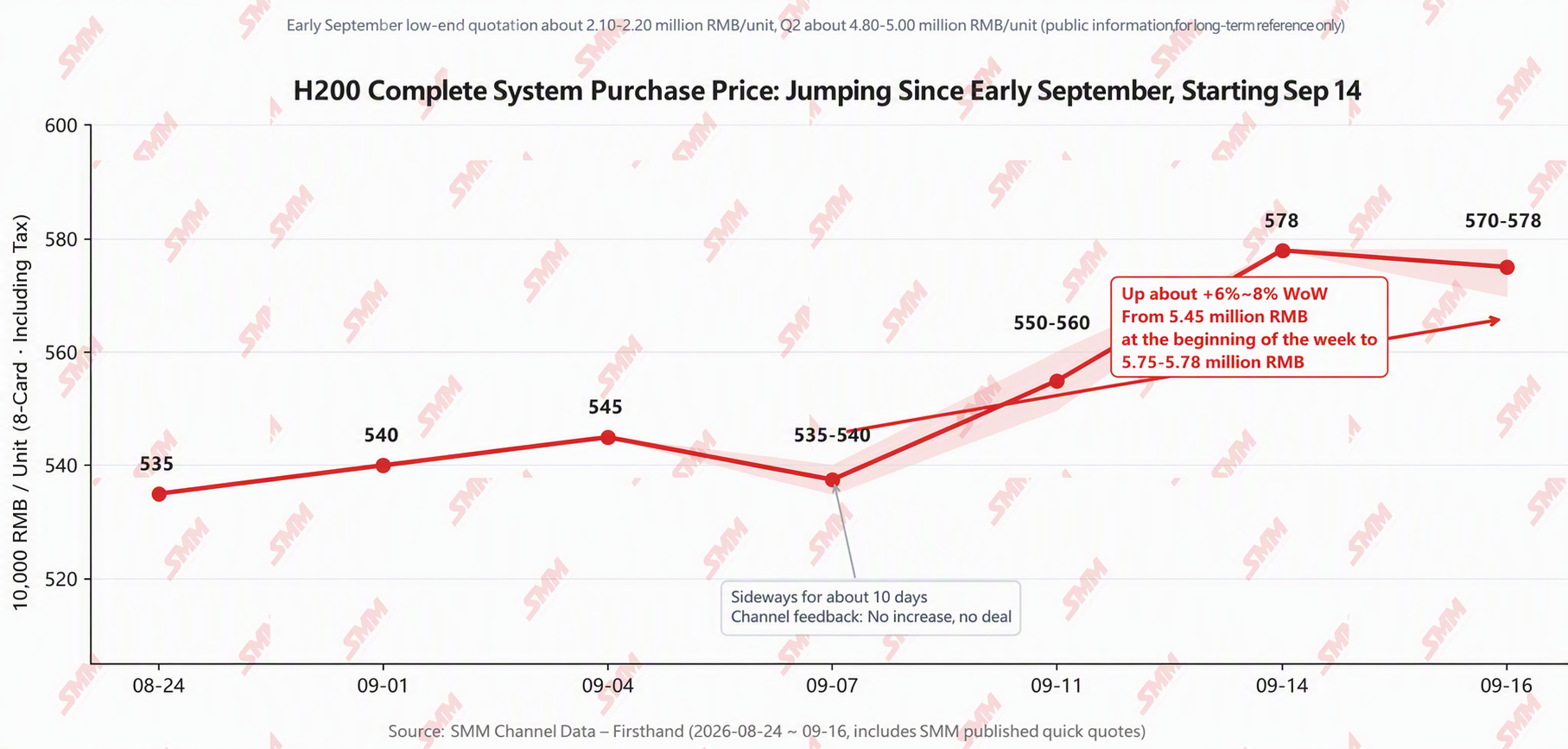
I. Prices: From "unable to rise further" to "unstoppable," with the upper end up 6%-8% in two weeks
SMM channel records show that from late August to early September, the outright purchase price of H200 complete systems was in a narrow range of 5.35-5.45 million yuan per unit. A trader explicitly stated in a phone conversation on September 7 that "it can't go any higher; buyers won't accept it." But the consolidation was broken on September 14:
- On September 11, a cloud service provider reported to SMM that quotes for H200 SXM in Shenzhen had risen to 5.5-5.6 million yuan per unit;
- On September 14, 30 Lenovo H200 complete systems were quoted at 5.78 million yuan per unit;
- On September 16, 256 Supermicro H200 2T units in a single batch were quoted at 5.7 million yuan per unit, 8 units of the same model with tax included were quoted at 5.75 million yuan per unit, and another channel quoted 5.78 million yuan per unit.
Based on the 5.35 million yuan per unit figure from SMM's flash report published on August 24, the 5.75 million yuan per unit on September 16 represents a cumulative increase of about 7.5% over roughly three weeks; from 5.45 million yuan per unit on September 4 to 5.75-5.78 million yuan per unit on September 14-16 alone, the upper end rose by about 6%-8% in two weeks. Longer-term coordinates compiled from public media also show that the low point for H200 complete systems was around 2.1-2.2 million yuan per unit in Q4 2025, rising to 4.8-5 million yuan per unit in Q2 2026. The current high is a continuation against the backdrop of persistently contracting supply.
> Channel sources' original words (Grade A evidence): A server producer executive said directly in a private chat on September 16 that H200 "has gone crazy over the past two weeks" and "spot procurement keeps rising." On the same day, another channel source responded to an SMM inquiry by saying, "Spot supply is basically gone within a few hours" and "one or two units occasionally available, but seven or eight is tough."
II. Structural mismatch: Supply side offers 256-unit batches, while demand side needs urgent purchases of 1-2 units
As prices jumped, the biggest obstacle to trading volume was not "too expensive," but rather"unable to match supply with demand".
SMM's review of WeChat group chats and private messages from September 14 to 17 found that available H200 supply was highly concentrated: 256 Supermicro 2T units in a single batch, 128 Chilwee 2T units in Shenzhen spot (minimum order of 32 units), 30 Lenovo units, and 8 Supermicro units, with most minimum order quantities above 32 units. Meanwhile, a large volume of demand-side inquiries fell in the spot order range—urgent purchases of 1-2 units, 5-10 units on one-year/three-year leases, and 32 units of spot complete systems. About 58% of supply-side shipment records were concentrated in orders of 32 units or more, while about 60% of demand-side inquiry records were for fewer than 10 units.
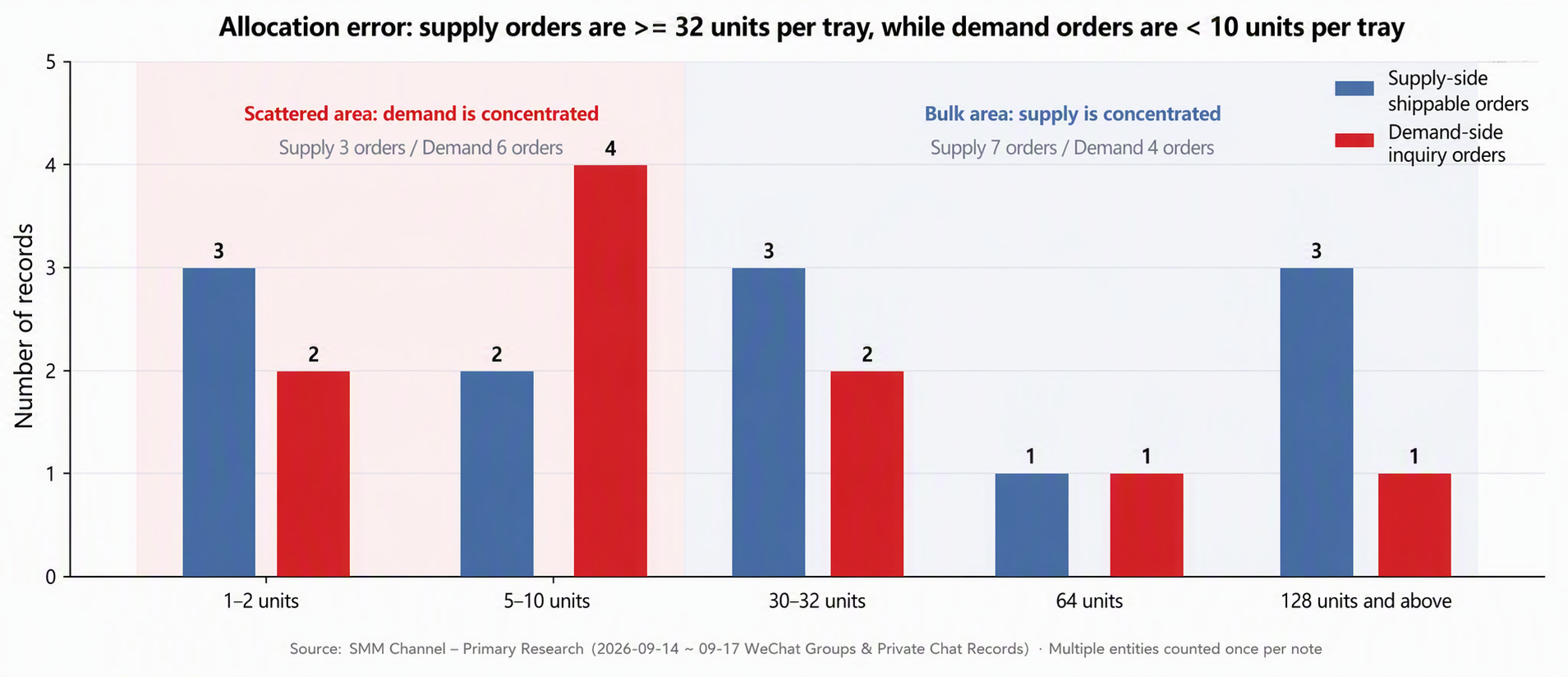
The result of this mismatch is that even when buyers accept high prices, they often cannot get the goods; and even when sellers have goods, they are unwilling to split whole batches for a few spot orders and bear the additional inspection and contract costs. One buyer seeking 1-2 H200 units reported that "it's really quite hard to find," which indirectly shows that the cost of matching spot orders has already exceeded the price spread.
III. Price tiers: Decommissioned units are discounted only 6.3% relative to brand-new ones, and spot supply is so tight that "new and used are not the same quality, yet no discount is given"
According to SMM records, on September 16, H200 complete systems showed a clear price tier at the same point in time:
- Decommissioned units (module assembly): 5.39 million yuan per unit
- Supermicro 2T, 256-unit batch: 5.7 million yuan per unit
- Supermicro 8 units, tax included: 5.75 million yuan per unit
- Lenovo complete systems, 30 units: 5.78 million yuan per unit
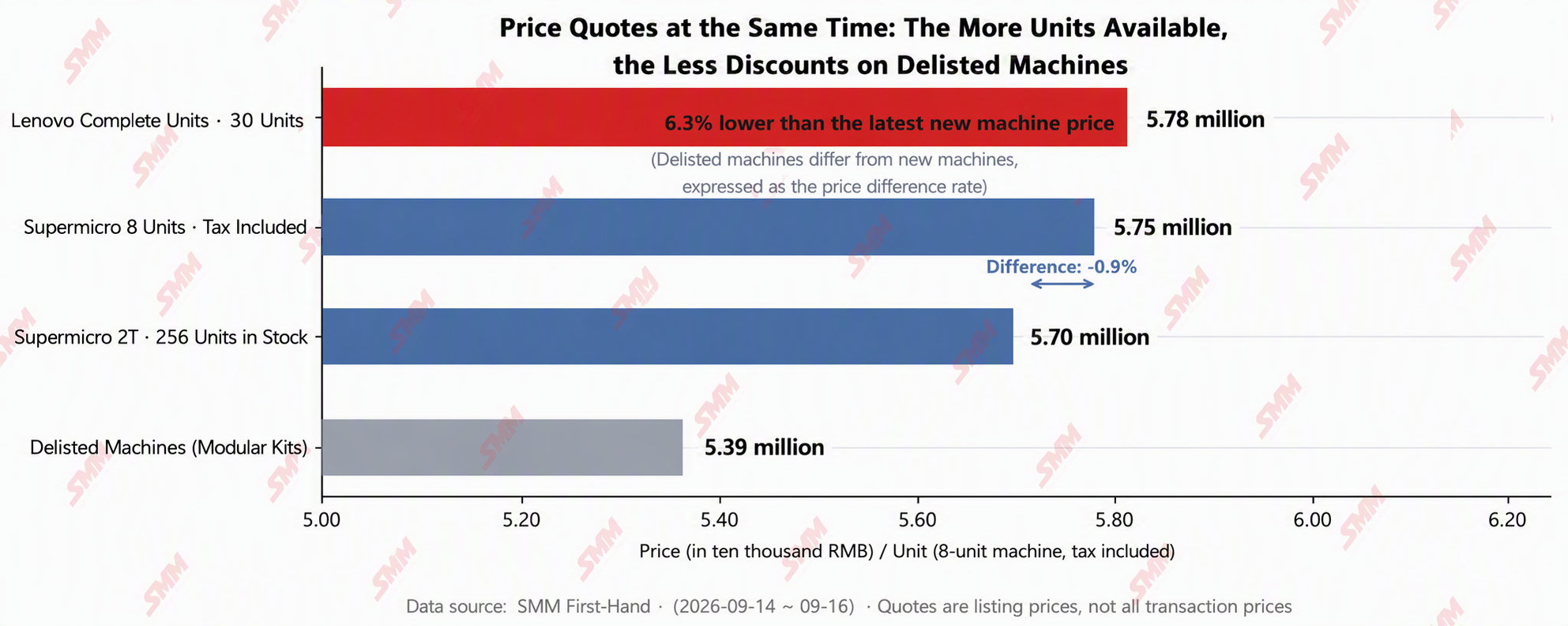
Normally, larger batches are cheaper (256 units at 5.7 million vs. 8 units at 5.75 million, a batch discount of about 0.9%), which is consistent with commercial logic. However, the fact thatdecommissioned units differ from brand-new units by only about 6.3%is highly unusual—since decommissioned units and brand-new units are not of the same quality, expressing this in terms of discount rate rather than percentage change means "decommissioned units are discounted 6.3% relative to brand-new units," which in turn shows that spot circulation is so low that even used units cannot be priced lower.
IV. Supporting logic: Supply contraction is occurring simultaneously on both the legislative and capacity fronts
This round of H200 tightness is not a single-channel phenomenon; public information provides multiple supporting factors:
1. The US BIS is upgrading export controls from "chip flows" to "computing power usage rights." According to foreign media reports (The Information, Tom's Hardware, Tech Times), the US Commerce Department's Bureau of Industry and Security (BIS) is drafting new rules that would require overseas cloud/data center operators receiving advanced US chips to verify end users and usage, with industry comments solicited as early as September 2026. If implemented, the path for Chinese enterprises to remotely rent controlled Nvidia chips through data centers in Singapore, Malaysia, Thailand, Japan, and other locations will be blocked. A report released by the nonprofit research organization C4ADS on September 10 also pointed out that from July 2025 to January 2026, Chinese universities and research institutions purchased at least 56 controlled Nvidia chips, with another 50 batches worth $13.4 million transshipped through Vietnam, India, and Malaysia. This explains why overseas detour channels and spot circulation have contracted simultaneously.
2. Original manufacturers' capacity continues to tilt toward next-generation architectures. Public information shows that leading cloud providers have already locked up the vast majority of long-term contract capacity for H200 SXM versions, and original manufacturers are prioritizing advanced capacity for B-series chips, further squeezing the spot supply of H200 that can flow into the channel market. A public self-media article written in 2026 stated that the spot price of original H200 PCIe cards has risen by more than 100,000 yuan per card in the past half month, and "daily price changes and scarce spot supply have become the industry norm."
3. Hardware smuggling channels via Taiwan are also being tightened. According to foreign media reports, in 2026, Taiwan authorities indicted 9 people for illegally shipping Supermicro servers equipped with Nvidia chips to mainland China, further narrowing gray-market import channels.
V. SMM's view: H200 is shifting from "high prices" to "scarce liquidity"
Combining first-hand channel records and public information, SMM believes the current H200 market is showing three mutually reinforcing signals:
- Accelerating price increases: The upper end of the range rose 6%-8% within two weeks, and this occurred after a 10-day consolidation in early September, indicating that the buyer's wait-and-see window was broken by supply contraction;
- Extremely fast spot clearance: The channel sentiment that "supply is gone within hours" means inventory turnover has shifted from "measured in days" to "measured in hours";
- Higher batch thresholds: Batches of 256 or 128 units have become the mainstream form of shipment, forcing spot order demand to pay higher matching costs or be excluded entirely.
These three signals collectively point to one conclusion:H200 scarcity has shifted from a "price problem" to an "availability problem". Under the triple impact of export control expectations, original manufacturers' capacity tilting, and tightening gray channels, H200 complete systems that are already listed and deliverable are commanding an increasingly high "delivery certainty premium" and "batch threshold premium."
What needs to be watched is that in a high-price environment, the risk of false quotes and futures short orders is rising simultaneously. SMM has noted that this week, a certain high-end computing power card model (B series) has already seen extreme payment structures such as "100% full prepayment," "33% guarantee letter + 30% prepayment," and "60% prepayment with 68% counter-guarantee." As a tight model within the same supply system, H200 buyers also need to focus on verifying cargo ownership, inspection periods, and default penalties when locking in supply.

![[SMM Computing Power Daily] H100 long-term contract at 87,000, 910C first quoted at 66,000](https://imgqn.smm.cn/usercenter/PeWqW20251217171735.jpg)
![[SMM Computing Power News] 100 units of H100 spot cargo shipped from Hong Kong warehouse, full payment required for goods movement](https://imgqn.smm.cn/usercenter/kLgYV20251217171736.jpg)