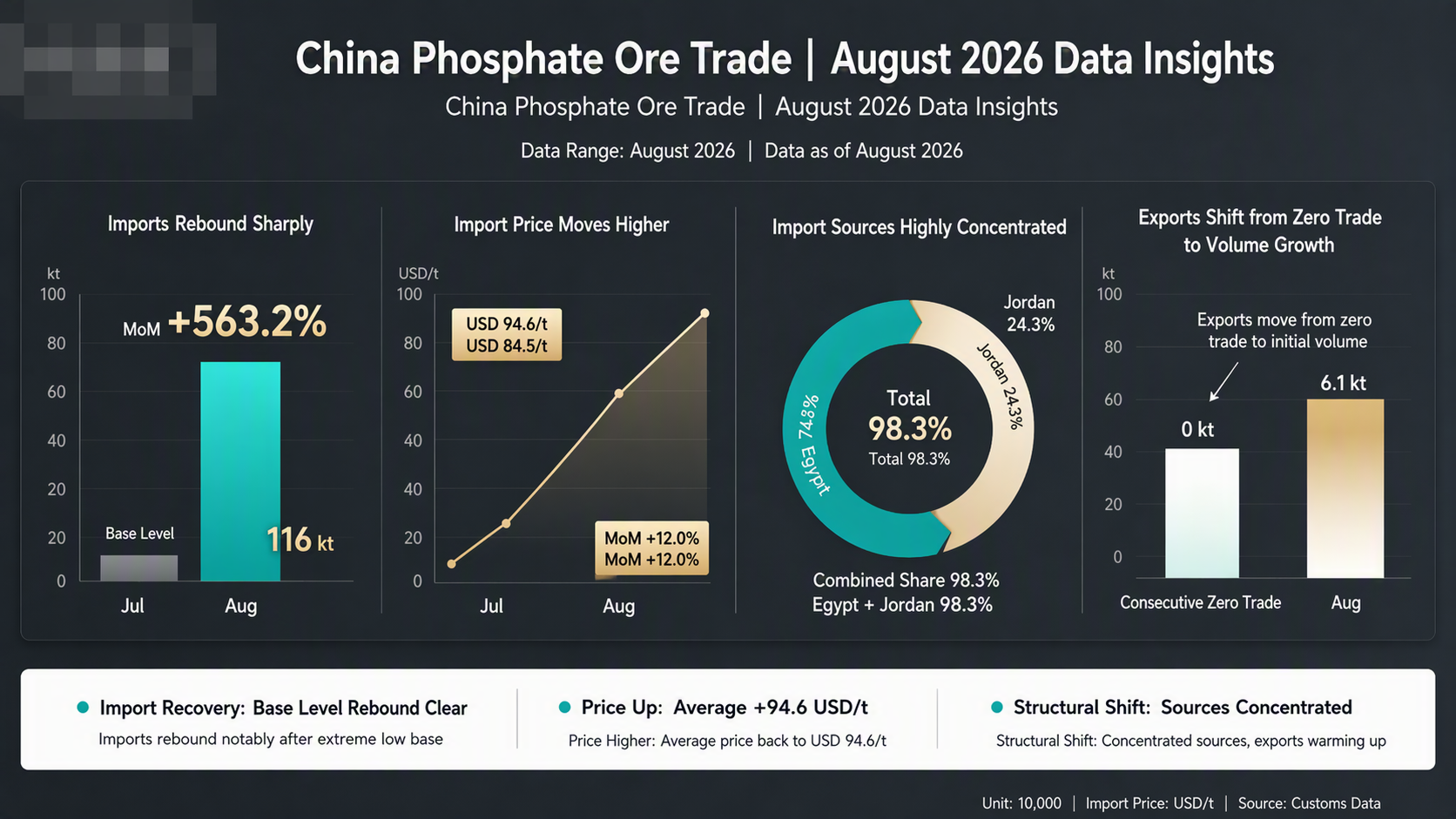
Key points: In August 2026, China's phosphate ore imports surged MoM and the price center shifted upward. Total imports for the month were 116,000 mt, up 563.2% MoM, largely recovering from the extremely low base in July caused by the export ban. The average import price rebounded to $94.6/mt, up 12.0% MoM. Egypt and Jordan together accounted for as much as 98.3%, further intensifying source concentration. Meanwhile, on the export side, after consecutive months of zero transactions, August suddenly saw volumes surge to 61,000 mt, signaling market pre-positioning ahead of the end of the phosphate fertiliser export ban window.
1. Total imports: Surged MoM, but absolute volume remained low
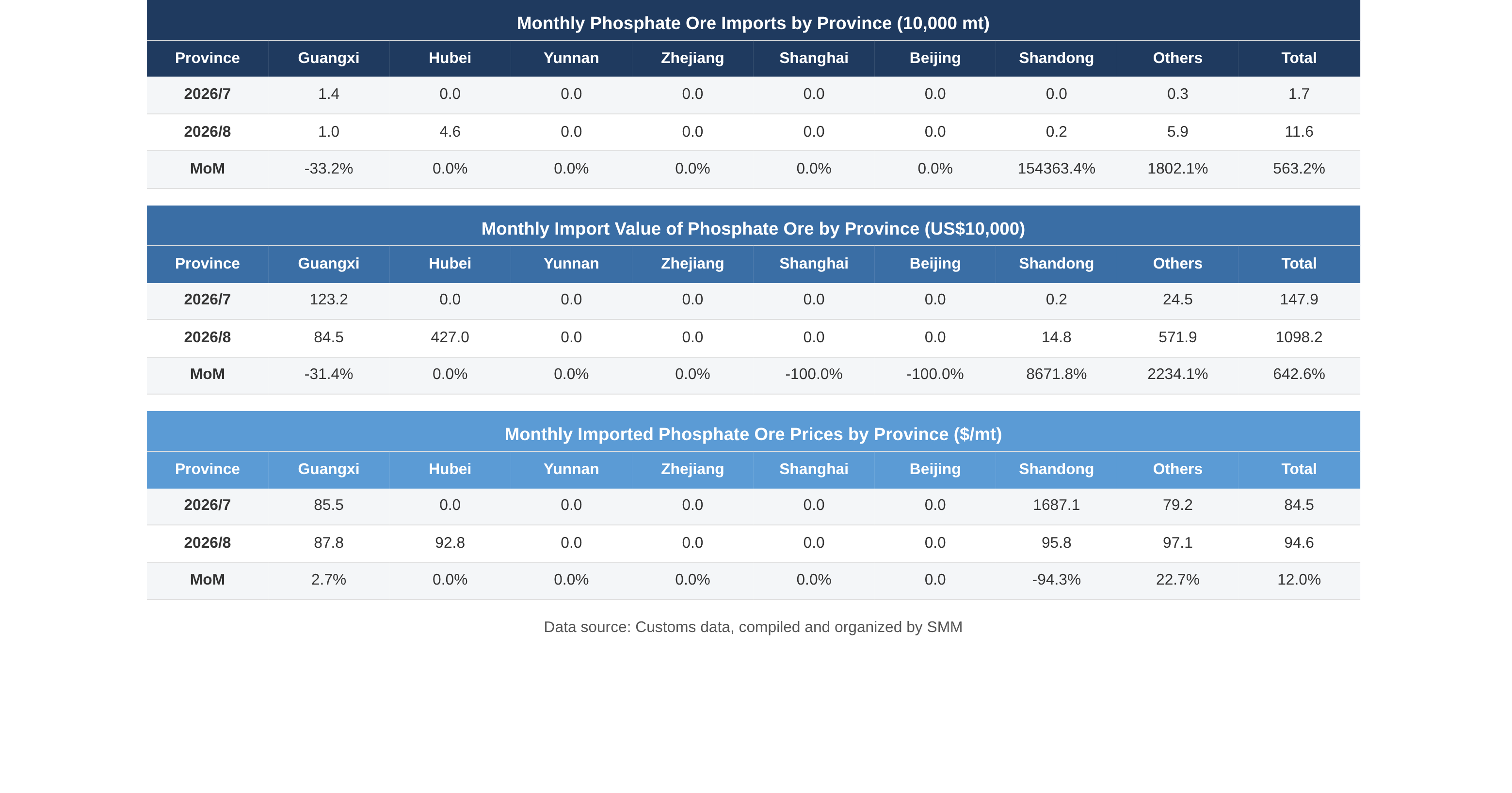
August total imports were 116,000 mt, up 563.2% MoM from 17,000 mt in July. Total import value soared from $1.479 million to $10.982 million, up 642.6% MoM.
Clear structural divergence:
Guangxi: Imports fell from 14,000 mt to 10,000 mt (-33.2% MoM), with value dropping from $1.232 million to $845,000 (-31.4%), making it the only major importing province to post a MoM decline.
Hubei: Imports jumped from zero to 46,000 mt (value: $4.27 million), becoming the largest source of incremental growth.
Other provinces (including Jiangsu, Guizhou, Tianjin, etc.): Imports surged from 3,000 mt to 59,000 mt (+1,802.1% MoM), with value soaring from $245,000 to $5.719 million (+2,234.1%). Based on earlier detailed data, Jiangsu took in large volumes of Egyptian ground ore, making it the core driver behind the surge in the "other" provinces.
2. Average import price: Rebounded to $94.6/mt, with buyer pressure for lower prices easing
The overall average import price in August was $94.6/mt, up 12.0% MoM. In July, demand had cooled sharply, and buyer sentiment for pushing prices lower was strong, with the average price at just $84.5/mt.
By region:
Other provinces (including Jiangsu): The highest average price at $97.1/mt (+22.7% MoM), mainly corresponding to high-grade Egyptian ground ore.
Hubei: Average price of $92.8/mt, mainly corresponding to Jordanian unground ore.
Guangxi: Average price of $87.8/mt (+2.7% MoM), mainly corresponding to low-grade Egyptian unground ore, the lowest price nationwide.
Shandong: The July unit price was as high as $1,687.1/mt, an anomaly driven by an extremely small base (only 200 mt imported in July, with a value of $2,000). In August, it returned to normal at $95.8/mt.
3. Source country landscape: Egypt and Jordan "duopoly," with concentration reaching 98.3%
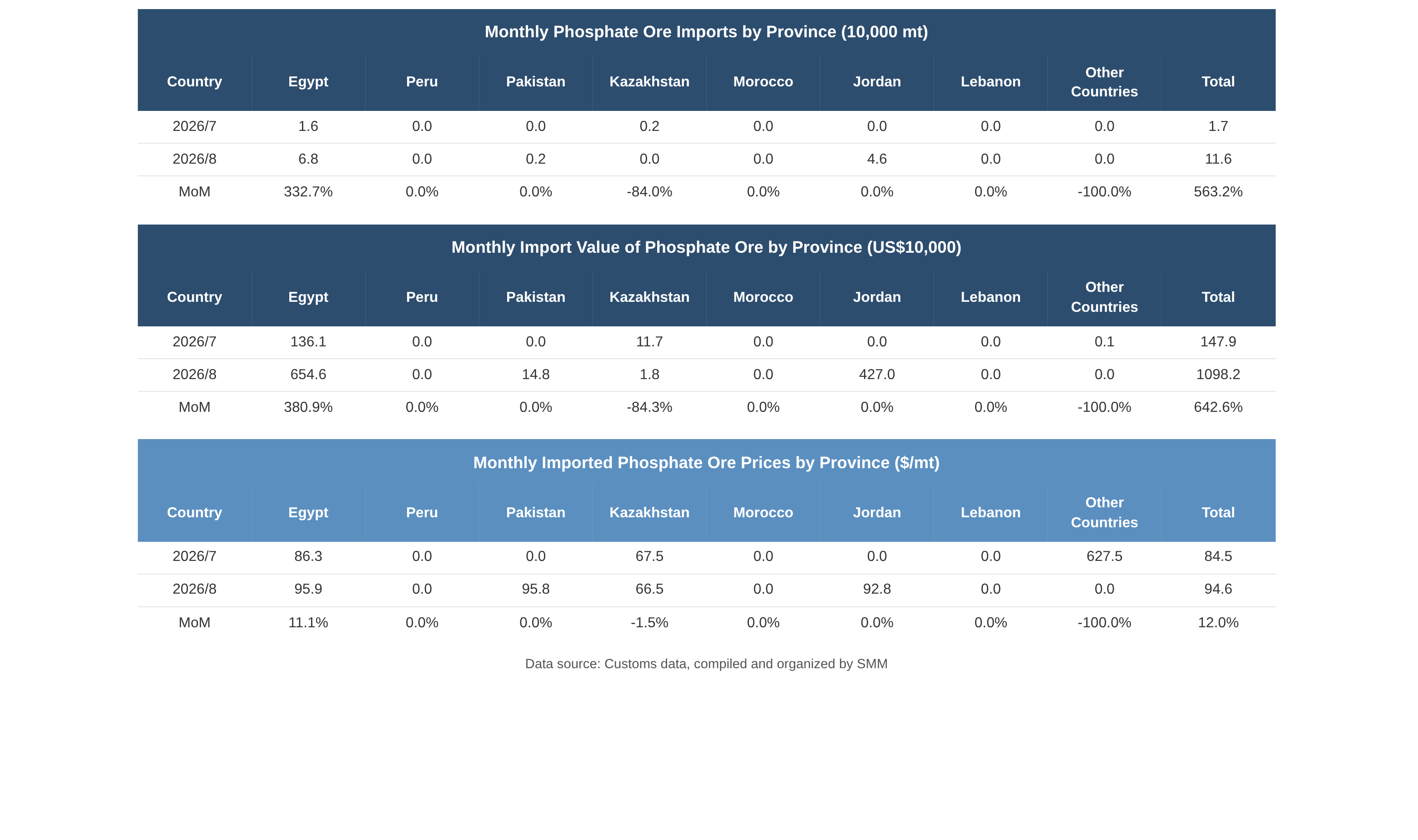
August import sources were extremely concentrated, presenting both risks and opportunities:
Egypt: imports of 68,000 mt (+332.7% MoM), accounting for about 59%; import value of $6.546 million, average price of $95.9/mt (+11.1% MoM).
Jordan: imports of 46,000 mt (zero in July), accounting for about 40%; value of $4.27 million, average price of $92.8/mt.
Pakistan: small top-up of 2,000 mt, average price of $95.8/mt.
Kazakhstan: fell from 2,000 mt in July to zero, with the average price of $67.5/mt (low-priced tailings) discontinued.
Peru, Morocco, Lebanon: August imports were all zero.
Note: Egypt and Jordan together accounted for 98.3%, highlighting the extreme risk of single-source dependence. Previously, Egypt's suspension of new export contracts in May led to a surge in Jordanian imports in June; now Jordan has resumed supply in August, but Egypt's supply outlook for 2027 remains uncertain.
IV. Export side: "ice-breaking" volume of 61,000 mt, policy window effect emerges
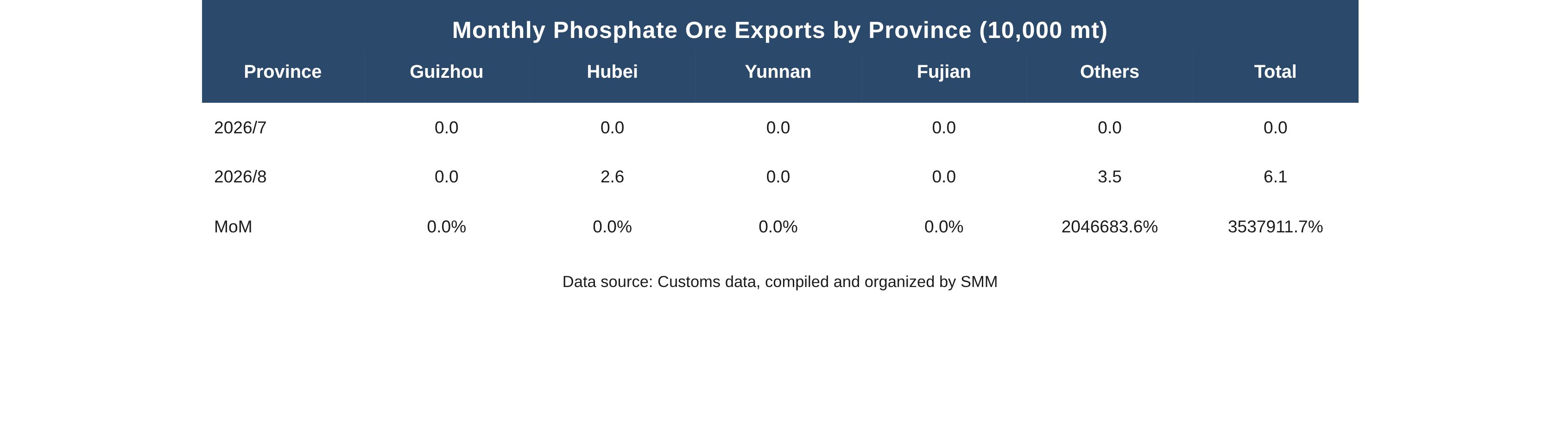
This is the most notable change in the August data. July exports were zero, while August exports surged to 61,000 mt.
Hubei: exports of 26,000 mt.
Other provinces: exports of 35,000 mt (Guizhou, Yunnan, Fujian and other provinces show zero in the table, but the "other" category covers unlisted exporting provinces).
Policy background: phosphate fertiliser exports were suspended from 14 March to 31 August 2026. August, as the final month of the ban, saw exports jump from zero to 61,000 mt, likely driven by enterprises stockpiling ahead of the resumption of normal exports on 1 September, warming up contracts, or exports of non-phosphate-fertiliser phosphorus chemical products (such as yellow phosphorus and fine phosphate salts).
V. Core logic for August and market outlook
Summary of August market logic:
Import side: a recovery rebound from July's extremely low base. Hubei (Jordanian ore) and Jiangsu (Egyptian ground ore) were the two core receiving regions. The 12% rebound in average prices indicates that downstream demand for high-grade ore remains rigid, narrowing the room for buyers to push for lower prices.
Export side: in the final stage of the policy ban, the export channel began to loosen. Although the export volume of 61,000 mt was relatively small, it marked a shift in market sentiment from "full stagnation" to "tentative recovery".
Outlook for September and Q4:
Imports: after phosphate fertiliser exports resume in September, downstream enterprises' operating rates are expected to rebound, but the current period is an off-season for demand with no spring ploughing and no winter stockpiling. September imports are expected to be basically flat or fluctuate slightly from August, with average prices consolidating in the $90-95/mt range.
Exports: After phosphate fertiliser exports return to normal in September, export volumes are expected to expand further, with major phosphate chemical provinces such as Hubei and Guizhou taking on the bulk of export orders.
Key variable: Egypt's phosphate ore export policy direction in 2027. If Egypt tightens further, China will be forced to increase its reliance on Jordan or seek new supply channels such as Morocco. Diversifying source countries will become a long-term strategic task for safeguarding phosphate resource security.
VI. Summary: Is peak demand season arriving?
In August, phosphate ore imports reached 116,000 mt, surging 563.2% MoM; exports jumped from zero to 61,000 mt, with the average price rebounding to $94.6/mt. The data look impressive, but the main drivers were the recovery from an extremely low base caused by the July export ban and pre-season stockpiling ahead of the September phosphate fertiliser export resumption. Autumn fertiliser stockpiling is gradually getting underway, providing support from rigid demand, but import sources remain highly concentrated in Egypt and Jordan, and absolute volumes are still low. Whether peak season has truly arrived will depend on whether September export orders and downstream operating rates can continue to rebound. A short-term rebound is likely, but a trend-level peak season still needs confirmation.
Note: If you have any additions regarding the details mentioned in this article or any questions about the phosphate chemical industry (phosphate ore, iron phosphate, LFP, etc.) and solid-state batteries, please feel free to contact us as follows:
Tel: 021-20707860 (or add WeChat 13585549799) Yang Chaoxing, thank you!
![[SMM Analysis] South Korea's NEV Exports Drop in August, but Cumulative Growth Persists Despite Production Disruptions](https://imgqn.smm.cn/usercenter/IpglC20251217171727.jpg)