August lead concentrate imports pulled back, with limited recovery expected in September [SMM Analysis]

Published: Sep 20, 2026 13:43
[Lead Concentrate Imports Pull Back in August, Limited Recovery Expected in September] According to the latest customs data, China imported 87,000 mt in physical content of lead concentrates in August 2026, down 28,200 mt in physical content or 24.44% MoM and down 35.35% YoY. Cumulative lead concentrate imports from January to August totaled 906,300 mt in physical content, down 2.3% YoY.

SMM, September 20:

According to the latest customs data, lead concentrates imports in August 2026 stood at 87,000 mt in physical content, down 28,200 mt in physical content or 24.44% MoM and down 35.35% YoY. Cumulative lead concentrates imports from January to August reached 906,300 mt in physical content, down 2.3% YoY.
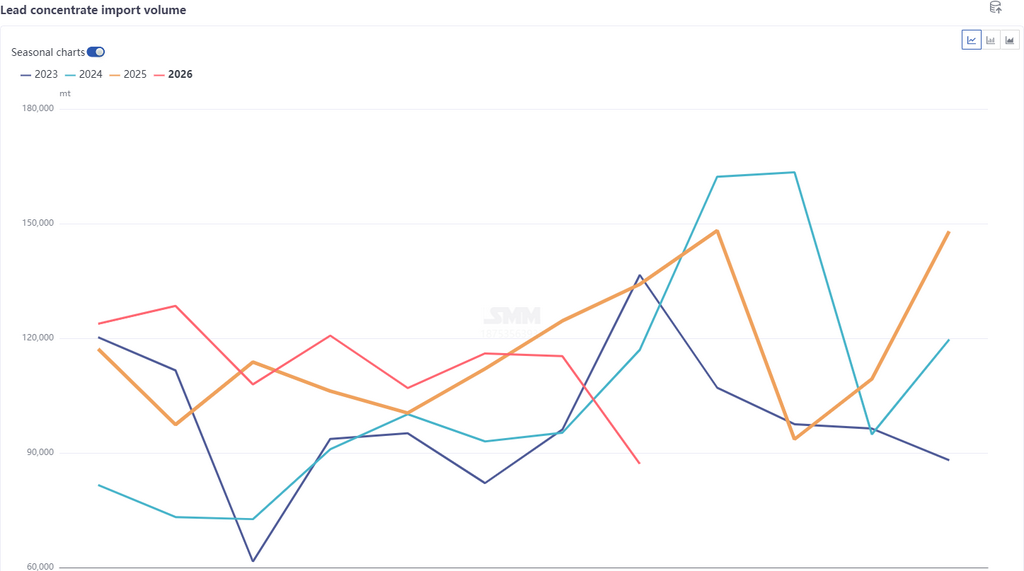
By country, the top three sources of lead concentrate imports in August were Russia (15,300 mt in physical content, 17.61%), Peru (13,900 mt in physical content, 15.95%), and Australia (10,500 mt in physical content, 12.03%). Lead concentrate imports fell sharply in August. By country, imports from Peru and Oman dropped significantly due to rain from El Niño, which hindered road transportation and caused a temporary mismatch in shipment pace, while imports from Australia rose notably. From an import profit margin perspective, the SHFE/LME lead price ratio recovered somewhat in August as the domestic market outperformed overseas markets, and the import loss for lead concentrates narrowed slightly to around -200 yuan/mt. The import window remained closed. Meanwhile, domestic primary lead smelters entered a concentrated maintenance cycle in August, reducing demand for ore and causing a sharp decline in lead concentrate imports.
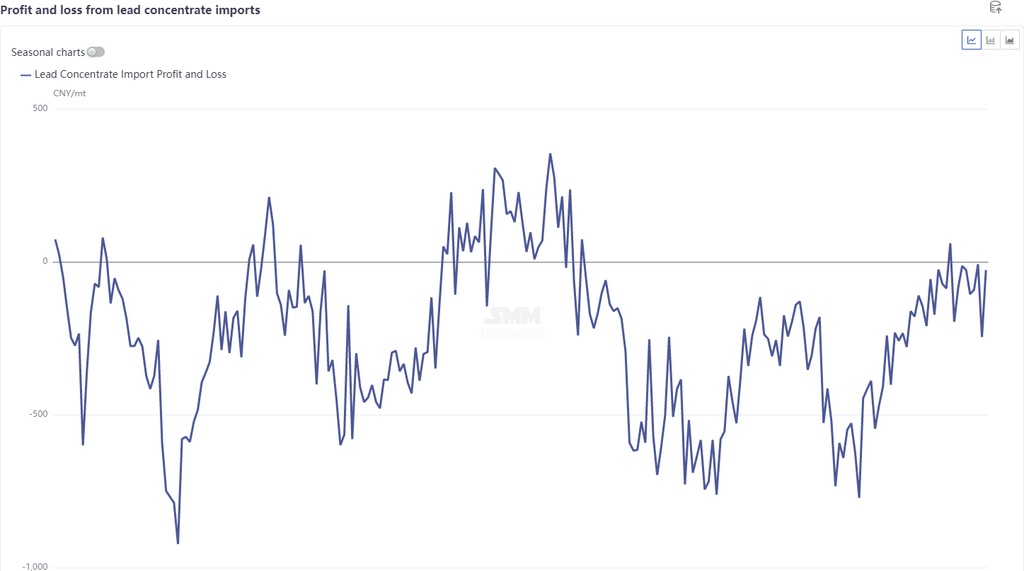
Entering September, lead concentrate imports are expected to increase MoM, but the growth will be limited. The main reasons are that, on one hand, previously delayed shipments are arriving at ports; on the other hand, the import ratio continues to recover, narrowing the import losses for lead concentrates. Some primary lead smelters in China that underwent maintenance in August are gradually resuming operations in late September, increasing demand for ore. However, although the domestic and international ratios have recovered, they remain in a loss-making state, and the overall pattern is expected to remain dominated by long-term contracts.

Data source statement: Except for publicly available information, all other data are processed by SMM based on public information, market communication, and SMM's internal database models, and are for reference only, not constituting decision-making advice.

Data Source Statement: Except for publicly available information, all other data are processed by SMM based on publicly available information, market communication, and relying on SMM's internal database model. They are for reference only and do not constitute decision-making recommendations.

For any inquiries or for more information, please contact: lemonzhao@smm.cn
For more information on how to access our research reports, please contact:service.en@smm.cn
Related News
[SMM Flash] Sulphuric acid prices in some regions dropping below 1,000 yuan/mt
2 hours ago
[SMM Flash] Sulphuric acid prices in some regions dropping below 1,000 yuan/mt
Read More
[SMM Flash] Sulphuric acid prices in some regions dropping below 1,000 yuan/mt
[SMM Flash] Sulphuric acid prices in some regions dropping below 1,000 yuan/mt
Since 10 July, SMM Chinese sulfuric acid price index from Copper smelters has declined for 11 consecutive weeks on a weekly basis. This weekend, sulphuric acid prices were further reduced in some regions, with the ex-works price of 98% smelting acid falling below 1,000 yuan/mt. However, demand from the fertiliser industry has yet to show any clear improvement, and there are no signs that exports of sulphuric acid and phosphate fertiliser can be restarted, leaving the market dominated by a strong wait-and-see sentiment.
2 hours ago
[SMM Flash] China's Sulphuric Acid Production Data for August
2 hours ago
[SMM Flash] China's Sulphuric Acid Production Data for August
Read More
[SMM Flash] China's Sulphuric Acid Production Data for August
[SMM Flash] China's Sulphuric Acid Production Data for August
NBS data shows that China's sulphuric acid (100% equivalent) production in August was 7.984 million mt, down 308,000 mt from 7.676 million mt in July, a YoY decrease of 15.5%. The cumulative production of sulphuric acid (100% equivalent) in 2026 was 68.141 million mt, a cumulative YoY decrease of 4.6%. The top five regions by production were Yunnan province (1.1927 million mt), Anhui province (698,700 mt), Shandong province (680,600 mt), Henan province (570,200 mt), and Guangxi Zhuang Autonomous Region (568,800 mt). For detailed data, please refer to SMM Data.
2 hours ago
[SMM Analysis] China Sulphur and Sulphuric Acid Import and Export Data for August
3 hours ago
[SMM Analysis] China Sulphur and Sulphuric Acid Import and Export Data for August
Read More
[SMM Analysis] China Sulphur and Sulphuric Acid Import and Export Data for August
[SMM Analysis] China Sulphur and Sulphuric Acid Import and Export Data for August
In August 2026, China's total monthly sulphur imports were 272,323.414 mt in physical content, down 29.34% MoM and down 65.03% YoY, with the main import sources being the UAE, South Korea, Canada, Japan, Kazakhstan, Vietnam, Singapore, and the Philippines. China's total monthly sulphur exports were 48 mt in physical content, down 96.34% MoM and up 26.32% YoY, with the main export destinations being Indonesia and South Korea. China's total monthly sulphuric acid imports were 9,938.436 mt in physical content, up 831.85% MoM and up 1,051.37% YoY, with the main import sources being South Korea, Taiwan, China, Germany, and the US. China's total monthly sulphuric acid exports were 2,474.46 mt in physical content, up 153.47% MoM and down 99.43% YoY, with the main export destinations being Angola, Ghana, Cambodia, Hong Kong, China, Vietnam, Singapore, Malaysia, and Tanzania.
3 hours ago
Register to Continue Reading
Gain access to the latest insights in metals and new energy
Already have an account?Sign in here