According to the latest customs data, China's imports of copper-zinc alloy (brass) bars and rods in August 2026 totaled 2,584.2 mt in physical content, up 26.04% YoY and up 11.03% MoM. Cumulative imports for January-August 2026 reached 19,500 mt in physical content, up 7.2% YoY. (HS codes 74072111, 74072119, 74072190).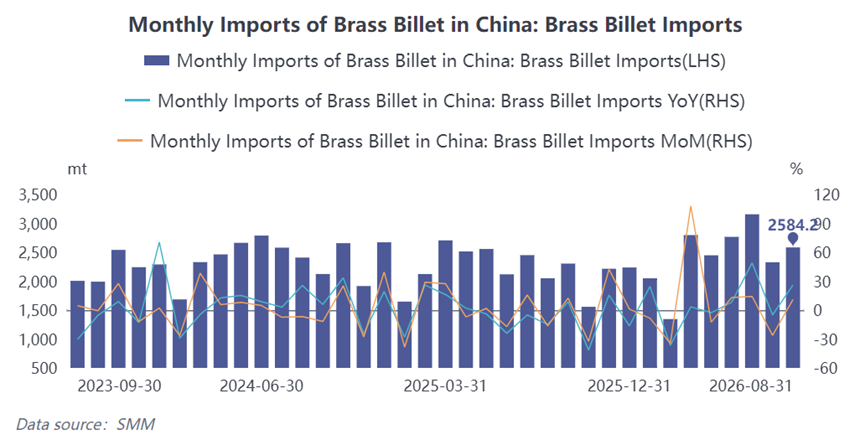
From the perspective of import source structure, South Korea remained China's largest source of brass billet imports. In August, imports from South Korea totaled 947.28 mt, up 6.07% MoM and down 2.66% YoY, accounting for 36.66% of total monthly imports. Japan rose to the second-largest source, with August imports of 450.04 mt, up 37.71% MoM and up 75.48% YoY, accounting for 17.42%. Thailand ranked third, with August imports of 239.49 mt, down 28.41% MoM but up 210.61% YoY, accounting for 9.27%. South Korea, Japan, and Thailand remained the three core suppliers, and the East Asian supply landscape stayed stable.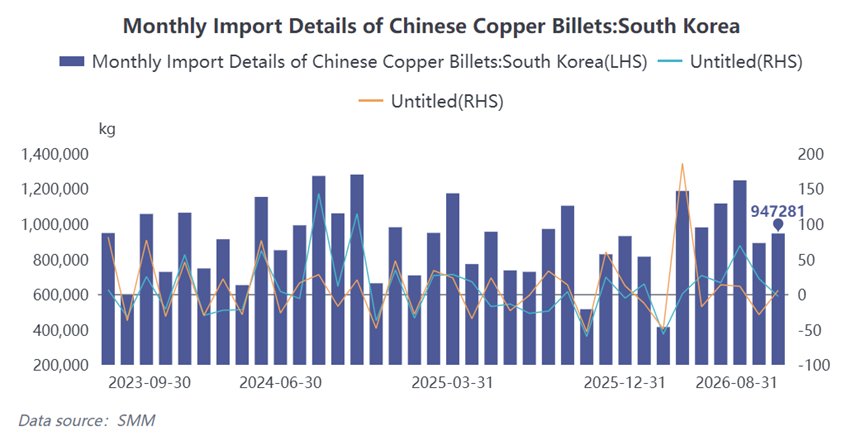
In terms of import value, August brass billet imports amounted to $25.2407 million, up 10.11% MoM and up 65.19% YoY. Cumulative import value for January-August 2026 reached $18.3867 million, up 35.51% YoY. The monthly import volume rebounded MoM, while import value rose sharply YoY, reflecting a continued increase in imported cargo value.
SMM believes that the MoM rebound in August brass billet imports was mainly driven by a recovery in low-level purchasing after the previous period, but the downstream peak season in China recovered slowly, and the substantive recovery in end-use demand remained limited. By source country, Japanese supply posted significant growth, while Thai imports pulled back notably MoM, showing divergence among countries. Cumulative imports and import value for January-August maintained positive YoY growth, and overseas supply continued to supplement the Chinese market. Looking ahead, improvement in domestic end-use demand for brass billet remains slow, and without sustained restocking, there is limited room for a significant strengthening in brass billet imports.