As September got underway, copper prices did not extend their decline after the US Federal Reserve delivered its rate hike. Instead, they rebounded quickly following a brief period of pressure. SHFE copper returned to elevated levels, while LME copper again approached its previous highs. The swift rebound cannot be explained by macro expectations alone. More precisely, the full pricing-in of the rate hike and subsequent short covering served as the immediate catalysts, while deeply negative treatment charges (TCs) for imported copper concentrates, more extensive smelter maintenance and a sharp decline in China’s social inventories of refined copper provided the fundamental underpinning.
Persistent Raw-Material Tightness and Frequent Smelter Maintenance Keep Supply Constrained
On September 18, the SMM Imported Copper Concentrate Index stood at -$221.89 per dry metric tonne, down another $12.19 per dry metric tonne from the previous reading and marking a fresh record low. Processing charges for copper anode are also at historically low levels, reflecting continued tightness in copper anode supply. Meanwhile, sulphuric acid prices have declined for around two and a half consecutive months, steadily eroding smelters’ by-product earnings and adding to operating pressure across the smelting sector.
Several Chinese copper smelters are scheduled to undergo maintenance in October and November. With the availability of supplementary cold-feed materials constrained, raw-material bottlenecks are creating downside risks to refined copper output. Market sources indicate that some smelters have already signalled an intention to cut production and have notified customers that deliveries under long-term contracts will be reduced, although the scale of the reductions has yet to be specified. SMM will continue to monitor the execution of planned maintenance, the scope of actual production cuts and the marginal impact of sulphuric acid prices on smelter operating rates.
Based on the maintenance schedule, the intensity of copper smelter maintenance in the second quarter of 2026 was notably higher than in 2025.
|
Metric |
2025 |
2026 |
Change |
|
Maintenance events |
30 |
38 |
Up 8, or 26.7% |
|
Average maintenance duration |
33.8 days |
35.2 days |
Up 1.4 days |
|
Maintenance lasting 40 days or more |
7 |
14 |
Doubled |
|
Maintenance lasting 60 days or more |
2 |
5 |
Up 3 |
The number of maintenance events scheduled for the full year increased from 30 to 38, while long-duration maintenance lasting 40 days or more rose from seven events to 14. In terms of timing, the maintenance peak shifted from April–May in 2025 to March–June in 2026, with a second wave of concentrated maintenance still scheduled for October–November. Based on currently available data, the combined realised and anticipated output losses in 2026 already slightly exceed the actual impact recorded in 2025. As estimates have yet to be disclosed for some upcoming maintenance events, the overall disruption to refined copper supply from smelter maintenance is expected to be greater in 2026 than in 2025.
Rapid Inventory Draws Shift the Market from Contango to Backwardation
Inventory movements have been the clearest fundamental signal behind the latest rebound in copper prices.
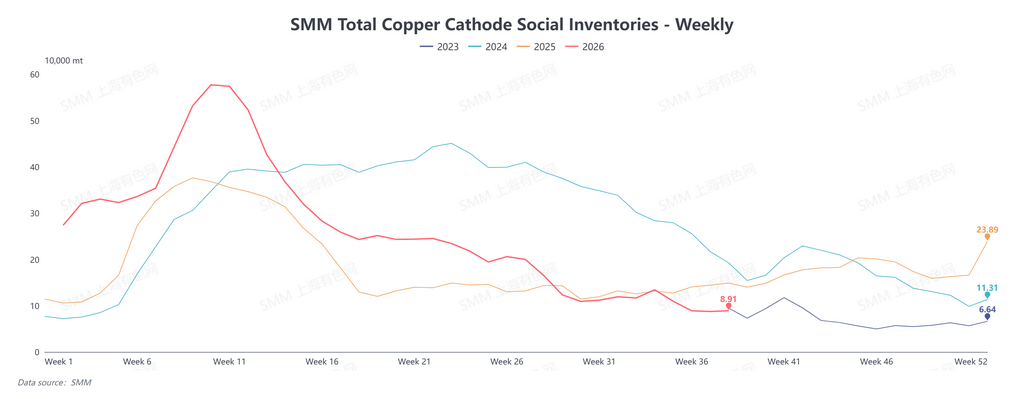
Around the 2026 Chinese New Year holiday, China’s social inventories of refined copper accumulated rapidly, at one point reaching approximately 570,000–580,000 mt. Inventories declined steadily after the holiday, falling to around 200,000 mt by Week 25. The drawdown accelerated further in the third quarter, with stocks dropping to roughly 90,000 mt in Weeks 36–37.
Compared with the same period in previous years, current inventories are not only significantly below their 2024 and 2025 levels but are also approaching the seasonal lows seen in recent years. From the year’s peak, domestic social inventories have declined by nearly 500,000 mt, a drop of more than 80%.
This means that the market’s inventory buffer has thinned considerably. When inventories are high, fluctuations of several tens of thousands of tonnes in arrivals or consumption may not be enough to alter the physical market structure. Once inventories fall to low levels, however, delayed imports, reduced smelter deliveries or periodic restocking by downstream producers can quickly amplify tightness in the physical market.
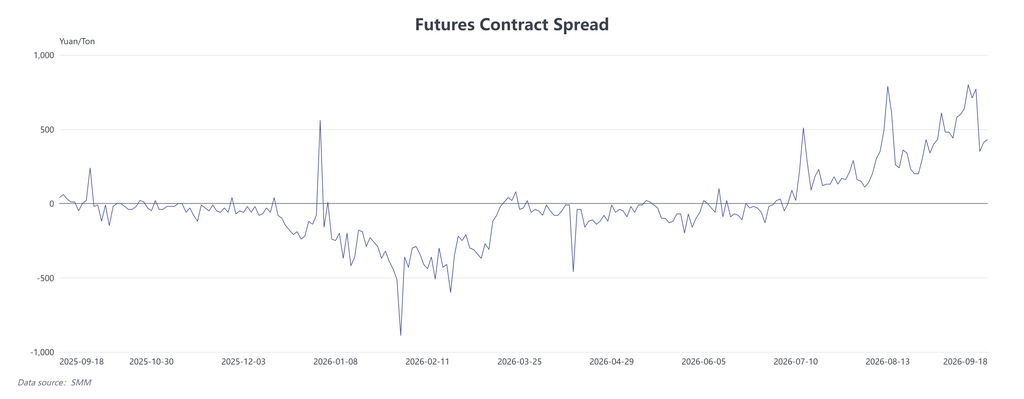
The shift in the market structure from contango to backwardation is precisely how these low inventories have been reflected in the futures market. As immediately available physical supply declines, nearby contracts command a higher premium over forward contracts, sellers become more inclined to hold firm on offers and nearby spreads widen accordingly. In other words, backwardation is not an independent driver of the current copper rally. Rather, it is the result of low inventories and tight physical supply, while also reinforcing expectations of near-term supply tightness.
It is important to note that falling inventories should not simply be equated with a sharp increase in end-user demand. The rapid drawdown in Chinese inventories reflects not only support from consumption but also the pull of copper units into the US market, import losses, the timing of cargo arrivals and smelter maintenance. A more accurate characterisation of the current physical tightness would therefore be that demand has not weakened materially, while supply replenishment has not arrived quickly enough, resulting in a rapid decline in readily available inventories.
Outlook: Copper Prices Remain Supported, but Market Tensions May Shift at Elevated Levels
In the short term, China’s social inventories remain low. With the National Day and Mid-Autumn Festival holidays approaching, downstream producers are also likely to restock in advance, lending continued support to spot premiums and nearby backwardation. At the same time, however, the C/L spread has turned slightly negative, and the cross-market arbitrage window for shipping copper to the US has largely closed. Global copper flows may therefore begin to shift, creating potential supply pressure in China’s physical market.
First, changes in the C/L spread and the potential return of overseas cargoes. The C/L spread has continued to narrow from its earlier highs and has now moved slightly into negative territory, indicating that the US market’s price incentive for overseas copper units has weakened significantly. If this negative spread persists, incremental cargoes that had previously flowed to the US may be redirected to China and other Asian markets. Chinese import arrivals could consequently increase, placing pressure on spot premiums and backwardation.
However, trade negotiations, contract signing, loading, vessel diversions and shipping all involve time lags. Any redirection of cargoes will therefore not be reflected immediately in domestic inventories; its impact is more likely to become visible later through import arrivals and changes in bonded-zone inventories. Conversely, if expectations of US tariffs on refined copper intensify again and the C/L spread widens, the pressure from returning cargoes may ease.
Second, pre-holiday restocking and the performance of spot premiums. As the holidays approach, downstream producers will need to secure material in advance to cover production requirements and logistics schedules during the holiday period. Against a backdrop of low social inventories and limited immediately available supply, sellers are likely to hold firm on offers. Spot premiums may rise further, while nearby backwardation could deepen accordingly.
However, pre-holiday restocking partly represents demand being brought forward. Once restocking is largely complete, high copper prices may curb downstream procurement and physical trading activity could cool rapidly. The sustainability of stronger pre-holiday premiums should therefore be assessed against actual transactions and post-holiday inventory movements.
Third, imported copper concentrate TCs and the actual pace of smelter production cuts. TCs for imported copper concentrates are already deeply negative, and the economics of processing spot imported concentrates continue to deteriorate. Some smelters have consequently shown a stronger willingness to reduce production. The key question is whether these intentions will translate into actual output losses.
If maintenance and operating-rate cuts broaden further, a contraction in Chinese refined copper supply would help offset the pressure from returning import cargoes. Conversely, if output recovers quickly once maintenance ends while overseas cargoes are simultaneously redirected to China, domestic supply pressure could rise markedly.
Fourth, whether Chinese smelter output can recover. As maintenance at some smelters concludes, a rebound in refined copper production during the fourth quarter, combined with a concentrated increase in import arrivals, could cause domestic inventories to shift from destocking to stabilisation or even accumulation.
Overall, pre-holiday restocking and low inventories should continue to support spot premiums in the near term. However, the negative C/L spread indicates that the US pull on global copper units has reached a potential inflection point. The market’s next key test is whether supply reductions at smelters can offset the return of import cargoes, and whether underlying consumption can continue to absorb high copper prices once concentrated pre-holiday restocking comes to an end.