SMM, September 18:
The expected "September peak season" in China failed to materialize. Against a backdrop of weak supply and demand, prices across the domestic tungsten industry chain pulled back slightly this week, with trading volumes shrinking. Midstream smelters, squeezed by persistently compressing processing margins, continued to reduce operating loads, proactively lowering operating rates and prioritizing inventory digestion. Trading was sluggish across the entire industry chain, with wait-and-see sentiment dominating. The weekly average price of wolframite concentrates (≥65%) fell by 3,000 yuan/mt to 409,500 yuan/mt; the weekly average price of APT (domestic) dropped 5,000 yuan/mt to 590,000 yuan/mt, with the price spread between spot orders and long-term contracts widening again. The powder segment weakened in tandem, with average prices of tungsten powder, tungsten carbide powder, and recycled tungsten carbide powder each falling 10 yuan/kg to 910, 860, and 790 yuan/kg respectively, alongside poor shipments. Over a longer horizon, since August 18, scheelite concentrates (≥65%) have cumulatively declined by 7,000 yuan/standard tonne (approx. -1.7%), and APT has fallen by 15,000 yuan/mt (approx. -2.5%), while intermediate and downstream products such as tungsten powder and AMT posted even steeper declines (tungsten powder -7.1% MoM, AMT -3.3%), reflecting more pronounced price pressure in the midstream and downstream segments of the industry chain.
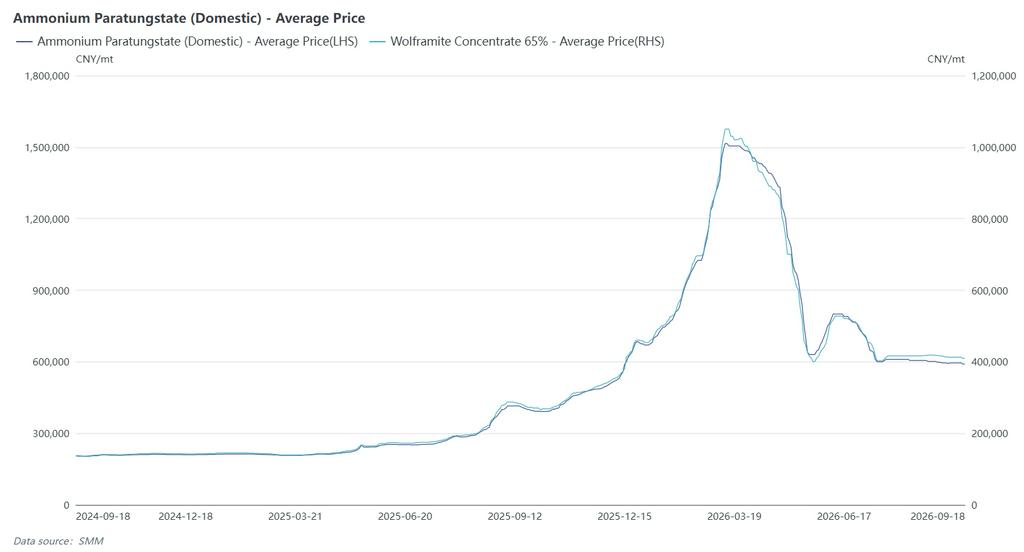
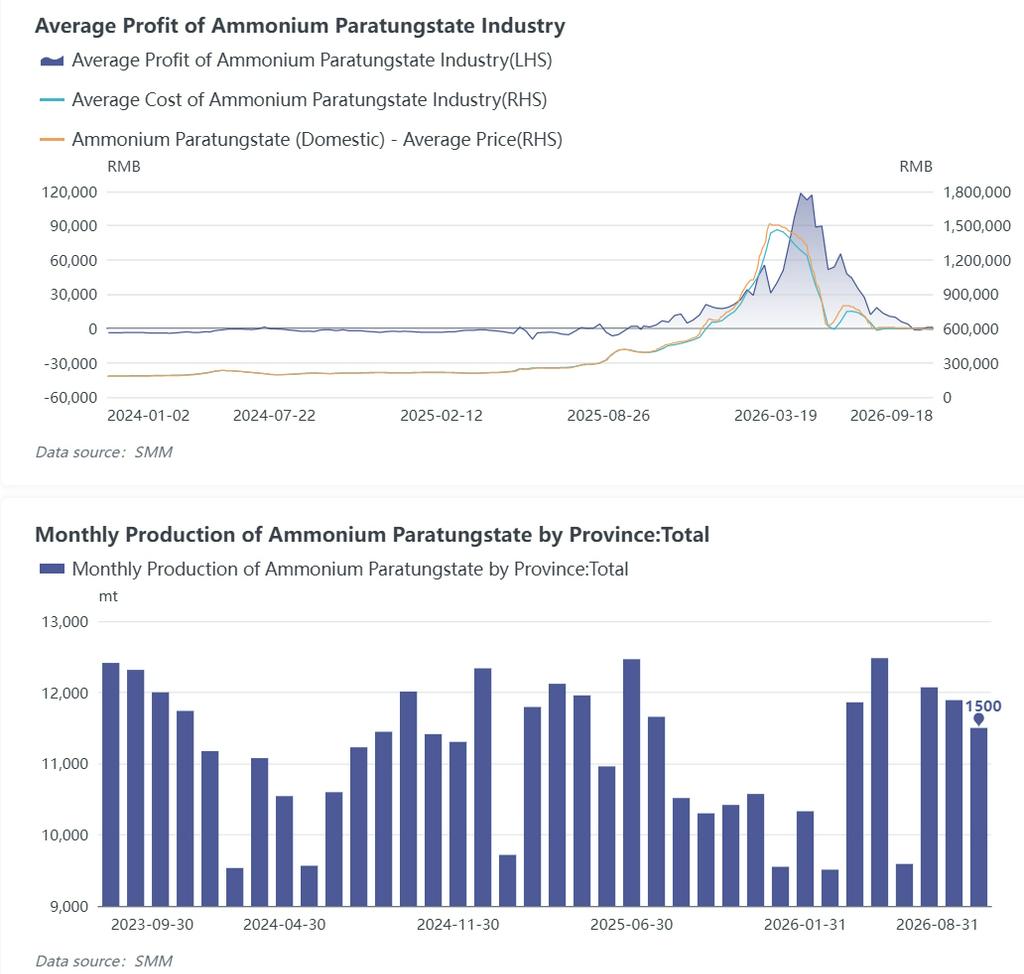
Multiple enterprises quoted uniform long-term contract prices for September. In H1 September, 55% wolframite concentrates were mostly executed at 413,000 yuan/standard tonne and scheelite concentrates at 412,000 yuan/standard tonne, while APT was mostly executed at 600,000 yuan/mt. Major producers actively stabilized the market, but order follow-through was insufficient. Last week, some enterprises in Xiamen and Hunan entered the market to purchase APT, but trading volumes were limited. Market supply remained ample, and APT smelters faced significant capital pressure, forcing them to cut operating rates and clear inventory to cope with the current situation. As of now, the domestic APT operating rate has fallen below 70%, and APT production in September is expected to decline by around 15% MoM. Downstream powder enterprises also reported weak orders, with powder transaction prices mostly grinding lower.
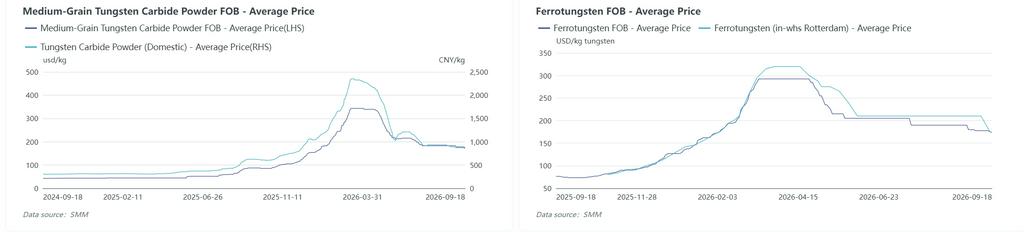
In markets outside China, European APT prices held steady this week, while the ferrotungsten market converged from elevated levels: the weekly average CIF Rotterdam APT price was reported at $3,000/mtu, holding flat for four consecutive weeks; the weekly average warehouse Rotterdam ferrotungsten price fell sharply by $35/kg W to $175/kg W, a weekly decline of approximately 16.7%, as the high premium on overseas ferrotungsten rapidly contracted. On the macro front, the US Fed raised interest rates by 25 basis points as expected at its September meeting to 3.75%-4.00% (the first hike since July 2023). The dot plot indicated one more rate hike may occur within the year, with a stronger US dollar and higher Treasury yields weighing on metals valuations and intensifying wait-and-see sentiment among overseas buyers. The export segment showed clear structural divergence: tungsten powder and tungsten carbide powder, as dual-use items, are subject to strict export approvals, and export orders in H1 this year mostly commanded high premiums. However, against a backdrop of weak domestic demand and significant inventory pressure at some enterprises, export offer premiums for powders have narrowed notably. For export orders with faster approval processes and larger procurement volumes, enterprises are mostly offering only a small premium over the spot-futures price spread on spot cargo. As of now, SMM tungsten carbide FOB quotes closed at $165–170/kg, while some transactions in the European market remain around $300/kg. The price spread between Chinese and overseas markets stays high, and Chinese tungsten product prices are at a relatively low level in the global tungsten price system, which to some extent stimulates tungsten product exports. However, the core contradiction lies in the tightening export approval for core tungsten products, while overseas demand for non-controlled products (such as ferrotungsten) is weak, and the price spread advantage is not obvious — SMM ferrotungsten FOB quotes are $170–175/kg, while ferrotungsten in Rotterdam, Europe is quoted at $170–180/kg. The price spread between Chinese and overseas markets is almost negligible, and the export arbitrage window has clearly narrowed.
In the short term, the decline in China's APT operating rate and the strong rigid constraints on ore supply still provide some support for upstream tungsten prices. However, downstream powder and cemented carbide enterprises are digesting high-priced inventory slowly, and order recovery will take time. Prices lack upward momentum and are expected to remain in the doldrums with consolidation and a slight downward shift in the center. Next week, attention should focus on the guidance from long-term contract quotes for the second half of September and the actual fulfillment of peak-season orders. In markets outside China, it is necessary to track the US dollar trend, peak-season restocking demand in Europe, and whether the narrowing Rotterdam ferrotungsten premium will further transmit to APT and tungsten scrap prices. In the medium and long term, China's resource endowment of 14 minerals including tungsten, with reserves ranking first in the world, along with control policies such as total mining volume controls and export licensing, still provides bottom support for tungsten prices. Meanwhile, overseas ore development is accelerating, but equipping downstream smelting capacity still requires a longer time cycle. The contradictions in the global tungsten supply industry chain are relatively concentrated, and the tungsten price system may be gradually restructuring. How the structural price spread between China and overseas markets evolves still requires close tracking.