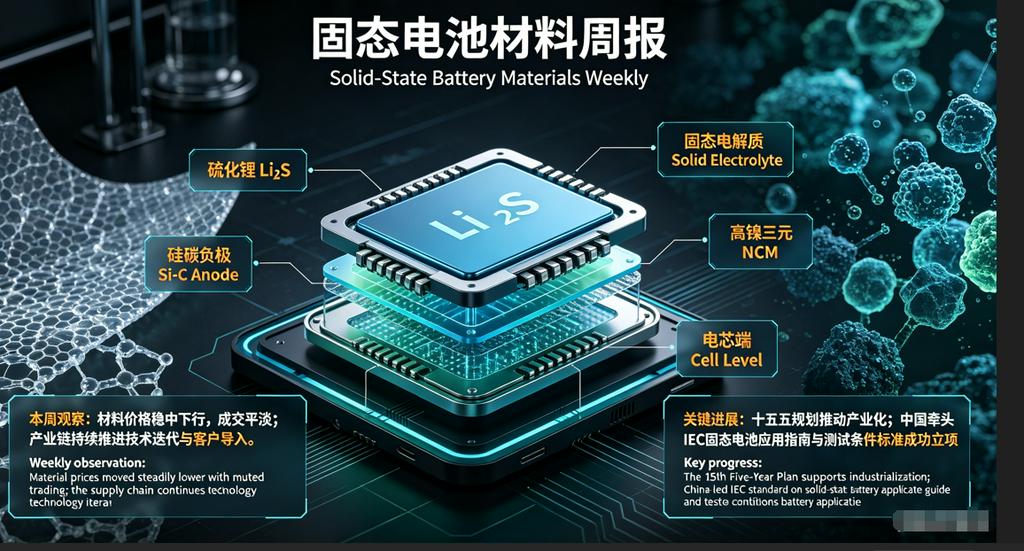
Key points: This week (September 11–17, 2026), prices of solid-state battery-related materials were stable with a downward bias, and market trading was relatively flat. On the raw material, material, and cell sides, leading companies quietly made continuous breakthroughs in R&D and technology iteration, while startups increased external promotion efforts to build sufficient customer reserves before the commercialization wave of solid-state batteries arrives. The Ministry of Industry and Information Technology (MIIT) and the National Development and Reform Commission (NDRC) issued the 15th Five-Year Plan for the Electronic Information Manufacturing Industry, explicitly promoting the industrialization of solid-state batteries. The Application Guide, Test Items and Conditions for Solid-State Batteries for Electric Vehicle Propulsion Secondary Lithium-Ion Batteries, led by China, was successfully approved by the International Electrotechnical Commission (IEC).
Preface: Price Signals and Industry Stage
This week, trading in SMM solid-state battery-related materials was flat, with prices stable but tending downward. Quotation ranges for lithium sulfide and sulfide electrolytes remained wide, with notable premiums. As kiloton-scale capacity is released, prices for oxide solid-liquid hybrid electrolytes are expected to decline. Silicon-carbon anode costs continued to fall amid the expansion of porous carbon capacity. Ton-level shipments of solid-state-specific cathode materials such as high-nickel and lithium-rich manganese-based materials increased, but specialty premiums have not yet narrowed significantly.
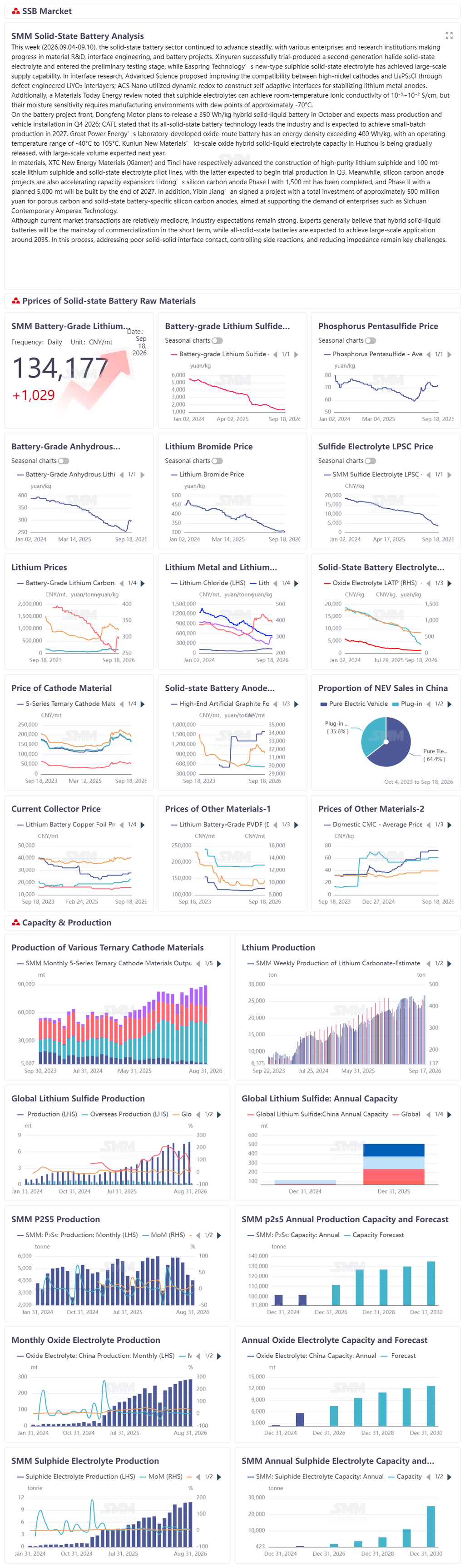
From a longer-term perspective, in the first half of 2026, lithium sulfide fell from RMB 2,000/kg at the beginning of the year to RMB 1,530/kg in early June, a decline of 23.5%. With Tinci Materials' 100-ton-scale production line put into operation in Q3 and the increase in self-supply ratios among leading companies, the H2 average price is expected to further drop to RMB 1,300–1,500/kg, and LPSC is expected to fall back to the RMB 6,000–7,500/kg range. From January to August, cumulative sulfide electrolyte output was about 70 tons, already exceeding the full-year 2025 output of 58 tons. However, Q4 average monthly output is expected to be in the 11.5–13.0-ton range, still insufficient to support large-scale vehicle installation demand.
The price characteristic on the material side this week: capacity release is outpacing downstream validation. Hundred-ton-scale production lines have been completed one after another, but actual procurement is still mainly based on kilogram- to ton-level "validation orders," so the indicative value of price signals is limited. The real inflection point depends on the speed at which downstream cell makers switch from pilot lines to mass production lines.
I. Materials: Cathodes, Anodes, and Electrolytes
1.1 Cathode materials: Lithium-rich manganese-based materials enter the certification window. The most noteworthy change on the cathode side this week came from Aimite under Tianhua New Energy. The lithium-rich manganese-based material developed by Aimite has a specific capacity of 300 mAh/g, an operating voltage of over 4.5 V, an energy density 30% higher than conventional ternary materials, and a capacity retention rate of over 85% after 1,000 cycles. The material has been sent to more than ten customers, including CATL and WeLion, and some have passed certification and achieved sales. Meanwhile, Jiangsu Yili's high-nickel ternary cathode has achieved mass production, with an investment of RMB 1.12 billion to build a 5,200-ton/year production line. Tianhua New Energy plans total solid-state battery material capacity of 15,000 tons in 2026.
1.2 Electrolytes: Lithium sulfide pilot progress; oxide capacity leads. Tinci Materials' 100-ton-scale lithium sulfide and solid electrolyte pilot line has been completed and put into use, and the company maintains close R&D cooperation with mainstream downstream cell makers and automakers. Langu New Energy's oxide solid electrolyte capacity has reached the ten-thousand-ton level, while sulfide and halide electrolytes have reached hundred-ton-scale capacity, with plans to expand to thousand-ton or even ten-thousand-ton scale. Easpring's sulfide electrolyte materials have entered the small-scale validation stage with leading solid-state battery customers, having opened up an integrated preparation chain of "lithium sulfide–highly active precursor–high-performance sulfide electrolyte."
1.3 Anodes: CVD silicon-carbon enters customer certification stage. During multiple institutional research visits this week, Xiangfenghua disclosed that its CVD silicon-carbon anode material is currently in the customer certification stage and has been sent to multiple domestic and overseas battery manufacturers for validation. The technology has moved from the laboratory R&D stage to the pilot validation stage and has a foundation for scale-up production. In the solid-state battery field, Xiangfenghua's anode cooperation with Qingtao Energy continues to advance product validation.
II. Batteries: Pilot Line Construction and Vehicle Installation Pace
The clearest signal on the battery side this week came from Chery Automobile. Chery Chairman Yin Tongyue publicly stated that the company's Rhinoceros solid-liquid hybrid battery will be installed in vehicles in Q4 2026, and all-solid-state batteries will start on-vehicle validation in 2027. This timetable is consistent with the overall industry rhythm—solid-liquid hybrids first, all-solid-state following.
Penghui Energy disclosed that its laboratory oxide-route battery can achieve an energy density of over 400 Wh/kg and an operating temperature range of -40°C to 105°C. Farasis Energy made clear that its all-solid-state battery pilot line is still under construction and has not yet reached mass production. Zhongqi New Energy and Leapmotor signed a technical cooperation agreement, under which the two sides will carry out R&D collaboration in frontier directions such as solid-state batteries, lithium-rich manganese-based batteries, and sodium-ion batteries, and jointly promote targeted development of standardized cells.
Two main lines can be read from the battery-side information: First, the vehicle installation pace for solid-liquid hybrid batteries is becoming clearer, and 2026 Q4 to 2027 will be an intensive validation period. Second, the mass production timetable for all-solid-state batteries still mainly focuses on "starting validation" in 2027, and there is still a distance before consumers can buy such products.
III. Projects and Capacity: Pilot Lines Advance Intensively
Multiple solid-state battery projects updated their progress this week. Jiangsu Jiuxing New Energy's solid-liquid hybrid battery project has a total investment of RMB 1 billion and is expected to complete plant equipment installation and full commissioning in December, with mass production in Q1 2027. Its products target high-end fields such as drones and robots. Lyric Robot disclosed that it has opened up the full process equipment chain of dry electrode, electrolyte transfer printing, isostatic pressing, and high-voltage formation and capacity grading. Its warm isostatic pressing equipment has reached mass production delivery standards, and the all-solid-state complete line project delivered to a leading automaker has completed phased acceptance.
Naknor's order backlog stands at RMB 2.718 billion. Some solid-state equipment, such as lithium strip calendering equipment and lithium supplementation composite integrated machines, has entered customer validation or delivery stages. Wuxi Lead Intelligent Equipment has continued to win orders from leading customers since Q3, covering core process equipment such as dry electrodes, electrolyte coating, solid-state stacking, and isostatic pressing.
Information density on the equipment side is clearly higher than on the material and battery sides. This is in line with industry logic—pilot line construction comes first, and equipment orders are the earliest industrialization signal.
IV. Financing Cooperation and Overseas Progress
4.1 Domestic cooperation: Tengyuan Cobalt and Hunan Liuli Exploration Technology reached a strategic cooperation to jointly build a lithium sulfide pilot line and carry out engineering validation of key upstream raw materials for sulfide electrolytes. Tengyuan Cobalt provides hydrometallurgy and high-purity material purification capabilities, while Hunan Liuli provides lithium sulfide material formulas and solid electrolyte R&D technology.
4.2 Overseas cooperation: Standards and capacity, two lines. On standards, the Application Guide, Test Items and Conditions for Solid-State Batteries for Electric Vehicle Propulsion Secondary Lithium-Ion Batteries, led by China, was successfully approved by the IEC. This is the first time China has led the formulation of an international standard in the solid-state battery field. The standard is led by an expert from a leading Chinese new energy battery company, with participation from experts from France, South Korea, Japan, and other countries. The approval of the standard will help end the conceptual confusion around terms such as "solid-liquid hybrid" and "quasi-solid-state," and establish a globally unified technical evaluation system.
4.3 Capacity: Solid Power confirmed plans to establish a sulfide solid electrolyte joint venture in South Korea before the end of 2026, with an initial target capacity of about 500 tons, forming supply capability by 2028, and later planning up to 20,000 tons/year. Factorial Energy is cooperating with Mitsui Kinzoku, which will mass-produce argyrodite-type sulfide solid electrolytes at a dedicated plant in Saitama Prefecture, Japan. Panasonic Energy has developed a solid-state battery that can operate at up to 150°C and will start sample delivery from October to December, mainly targeting the industrial machinery sector.
V. Industry Voices
Pan Ruijun of Gotion High-tech: When the price of lithium sulfide falls to RMB 500,000/ton and the price of solid electrolyte falls to RMB 300,000/ton, solid-state batteries will enter the "1 yuan/Wh era." The current average price of lithium sulfide is about RMB 1.5 million/ton, accounting for 88% of the BOM cost of sulfide electrolytes, still a long way from the target.
New voices this week: In the technical cooperation between Zhongqi New Energy and Leapmotor, both sides explicitly made "jointly promoting targeted development of standardized cells" one of the core goals. This means that the cooperation model between automakers and battery companies in solid-state batteries is transitioning from the "technical validation" stage to the "product definition" stage.
SMM固态电池会参会名单(部分)


**Note:** For further details or inquiries regarding solid-state battery development, please contact:
Phone: 021-20707860 (or WeChat: 13585549799)
Contact: Chaoxing Yang. Thank you!
![[Solid-state battery: Jinyu New Energy predicts that the demand for batteries in the low-altitude sector will be around 300 GWh by 2035]](https://imgqn.smm.cn/usercenter/ipFFo20251217171725.jpg)
![[Solid-State Battery: Wanbang's Yu Yanan Shares Progress on Materials Such as Lithium Sulfide and Silicon-Lithium Anodes]](https://imgqn.smm.cn/usercenter/nVnLo20251217171728.jpg)
![[Solid-State Battery: Wang Jiutian of Zhongke Yuanben Analyzes Sulphide All-Solid-State Battery Technology and Enterprise Layout at SMM SSBC Annual Conference]](https://imgqn.smm.cn/usercenter/WBREf20251217171728.png)