Since late July 2026, the steel supply chain on both sides of the Black Sea has failed simultaneously within a month: three mainstream Ukrainian steel mills successively halted production due to attacks, cutting August crude steel output by more than half year-on-year; Russian Black Sea slab shipments have completely stalled since early August, with Novorossiysk repeatedly attacked and liner giants suspending bookings. What has actually severed the trade flow is not just capacity loss, but freight and war risk—Black Sea-Türkiye billet freight has climbed from 25–35 USD/tonne to 60–70 USD/tonne with no actual deals concluded, already exceeding the price spread between the two markets itself. The result is that Türkiye has shifted its semi-finished product procurement to Asia and overland routes, while Europe is accelerating its decoupling from Ukrainian supply under the triple barriers of quotas, CBAM, and the "melt and pour" rule.
I. One month, both shores simultaneously lost the ability to ship
On the Ukrainian side, the impact is concentrated on the mills themselves. According to Ukrmetalurgprom data, Metinvest's Zaporizhstal completely halted production after two ballistic missile strikes on August 11 and August 27; before the shutdown, the plant had only produced 46,200 tonnes that month. The company confirmed the attacks caused 7 fatalities and 21 injuries, with heavy damage to the coke, blast furnace, and energy units, and no restart timeline has been given. The plant has an annual capacity of 4 million tonnes of pig iron, 3.6 million tonnes of hot-rolled, and 1.2 million tonnes of cold-rolled products; its pig iron is mainly sold to the US, while flat products are primarily exported to Europe.
On August 16, ArcelorMittal Kryvyi Rih, Ukraine's largest steelmaker, was attacked, leaving 2 dead and 14 injured. Power supply and blast furnace-related facilities were damaged, forcing some processes to stop. On September 5, key production and infrastructure facilities at Kametstal were damaged in a ballistic strike, also resulting in a complete halt.
Production data has already reflected this impact. Ukraine's crude steel output in August was 277,000 tonnes, down 57.3% year-on-year and 39.4% month-on-month; pig iron was 257,100 tonnes, down 65.6% y/y; finished steel was 269,500 tonnes, down 57.4% y/y. Cumulative crude steel for January-August was 4.3 million tonnes, down 12.5% y/y; pig iron was 4.35 million tonnes, down 14.8% y/y; finished steel was 3.59 million tonnes, down 15.6% y/y. In other words, the double-digit decline of the first seven months was magnified into a halving in the single month of August.
The raw material end is similarly choked off. Since July 23, commercial vessels stopped calling at the Greater Odesa port area; on July 28, Ferrexpo confirmed a vessel was hit by a drone, and the company stated it was unable to resume shipments for the foreseeable future, leaving 189,000 tonnes of pellets stranded in stock, valued at approximately 20 million USD; on August 3, Poltava Mining halted operations due to a working capital shortfall, with Southern Mining stopping concurrently; Metinvest expects its August extraction volume to drop by about 30%. Ukraine exports roughly 33 million tonnes of iron ore annually, about 60% of which goes by sea. The blockage of the maritime corridor directly threatens about 1 million tonnes of monthly shipments, corresponding to a monthly export revenue loss of 60-70 million USD.
On the Russian side, the problem lies not with the mills, but with ports and ships. On August 12, Ukrainian drones attacked the Novorossiysk grain terminal, killing 3 people; on August 14, the Sheskharis terminal, which handles about 700,000 barrels of crude oil daily, stopped loading due to a drone alert; in late August, Tuapse was struck, triggering force majeure. On August 26, MSC announced the immediate suspension of new bookings for Novorossiysk after its vessel MSC ULSAN III was attacked, retaining only services at St. Petersburg and other Russian ports; on September 9, Novorossiysk was again hit by drones. According to SMM, Russian Black Sea slab shipments have been completely stalled since early August, with massive resources stranded at the port, and the Baltic Sea corridor is also facing drone harassment.
It is worth noting that the Russian steel industry was already contracting. Russian crude steel output in 2025 was 67 million tonnes, down 12% from 2021; Q1 2026 output was 15.6 million tonnes, down 10.4% y/y, hitting a 15-year low. Domestic steel consumption dropped 14% in 2025 and fell another 15% in early 2026. MMK recorded a net loss of 14.9 billion rubles in 2025, with capacity utilization dropping to 60%; Severstal's profit shrank to one-fifth, with free cash flow standing at negative 30.5 billion rubles. The port disruption acts as an additional lock on a system already suffering from insufficient capacity utilization.
II. Insurability, not tonnage, is what cut the trade flow
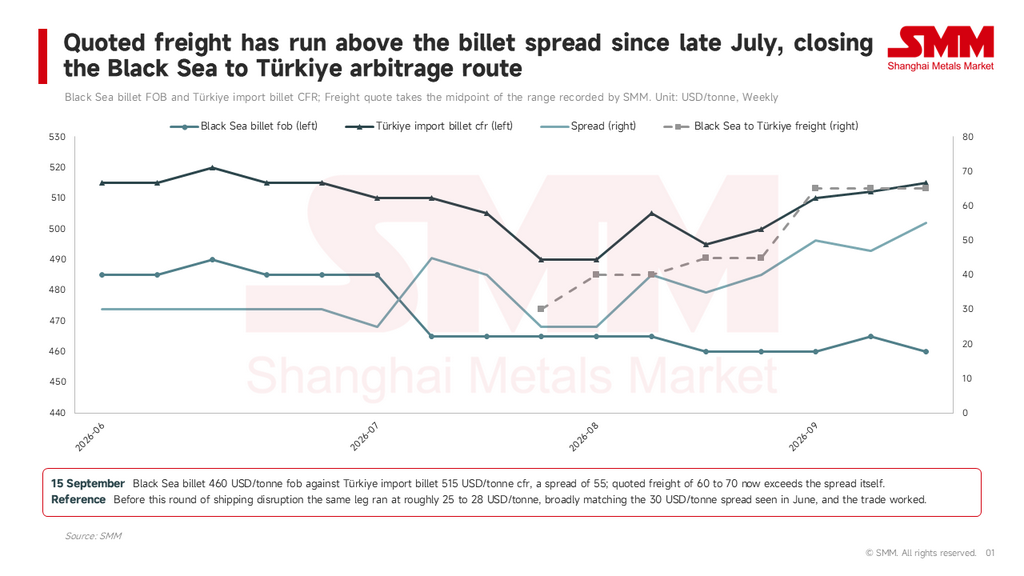
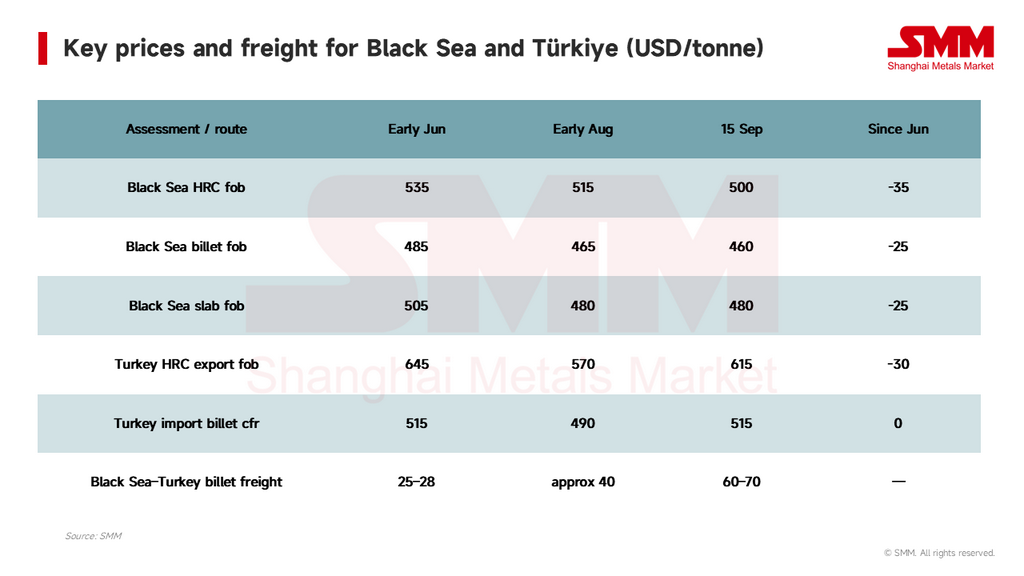
What pressed the pause button on Black Sea exports is war risk, not artillery shells. On July 30, SMM recorded this turning point in its international steel daily: Russian reinsurers canceled war risk coverage, and coupled with multiple merchant vessels being attacked, sunk, or damaged, shipowners suspended sailings citing force majeure. Freight rates for steel billet from the Black Sea to Türkiye climbed to 25–35 USD/tonne, and insurance premiums soared to 10–15 USD/tonne. Thereafter, freight rates rose week by week—reaching about 40 USD/tonne on August 5, 45 USD/tonne on August 19, and 60–70 USD/tonne during the week of September 4, with no actual transactions recorded. By contrast, the normal freight rate for the same route before this disruption was about 25–28 USD/tonne.
The consequences of runaway freight rates can be clearly seen through a simple calculation. As of September 15, SMM's Black Sea billet FOB was quoted at 460 USD/tonne, and Türkiye's import billet CFR was 515 USD/tonne, leaving a spread of 55 USD/tonne; however, freight quotes from the Black Sea to Türkiye had reached 60–70 USD/tonne. This means that even if Russian steel mills push their FOB prices to the absolute bottom, the total delivered cost of the cargo to Türkiye is already higher than what local buyers are willing to pay CFR. This is the pricing mechanism behind "can quote, cannot ship": it is not a lack of buyers, but the voyage itself consuming the entire price spread.
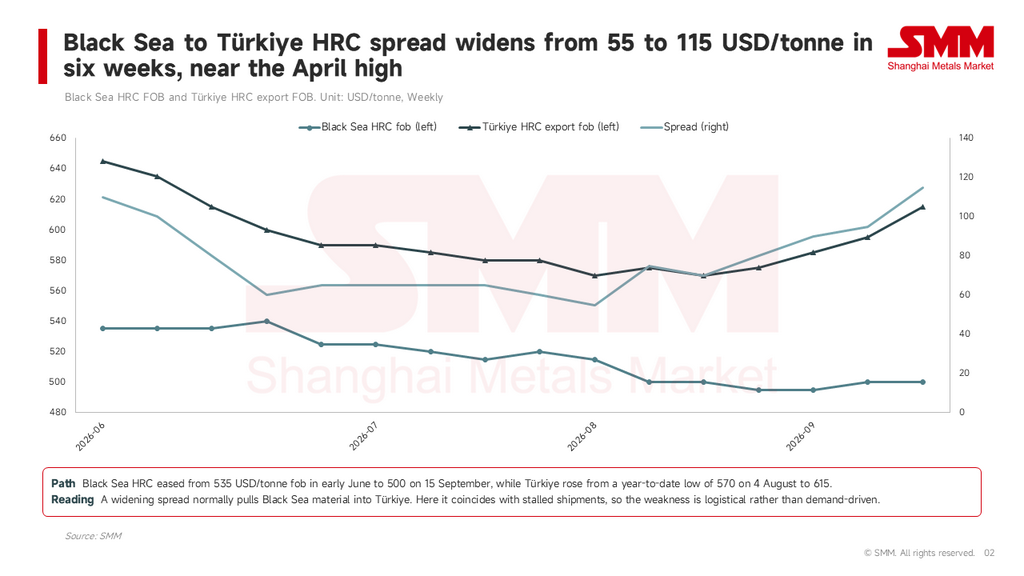
The gap in flat products is even wider. Black Sea HRC FOB fell from 535 USD/tonne in early June to 495 USD/tonne in late August, and slightly recovered to 500 USD/tonne from September 4; over the same period, Türkiye's HRC export price continuously rose from a year-to-date low of 570 USD/tonne FOB in early August to 615 USD/tonne FOB on September 15, with domestic EXW prices simultaneously rising from 580 USD/tonne EXW to 610 USD/tonne EXW. The price spread between the two regions doubled in six weeks, from a year-to-date low of 55 USD/tonne on August 4 to 115 USD/tonne on September 15, approaching the high of 130 USD/tonne seen in April. Historically, Black Sea resources flowed into Türkiye and the Mediterranean exactly because of this spread. Now, the wider the spread, the less cargo moves—this is the key to judging the nature of the current market: the weakness of the Black Sea is logistical, not demand-driven.
Slab is the only product trending stronger against the grain. After continuously sliding to 470 USD/tonne between mid-July and late August, SMM's Black Sea slab FOB rebounded for two consecutive weeks in September, reaching $480/t on September 15. Against the backdrop of completely stalled shipments and buyers unable to lift cargo, the upward quote reflects a scarcity premium for available cargo, not an improvement in transactions.
III. Three redirections of trade flows: domestic, Asian, overland
Türkiye is the primary absorber of the Black Sea supply cutoff and the hub for the restructuring of global semi-finished product trade flows.
The first redirection is domestic substitution. On July 30, amidst the paralysis of Black Sea shipments and soaring insurance premiums, Kardemir raised its billet quote by 10 USD/tonne to 525–530 USD/tonne EXW, subsequently selling about 100,000 tonnes. This is the first solid evidence of the supply cutoff transmitting to local pricing.
The second redirection is Asian semi-finished products. On August 19, SMM recorded a mill in Izmir purchasing 50,000 tonnes of imported billet, and another section steel producer ordering about 50,000 tonnes of Chinese billet; the assessed price for Türkiye import billet at that time was 495–500 USD/tonne CFR, while Indonesian billet was quoted at 480 USD/tonne. Since then, this procurement wave has continued to surge. Customs data shows that from January to July 2026, China's cumulative exports of steel products and billets reached about 77.15 million tonnes, a year-on-year increase of 2.2%, but this total growth was almost entirely driven by billets: cumulative billet exports were 12.12 million tonnes, an increase of 4.64 million tonnes or 62.1% y/y, making it the only product with a growth exceeding 4 million tonnes. Over the same period, China's finished steel exports to Türkiye actually fell by 6% (down to 2.89 million tonnes), further confirming that Türkiye's current heavy procurement from Asia consists of front-end billets, rather than finished coils that would directly impact its domestic rolling capacity.
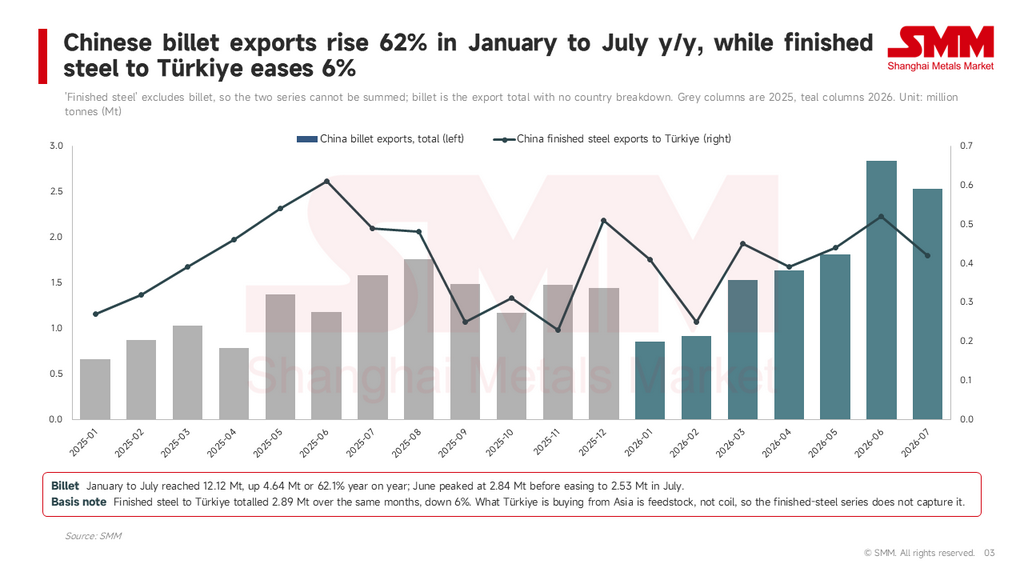
It should be noted that the starting point of this growth was supply disruptions in the Middle East, with the Black Sea cutoff acting as an overlapping second wave—but it is precisely this second wave that has pushed China and Indonesia into the marginal pricing position for Türkiye's semi-finished products. Türkiye import billet CFR rose from the year-to-date low of 490 USD/tonne on August 6 to 515 USD/tonne on September 15, an increase of 25 USD/tonne, which is essentially co-priced by Asian cargo sources and freight rates.
The third redirection is overland transport. On August 5, SMM recorded Turkish buyers turning to Iranian billet resources transported by rail, with a delivered price of 480–485 USD/tonne, while the concurrent CFR price for Türkiye import billet was 490 USD/tonne. When maritime insurance premiums plus freight exceed the time and loss costs of land transport, rail turns from an "alternative" into the "default".
On the Ukrainian side, the redirection is passive. With maritime channels blocked, exports have been forced to reroute to Danube ports as well as overland routes and ports in Romania, Bulgaria, and Poland. Both transportation costs and turnaround times have increased simultaneously, and low-value bulk commodities like iron ore are the most sensitive to freight rates—which is the direct reason why mines halted operations earlier than steel mills.
4. Europe: The triple barriers of quotas, CBAM, and "melt and pour"
Even if logistics recover, Ukraine’s European channel has already been narrowed by policy.
The EU Steel Regulation (EU) 2026/1384 came into effect on July 1, reducing the global duty-free quota to 18.3 million tonnes/year, a cut of about 47% compared to the previous safeguard measures, with the out-of-quota tariff raised to 50%. Ukraine was allocated 1.05 million tonnes/year, whereas its steel exports to Europe were 2.215 million tonnes in 2024 and grew by another 8% in 2025; the EU accounts for 79% of Ukraine's steel exports. ArcelorMittal Kryvyi Rih stated that the allocated volume is insufficient to maintain proper production levels, preserve jobs, or ensure competitiveness; Oleksandr Kalenkov, President of Ukrmetalurgprom, frankly pointed out that in reality, there is no preferential treatment for Ukraine. In contrast, under its trade agreement framework, the UK maintains zero tariffs and does not apply restrictive measures on Ukrainian steel.
Carbon cost is the second barrier. According to SMM calculations, Ukraine's CBAM default value is 2.48 tonnes CO₂/tonne of steel, corresponding to a cost of about 105 EUR/tonne (roughly 121 USD/tonne). In the first quarter, ArcelorMittal Kryvyi Rih suffered a loss of about 300,000 tonnes of European exports as CBAM added 60–90 USD/tonne in costs, leading European customers to cancel orders; the company originally planned to ship 1.2 million–1.25 million tonnes to Europe in 2026, nearly half of its output.
The third barrier is traceability. On September 1, the EU's new quota system and the "Melt and Pour" traceability rules were implemented. Starting October 1, importers must declare the country where the steel was first melted and poured into a solid state, providing mill test certificates. For exporters like Ukraine, which have integrated domestic production and a clear melting country, the new rule itself does not pose an additional obstacle, and its HRC can still enter the FTA shared supplementary pool (484,000 tonnes for HRC, 234,000 tonnes for coated sheets) once the country quota is exhausted—but this also means Ukraine will directly compete in the same pool with Japan, South Korea, India, Türkiye, and Egypt.
The combined result of these triple barriers is that Europe experienced a typical "policy + incident" resonant market trend in early September: the implementation of new quotas and traceability rules, coupled with the successive shutdowns and force majeure declarations of two Italian slab suppliers, caused Northwest European and Italian HRC EXW prices to rise for several days, with import CFR prices jumping simultaneously. The gap is being filled not by Ukraine, but by India and Türkiye—Indian quotes to Europe remain high and they have already started scheduling production for Q4 quotas, while Türkiye is using the new policy window to tentatively raise prices into Europe. This is the most substantial rewrite of trade flows caused by the current conflict: the European market share relinquished by Ukraine is being taken over by third parties possessing quota and carbon cost advantages, and this takeover is sticky.
5. Three trends to keep tracking
- Pig iron and US EAF raw materials: The merchant pig iron from Zaporizhstal is primarily sold to the US, and its shutdown directly removes a major source of low-impurity raw materials for US electric arc furnaces (EAF). Given the limited substitution elasticity between scrap and pig iron, this gap is more likely to manifest as a rise in the US delivered pig iron price, rather than just a loss in output volume.
- Transfer of pricing power for Asian semi-finished products: Türkiye's continuous procurement of Asian billets is pushing quotes from China and Indonesia from being "Southeast Asian regional prices" toward "cross-regional benchmark prices". However, the sustainability of this demand requires vigilance: SMM research shows that billet inventories for most Southeast Asian traders are already at high levels, and the price spread between China and India is converging. If Black Sea logistics marginally improve, the volume on this route could drop off quickly.
- Reversibility of production halts: Neither Zaporizhstal nor Kametstal has provided a restart timeline, and the repair cycles for blast furnaces and coking facilities are typically measured in quarters. At the same time, the massive scale of Russian slab stranded at Black Sea ports dictates that once logistics resume, the market will face a concentrated round of sell-offs—meaning the current strength of Black Sea slab FOB contains a highly reversible component.
Risk note: The situation in the Black Sea region and vessel insurance conditions are changing rapidly; the freight, insurance premiums, and prices cited in this article are assessed values at their corresponding times. The practical execution standards of the EU quota and "melt and pour" rules may still be adjusted.


![[Domestic Iron Ore Brief] Iron ore prices in the Liaodong region are likely to remain stable](https://imgqn.smm.cn/usercenter/ikbxI20251217171718.jpg)